MIDDLE EAST - ISRAEL
This page has news excerpts and comments on a variety of topics, mostly pertaining to
the Middle East and Israel. You are welcome to e-mail your thoughts; those deemed of interest
to our visitors will be included here.
Click here to send E-mail
now Please include software or other words in the subject of the e-mail to
clearly show it is not spam. Thanks.
You can search this individual page by using
the FIND function. Enter "Control - F" (FIND), or click on Edit
(Ctrl-E), then click on Find (Alt-F). Enter the keyword for the
search. Then, click on Find Next (Alt-F or hit enter) to locate the word or name
you seek.
Or, you can: SEARCH ENTIRE WINSPORTS SOFTWARE WEB SITE
TOPICS
Israel creation and
history
Comprehensive history
The Jews took
nobody's land
Security Fence
Arafat, Hamas, and terrorism
Muslims and Jews
Ethiopian
immigration to Israel
Anti-Semitism in Europe
Nobel Prizes . . . comparing Muslim and
Jewish recipients
Rand Study for
Independent Palestinian State
Irena Sendler, Polish Holocaust Heroione
Charles Winters, 1948 Aircraft to Israel
Variety of Middle East web
sites
Arab View
Israel
creation and history
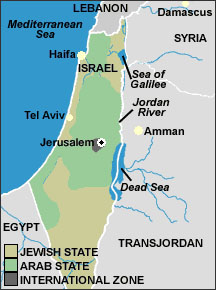
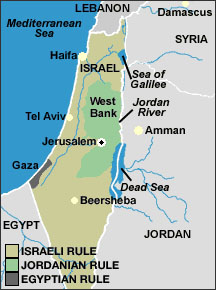
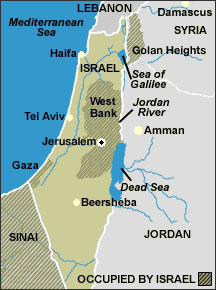
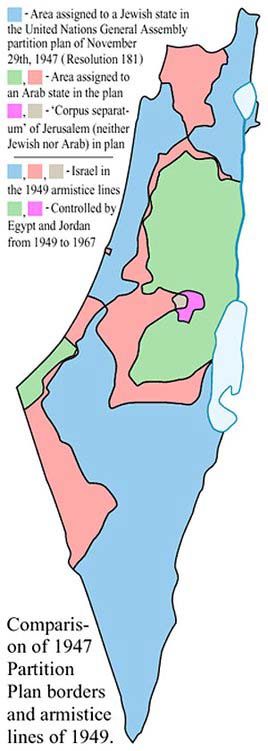
Israel creation maps
Five wars where
the Arabs attacked Israel: 1948, 1956, 1967, 1973, 1982. And the Arabs complain
that the Jews are the aggressors and the oppressors. Now the Arabs want some of
their lost land returned, so they can regroup and again try to capture all of
Israel. (2019)
The Arabs had what they are
demanding now, but still were not satisfied. Almost
immediately after Israel was created, armies from five Arab countries (with 80
million Arabs) invaded Israel, determined to drive the Israelis into the sea.
About 1/2 million Israelis, with very limited arms, battled for 15 months, lost
more than 1% of its people (6000), and finally forced a truce in 1949. The Arabs had
full control of Gaza, West Bank, Golan Heights, and East Jerusalem. The Arabs
refused to allow Jews access to their holiest site (Western Wall), when the
Arabs controlled it. ( Israel always has allowed all religions access to their
holy sites.) Israel was about 4 miles wide near Tel Aviv. Arab tanks could have cut
Israel in half in about 10 minutes. Unfortunately, the Arabs would not allow the
Israelis to live in peace. The Arabs repeatedly broke the truce, determined to
destroy Israel. Israel was able to defend itself and improve its defensible
borders. Whatever problems the Arabs now have, they themselves are responsible.
Perhaps Turkey's partitioning of Cypress is an example of the only possible
immediate solution for Israel. Maybe, after several generations without hate
being taught in the schools, the walls can come down and both peoples can live
in peace. (factsandlogic.org, more
info) Very complete web sites with many links: www.geocities.com/truthmustbesaid/Middle-East
http://www.mideasttruth.com/index.html
http://www.geocities.com/compassionplease/SyriaTheMonster
Egypt
(with additional troops from Saudi Arabia, Kuwait, and Algeria), Syria, Jordan,
Iraq, and Lebanon attacked Israel in
1967. Syria said it will drench the land
with Israeli blood and throw them into the sea. Against all odds, Israel won the
war and took land needed as a buffer zone against further attacks. (OCR,
9/30/01, Commentary 3 letter) [Arabs now want pre-1967 borders, to regain land
they lost after attacking and trying to destroy Israel.] ..... The middle east
Arab cartel produce oil for $2 a barrel, and sell it for $30 a barrel. (OCR,
9/9/03, Local 9) ..... Oppression
of Christians in Muslim countries:
"In its October 18 [2003] edition, “La Civiltà Cattolica” published a
strikingly severe article on the condition of Christians in Muslim countries.
The central thesis of the article is that “in all of its history, Islam has
shown a warlike and conquering face”; that “for almost a thousand years,
Europe lived under its constant threat”; and that what remains of the
Christian population in Islamic countries is still subjected to “perpetual
discrimination,” with episodes of bloody persecution." http://213.92.16.98/ESW_articolo/0,2393,41931,00.html
..... Hamas leader Mahmoud Zahar said, "resistance will continue until the
Islamic
flag is raised
not
only over the minarets of Jerusalem, but
over
the whole universe."
THE LION HUNTER OF ZION
In his youth, King David proved his heroism by slaying a lion. He went on to
put his life on the line for the Jewish People and become a hero for all
Israel. Three thousand years later, another lion-hearted lion-slayer also put
his life on the line for the Jewish People and became a hero for all Israel.
He wasn’t even Jewish, but he was one of the greatest friends and supporters
that the Jewish People ever had - and his experiences with lions assisted in
numerous ways.
Colonel John Patterson was an Irish soldier and engineer assigned to Kenya by
the British Empire at the turn of the twentieth century. His job was to
supervise the construction of a bridge over the Tsavo river for a massive
railroad project. Unfortunately, railroad workers were constantly being
slaughtered by the most notorious man-eating lions in recorded history. Two
maneless but huge lions, working together, were estimated to have killed and
eaten well over a hundred people working on the railroad.
Night after night, Patterson sat in a tree, hoping to shoot the lions when
they came to the bait that he set for them. But the lions demonstrated almost
supernatural abilities, constantly breaking through thorn fences to take
victims from elsewhere in the camp, and seemingly immune to the bullets that
were fired at them.
Patterson was faced with the task of not only killing the lions, but also
surviving the wrath of hundreds of workers, who were convinced that the lions
were demons that were inflicting divine punishment for the railroad. At one
point, Patterson was attacked by a group of over a hundred workers who had
plotted to lynch him. Patterson punched out the first two people to approach
him and talked down the rest!
After many months, Patterson eventually shot both lions. He himself was nearly
killed in the process on several occasions, such as when one lion that he had
shot several times suddenly leaped up to attack him as he approached its body.
He published a blood-curdling account of the episode in The Man-Eaters of
Tsavo, which became a best-seller, and earned him a close relationship with US
President Roosevelt.
Upon returning to England, Patterson was hailed as a hero. When World War One
broke out, however, Patterson traveled to Egypt and took on a most unusual
task: forming and leading a unit of Jewish soldiers, comprised of Jews who had
been exiled from Palestine by the Turks. As a child, Patterson had been
mesmerized by stories from the Bible. He viewed this task as being of
tremendous, historic significance. The unit, called the Zion Mule Corps, was
tasked with providing supplies to soldiers in the trenches in Gallipoli.
Patterson persuaded the reluctant War Office to provide kosher food, as well
as matzah for Passover, and he himself learned Hebrew and Yiddish in order to
be able to communicate with his troops. The newly trained Jewish soldiers
served valiantly, but the campaign against the Turks in Gallipoli was
ultimately unsuccessful, and the Zion Mule Corps was eventually disbanded.
In 1916 Patterson joined forces with Vladimir Jabotinsky to create a
full-fledged Jewish Legion in the British Army, who would fight to liberate
Palestine from the cruel reign of the Ottoman Empire and enable the Jewish
People to create a home there. The War Minister, Lord Derby, succumbed to
anti-Zionist agitators and attempted to prevent the Jewish Legion from
receiving kosher food, from serving in Palestine, and from having “Jewish”
in their name.
Patterson promptly threatened to resign and risked a court-martial by
protesting Derby’s decision as a disgrace. Derby backed down and
Patterson’s Jewish Legion was successfully formed. During training,
Patterson again threatened the War Office with his resignation if his men
(many of whom were Orthodox) were not allowed to observe Shabbos, and again
the army conceded. Meanwhile, Patterson brought Rabbi Avraham Yitzchak Kook to
address and inspire his troops.
Patterson clashed repeatedly with antisemitic officers in the British Army.
Once, when a visiting brigadier called one of his soldiers “a dirty Jew,”
Patterson demanded an apology, ordering his men to surround the brigadier with
bayonets until he did so.
The apology was produced, but Patterson was reprimanded by General Allenby. On
another occasion, Patterson discovered that one of his Jewish soldiers had
been sentenced to execution for sleeping at his post.
Patterson circumvented the chain of authority and contacted Allenby directly
in order to earn a reprieve. The reprieve came, but a notoriously antisemitic
brigadier by the name of Louis Bols complained about Patterson’s
interference to General Shea. Shea summoned Patterson and, rather than
discipline him, revealed that his children were great fans of The Man-Eaters
of Tsavo. The Jewish Legion fought well, and Palestine was liberated from the
Turks. But Patterson himself was the only British officer in World War One to
receive no promotion at all - a result of his outspoken efforts on behalf of
the Jewish People.
After the war, Patterson dedicated himself to assisting with the creation of a
Jewish homeland. The achievements of the Jewish Legion gained sympathy for the
cause, but there was much opposition from both Jews and non-Jews.
One Jewish delegation, seeking to explore an alternate option of creating a
Jewish homeland in Africa, was dissuaded after reading The Man-Eaters of Tsavo.
Meanwhile, against Patterson’s strenuous efforts, Bols was appointed
Military Governor of Palestine, and filled the administration with antisemites
who attempted to undermine the Balfour Declaration and empowered hostile
elements in the Arab world.
When World War II broke out, Patterson, now an old man, fought to create
another Jewish Legion. After great effort, the Jewish Infantry Brigade was
approved. Aside from fighting the Germans, members of the Brigade succeeded in
smuggling many concentration camp survivors into Palestine. Many other
survivors had been cruelly turned away, and Patterson protested this to
President Truman, capitalizing on his earlier relationship with Roosevelt.
This contributed to Truman’s support for a Jewish homeland.
Patterson spent most of his later years actively campaigning for a Jewish
homeland and against the British Mandate’s actions towards the Jews in
Palestine. Tragically, he passed away
a month before the State of Israel was created. The newly formed
country would not have won the War of Independence without trained soldiers -
and the soldiers were trained by veterans of Patterson’s Jewish Legion and
Jewish Infantry Brigade.
Colonel John Patterson had ensured the survival of the Jewish
homeland. But his legacy lived on in another way, too. Close friends of his
named their child after him, and the boy grew up to be yet another
lion-hearted hero of Israel. ...His name was Yonatan Netanyahu.
(5/20/22)
Toward the end of
Obama's second term in office, the US spearheaded UNSC Resolution 2334, which
states that Israel is in violation of international law by its presence
in the territories captured in the 1967 Six-Day War. Israel realized at the
time that the US administration was coordinating the resolution with the
Palestinians and Europeans, but had no way of blocking it without support from
the US.
On Nov. 24, 2016, Netanyahu called Russian President
Vladimir Putin and explained that the resolution Obama was working to pass
would disrupt regional stability and harm Israel. Netanyahu asked Putin to
state that he intended to use his UNSC veto to scupper the resolution. But
Putin refused. On Dec. 23, 2016, the UNSC passed Resolution 2334, although
then-US Ambassador to the UN Samantha Power ultimately abstained.
However, Obama had additional plans, even though he had
less than a month left in the White House. He and his staff began working on
another UNSC resolution, which would have forced Israel to agree to a
Palestinian state based on the 1948 borders. Israel's UN ambassador at the
time, Danny Danon, sounded the alarm.
Netanyahu again sought help from Putin. In another phone
conversation, he explained to Putin that Obama's new resolution would do
serious harm to Israel and could destabilize the region.
Putin was
convinced and told Netanyahu that if the resolution came to a vote, Russia
would veto it.
According to what Netanyahu said in the closed meeting,
Obama was informed of Russia's intention to veto the American move. Obama
realized that if Russia vetoed a US resolution in order to protect Israel, it
would be a fatal blow to the US's image as an ally of Israel and its
standing in the Jewish community. Therefore, Obama decided to shelve the
resolution, Netanyahu said.
https://www.israelhayom.com/2020/06/15/how-russia-saved-israel-from-a-palestinian-state-based-on-the-48-borders/
(6/15/20)
by
Richard Kemp • January
7, 2022 at 5:00 am
-
The
breakdown in Israel-Soviet relations was later compounded by Israel's
defensive victories against the Arabs in 1967 and again in 1973. Over this
period all hope of Israel becoming a Soviet client had steadily
evaporated. Arab armies sponsored, trained and equipped by the USSR had
been humiliated, and so had Moscow. Thus the Soviets progressively
developed a policy of undermining Israel. Their primary objective was to
use the country as a weapon in their Cold War struggle against the US and
the West.
-
"We
needed to instil a Nazi-style hatred for the Jews throughout the Islamic
world, and to turn this weapon of the emotions into a terrorist bloodbath
against Israel and its main supporter, the United States." — Yuri
Andropov, Chairman of the Soviet KGB, later General Secretary of the
Soviet Communist Party, as reported by General Ion Pacepa, former chief of
Romania's intelligence services.
-
As
well as mobilising the Arabs to the Soviet cause, Andropov and his KGB
colleagues needed to appeal to the democratic world. To do so, the Kremlin
decided to turn the conflict from one that sought simply to destroy Israel
into a struggle for human rights and national liberation from an
illegitimate American-sponsored imperialist occupier. They set about
transforming the narrative of the conflict from religious jihad — in
which Islamic doctrine demands that any land that has ever been under
Muslim control must be regained for Islam — to secular nationalism and
political self-determination, something far more palatable to Western
democracies. This would provide cover for a vicious terrorist war, even
garnering widespread support for it.
-
To
achieve their goal, the Soviets
had to create a Palestinian national identity that did not hitherto
exist and a narrative that Jews had no rights to the land and were naked
aggressors. According to Pacepa, the KGB created the Palestine Liberation
Organization (PLO) in the early 1960s, as they had also orchestrated
so-called national liberation armies in several other parts of the world.
He says the 1964 Palestinian National Charter was drafted in Moscow. This
document was fundamental to the invention and establishment of an
artificial Palestinian nationhood.
-
The
details of Moscow-sponsored terrorist operations in the Middle East and
elsewhere are set out in 25,000 pages of KGB documents copied and then
smuggled out of Russia in the early 1990s by senior KGB archivist Vasili
Mitrokhin and now lodged in the UK, at Churchill College, Cambridge.
-
The
initial charter did not claim the West Bank or the Gaza Strip for
"Palestine". In fact, it explicitly repudiated any rights to
these lands, falsely recognising them respectively as Jordanian and
Egyptian sovereign territories. Instead, the PLO claim was to the rest of
Israel. This was amended after the 1967 war when Israel ejected the
illegal Jordanian and Egyptian occupiers, and the West Bank and Gaza for
the first time were re-branded as Palestinian territory.
-
Moscow
first took its campaign to brand Israeli Jews as the oppressors of their
invented "Palestinian people" to the UN in 1965. Their attempts
to categorise Zionism as racism failed at that attempt but succeeded
nearly a decade later in the infamous UN General Assembly Resolution 3379.
-
Zuheir
Mohsen, a senior PLO leader, admitted in 1977: "The
Palestinian people do not exist. The creation of a Palestinian
state is only a means for continuing our struggle against the state of
Israel for our Arab unity... Only for political and tactical reasons do we
speak today about the existence of a Palestinian people, since Arab
national interests demand that we posit the existence of a distinct
'Palestinian people' to oppose Zionism. Yes, the existence of a separate
Palestinian identity exists only for tactical reasons."
-
The
Mitrokhin documents show that both
Yasser Arafat, and his successor as PLO chief, Mahmoud Abbas, now
President of the Palestinian Authority, were KGB agents. Both were
instrumental in the KGB's disinformation operations as well as its
terrorist campaigns.
-
For
his dealings with Washington, Ceaușescu told Arafat in 1978:
"You simply have to keep on pretending that you'll break with
terrorism and that you'll recognize Israel — over, and over, and
over."
-
Ceaușescu's
advice was reinforced by North Vietnamese communist General Vo Nguyen Giap,
whom Arafat met several times: "Stop talking about annihilating
Israel and instead turn your terror war into a struggle for human rights.
Then you will have the American people eating out of your hand".
-
Like
his predecessor Arafat, Abbas's consistent rejection of every offer of
peace with Israel, while concurrently talking the talk about peace and
while sponsoring terrorism, shows the continuing influence of his Soviet
masters.
-
Meanwhile
the Palestinian movement created by Moscow, in the words of American
historian David Meir-Levi, is "the only national movement for
political self-determination in the entire world, and across all of world
history, to have the destruction of a sovereign state and the genocide of
a people as its only raison d'être."
-
Moscow's
campaign was significantly undermined by the 2020 rapprochement between
Israel and Arab states. The lesson here is the importance of American
political will against authoritarian propaganda, which led to the
game-changing Abraham Accords.
The
Arab pogrom that started it all [Jerusalem Post, 4/3/14]
Arab assailants proceeded to attack innocent Jewish men, women and
children on the streets, punching, kicking and beating them, as well as
hurling stones. This pogrom serves to remind us of some very important truths
about the nature of the ongoing conflict between Palestinian Arabs and Jews.
It was the middle of the morning on April 4, 1920, precisely 94 years ago,
during the intermediate days of Passover, and the Jews of Jerusalem thought
the danger hanging over them had mostly receded.
Muslims were marking the third and final day of the Nebi Musa festival,
and despite fears of large-scale Arab violence, the holiday had thus far
passed more quietly than anticipated.
But all that was about to change.
Tens of thousands of Arabs gathered in Jerusalem’s Old City and several
speakers began firing up the horde, including the nefarious Haj Amin al-Husseini,
who would subsequently be appointed the city’s Mufti.
Amid chants of “Palestine is our land and the Jews are our dogs!”
the crowd descended into a violent frenzy and went on the offensive.
Arab assailants proceeded to attack innocent Jewish men, women and
children on the streets, punching, kicking and beating them, as well as
hurling stones and other objects.
They broke into Jewish homes, raped Jewish women, and plundered
property. Cemeteries and yeshivot were also attacked, with tombstones and
Torah scrolls falling victim to the Arab mob’s fury.
Arab policemen, whose task was to maintain order, instead joined in the fray,
while the British Mandatory authorities responded with their characteristic
lethargy and incompetence.
Over 100 Jews were injured in just the first few hours, and the rioting
intensified the following day, leading the British to impose martial law.
Finally, after several more days of unrest, the violence was finally quelled.
When the dust had settled, a total of five Jews had been killed and more
than 200 wounded, while four Arabs were dead and 25 injured.
Zionist leader Chaim Weizmann along with a senior British military officer
insisted that the British Mandatory authorities had actively encouraged Arab
leaders to incite the violence due to their hostility towards Zionism.
One month later, in May 1920, the British government dispatched a commission
of inquiry, known as the Palin Commission, to investigate.
In predictable fashion, the final report sought to place blame on both
sides, criticizing the Zionists for “impatience to achieve their ultimate
goal,” as if that would somehow justify an Arab pogrom.
Nonetheless, the commission did note that it was clear that “the incidence
of the attack was against the Jews and… was made in customary mob fashion
with sticks, stones and knives. All the evidence goes to show that these
attacks were of a cowardly and treacherous description, mostly against old
men, women and children, and frequently in the back.”
The repercussions of the riots were profound.
Among other things, they led to the organization and establishment of more
Jewish self-defense units which became the core of the Hagana, thereby
accelerating the process of Jewish independence.
And among the Arabs, the riots crystallized the formation of a
“Palestinian national consciousness.”
As Dr. Daniel Pipes noted in “The Year the Arabs Discovered
Palestine” (Middle East Review, Summer 1989), “In January 1920,
Palestinian nationalism hardly existed; by December of that critical year, it
had been born.”
But beyond the fact that we are still feeling the impact of the riots even
today, it is worth recalling what happened so long ago in the streets of
Jerusalem because it serves as an important reminder of what the Arab-Israeli
conflict is truly all about.
Simply put: it has nothing to do with Jewish settlements in Judea and
Samaria and everything to do with Jews.
Unless they had extraordinary paranormal powers enabling them to gaze
into the future, the Arab rioters of 1920 did not spill innocent blood because
Jews would later settle in Beit El and Kedumim in the 1970s and ’80s.
And they did not go on the rampage because they believed in two states, Arab
and Jewish, living side by side in peace and security.
They attacked Jews then, as they do today, because they are unwilling
to accept a permanent and sovereign Jewish presence in the region.
Their dream today remains what it was back in 1920: to scare us off and
clear us out.
Then, as now, the Palestinian Arabs are unwilling to recognize the
biblical, historical and moral right of the Jewish people to the Land of
Israel.
And then, as now, they are willing to employ violence and terror to
advance their goals.
And this is why all the plans, from the Rogers plan to the Reagan plan, from
the Oslo accords to the Kerry plan, have accomplished little, because they
ignore the cold, hard truth that has been staring us all in the face for the
past century: there can be no peace
because the Palestinian Arabs do not want peace. What they want is Israel.
Islamized.
These were areas from which the Palestinian Jews had been driven out, and that
Europe referred to as Jewish colonies. They are called Jerusalem, Judea and
Samaria. No European nation protested against the Islamic colonization of
Jewish-Palestinian areas, the expulsion of their Jewish inhabitants and the
seizure of their belongings, or against the persecution of Jews in Arab
countries.An artificial Palestinian Arab "people" was created in
order to replace the people of Israel. A European army of forger-historians
and Arab Christiandhimmis transferred
the historic characteristics of the Jews onto them. Names of towns and regions
were Islamized: Jerusalem was called Al-Quds and "the West Bank"
replaced Judea and Samaria. (1/6/17) https://www.gatestoneinstitute.org/9725/security-council-resolution-israel
The avowed aim of Zionism is to ingather all the Jews in the world in
the Jewish State. The avowed aim of the anti-Semites is to expel the Jews from
all their countries. Both sides want the same. No conflict.
Theodor Herzl,
the Founding Father of Zionism, recognized this right from the beginning. He
went to Czarist Russia, which was governed by anti-Semites, and offered a
deal: we take the Jews off your hands, you help us to convince them to leave.
That was in the heyday of the murderous pogroms. But the Jews who left Russia
went en masse to America, very few to Ottoman-ruled Palestine.
This was not a unique chapter. Throughout Zionist history, many attempts
have been made to enlist anti-Semites to help in the implementation of the
Zionist project.
Even before the
Zionist movement was born, American and British evangelists preached the
ingathering of the Jewish exiles in the holy land. They may have been
Herzl’s inspiration. However, this message of redemption for the Jews had a
secret clause. The return of the Jews to Palestine would allow for the second
coming of Christ. But then, the Jews would convert to Christianity. Those who
refused would be annihilated.
IN 1939, when the Nazi danger became obvious, the extreme Zionist leader
Vladimir (Ze'ev) Jabotinsky called for a meeting of his followers in Poland.
The leaders of the Irgun underground in Palestine attended. One of them was
Abraham Stern, whose nom de guerre was Ya'ir.
The meeting
decided to approach the anti-Semitic commanders of the Polish army and offer
them a deal: you arm and train young Polish Jews, and we shall liberate
Palestine and transport the Polish Jews there. The officers agreed and
training camps were set up in Poland. World War II put an end to the plan.
With the
outbreak of the war, Jabotinsky, an ardent Anglophile in spite of everything,
ordered the Irgun to stop all such actions and cooperate with the British.
Stern proposed the opposite approach. His credo was: our enemy is Britain. The
war provides us an opportunity to drive them out. The enemy of our enemy is
our friend. Adolf Hitler is an anti-Semite, but now he is our potential ally.
Stern's approach caused a split in the Irgun. A furious debate broke out
in all the secret cells. As a 16-year old member, I took part. Being a refugee
from Nazi Germany, I rejected Stern's thesis.
Stern created his own group (later called Lehi, Hebrew initials of
Fighters for the Freedom of Israel, also known as the "Stern gang".)
He sent an emissary to neutral Turkey, where he delivered the German
ambassador a letter for "Mr. Hitler", offering cooperation. The
Fuehrer did not reply. That was, of course, before the Holocaust.
Stern was
caught by the British and "shot while trying to escape". When the
war ended, and Soviet Russia became the enemy of Britain and the West, Stern's
heirs approached Stalin and offered cooperation. Stalin, whose anti-Semitism
was becoming more pronounced at the time, ignored the offer.
During the war,
one of the architects of the Holocaust was Adolf Eichmann, the SS officer who
was in charge of organizing the transport of Hungarian Jews to Auschwitz. In
Budapest he established contact with a group of Zionists, led by Israel
Kastner, with whom he made a deal. As a good-will gesture he allowed him to
send a few hundred Jews to neutral Switzerland.
Eichmann sent one member of the group, Yoel Brand, to Istanbul, with a
crazy-looking offer to the Zionist leadership in Jerusalem: if the allies
provided the Nazis with a thousand trucks, the deportation of the Hungarian
Jews would be stopped.
Contrary to his instructions, Brand crossed the border into
British-occupied Syria and was arrested by the British. The deportation of the
Hungarian Jews - ten thousand a day – went on.
Mahmood Abbas,
by the way, as a student at Moscow University, wrote his doctoral thesis on
Nazi-Zionist cooperation.
Uri
Avnery (member of the Irgun as a teenager, sat in the Knesset from 1965 to
1974 and from 1979 to 1981),
12/31/16,
http://zope.gush-shalom.org/home/en/channels/avnery/1483105431/
Indo-Israel
ties on the march
Israeli-Indian
ties moved up a notch Sunday when Prime Minister Binyamin Netanyahu met in New
York with his Indian counterpart, Narendra Modi, marking the first
meeting between Israeli and Indian prime ministers since Prime Minister Ariel
Sharon visited New Delhi in 2003.
Then,
as now, the ruling party was not the Congress Party of the Gandhis and Nehrus,
a party deeply sympathetic with the Palestinians, but rather the Hindu
nationalist Bharatiya Janata Party (BJP) party.
Congress’s
lack of sympathy for Israel can be traced backed to the country’s founder, Mahatma
Gandhi, who in 1938 wrote the following about the prospect of a Jewish
state: “The cry for a national home for the Jews does not make much appeal
to me,” he wrote in 1938. “The sanction for it is sought in the Bible, but
the Palestine of Biblical conception is not a geographical tract.” He added
that “it is wrong and inhuman to impose the Jews on the Arabs.”
Israel
and India did not establish diplomatic ties until 1992, and those ties were
kept largely under the radar screen until the BJP came into power in 1999.
Among the reasons for this was the Congress Party’s historic lack of
enthusiasm for the Zionist project, as well as the Indian government’s
concern -- partly because of domestic political considerations -- not to
antagonize the country’s huge Muslim population, which today stands at some
150 million.
Prime
Minister Atal Bihari Vajpayee changed that when he invited Sharon in
September, 2003, for a three-day visit that was cut short because the prime
minister rushed home following a terrorist attack. But the visit, short as it
was, sent a signal: India, thankful for the military help rendered by Israel
in its 1999 war with Pakistan, was taking the relationship out of the closet
and to a different plane.
http://www.jpost.com/Israel-News/Indo-Israel-ties-on-the-march-376555,
9/29/14
History, Reality and Prophecy
The
Omega Letter Intelligence Digest
December 04, 2012
Israel
promised to respond to the UN General Assembly's recognition of Palestine as a
state, in violation of the Oslo Agreement, by building an additional 3,000
settlement units on land claimed by the Palestinians.
This
immediately prompted cries from the Arab League-dominated UN about Israel's
"expansionist" policies requiring immediate UN intervention. The
UN General Assembly voted to recognize Palestine based on the pre-1967 borders.
If
they are pre-1967 borders, then what does that mean? It
means the borders which existed prior to the Six Days War, which means the
borders as they existed in 1948.
Let's
fire up the WayBack Machine and revisit how the State of Israel came to be in
the first place.
During
the First World War, Turkey supported Germany against the Allies, so when
Germany was defeated, so were the Turks. The Ottoman Empire was broken up
via the Sykes-Picot Agreement that divided up the former Empire into Western
zones of influence.
Lebanon
and Syria were mandated over to France. What is today known as Jordan and
Israel (including the West Bank) was mandated to Great Britain.
Since
no other people had established a homeland in the region since the Jews had been
expelled by the Romans 2000 years earlier, the British government "looked
favorably" upon the establishment of a Jewish homeland on their ancestral
territory of Palestine. (Israel, West Bank, Gaza, Jordan).
In
1917, Lord Balfour issued what is known to history as "The Balfour
Declaration":
"His
Majesty's government view with favour the establishment in Palestine of a
national home for the Jewish people, and will use their best endeavours to
facilitate the achievement of this object, it being clearly understood that
nothing shall be done which may prejudice the civil and religious rights of
existing non-Jewish communities in Palestine, or the rights and political
status enjoyed by Jews in any other country."
Everything
would have probably proceeded forward from this point without a hitch . . .
except there was one. A big one that neither the Europeans nor the Americans
could ignore. As Winston Churchill wrote in 1922:
"In
both Houses of Parliament there is growing movement of hostility, against
Zionist policy in Palestine. . ."
"Zionist
policy . . ." -- what does that mean? What is a
"Zionist?"
A
Zionist is one that believes in a national homeland for the Jews. Modern
Zionism emerged in the late 19th century in response to the violent persecution
of Jews in Eastern Europe, anti-Semitism in Western Europe.
Zionists
recognize the historical reality of Jewish persecution and agree with the Jews
that without a national homeland, there is nothing to prevent more pogroms,
persecutions and genocidal terror being perpetrated against the Jewish people.
And
more than that, a Zionist recognizes that the reason for the pogroms,
persecutions and genocide is because they are Jews. Zionism
recognizes that Jew-hatred is blind, unreasoning and deadly.
And
so, the "Zionist policy" objected to by Churchill and the Parliament
was the establishment of a homeland for the Jews as a defense against
persecution.
In
1923, the British reneged on their promise and divided the Palestine portion of
the Ottoman Empire into two administrative districts, with everything east of
the Jordan going to the Arabs and everything west of the Jordan for the Jews.
In
effect, the British had "chopped off" 75% of the originally proposed
Jewish Palestinian homeland to form an Arab Palestinian nation called
Trans-Jordan (meaning "across the Jordan River").
The
territory east of the Jordan River was given to Emir Abdullah (from Hejaz, now
Saudi Arabia) who was not even a "Palestinian". This portion of
Palestine was renamed Trans-Jordan. Trans-Jordan would later be renamed
"Jordan".
So
the eastern 3/4 of Palestine would be renamed TWICE, in effect, erasing all
connection to the name "Palestine". The remaining 25% of
Palestine (now WEST of the Jordan River) was to be the Jewish Palestinian
homeland.
In
1947 the UN passed Resolution 181 partitioning the remaining 25% of the Jewish
mandate into a Jewish partition and an Arab partition. The Jewish
Palestinians accepted 12.5% of the Balfour Mandate gratefully. The Arabs
rejected the 1947 Plan (which would have resulted in the creation of a
Palestinian state sixty-five years ago).
Israel
declared independence on its 12.5% of the British Mandate on May 14, 1948.
The
next day, the combined forces of Egypt, Jordan, Lebanon, Saudi Arabia, Iraq and
Yemen attacked.
(It
is worth noting that all of those Arab states were also created by the
same British authority out of the Ottoman Empire following WWI, only years AFTER
the 1917 Balfour Declaration.)
Arabs
living inside the newly declared State of Israel were encouraged to leave by the
invaders to keep them out of the crossfire.
Once
the Arab Legions had eliminated the Jews, the displaced Arabs could return and
reclaim their own property, plus whatever the Jews left behind.
(Similar
to what actually did occur fifty-eight years later when Israel unilaterally
pulled out of Gaza in 2005.)
Some
70% of the Arabs living in the new state of Israel fled. Not because they
feared the Jewish army, but because it was a good deal. Avoid the war,
stay out of the crossfire, and be rewarded with the spoils of war for staying
safe.
Those
that did not flee are today full citizens of the State of Israel, with the same
civil rights as Jews, including Arab representation at the Knesset.
The
borders as they existed in 1948 (essentially pre-1967) puts the Palestinians in
possession of East Jerusalem, the Old City, all of Gaza, and all of the West
Bank, leaving Israel almost cut in half at the center.
What
would have been the Palestinian State under the UN Partition Plan was
immediately occupied by Egypt and Jordan. Egypt took control of the Gaza
Strip and Trans-Jordan occupied the land west of the Jordan River (Biblical
Judea and Samaria) all the way to Jerusalem.
In
1950, Trans-Jordan formally annexed the West Bank and since it was no longer
divided by the Jordan River, renamed itself Jordan and extended Jordanian
citizenship to those Arabs living in the West Bank.
What
about those Arabs that fled to neighboring Arab countries to await the
destruction of the Jews? Their Arab brothers interned them in
concentration camps that they renamed "refugee camps" and kept them
there for sixty-five years.
The
Jordanians that lived in the West Bank after 1950 never petitioned Jordan for a
homeland -- and Jordan never offered. Instead, they "discovered"
in 1964 that they were really an ancient people called "Palestinians"
rather than Jordanians.
(The
total lack of evidence of any prior Palestinian indigenous people, Palestinian
language, culture, history or unique national characteristics notwithstanding.)
Led
by an Egyptian Arab named Yasser Arafat they formed the PLO, which was dedicated
to creating a "Palestinian" homeland. Of course, at the time,
they had one -- they were Jordanians!
In
1967, the armies of Egypt, Jordan and Syria massed for another invasion of
Israel aimed at driving the Jews into the sea. Instead, Israel soundly defeated
the invaders, pushing Egypt out of Israel and back inside its own territory and
pushing Jordan back across the Jordan River.
That
left Israel in possession of Gaza and the West Bank. Now the Jews occupied
1/640 of the total land mass of the Arab world and were only outnumbered fifty
to one.
Thus
began Israel's "brutal occupation" -- an occupation so brutal
that Israeli-Arabs in East Jerusalem voted against being ruled by the
Palestinian Authority, preferring to stay under Israeli jurisdiction.
Evidently, freedom trumps Arab nationalism.
There
is a lesson in there, somewhere.
Assessment:
Consider
the situation as it actually exists, devoid of the anti-Semitic propaganda of
the Arab world (and a significant portion of mainstream Western Christianity).
From
1948 to 1967, Egypt ruled Gaza, Syria ruled the Golan Heights, while Jordan
ruled the West Bank. They could have set up independent Arab-Palestinian
states in any or all of those territories, but they didn't even consider it.
Instead,
in 1967 they used the Golan Heights, Gaza and the West bank to launch a war that
was unambiguously aimed at destroying Israel, which is how Israel came into
possession of those territories in the first place.
The
historical reality is that, if there is a Palestinian State, it would be Jordan,
since Jordan accounts for 75% of the British Mandate of Palestine. The
"Palestinians" living in the West Bank could have had an independent
state sixty-five years ago, but their goal wasn't independence.
It
was NEVER independence. The goal was and is the destruction of the Jewish
State. In every instance where they were offered some measure of
independence, they used that independence to attack Israel.
The
fact is, until Yasser Arafat invented a Palestinian people, the Palestinians
were the Jews!
The
Middle East Conflict was always a war by Arabs against Jews, not a conflict
between Israelis and "Palestinians". The war was repackaged as a
conflict between Jews and Palestinians as a public relations gimmick in the
early 1970's.
The
Palestinians were a regional group of Arabs having virtually no cultural nor
national distinctive traits separating them from Syrians, Lebanese, and
Jordanians. The bulk of what are called "Palestinian Arabs" are
members of families who migrated into the Land of Israel beginning in the late
19th century.
Palestinian
nationalism is a reinvented version of Arab nationalism. Arab nationalism
exists, although it is closely bound up with Islamic nationalism and even
Islamism. Palestinian nationalism, however, is a phantom. The Arab
assaults and aggressions against Israel in 1948, 1956, 1967, 1968, and 1973 had nothing
to do with Palestinians.
They
were wars of annihilation launched against Israel by the Arabs; Egypt, Jordan,
Syria, Iraq, Saudi Arabia, etc. -- not a 'Palestinian' in the woodpile.
Having
been defeated in every instance, the Arab world focused on using the
"Palestinians" as a fifth column inside Israel to facilitate the
eventual annihilation of the Jewish State.
FN Mausers and the Fight for Israel (American Rifleman,
10/19/18)
Since the creation of the United Nations, few measures have garnered as much attention as Resolution 181 (II). Radio and television sets worldwide tuned in on Nov. 29, 1947, for the vote to propose an independent Jewish state in Palestine. The controversial vote passed with the
approval of 33 nations, while 13 countries voted against and 11 abstained or were absent.
Even before the United Nations resolution passed, the entire region of Palestine was engulfed in a civil war. This war morphed into the Israeli War of Independence (or Arab-Israeli War) after Israel declared independence on May 14, 1948. Jerusalem was immediately besieged on May 15. The situation quickly turned dire; the
Jewish population of 600,000 was surrounded by
hostile Arab countries with a population of more than 15
million. The new government relied on the members of older independence groups, most notably the Haganah, “The Defense,” which had fought to protect Jewish interests, and for independence, over a period of decades. Poorly outfitted Jewish fighters were facing well-equipped armies from Egypt, Iraq and Jordan. The Arabs vowed to annihilate the Jews. It was a fight for survival and a fight against a second Holocaust.
Three of the countries voting for the UN resolution, the United States, Czechoslovakia and Belgium, had a significant impact on the survival of the Jewish state of Israel.
Czechoslovakia
The Czech legation at the UN voted for the Jewish state only a few months before a Communist coup turned Czechoslovakia into a Soviet satellite state. Czechoslovakia became the most important cog in the wheel to help arm the Jewish people. Surplus German and Czech World War II guns were acquired from the Czechoslovak government and shipped to Palestine. The Czechoslovak aid is well-known; not only did it provide small arms, the country became a centralized hub for all forms of material aid. While small arms were important, the Jews needed armor and an air force to counter the Arab armies. The
Czechs helped establish the Israeli air force by initially selling surplus German Messerschmitt Bf 109 fighter planes, as well as Czech clones known as the Avia S-199. Sales were later expanded to include surplus Spitfires. All this aid amounted to huge financial revenues for the Czechs. During this time, Joseph Stalin allowed continued support after the Czech communist coup, not so much to support the Jews but for the consternation of the British Empire.
Belgium
The Belgians also voted in favor of the UN resolution after the socialist Belgian foreign minister Paul-Henri Spaak caused controversy by calling a Jewish state “dangerous.” Most Belgians did not share that viewpoint. Many were troubled by the fate of the Jewish people during the war, and by the 1946 British blockade against Jewish immigrants. The British internment camps in Cyprus and the detainment of Holocaust survivors were considered scandalous.
Publicly, some Belgian politicians appeased their allies, including Great Britain, who favored the Arabs while advocating for the international arms embargo. Privately, some Belgian officials turned a blind eye toward the embargo in favor of arming the Jewish people.
A notorious international arms dealer negotiated with the Belgian government for the purchase of all available surplus wartime German small arms. The extent of the government’s involvement in the arms deal is still cloaked in secrecy, but export permits were granted. It was not the first time the Belgian government had gone against the wishes of Great Britain. In the 1930s, Fabrique Nationale (FN) had sold arms to Abyssinia while Belgian military officers were advising and forming modern military fighting units to counter the growing threat from fascist Italy.
The arms dealer most likely sold the surplus guns at enormous profit. The desperate situation of the Jews in Palestine was well-known, and fundraising events were held worldwide. Financing the arms purchases was not the problem, purchasing arms and getting them to the region was far more difficult.
Receiver markings on Israeli FN Mausers include: (l.-r.) A pre-war “FN” crest; a pre-war Ethiopian crest with added “7.62” marking; a pre-war Lithuanian crest with “7.62”; a 1950s IDF crest with “7.62”; and the same crest on a trainer chambered in .22 Long Rifle.
The United States
President Harry S. Truman was an essential supporter of the UN resolution and had flexed political muscle in order to garner international support. The support came, however, after Truman wrote Congress on April 15, 1947, to restore the Neutrality Act. Consequently, an international arms embargo went into effect on Dec. 5, 1947.
It was illegal for United States citizens to sell equipment to, or fight for, the state of Israel. The
Israelis lacked pilots, so recruiting former U.S. airmen in secrecy was a high
priority. Despite the restrictions and risks, several American veterans answered the call and made their way to Czechoslovakia in order to fly combat missions for Israel. Clandestine groups in the U.S. were focusing on acquiring surplus World War II planes. A
fake Panamanian airline company was established in order to mislead the U.S. government about the true purpose of these acquisitions. Some Curtiss C-46s and a few military Lockheed Constellations were purchased and flown to Panama before making their way to Israel (via Brazil, Morocco, Italy and Czechoslovakia). American veterans flew and fought for Israel at great peril, the
U.S. State Dept. had warned that these men would lose their citizenship if caught breaking the Neutrality
Act. That was of little concern to those in combat—with some paying the ultimate price. Others remained in Israel after the war to help build the country, especially the Israeli Air Force and El Al airline.
Israel’s Arms
The Israeli War of Independence was, ironically, fought with large quantities of arms manufactured by Nazi Germany. Small arms included thousands of K98 Mauser rifles, Luger pistols, P38 pistols, pre-war and wartime FN-Browning pistols, Radom VIS pistols, MG 34 machine guns, and surplus Czech arms, including CZ pistols and machine guns among others. Large quantities of British arms were also used, specifically (captured) Enfield rifles, Bren light machine guns, Sten submachine guns and Webley revolvers. The simplicity of the Sten made it a perfect candidate for domestic manufacture, copies were already being manufactured in Palestine before the War of Independence. Surplus U.S. arms, such as the Thompson submachine gun, M1 carbine and Garand, were also used extensively. All arms were vital, no matter how challenging the logistics. Despite origin and connotation, German wartime markings were rarely defaced by arsenals. American pilots were issued wartime German flight suits and asked to fight in German planes. Signs of Nazi Germany were present on much of the equipment.
Jewish forces quickly focused on the K98 as their main battle rifle, which may have been predicated by the large quantities of surplus rifles obtained from Czechoslovakia and Belgium, or the large quantities of available 7.92x57 mm ammunition. Unlike British arms, the Israelis could acquire new K98 rifles and ammunition from the Czechoslovak government, which continued to produce the model after the war.
The communist coup in February 1948 in Czechoslovakia may have been a contributing factor as to why Fabrique Nationale was contracted to manufacture a version of the K98 for Israel. By that time, Joseph Stalin was in control of the nations behind the Iron Curtain, and his support of Israel was unreliable and contradictory at best.
While the details of the Belgian purchases remain cloaked in mystery, the state of Israel began buying rifles from FN after it declared independence. Although FN had manufactured a few K98 parts during the German occupation, it had never before built complete K98 rifles. The rifles were marked with the emblem of the Israeli Defense Forces (IDF), which was actually the old logo of the Haganah—a sword and olive branch. All rifles were finished in FN’s standard rust blue and were chambered in 7.92x57 mm. No rifles were chambered in 7.62x51 mm NATO as is often reported. Early contract rifles conveniently lack production year code markings. This first order marked the beginning of more than 40 years of cooperation between FN and the state of Israel.
The state of Israel purchased thousands of FN K98-style rifles, including 1,800 .22 Long Rifle training rifles, up to about 1956. Additionally, Energa Rifle grenades and launchers, FN Browning High Power pistols and FN BAR machine guns were also acquired. Israel lacked armored vehicles, and the Energa grenade was essential to counter the armored vehicles of the hostile Arab armies.
All
peace negotiations between Israel and the Palestinians must properly address
where Israel’s Eastern border is. The border is the Jordan River, not the
“Green Line.”
Under
international law, a state has the rights to all the land within its borders. It
is likely that Israel will withdraw from territory east of the “Green Line,”
but the starting point of negotiations must be that Israel has the rights to the
territory up to the Jordan River. Many fail to understand the nature of the line
dividing the State of Israel and the West Bank. Even world leaders, such as
President Obama, are susceptible to this fundamental misunderstanding.
The
“Green Line,” or the “1967 border,” is mistakenly considered Israel’s
Eastern border, but it is simply an armistice line. Under international
law, armistice lines have no legal significance in constituting a border. To
name the armistice line “the 1967 border” is misleading and
factually incorrect.
After
the cessation of hostilities of the 1948 War of Independence, Israel signed
bilateral armistice agreements with the warring countries, including Jordan. The
Jordanian-Israeli General Armistice Agreement created the demarcation line along
Israel’s eastern front, the “Green Line.” The name “Green Line” stems
from the fact that the Israeli general was using a green marker on the map to
indicate where the respective armies had to withdraw.
Israel’s
preexisting border, as defined by the Palestine Mandate (the League of Nations
Resolution of 1922 that gave the Jews the rights to Palestine), left Israel
with the Jordan River as its Eastern border. This border was not changed by the
armistice agreements, and Israel’s border remained the same even though Israel
temporarily lost control of its territory between 1949 and the 1967.
The
Jordanian-Israeli General Armistice Agreement specifically stated that the
purpose and intention of the Armistice Agreement was to “eliminate the
threat to the peace in Palestine.” The Agreement reiterates its intention
in at least four different instances: (1) “…no military or political
advantage should be gained under the truce,” (2) “The basic
purpose of the Armistice Demarcation Lines is to delineate the lines beyond
which the armed forces of the respective Parties shall not move,” (3) “This
article shall not be interpreted as prejudicing … an ultimate political
settlement between the Parties to this Agreement,” and finally (4) “The
Armistice Demarcation Lines [shall not] prejudice … future
territorial settlements or boundary lines or to claims of either Party relating
thereto.”
Despite
Jordan’s conquest of the West Bank in the 1948 War, Jordan cannot be assumed
to be the rightful heir to the territory simply because of its conquest.
To determine Israel’s borders, we must refer back to the Palestine
Mandate.
Finally,
once a peace treaty is signed, any existing armistice agreements cease to have
any legal relevance. Therefore, after the ratification of the Jordanian-Israeli
Peace Treaty of 1994, which specifies the border between Israel and Jordan as
the Jordan River, the Jordanian-Israeli General Armistice Agreement became outdated
and legally irrelevant. Israel’s Eastern border is the Jordan river, not the
“Green Line.” In all peace negotiations, it is critical to be cognizant of
this fact.
http://www.algemeiner.com/2016/07/06/the-green-line-is-not-israels-border/#
Jerusalem,
Capital of Israel: An Islamic Prophecy
Jerusalem is the capital of the Children of Israel, now
called the Jews; and it is forbidden
for Musims to demand it, just as a married woman belongs only to her
husband. Is it possible that Allah, who on His infinite mercy, calls them the
Chosen People, and promises them the Holy Land, also plans to murder them,
using the Muslims in Palestine as His intermediary? Every Muslim knows that
Allah does not break His promises.
If you listen in Arabic to the hate-speeches made by
Egyptian President Mohamed Morsi; or to Turkish President Erdogan; or to the
calls made from Qatar by Muslim Brotherhood leader Sheikh Yusuf al-Qaradawi and
from the Gaza Strip by the head of Hamas, Khaled Mashaal for the killing of the
Jews, you will understand why Arabs and Muslims believe Allah is punishing them
by having them kill each other: It is because His prophecies are not being
fulfilled.
For example, it is heresy and a violation of the will of
Allah to sidestep calls for recognizing Jerusalem as official capital of the
Children of Israel, and moving the American embassy there. It ignores the
prophecy of the Noble Qur'an, which predicts the return of the Children of
Israel to their land from the four corners of the earth, as it is written in Al-Isra,
Verse 104, "And we said to the Children of Israel after him, "Dwell in
the land, then, when the final and the last promise comes near, we shall bring
you altogether as a mixed crowd."
Although the stance adopted by the leaders of the Western
world in general, and the American administration in particular, may be the
consequence of their desire to strengthen their image in the eyes of the Muslim
countries, their image is seen only as reflecting their weakness and attempts to
ingratiate themselves with both radical Islam and Christian anti-Semitism.
It is not my intention to state that the other monotheistic
religions do not also have their place in the holy city of Jerusalem. But
political lies come mostly from radical Islamist sources, then somehow become
accepted facts. This violates the prophecies of the messengers of Allah, and
especially those of the greatest of His prophets, Muhammad (Peace and the
blessing of Allah be upon him: sallal laahu alaihi wasallam).
The various distortions of history and religion by
politically-oriented Islamic sheiks and leaders for the sake of false, infidel,
political goals, are legion. The way the Salafist Islamic sheiks and members of
the Muslim Brotherhood twist the Noble Qur'an to suit their narrow political
goals makes me angry, as it also makes angry the millions of Muslims around the
world who know the eternal truth written in Islam's Noble Qur'an.
Palestinian leader Yasser Arafat, for example, invented the
fabrication that Palestinians are the descendants of the Jebusites and other
Canaanite tribes of the land of the at the time of the Book. Behind this
fabrication was Arafat's attempt to "prove" that the Palestinians
lived in the Holy Land before the Children of Israel, and that therefore they
have a greater right to it,
According to the Qur'an, however, "a race of
giants" lived in the Holy Land but were destroyed by the Children of
Israel, led by Joshua with the help of Allah the Almighty. There were never
"Palestinians" in the Holy Land, nor is there one word of them in the
Noble Qur'an, nor any prophecy regarding their existence, nor any right to the
Holy Land or any other place in the future or on Day of Judgment in the Noble
Book of Allah.
The Palestinians are not mentioned or even hinted at in the
Noble Qur'an, but the Children of Israel
are mentioned countless times and they are mentioned as the Chosen People, as it
is written in Al-Baqara, Verse 47, "O Children of Israel, remember My favor
that I have bestowed upon you and that I preferred you over the worlds."
They are mentioned as inheritors of the
Holy Land which, according to all the Islamic commentators, is Jerusalem
and the country around it. The Muslim claim that the Divine promise to the
Children of Israel appears in the Noble Qur'an in the past tense and therefore
is not relevant today is a malicious lie. Everyone knows that most of the Noble
Qur'an was written in the past tense, but what was written about the Children of
Israel was a promise and a prophecy, and Allah does not change His mind or break
His promises.
Anyone who claims that what is written about the Jews is
only relevant for the past and that the Children of Israel disappeared turns our
beloved Prophet from prophet to mere historian who did not know what the future
would bring. Anyone who claims that the "real" Children of Israel
disappeared and that the Jews of today are not the genuine Children of Israel of
the Noble Qur'an is a liar and a deceiver, because if there are no Children of
Israel then the prophecy of Muhammad, (Peace and the blessing of Allah be upon
him) (sallal laahu alaihi wasallam), is irrelevant and he did not foresee
the return of the Children of Israel to their land for the third time and
instruct them to settle it, and promise that if they did what was right in the
eyes of Allah and acted well they would succeed, as it is written in Al-Isra,
Verses 6 and 7, "We gave you back the power against them, and aided you
with wealth and children, and made you larger in numbers. Now, if you do
well, you will do well for your own souls; and if you do evil, it will only
go against them…." And if one prophecy is false then all are false,
and the Noble Qur'an has no value. Thus we have to admit that regardless of the
mistakes the Jews make concerning our Palestinian brothers, they in fact act
well, even to the Arabs in Israel, and they are charitable according to the
tradition of Islam, and they are clearly more honest than the Arab and Muslim
leaders today who oppress their own people and daily slaughter them and shed
their blood.
To the eternal credit of Islam it must be said that in the
seventh century the armies of Islam invaded Palestine and wrested it from
the Byzantines, and that Jerusalem was turned over without a battle to the
Muslims by the Christian Bishop Sophronius. This was the beginning
of the Arab presence in the Holy Land, which ended and was renewed for
years under various conquests, including the Crusaders, but ended for good
nearly a century ago, when the Turks went back home. The Holy Land was then
given back into the hands of the Children of Israel, according to the decree of
the Noble Qur'an and the prophecy of Muhammad, (Peace and the blessing of Allah
be upon him: sallal laahu alaihi wasallam). The Children of Israel came
from all the corners of the earth, as it is written in Al-A'raf, Verse 137,
"And we caused the people who had been oppressed to inherit the eastern
regions of the land and western ones, which We had blessed. And the good word of
your Lord was fulfilled for the Children of Israel because of what they had
patiently endured."
The Palestinian
claim that the Prophet Jesus was a Palestinian Arab is also a fabrication,
unfortunately characteristic of Palestinian leaders who invent them and invest
enormous sums of money to buy weapons, kill the Children of Israel, carry out
terrorist attacks and launch Qassam rockets at civilians instead of
rehabilitating the Palestinian refugees, their brothers, who, as a result of the
establishment of Israel, actually returned to the bosom of the Islamic nation.
The more the Palestinians repeat the infamy that Jesus was
a Palestinian Arab, the more likely it is that the Christians themselves will
believe it, especially those who, by ignoring and denying the rights of the
Children of Israel to Jerusalem, reveal their own baseness and lack of respect
for their own religion, based on Judaism and begun in the Jewish capital of
Jerusalem. According to such an absurdity, the Jewish prophet Jesus, son of
Mary, who opposed the corrupt Jewish priests in the Jewish Temple in Jerusalem,
was a "Palestinian Arab; " but it is just another way of denying the
Jews the right to their land. Christians who ignore the Jewish right to
Jerusalem are also denying their own religion.
From a religious point of view, the connection between
Muslims and Jerusalem began with the "Night Journey," a dream that
appears in the Noble Qur'an and was also reported by the Prophet's beloved
child-wife, Aisha. According to the dream, Muhammad (Peace and the blessing of
Allah be upon him: sallal laahu alaihi wasallam), went on a night journey
from Mecca to Jerusalem riding on a marvelous animal named Al-Buraq, and from
Jerusalem to heaven, where he received the principles of Islam. Jerusalem was
then temporarily designated as the "Kibla," the first direction for
Muslims to face during prayers; but Muhammad (Peace and the blessing of Allah be
upon him: sallal laahu alaihi wasallam) changed the direction to Mecca.
Since that time Jerusalem has been
considered as only the third most sacred place for Islam.
It is saddening to think that we deny the Jews, the
modern-day Children of Israel,
their identity, despite the fact that we know that they preserved
their faith for thousands of years in the face of torture, rape, persecution,
burning and genocide, all crimes committed against them because they were Jews
and were determined to remain Jews. We, however, the faithful of Islam,
accept into our ranks every criminal and murderer who converts, in or out of
prison, who only has to say, "There is no God but Allah and Muhammad is His
prophet;" all it takes is five minutes. This new Muslim is considered a
good Muslim, but a Jew who has adhered to the history and faith of his Jewish
ancestors, the faith kept for thousands of years, is not in our eyes a genuine
Jew, a Child of Israel. How long will we deny the Islamic faith and the
prophecies of our Prophet Muhammad, (Peace and the blessing of Allah be upon
him) (sallal laahu alaihi wasallam)?
Unfortunately, even those among us who do believe that the
Jews in Israel are genuine Children of Israel, the ones Muhammad (Peace and the
blessing of Allah be upon him: sallal laahu alaihi wasallam), referred to
in his noble Surahs, the ones who have inherited the Holy Land promised to them
by the Noble Qur'an, conduct themselves despicably. They adopt the counterfeit,
apocalyptic, false sayings which do not appear in the Noble Qur'an and are
falsely attributed to the Prophet of Allah. They adopt as genuine traditions
those which are lies, and, contradicting the promises made by Allah in the Noble
Qur'an, falsely prophesy the destruction of the Jews by the Muslims in
Palestine.
These commentators, inspired by Satan, refer to the Jews as
"Zionists," as though changing their name makes it permissible to kill
the People of the Book and violate the words of Allah and His prophets. Is it
possible that Allah, who in His infinite mercy calls them the Chosen People, and
promised them the Holy Land, also plans to murder them using the Muslims in
Palestine as His intermediary? Every Muslim knows that Allah does not break His
promises. Therefore, his promise to the Children of Israel is both relevant and
eternal. The Jews, weak and miserable, who came from all over the globe, victims
of hatred and murder would not found their state in Palestine unless it were the
will of Allah, who supports them.
Jerusalem is the
capital of the Children of Israel and it is forbidden for Muslims to demand it,
just as a married woman belongs only to her husband. Jerusalem is never
mentioned by name in the Noble Qur'an, but it is mentioned there as the heart of
the Holy Land given in perpetuity to the Jews. It therefore has to be capital of
the Children of Israel in the Land of Israel and not of the planned state of
"Palestine." If, as Muslims, we look into our hearts, we have to admit
that a state called Palestine never existed but we need to help it come into
being, with the help of Allah, next to Israel. Since there never was a state
called "Palestine" or a Palestinian people, Jerusalem was never their
capital or the capital of any people or country except for the current State of
Israel. Therefore the Palestinians
cannot demand Jerusalem as its capital, but they can demand the right for
all Muslims to pray at Al-Aqsa mosque. Actually, the Jews allow freedom of
worship to all the religions in Jerusalem, and Al-Aqsa mosque is under the
management of the king of Jordan, a descendant of the Prophet Muhammad (Peace
and the blessing of Allah be upon him: sallal laahu alaihi wasallam).
In addition, nowhere in the world have Muslims turned a
city holy to Islam into a capital. Neither Mecca nor Madinah is the capital of
Saudi Arabia and Karbala and Qom are not the capitals of Iraq and Iran. Even
Jordan, whose capital is Amman, did not turn Jerusalem into its capital when it
controlled the city between 1948 and 1967.
Instead of the monotheistic religions' helping the Jews to
construct Jerusalem in preparation for Judgment Day and as proof of the truth of
the prophecies in the Noble Qur'an, the infidels protest construction of new
housing. If the Muslims used the return
of the Children of the Book to Israel as proof of the truth of the prophecy of
the Noble Qur'an, they would succeed in fulfilling the mission of
Muhammad, the prophet of the entire world (Peace and the blessing of Allah be
upon him: sallal laahu alaihi wasallam) to Islamize the world. Whoever
goes against the will of Allah will fail. The Christians as well suffer from the
historical lie and from the denial of the rights of the Jews to Jerusalem. What
is happening in the Middle East and the mutual bloodletting of the Muslims is
not a consequence of the "problem of Palestine." It is a manifestation
of Allah's anger at the infidels of the world who do not accept His prophecy
regarding the return of the Jews to their land and establishing their capital in
the united holy city of Jerusalem.
Israel
and Palestine: A Brief History
Geography and Early
History of Israel and Palestine
The
land variously called Israel and Palestine is a small, (10,000 square miles at
present) land at the eastern end of the Mediterranean Sea. During its long
history, its area, population and ownership varied greatly. The present state of
Israel occupies all the land from the Jordan river to the Mediterranean ocean,
bounded by Egypt in the south, Lebanon in the north, and Jordan in the East. The
recognized borders of Israel constitute about 78% of the land. The remainder is
divided between land occupied by Israel since the 1967 6-day war and the
autonomous regions under the control of the Palestinian autonomy. The Gaza strip
occupies an additional 141 square miles south of Israel, and is under
the control of the Palestinian authority.
Palestine
has been settled continuously for tens of thousands of years. Fossil remains
have been found of Homo Erectus, Neanderthal and transitional
types between Neanderthal and modern man. Archeologists have found hybrid
Emmer wheat at Jericho dating from before 8,000 B.C., making it one of the
oldest sites of agricultural activity in the world. Amorites, Canaanites, and
other Semitic peoples related to the Phoenicians of Tyre entered the area about
2000 B.C. The area became known as the Land of Canaan. (Click
here for historical maps and some details of early history)
The
Jewish Kingdoms of Ancient Judah and Israel
The
archeological record indicates that the Jewish people evolved out of native
Cana'anite peoples and invading tribes. Some time between about 1800 and 1500
B.C., it is thought that a Semitic people called Hebrews (hapiru) left
Mesopotamia and settled in Canaan. Canaan was settled by different tribes
including Semitic peoples, Hittites, and later Philistines, peoples of the sea
who are thought to have arrived from Mycenae, or to be part of the ancient Greek
peoples that also settled Mycenae.
According
to the Bible, Moses led the Israelites, or a portion of them, out of Egypt.
Under Joshua, they conquered the tribes and city states of Canaan. Based
on biblical traditions, it is estimated that king David conquered Jerusalem
about 1000 B.C. and established an Israelite kingdom over much of Canaan
including parts of Transjordan. The kingdom was divided into Judea in the south
and Israel in the north following the death of David's son, Solomon. Jerusalem
remained the center of Jewish sovereignty and of Jewish worship whenever the
Jews exercised sovereignty over the country in the subsequent period, up to the
Jewish revolt in 133 AD.
The
Assyrians conquered Israel in 722 or 721 B.C. The Babylonians conquered
Judea or Judah around 586 B.C. They destroyed Solomon's Temple in
Jerusalem, and exiled a large number of Jews. About 50 years later, the
Persian king Cyrus conquered Babylonia. Cyrus allowed a group of Jews from
Babylonia to rebuild Jerusalem and settle in it. However, a large number of Jews
remained in Babylonia, forming the first Jewish Diaspora. After the
reestablishment of a Jewish state or protectorate, the Babylonian exiles
maintained contact with authorities there. The Persians ruled the land from
about 530 to 331 B.C. Alexander the Great then conquered the Persian Empire.
After Alexander's death in 323 B.C., his generals divided the empire. One of
these generals, Seleucus, founded a dynasty that gained control of much of
Palestine about 200 B.C. At first, the new rulers, called Seleucids, allowed the
practice of Judaism. But later, one of the kings, Antiochus IV, tried to
prohibit it. In 167 B.C., the Jews revolted under the leadership of the
Maccabeans and either drove the Seleucids out of Palestine or at least
established a large degree of autonomy, forming a kingdom with its capital in
Jerusalem. The kingdom received Roman "protection" when Judah Maccabee
was made a "friend of the Roman senate and people" in 164 B.C.
according to the records of Roman historians.
Palestine
From Roman to Ottoman Rule
About
61 B.C., Roman troops under Pompei invaded Judea and sacked Jerusalem in support
of King Herod. Judea had become a client state of Rome. Initially it was
ruled by the client Herodian dynasty. The land was divided into districts of
Judea, Galilee, Peraea and a small trans-Jordanian section, each of which
eventually came under direct Roman control. The Romans called the large central
area of the land, which included Jerusalem, Judea. According to Christian
belief, Jesus Christ was born in Bethlehem, Judea, in the early years of Roman
rule. Roman rulers put down Jewish revolts in about A.D. 70 and A.D. 132. In
A.D. 135, the Romans drove the Jews out of Jerusalem, following the failed Bar
Kochba revolt. The Romans named the area Palaestina, at about this time.
The name Palaestina, which became Palestine in English, is
derived from Herodotus, who used the term Palaistine Syria to refer to
the entire southern part of Syria, meaning "Philistine Syria." Most of
the Jews who continued to practice their religion fled or were forcibly exiled
from Palestine, eventually forming a second Jewish Diaspora. However, Jewish
communities continued to exist, primarily in the Galilee, the northernmost part
of Palestine. Palestine was governed by the Roman Empire until the fourth
century A.D. (300's) and then by the Byzantine Empire. In time, Christianity
spread to most of Palestine. The population consisted of Jewish converts to
Christianity and paganism, peoples imported by the Romans, and others who had
probably inhabited Palestine continuously.
During
the seventh century (A.D. 600's), Muslim
Arab armies moved north from Arabia to conquer most of the Middle East,
including Palestine. Jerusalem was conquered about 638 by the Caliph Umar (Omar)
who
gave his protection to its inhabitants. Muslim powers controlled the region
until the early 1900's. The rulers allowed Christians and Jews to keep their
religions. However, most of the local population gradually accepted Islam and
the Arab-Islamic culture of their rulers. Jerusalem (Al-Quds)
became holy to Muslims as the site where, according to tradition, Muhammad
ascended to heaven after a miraculous overnight ride from Mecca on his horse Al-Buraq.
The al-Aqsa
mosque was built on the site generally regarded as the area of the Jewish
temples.
The
Seljuk
Turks conquered Jerusalem in 1071, but their rule in Palestine lasted less than
30 years. Initially they were replaced by the Fatimid
rulers of Egypt. The Fatimids took advantage of the Seljuk
struggles with the Christian crusaders. They made an alliance with the crusaders
in 1098 and captured Jerusalem, Jaffa and other parts of Palestine.
The
Crusaders, however, broke the alliance and invaded Palestine about a year later.
They captured Jaffa and Jerusalem in 1099, slaughtered many Jewish and Muslim
defenders and forbade Jews to live in Jerusalem. They held the city until 1187.
In that year, the Muslim ruler Saladin
conquered Jerusalem. The Crusaders then held a smaller and smaller area along
the coast of Palestine, under treaty with Saladin. However, they broke the
treaty with Saladin and later treaties. Crusade after crusade tried to
recapture Jerusalem, but they were unable to do so for more than a brief period.
The
Crusaders left Palestine for good when the Muslims captured Acre in 1291. During
the post-crusade period, crusaders often raided the coast of Palestine. To deny
the Crusaders gains from these raids, the Muslims pulled their people back from
the coasts and destroyed coastal towns and farms. This depopulated and
impoverished the coast of Palestine for hundreds of years.
In
the mid-1200's, Mamelukes,
originally soldier-slaves of the Arabs based in Egypt, established an empire
that in time included the area of Palestine. Arab-speaking Muslims made up most
of the population of the area once called Palestine. Beginning in the late
1300's, Jews from Spain and other Mediterranean lands settled in Jerusalem and
other parts of the land. The Ottoman
Empire defeated the Mamelukes
in 1517, and Palestine became part of the Ottoman
Empire. The Turkish Sultan invited Jews fleeing the Spanish Catholic
inquisition to settle in the Turkish empire, including several cities in
Palestine.
In
1798, Napoleon entered the land. The war with Napoleon and subsequent
misadministration by Egyptian and Ottoman rulers, reduced the population of
Palestine. Arabs and Jews fled to safer and more prosperous lands. Revolts
by Palestinian Arabs against Egyptian and Ottoman rule at this time may have
helped to catalyze Palestinian national feeling. Subsequent reorganization
and opening of the Turkish Empire to foreigners restored some order. They also
allowed the beginnings of Jewish settlement under various Zionist and
proto-Zionist movements. Both Arab and Jewish population increased. By
1880, about 24,000 Jews were living in Palestine, out of a population of about
400,000. At about that time, the Ottoman government imposed severe restrictions
on Jewish immigration and land purchase, and also began actively
soliciting/inviting Muslims from other parts of the Ottoman empire to settle in
Palestine, including Circassians and Bosnians. The restrictions were
evaded in various ways by Jews seeking to colonize Palestine, chiefly by
bribery.
The
Rise of Zionism - Jews had never
stopped coming to "the Holy land" or Palestine in small numbers
throughout the exile. Palestine also remained the center of Jewish worship and a
part of Jewish culture. However, the Jewish connection with the land was mostly
abstract and connected with dreams of messianic redemption.
In
the nineteenth century new social currents animated Jewish life. The
emancipation of European Jews, signaled by the French revolution, brought Jews
out of the Ghetto and into the modern world, exposing them to modern ideas. The
liberal concepts introduced by emancipation and modern nationalist ideas
were blended with traditional Jewish ideas about Israel and Zion. The marriage
of "love of Zion" with modern nationalism took place first among the
Sephardic (Spanish and Eastern) Jewish community of Europe. There, the tradition
of living in the land of the Jews and return to Zion had remained practical
goals rather than messianic aspirations, and Hebrew was a living language.
Rabbi Yehuda Alcalay, who lived in what is now Yugoslavia, published the first
Zionist writings in the 1840s. Though practically forgotten, these ideas took
root among a few European Jews. Emancipation of Jews triggered a new type of
virulent anti-Jewish political and social movement in Europe, particularly in
Germany and Eastern Europe. Beginning in the late 1800's, oppression of Jews in
Eastern Europe stimulated emigration of Jews to Palestine.
The
Zionist movement became a formal organization in 1897 with the first
Zionist congress in Basle, organized by Theodor
Herzl. Herzl's grandfather was acquainted with the writings of Alcalay, and
it is very probable that Herzl was influenced by them. The Zionists wished to
establish a "Jewish Homeland" in Palestine under Turkish or German
rule. Initially, most Zionists were not concerned about the Arab population,
which they ignored, or thought would agree to voluntary transfer to other Arab
countries. In any case, they envisioned the population of Palestine by millions
of European Jews who would soon form a decisive majority in the land. The
Zionists established farm communities in Palestine at Petah Tikva, Zichron
Jacob, Rishon Letzion and elsewhere. Later they established the new city of Tel
Aviv, north of Jaffa. At the same time, Palestine's Arab population grew
rapidly. By 1914, the total population of Palestine stood at about 700,000.
About 615,000 were Arabs, and 85,000 to 100,000 were Jews. (See
population figures). Additional information about Zionism
and the creation of Israel , British
Zionism and (off site) Christian
Zionism Click
here for books about Zionism. Photo
history of Zionism Zionism
World
War I - During World War I (1914-1918), the
Ottoman Empire joined Germany and Austria-Hungary against the Allies. An Ottoman
military government ruled Palestine. The war was hard on both Jewish and Arab
populations, owing to outbreaks of cholera and typhus; however, it was more
difficult for the Jews. For a time, the Turkish military governor ordered
internment and deportation of all foreign nationals. A large number of Jews were
Russian nationals. They had been able to enter Palestine as Russian nationals
because of the concessions Turkey had granted to Russian citizens, and they had
used this method to overcome restrictions on immigration. They had also
maintained Russian citizenship to avoid being drafted into the Turkish army.
Therefore, a large number of Jews were forced to flee Palestine during the war.
A small group founded the NILI underground that fed intelligence information to
the British, in order to free the land of Turkish rule. The Turks eventually
caught members of the NILI group, but the information they provided is said to
have helped the British invasion effort.
Britain
and France planned to divide the Ottoman holdings in the Middle East among
themselves after the war. The Sykes-Picot
Agreement of 1916 called for part of Palestine to be under British rule,
part to be placed under a joint Allied government, and for Syria and Lebanon to
be given to the France. However, Britain also offered to back Arab demands
for postwar independence from the Ottomans in return for Arab support for the
Allies and seems
to have promised the same territories to the Arabs. In 1916, Arabs led by
T.E. Lawrence and backed by Sharif Husayn revolted against the Ottomans in the
belief that Britain would help establish Arab independence in the Middle East.
Lawrence's exploits and their importance in the war against Turkey were somewhat
exaggerated by himself and by the enterprising publicist Lowell Thomas. The
United States and other countries pressed for Arab self-determination. The
Arabs, and many in the British government including Lawrence, believed that the
Arabs had been short-changed by the British promise to give Syria to the French,
and likewise by the promise of Palestine as a Jewish homeland. The Arabs
claimed that Palestine was included in the area promised to them, but the
British denied this.
The
British Mandate for Palestine
The
Balfour Declaration - In November 1917,
before Britain had conquered Jerusalem and the area to be known as Palestine,
Britain issued the Balfour
Declaration. The declaration was a letter addressed to Lord Rothschild,
based on a request of the Zionist organization in Great Britain. The declaration
stated Britain's support for the creation of a Jewish national home in
Palestine, without violating the civil and religious rights of the existing
non-Jewish communities. The declaration was the result of lobbying by the small
British Zionist movement, especially by Dr. Chaim
Weizmann, who had emigrated from Russia to Britain, but it was motivated by
British strategic considerations. Paradoxically, perhaps, a major motivation for
the declaration may have been the belief, inspired by anti-Semitism, that
international Jewry would come to the aid of the British if they declared
themselves in favor of a Jewish homeland, and the fear that the Germans were
about to issue such a declaration.
At
the Paris peace conference in 1919, Zionist and Arab representatives pleaded
their case, and met each other. The Zionists presented a map
of the area they wanted for the Jewish national home. Remarkably, Dr.
Weizmann and the Emir Feisal reached a signed agreement regarding Arab
support for a Jewish national home. Feisal also assured the American Zionist
representative, Chief Justice Frankfurter, of his support for the Zionist cause
(see Feisal-Frankfurter
Correspondence ). However, Feisal conditioned his support on satisfaction of
Arab aspirations in Syria. Instead, Syria was given to the French as a League of
Nations mandate and Feisal not only withdrew his support from the Zionist
project, but claimed he had never signed any such documents.
At
the Paris peace conference and through the League of Nations, much of the Ottoman
Empire was divided into mandated territories assigned to the victors of the
war. The British and French saw the Mandates as instruments of imperial
ambitions. US President Wilson insisted that the mandates must foster eventual
independence. The British were anxious to keep Palestine away from the French,
and decided to ask for a mandate that would implement the Jewish national home
of the Balfour declaration, a project that would be supported by the Americans.
The Arabs opposed the idea of a Jewish national home, considering that the areas
now called Palestine were their land. The Arabs felt they were in danger of
dispossession by the Zionists, and did not relish living under Jewish rule.
Arabs
lobbied the American King-Crane
commission, in favor of annexation of the Palestine mandate area to Syria,
and later formed a national movement to combat the terms of the Mandate. At the
instigation of US President Wilson, the King Crane commission had been sent to
hear the views of the inhabitants. At the commission hearings, Aref Pasha Dajani
expressed this opinion about the Jews, "Their history and their past
proves that it is impossible to live with them. In all the countries where they
are at present, they are not wanted...because they always arrive to suck the
blood of everybody..."
By
this time, Zionists had recognized the inevitability of conflict with the
Palestinian and other Arabs. David Ben Gurion, who would lead the Yishuv (the
Jewish community in Palestine) and go on to be the first Prime Minister of
Israel, told a meeting of the governing body of the Jewish Yishuv in
1919 "But not everybody sees that there is no solution to this
question...We as a nation, want this country to be ours, the Arabs as a nation,
want this country to be theirs."
|
The
Zionists
and others presented their case to the Paris Peace conference.
Ultimately, the British plan was adopted. The main issues taken into
account were division of rights between Britain and France, rather
than the views of the inhabitants.
In
1920, Britain received a provisional mandate over Palestine, which
would extend west and east of the River Jordan. The area of the
mandate (see map at right) given to Britain at the San Remo conference
was much larger than historic Palestine as envisaged by the Zionists,
who had sought an eastern border to the West of Amman. The mandate,
based on the Balfour declaration, was formalized in 1922. The
British were to help the Jews build a national home and promote the
creation of self-governing institutions. The mandate provided for an
agency, later called "The Jewish Agency for Palestine," that
would represent Jewish interests in Palestine to the British and to
promote Jewish immigration. A Jewish agency was created only in 1929,
delayed by the desire to create a body that represented both Zionist
and non-Zionist Jews. The Jewish agency in Palestine became in many
respects the de-facto government of the Jewish Yishuv
(community).
|
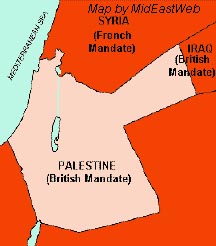 |
|
The
area granted to the mandate was much larger than the area sought by
the Zionists.
It is possible, that as Churchill suggested in 1922, the British never
intended that all of this area would become a Jewish national home. On
the other hand, some believe that Britain had no special plans for
Transjordan initially. In his memoirs, Sir Alec Kirkbride, the British
representative in Amman, wrote that "There was no intention at
that stage [1920] of forming the territory east of the river Jordan
into an independent Arab state." (Kirkbride, Alexander, A crackle
of thorns, London, 1956 p 19)
However,
Abdullah, the son of King Husayn of the Hijaz, marched toward
Transjordan with 2,000 soldiers. He announced his intention to
march to Damascus, remove the French and reinstate the Hashemite
monarchy. Sir Alec Kirkbride, had 50 policemen. He asked for
guidance from the British High Commissioner, Herbert Samuel, and
Samuel eventually replied that it was unlikely Abdullah would enter
British controlled areas. Two days later, Abdullah marched north and
by March 1921, he occupied the entire country. Abdullah made no
attempt to march on Damascus, and perhaps never intended to do so
In
1922, the British declared that the boundary of Palestine would be
limited to the area west of the river. The area east of the river,
called Transjordan (now Jordan), was made a separate British mandate
and eventually given independence (See map at right) . A part of the
Zionist movement felt betrayed at losing a large area of what they
termed "historic Palestine" to Transjordan, and split off to
form the "Revisionist" movement, headed by Benjamin Vladimir
(Ze'ev) Jabotinsky.
|
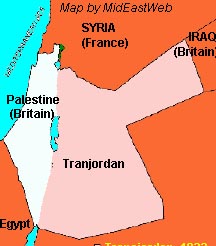 |
The
British hoped to establish self-governing institutions in Palestine, as required
by the mandate. The Jews were alarmed by the prospect of such institutions,
which would have an Arab majority. However, the Arabs would not accept proposals
for such institutions if they included any Jews at all, and so no institutions
were created. The Arabs wanted as little as possible to do with the Jews and the
mandate, and would not participate in municipal councils, nor even in the Arab
Agency that the British wanted to set up. Ormsby-Gore, undersecretary of state
for the colonies concluded, "Palestine is largely inhabited by
unreasonable people."
Arab
Riots and Jewish immigration - In the spring
of 1920, spring of 1921 and summer of 1929, Arab nationalists opposed to the
Balfour declaration, the mandate and the Jewish National Home, instigated riots
and pogroms against Jews in Jerusalem, Hebron, Jaffa and Haifa. The violence led
to the formation of the Haganah
Jewish self-defense organization in 1920. The riots of 1920 and 1921 reflected
opposition to the Balfour declaration and fears that the Arabs of Palestine
would be dispossessed, and were probably attempts to show the British that
Palestine as a Jewish National home would be ungovernable. The major instigators
were Hajj
Amin El Husseini, later Grand Mufti of Jerusalem and eventually a Nazi
collaborator, and Arif -El Arif, a prominent Palestinian journalist. The riots
of 1929 occurred against the background of Jewish-Arab nationalist antagonism.
The Arabs claimed that Jewish immigration and land purchases were displacing and
dispossessing the Arabs of Palestine. However, economic, population and
other indicators suggest that objectively, the Arabs of Palestine benefited from
the Mandate and Zionist investment. Arab standard of living increased faster in
Palestine than other areas, and population grew prodigiously throughout the
Mandate years. (see Zionism
and its Impact). The riots were also fueled by false rumors that the
Jews intended to build a synagogue at the wailing wall, or otherwise encroach
upon the Muslim rule over the Temple Mount compound, including the Al-Aqsa
mosque. The pogroms led to evacuation of most of the Jewish community of Hebron.
. The British responded with the Passfield
White Paper. The white paper attempted to stop immigration to Palestine
based on the recommendations of the Hope
Simpson report. That report stated that in the best case, following
extensive economic development, the land could support immigration of another
20,000 families in total. Otherwise further Jewish immigration would infringe on
the position of the existing Arab population. However, British MPs and the
Zionist movement sharply criticized the new policy and PM
Ramsay McDonald issued a "clarification" stating that Jewish
immigration would not be stopped.
Jewish
immigration swelled in the 1930s, driven by persecution in Eastern Europe, even
before the rise of Nazism. Large numbers of Jews began to come from Poland owing
to discriminatory laws and harsh economic conditions. The rise of Hitler in
Germany added to this tide of immigration. The Jewish Agency made a deal, the Hesder,
that allowed Jews to escape Germany to Palestine in return for hard currency
that the Reich needed. The Hesder saved tens of thousands of lives.
Arab
Revolt and the White Paper - In 1936
widespread rioting, later known as the Arab
Revolt or Great Uprising, broke out. The revolt was kindled when
British forces killed Izz al din El Qassam in a gun battle. Izz al Din El Qassam
was a Syrian preacher who had emigrated to Palestine and was agitating against
the British and the Jews. The revolt was coopted by the Husseini family and by
Fawzi El Kaukji, a former Turkish officer, and it was possibly financed in part
by Nazi Germany and Fascist Italy. Thousands of Arabs and hundreds of Jews were
killed in the revolt, which spread rapidly owing to initial unpreparedness of
the British authorities. About half the 5,000 residents of the Jewish quarter of
the old city of Jerusalem were forced to flee, and the remnant of the Hebron
Jewish community was evacuated as well.
The
Husseini family killed both Jews and members of Palestinian Arab families
opposed to their hegemony. The Yishuv (Jewish community) responded with both
defensive measures, and with random terror and bombings of Arab civilian
targets, perpetrated by the Irgun (Irgun Tsvai Leumi or "Etsel,").
Etsel was the military underground of the right-wing dissident "revisionist
group" headed first by Vladimir
(Ze'ev) Jabotinsky, who seceded from the Zionist movement, and later by
Menachem Begin. The Peel
commission of 1937 recommended partitioning Palestine into a small Jewish state
and a large Arab one. The commission's recommendations also included voluntary
transfer of Arabs and Jews to separate the populations. The Jewish leadership
considered the plan but the Palestinian and Arab leadership, including King
Saud of Saudi Arabia , rejected partition and demanded that the British
curtail Jewish immigration. Saud said that if the British failed to follow Arab
wishes in Palestine, the Arabs would turn against them and side with their
enemies. He said that Arabs did not understand the "strange attitude of
your British Government, and the still more strange hypnotic influence which the
Jews, a race accursed by God according to His Holy Book, and destined to final
destruction and eternal damnation hereafter, appear to wield over them and the
English people generally."
In
response to the riots, the British began limiting immigration and the 1939
White Paper decreed that 15,000 Jews would be allowed to enter Palestine
each year for five years. Thereafter, immigration would be subject to Arab
approval. At the same time, the British took drastic and often cruel steps to
curtail the riots. Husseini
fled to Iraq, where he was involved in an Axis-supported coup against the
British and then to Nazi Germany, where he subsequently broadcast for the
Axis powers, was active in curtailing Jewish immigration from neutral countries
and organized SS death squads in Yugoslavia. (More about he Arab
Revolt or Great Uprising).
The
Holocaust - During World War II (1939-1945),
many Palestinian Arabs and Jews joined the Allied forces. though some
Palestinian and Arab leaders were sympathetic to the Nazi cause. Jews had a
special motivation for fighting the Nazis because of Nazi persecution of Jews
and growing suspicions that the Nazis were systematically exterminating the Jews
of Europe. These suspicions were later confirmed, and the extermination of
European Jews came to be known as the Holocaust. The threat of
extermination also created great pressure for immigration to Palestine, but the
gates of Palestine were closed by the British
White Paper. In 1941 the British freed Jewish Haganah underground
leaders in a general amnesty, and they joined the British in fighting the
Germans.
Illegal
Immigration - The Jews of Palestine
responded to the White
Paper and the Holocaust by organizing illegal immigration to Palestine from
occupied Europe, through the "Institution for Illegal Immigration" (Hamossad
L'aliya Beth). Illegal immigration (Aliya
Bet) was organized by the Jewish Agency between 1939 and 1942, when a
tightened British blockade and stricter controls in occupied Europe made it
impractical, and again between 1945 and 1948. Rickety boats full of refugees
tried to reach Palestine. Additionally, there were private initiatives, an
initiative by the Nazis to deport Jews and an initiative by the US to save
European Jews. Many of the ships sank or were caught by the British or the
Nazis and turned back, or shipped to Mauritius or other destinations for
internment. The Patria
(also called "Patra") contained immigrants offloaded from three other
ships, for transshipment to the island of Mauritius. To prevent transshipment,
the Haganah
placed a small explosive charge on the ship on November 25, 1940. They thought
the charge would damage the engines. Instead, the ship sank, and
over 250 lives were lost. A few weeks later, the SS Bulgaria docked
in Haifa with 350 Jewish refugees and was ordered to return to Bulgaria. The
Bulgaria capsized in the Turkish straits, killing 280. The Struma,
a vessel that had left Constanta in Rumania with about 769 refugees, got to
Istanbul on December 16, 1941. There, it was forced to undergo repairs of its
engine and leaking hull. The Turks would not grant the refugees sanctuary. The
British would not approve transshipment to Mauritius or entry to Palestine. On
February 24, 1942, the Turks ordered the Struma out of the harbor. It sank with
the loss of 428 men, 269 women and 70 children. It had been torpedoed by a
Soviet submarine, either because it was mistaken for a Nazi ship, or more
likely, because the Soviets had agreed to collaborate with the British in
barring Jewish immigration. Illegal immigration continued until late in
the war, apparently without the participation of the Mossad
l'aliya Bet. Despite the many setbacks, tens of thousands of Jews were
saved by the illegal immigration.
The
Biltmore Declaration - Reports of Nazi
atrocities became increasingly frequent and vivid. Despite the desperate need to
find a haven for refugees, the doors of Palestine remained shut to Jewish
immigration. The Zionist leadership met in the Biltmore
Hotel in New York City in 1942 and declared that it supported the
establishment of Palestine as a Jewish Commonwealth. This was not simply a
return to the Balfour declaration repudiated by the British White
Paper, but rather a restatement of Zionist aims that went beyond the Balfour
declaration, and a determination that the British were in principle, an enemy to
be fought, rather than an ally.
Assassination
of Lord Moyne - On November 6, members of
the Jewish Lehi underground Eliyahu
Hakim and Eliyahu
Bet Zuri assassinated Lord Moyne in Cairo. Moyne, a known
anti-Zionist, was Minister of State for the Middle East and in charge of
carrying out the terms of the 1939
White Paper - preventing Jewish immigration to Palestine by force. He was
also a personal friend of Winston Churchill. The assassination did not change
British policy, but it turned Winston Churchill against the Zionists. Hakim and
Bet Zuri were caught and were hanged by the British in 1945.
The
Season ("Sezon") - The Jewish
Agency and Zionist Executive believed that British and world reaction to the
assassination of Lord Moyne could jeopardize cooperation after the war, that had
been hinted at by the British, and might endanger the Jewish Yishuv if they came
to be perceived as enemies of Britain and the allies. Therefore they embarked on
a campaign against the Lehi and Irgun, known in Hebrew as the "Sezon"
("Season"). Members of the underground were to be ostracized. Leaders
were caught by the Haganah, interrogated and sometimes tortured, and about
a thousand persons were turned over to the British.
Displaced
Persons - After
the war, it was discovered that the Germans had murdered about six million Jews
in Europe, in the Holocaust. These people had been trapped in Europe,
because virtually no country would give them shelter. The Zionists felt that
British restriction of immigration to Palestine had cost hundreds of thousands
of lives. The Jews were now desperate to bring the remaining Jews of Europe,
about 250,000 people being held in displaced persons camps, to Palestine.
United
Resistance - In the summer of 1945, the
Labor party came to power in Great Britain. They had promised that they would
reverse the British White Paper and would support a Jewish state in Palestine.
However, they presently reneged on their promise, and continued and redoubled
efforts to stop Jewish immigration. The Haganah attempted to bring
immigrants into Palestine illegally. The rival Zionist underground groups
now united, and all of them, in particular the Irgun and Lehi ("Stern
gang") dissident terrorist groups, used force to try to drive the British
out of Palestine. This included bombing of trains, train stations, an officers
club and British headquarters in the King David Hotel, as well as kidnapping and
murder of British personnel. In Britain, newspapers and politicians began to
demand that the government settle the conflict and stop endangering the lives of
British troops.
The
US and other countries brought pressure to bear on the British to allow
immigration. An Anglo-American
Committee of Inquiry recommended allowing 100,000 Jews to immigrate
immediately to Palestine. The Arabs brought pressure on the British to
block such immigration. The British found Palestine to be ungovernable and
returned the mandate to the United Nations, successor to the League of Nations.
The report of the Anglo-American
Committee provided a detailed
summary of the British mandate period and the security
situation in Palestine, as well as a report on the effects
of the Holocaust and the condition of European Jewry.
|
Partition
- The
United Nations Special Commission on Palestine (UNSCOP) recommended
that Palestine be divided into an Arab state and a Jewish state. The
commission called for Jerusalem to be put under international
administration The UN General Assembly adopted this plan on Nov. 29,
1947 as UN
Resolution (GA 181), owing to support of both the US and the
Soviet Union, and in particular, the personal support of US President
Harry S. Truman. Many factors contributed to Truman's decision to
support partition, including domestic politics and intense Zionist
lobbying, no doubt. Truman wrote in his diary, however, "I
think the proper thing to do, and the thing I have been doing, is to
do what I think is right and let them all go to hell."
The
Jews accepted the UN decision, but the Arabs rejected it. The
resolution divided the land into two approximately equal portions in a
complicated scheme with zig-zag borders (see map at right and see
Partition Map and detailed
partition map of UNSCOP Proposal and final map: UN
Palestine Partition Plan Map - 1947). The intention was an
economic union between the two states with open borders. At the time
of partition, slightly less than half the land in all of Palestine was
owned by Arabs, slightly less than half was "crown lands"
belonging to the state, and about 8% was owned by Jews or the Jewish
Agency. There were about 600,000 Jews in Palestine, almost all living
in the areas allotted to the Jewish state or in the internationalized
zone of Jerusalem, and about 1.2 million Arabs. The allocation of land
by Resolution 181 was intended to produce two areas with Jewish and
Arab majorities respectively. Jerusalem and environs were to be
internationalized. The relatively large Jewish population of Jerusalem
and the surroundings, about 100,000, were geographically cut off from
the rest of the Jewish state, separated by a relatively large area,
the "corridor," allotted to the Palestinian state. The
corridor included the populous Arab towns of Lod and Ramla and the
smaller towns of Qoloniyeh, Emaus, Qastel and others that guarded the
road to Jerusalem. (Click
for Large Detailed Map)
|
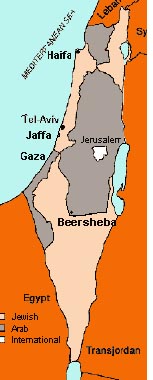 |
It
soon became evident that the scheme could not work. Mutual antagonism would make
it impossible for either community to tolerate the other. The UN was unwilling
and unable to force implementation of the internationalization of Jerusalem. The
Arab
League, at the instigation of Haj Amin Al-Husseini, declared a war to rid
Palestine of the Jews. In fact however, the Arab countries each had separate
agendas. Abdullah, king of Jordan, had an informal and secret agreement with
Israel, negotiated with Golda Meir, to annex the portions of Palestine allocated
to the Palestinian state in the West Bank, and prevent formation of a
Palestinian state. Syria wanted to annex the northern part of Palestine,
including Jewish and Arab areas.
Modern
History
The
War of Independence - 1948 War (the 'Nakba') -
The War of Independence or 1948 War is divided into the pre-independence period,
and the post-independence period. Clashes between Israeli underground groups and
Arab irregulars began almost as soon as the UN passed the partition resolution.
During this time, Arab countries did not invade, though the Jordan legion did
assist the in the attack against Gush Etzion, a small block of settlements in
the territory allocated to the Palestinian state, south of Jerusalem. (See 1948
Israel War of Independence (1948 Arab-Israeli war) Timeline (Chronology) and
Israel
War of Independence (First
Arab-Israel War)
Pre-Independence
- During the period before Israeli independence was declared, two armies of Arab
irregular volunteers, led by Haj Amin El Husseini in the Jerusalem area, and by
Fawzi El Kaukji in the Galilee, placed their fighters in Arab towns and
conducted various aggressive operations against the Jewish towns and village
under the eyes of the British. Kaukji and his irregulars were allowed into
Palestine from Syria by the British, with the agreement that he would not engage
in military actions, but he soon broke the agreement and attacked across the
Galilee. The Arab irregulars were met by the Zionist underground army, the
Haganah, and by the underground groups of the "dissident" factions,
Irgun and Lehi.
In
Jerusalem, Arab riots broke out on November 30 and December 1 1947. Palestinian
irregulars cut off the supply of food, water and fuel to Jerusalem during a long
siege that began in late 1947. Fighting and violence broke out immediately
throughout the country, including ambushes of transportation, the Jerusalem
blockade, riots such as the
Haifa refinery riots, and massacres that took place at Gush
Etzion (by Palestinians) and in Deir
Yassin (by Jews). Arab Palestinians began leaving their towns and villages
to escape the fighting. Notably, most of the Arab population of Haifa left in
March and April of 1948, despite pleas by both Jewish and British officials to
stay.
The
British did little to stop the fighting, but the scale of hostilities was
limited by lack of arms and trained soldiers on both sides. Initially, the
Palestinians had a clear advantage, and a Haganah
intelligence report of March, 1948 indicated that the situation was
critical, especially in the Jerusalem area. It is generally agreed
that April 1948 marked a turning point in the fighting before the invasion
by Arab armies, in favor of the initially outnumbered and outgunned Jewish
forces. To break the siege of Jerusalem, the Haganah prematurely activated "Plan
Dalet" - a plan prepared for general defense that was supposed to have
been implemented when the British had left. It required use of regular armed
forces and army tactics, fighting in the open, rather than as an underground. It
also envisioned the "temporary" evacuation of Arab civilians from
towns in certain strategic areas, such as the Jerusalem corridor. This provision
has been cited as evidence that the Zionists planned for the exodus and
expulsion of Arab civilians in advance.
The
Haganah mounted its first full scale operation, Operation Nahshon, using 1,500
troops. It attacked the Arab villages of Qoloniyah and Qastel, occupied by Arab
irregular forces after the villagers had fled, on the road to Jerusalem and
temporarily broke the siege, allowing convoys of supplies to reach the city.
Qastel fell on April 8, and the key Palestinian military commander, Abdel Khader
Al-Husseini was killed there. Qoloniyeh fell on April 11. In the north, Fawzi
El-Kaukji's "Salvation Army" was beaten back at the battle of Mishmar
Haemeq on April 12, 1948. These successes helped convince US President
Truman that the Jews would not be overrun by Arab forces, and he abandoned the
trusteeship proposal that the US had put before the UN earlier. Following
attacks by Arab irregulars, the Irgun attacked the Arab town of Jaffa, just
south of Tel Aviv. Palestinians fled en masse despite the pleas of the British
to remain.
The
Arab Invasion - The governments of
neighboring Arab states were more reluctant than is generally assumed to enter
the war against Israel, despite bellicose declarations. However, fear of popular
pressure combined with fear that other Arab states would gain an advantage over
them by fighting in Palestine, helped sway Syria, Jordan and Egypt to go to war.
While officially they were fighting according to one plan, in fact there was
little coordination between them.
On
May 14, 1948, the Jews proclaimed the
independent State of Israel, and the British withdrew from Palestine. In the
following days and weeks, neighboring Arab nations invaded Palestine and Israel
(click
here for map). The fighting was conducted in several brief periods,
punctuated by cease fire agreements ( truces were declared June 11 to July 8,
1948 and July 19- October 15, 1948).
In
the initial stage, notable successes were scored by the Egyptian and Syrian
armies. In particular, the Egyptians, backed by tanks, artillery, armor and
aircraft, which Israel did not have, were able to cut off the entire Negev and
to occupy parts of the land that had been allocated to the Jewish state.
In his book, "In the Fields of Phillistia," Israeli peace activist Uri
Avnery recounts how the Egyptian army attempted a massed armored strike against
Tel Aviv. Palestinian attempts to set up a real state were blocked by Egypt and
Jordan. Jordan kept to its agreement not to invade areas allocated to the Jewish
state, but Syria and Egypt did not. The strike was turned back by a few recently
arrived Messerchmitt aircraft, bought from Czechoslovakia. The Syrians made some
advances into the territory that had been allotted to the Palestinian state.
While
Jordan did not invade Jewish territory, the Arab Legion blocked convoys to
besieged Jewish Jerusalem from its fortified positions in Latroun. Jerusalem was
to have been internationalized according to UN
General Assembly Resolution 181 and UN
General Assembly Resolution
303.The Jordanian positions at Latroun
(or Latrun) could not be overcome despite several bloody attacks. To get
around it, the Israelis ultimately built a "Burma Road' that was completed
in June of 1948 and broke the siege of Jerusalem.
The
first cease fire and the Altalena - A cease
fire in June gave all sides time to regroup and reorganize. This marked a
critical stage in the fighting. The Arab side made a crucial error in accepting
the truce. The Israelis took advantage of the cease fire to reorganize and
recruit and train soldiers. They were now able to bring in large shiploads of
arms, despite the treaty terms, and to train and organize a real fighting force
of 60,000 troops, giving them a real advantage in troops and armament for the
first time. The truce probably saved Jerusalem, which had been on the brink of
starvation. During the long truce, the underground armies of the Haganah, Palmah,
Irgun and Lehi were amalgamated into a single national fighting force, the
Israel Defense Force (IDF). The revisionist Irgun movement attempted to bring a
shipload of arms into Israel on a ship called the Altalena, in order to maintain
a separate fighting force. Israeli PM Ben Gurion ordered the IDF to sink the
Altalena when Irgun leader Menahem Begin refused to give up its cargo of arms.
The Palestinians and Arabs did not use the time well. A large shipment of arms
intended for the Palestinians was blocked by the IDF/Haganah and never reached
Syria. Arab states were reluctant to commit more men to the struggle or to spend
more money.
|
Resumption
of the war - The war with the
Egyptians had been static, as they were isolated in the "Falluja"
pocket in central Israel. After the cease fire expired, Israel took
the war with the Egyptians to their territory and entered the Sinai
peninsula. The IDF was forced to withdraw after encounters with
British aircraft.
In
the center, the IDF cut a swath of land to open the
"corridor" between Jerusalem and the rest of Israel. During
the "ten days" period of fighting between the two truces,
they invaded the Arab towns of Lod and Ramla that had been blocking
the road to Jerusalem and expelled most of the Palestinians living
there, after killing a large number. They destroyed numerous small
Palestinian villages surrounding Tel-Aviv, so that virtually no
Palestinians were left in central Israel. (Click
here for a map of Palestine before 1948)
The
Arab defeat and the birth of the refugee problem -
Despite initial setbacks, better organization and intelligence
successes, as well as timely clandestine arms shipments, enabled the
Jews to gain a decisive victory. The Arabs and Palestinians lost their
initial advantage when they failed to organize and unite. When the
fighting ended in 1949, Israel held territories beyond the boundaries
set by the UN plan - a total of 78% of the area west of the Jordan
river. The UN made no serious attempt to enforce the
internationalization of Jerusalem, which was now divided between
Jordan and Israel, and separated by barbed wire fences and no man's
land areas. Click
here to view a map of the UN plan for Jerusalem and Jerusalem as
divided under the armistice agreements. The rest of the area
assigned to the Arab state was occupied by Egypt and Jordan.
Egypt held the Gaza Strip and Jordan held the West Bank. About
726,000 Arabs fled or were driven out of Israel and became refugees in
neighboring Arab countries. The conflict created about as many
Jewish refugees from Arab countries, many of whom were stripped of
their property, rights and nationality, but Israel has not pursued
claims on behalf of these refugees (see Jewish
refugees of the Arab-Israel conflict).
The
Arab countries refused to sign a permanent peace treaty with Israel.
Consequently, the borders of Israel established by the armistice
commission never received de jure (legal) international
recognition. Arabs call the defeat and exile of the Palestinian Arabs
in 1948 the Nakba (disaster).
The
UN arranged a series of cease-fires between the Arabs and the Jews in
1948 and 1949. UN
GA Resolution 194 called for cessation of hostilities and return
of refugees who wish to live in peace. Security
Council Resolution 62 called for implementation of armistice
agreements that would lead to a permanent peace. The borders of Israel
were established along the "green line" of the armistice
agreements of 1949. (Click
here for a map of the armistice lines (so called "green
line") . These borders were not recognized by Arab
states, which continued to refuse to recognize Israel. Though
hostilities ceased,
the refugee problem was not solved. Negotiations broke down
because Israel refused to readmit more than a small number of
refugees. The USSR, initially in favor of the Zionist state, now
aligned itself with the Arab countries. Despite continued US support
for the existence of Israel, US aid to Israel was minimal and did not
include military aid during the Truman and Eisenhower administrations.
The Israel Defense Forces (IDF) were equipped with surplus arms
purchased third hand and with French aircraft and light armor. The
Arab countries, especially Syria and Egypt, began receiving large
quantities of Soviet military aid. The Arab League instituted an
economic boycott against Israel that was partly honored by most
industrial nations and continued in force until the 1990s.
|
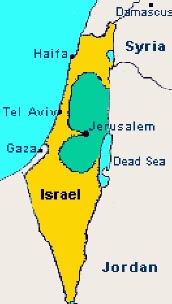
Map
of the Israel "Green Line" Borders |
|
The
Sinai Campaign - Following the
overthrow of King Farouk of Egypt by the free officers headed by
Naguib and Nasser, Egypt made some moves toward peace with Israel. However,
in 1954, an Israeli spy ring was caught trying to blow up the US
Information agency and other foreign institutions in Egypt. The
goal was to create tension between the US and Egypt and prevent
rapprochement. In Israel, both Defense Minister Pinhas Lavon and Prime
Minister David Ben Gurion disclaimed responsibility for the action,
and blamed each other. This incident came to be known variously as
"the Lavon affair" and "the shameful business." (click
here for details). Egypt became suspicious of Israeli
intentions, and began negotiating to purchase large quantities of
arms. When they were turned down by the West, the Egyptians turned to
the Eastern bloc countries and concluded a deal with Czechoslovakia.
Egyptian President Gamal Nasser also closed the straits of Tiran and Suez
Canal to Israeli shipping. Israeli strategists believed that
Egypt would go to war or force a diplomatic showdown as soon the
weapons had been integrated, and began looking for a source of arms as
well. Israel concluded an arms deal with France. A series of border
incursions by Palestinians and by Egyptians from Gaza evoked
increasingly severe Israeli reprisals, triggering larger raids. The
assessment of Israeli "activists" like Moshe Dayan was that
Israel should wage preventive war before Egypt had fully integrated
the new weapons.
In
the summer of 1956, Israel, France and Britain colluded in a plan to
reverse the nationalization of the Suez canal. Israel would invade the
Sinai and land paratroopers near the Mitla pass. Britain and France
would issue an ultimatum, and then land troops ostensibly to separate
the sides. The plan was carried out beginning October 29, 1956.
Israel swiftly conquered Sinai. The US was furious at Israel, Britain
and France. UN
General Assembly Resolution 997 called for immediate withdrawal.
Israeli troops remained in Sinai for many months. Israel subsequently
withdrew under pressure from the UN and in particular the United
States. Israel obtained guarantees that international waterways would
remain open to Israeli shipping from the US, and a UN force was
stationed in Sinai.
|
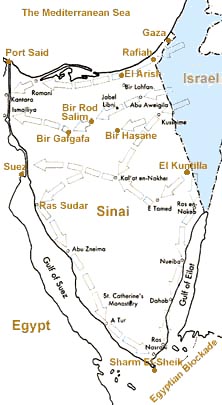 |
|
Sinai
Campaign - Map |
The
beginning of the Fatah - Yasser
Arafat, an Egyptian Palestinian who grew up in the Gaza strip and had been a
member of the Ikhwan (Muslim Brothers) and the Futuwwah or Futtuwah (officially
called "Nazi Scouts" according to Benny Morris, Righteous Victims,
1999, page 124, Palestinian armed faction of Grand
Mufti Hajj Amin El Husseini) was recruited by Egyptian intelligence while
studying in Cairo in 1955, and founded the General Union of Palestinian Students
(GUPS). In 1957 he moved to Kuwait and together with Khalil Al Wazir (Abu Jihad)
Farouq Qadumi, Khalid al Hassan, Mahmoud Abass and others founded the Palestine
Liberation Committee, later renamed the Fatah (reverse acronym for Harakat
Tahrir Filastin - the Palestine Liberation Movement) modeled on the Algerian
FLN.
The
1967 6-Day War - Tension began developing
between Israel and Arab countries in the 1960s. Israel began to implement its
National Water Carrier plan, which pumps water from the Sea of Galilee to
irrigate south and central Israel. The project was in accordance with a plan
proposed by US envoy Eric Johnston in 1955, and agreed to by Arab engineers.
Arab governments refused to participate however, because of the implied
recognition of Israel. In secret meetings, Israel and Jordan agreed to abide by
the water quotas set by the plan.
The
newly formed Palestinian Fatah movement seized on the Israeli diversion as an
"imperialist event" that would catalyze their revolution, and Yasser
Arafat began calling for war to eliminate Israel. In the Fatah newspaper, Filastinunah,
("our Palestine") Arafat ridiculed Egyptian President Nasser and other
Arab leaders for their impotence, and called for effective action against
Israel. Nasser decided to found the Palestine Liberation Organization (PLO) as a
"tame" alternative to the Fatah, and placed Ahmed Shukhairy, an
ineffective and bombastic diplomat at its head.
The
Syrians, who had broken with Nasser's pan-Arabism, countered by supporting Fatah
and attempted to take over the Fatah group. Syrian army intelligence
recruited terrorists for actions against Israel, giving credit for the
operations to Fatah. The first of these actions was announced on December 31,
1964, an attack on the Israel water carrier at Beit Netopha, but in fact no
attack had taken place. A second attempt was made on January 2, 1965, but the
explosives charge was disarmed. However, successful attacks soon followed on
January 14 and February 28. These minor terrorist activities received great
publicity in the Arab world, and were contrasted with the lack of action and
bombastic talk of Gamal Nasser, challenging Nasser's leadership. This ferment is
considered the catalyst of the events that brought about the 6-day war. It is a
moot point whether it is to be attributed to Syrian rivalry with Nasser, or as
Yasser Arafat and the Palestinians claim, to the Fatah movement. Faced with the
"heroic" deeds of the Palestinians under Syrian tutelage, Nasser was
pushed to an increasingly bellicose stance.
In
several summit conferences beginning in 1964,
Arab leaders ratified the establishment of the PLO, declared their resolve
to destroy Israel, and decided to divert the sources of the Jordan river that
feed the Sea of Galilee, to prevent Israel from implementing the water carrier
plan. The Syrians and Lebanese began to implement the diversions. Israel
responded by firing on the tractors and equipment doing the work in Syria, using
increasingly accurate and longer range guns as the Syrians moved the equipment
from the border. This was followed by Israeli attempts to cultivate the
demilitarized zones (DMZ) as provided in the armistice agreements. Israel was
within its rights according to the armistice agreements, but Moshe Dayan claimed
many years later that 80% of the incidents were deliberately provoked. The
Syrians responded by firing in the DMZs (Click
here for a map of the demilitarized zones). When Israelis responded in
force, Syria began shelling Israeli towns in the north, and the conflict
escalated into air strikes. The USSR was intent on protecting the new
Ba'athist pro-Soviet government of Syria, and represented to the Syrians and
Egyptians that Israel was preparing to attack Syria. As tension rose, Syria
appealed to Egypt, believing the claim of the USSR that Israel was massing
troops on the Syrian border. The claim was false and was denied by the UN.
Against
this background, in Mid-May, 1967, Egyptian President Gamal Nasser began making
bellicose statements. On May 16, 1967, a Radio Cairo broadcast stated: "The
existence of Israel has continued too long. We welcome the Israeli aggression.
We welcome the battle we have long awaited. The peak hour has come. The battle
has come in which we shall destroy Israel." On the same day, Egypt
asked for the withdrawal of the UN Emergency Force (UNEF) from Sinai and the
Gaza Strip. UN Secretary General U Thant agreed to remove the troops on May 18.
Formally, the troops could only be stationed in Egypt with Egyptian agreement.
However, for a long time it was believed that Nasser had really hoped U Thant
would not remove the troops, and that he could use the presence of the UN troops
as an excuse to do nothing.
On
May 23, Nasser closed the straits of Tiran to Israeli shipping. The United
States failed to live up to its guarantees of freedom of the waterways to
Israel. A torrent of rhetoric issued from Arab capitals and in the UN. At the
UN, PLO Chairman Ahmed Shukhairy announced that "if it will be our
privilege to strike the first blow" the PLO would expel from Palestine all
Zionists who had arrived after 1917 and eliminate the state of Israel.
In a speech to Arab Trade Unionists on May 26, 1967, Nasser justified the
dismissal of the UNEF, and made it clear that Egypt was prepared to fight Israel
for Palestinian rights. He also attacked the Jordanians as tools of the
imperialists, stepping up the constant pressure on Jordan's King Hussein.
Despite
the bellicose rhetoric, analysts such as Avi Shlaim (The Iron Wall) and
others believe that each country was dragged into the conflict by inter-Arab
rivalry and did not contemplate a war. Nasser never intended to attack Israel
according to Shlaim. He had been dragged into the conflict by Soviet maneuvers
and Syrian fears and his need to claim leadership of the Arab world according to
them. Be that as it may, according to Michael Oren, recently declassified
documents reveal that the Egyptians in fact planned to attack Israel on May 28,
1967. The plan, codenamed operation Dawn, was discovered by Israel. The Israelis
told the Americans. US President Johnson told Soviet Premier Kosygin, and
Kosygin wrote to Nasser. Nasser understood that he had lost the element of
surprise and called off the attack. Nonetheless,
on May 29, 1967, Nasser was still speaking of confrontation with Israel. He told
members of the Egyptian National Assembly, "God will surely
help and urge us to restore the situation to what it was in 1948."
IDF
officers began pressuring the civilian establishment to declare war, because it
was considered that an Arab attack might be imminent, and because Israel's
ability to maintain its army fully mobilized is limited, but Prime Minister
Eshkol was reluctant to take action, and Foreign Minister Abba Eban opposed
unilateral action, which he believed would be against the wishes of the United
States. Ariel Sharon now admits that he and others, including Yitzhak
Rabin, had discussed the possibility of a sort of coup, in which government
officials were to be locked in a room, while the army started the war, but the
idea never got past the stage of thinking out loud.
On
May 30, Jordan signed a defense pact with Egypt, readying itself for war. Nasser
stated: "The armies of Egypt, Jordan, Syria and Lebanon are poised on the
borders of Israel...to face the challenge, while standing behind us are the
armies of Iraq, Algeria, Kuwait, Sudan and the whole Arab nation. This act will
astound the world. Today they will know that the Arabs are arranged for battle,
the critical hour has arrived. We have reached the stage of serious action and
not declarations."
On
June 4, Iraq likewise joined a military alliance with Egypt and committed itself
to war. On May 31, the Iraqi President Rahman Aref announced, "This is our
opportunity to wipe out the ignominy which has been with us since 1948. Our goal
is clear--to wipe Israel off the map."
US
and Israeli assessments were that Israel would win any war handily, despite the
huge superiority in armor, aircraft, and troops favoring the combined forces of
the Arab countries. Prior to 1967, Israel had gotten almost no military aid from
the United States. Egypt and Syria were equipped with large quantities of the
latest Soviet military equipment. Israel's main arms supplier was France. On
paper, Israel had almost as many aircraft as the Egyptians, but the Israeli
aircraft were mostly old, and even the Super-Mirages were no match for the
Mig-21 fighters acquired by Egypt from the USSR. On paper, the IDF had a large
number of "tanks" matching or almost matching the arms of the Arab
countries. However, while Syrians and Egyptians were equipped with late model
Soviet heavy tanks, many of the Israeli "tanks" were in fact tiny
French AMX anti-tank vehicles, and the heavy tanks were refurbished WWII Sherman
tanks fitted with diesel engines. Israel had also been allowed to purchase about
250 M-48 Patton tanks from Germany in 1965. Most of these tanks were being
refitted with Diesel engines in 1967, and the US refused an Israeli request for
100 Pattons to replace the ones that were out of service. The Israeli and Jewish
public, and some in the government, believed that there was a mortal threat to
Israel. Ten thousand graves were dug in Tel Aviv public parks in anticipation of
the heavy casualties.
The
Israeli government probably did not want war, and some at least were fearful of
war. Ben Gurion berated Chief of Staff Itzhak Rabin for making aggressive
statements that had, according to him, escalated the conflict and gotten Israel
into trouble. Israeli Prime Minister Levi Eshkol appeared hesitant, and
stuttered in a dramatic radio speech to the nation. Under great public pressure
from opposition parties, a unity government was formed. Foreign Minister Abba
Eban tried in vain to obtain from the US a guarantee that they would reopen the
straights of Tiran. At first, President Johnson promised an international
flotilla, and warned Israel not to attack on its own. However, the US was unable
to initiate any international action, and reversed its position, hinting broadly
that Israel would have to handle the problem itself.
Israel
could not maintain total mobilization indefinitely. When it became apparent that
Egypt would not stand down, Israel attacked the Egyptians beginning on June 5,
1967. In the first hours of the war, Israel destroyed over 400 enemy aircraft to
achieve total air superiority. Israeli troops quickly conquered the Sinai
Peninsula and Gaza. Jordanian artillery began firing at Jerusalem on the first
day of the war, despite a warning by Israeli PM Levi Eshkol to stay out of the
war, and then the Jordan Legion advanced and took over the headquarters of the
UN (Governor's house - Armon Hanatziv ) in Jerusalem. After warning King
Hussein repeatedly to cease fire and withdraw, Israel conquered the West Bank
and Jerusalem. During the first days of the war, Syrian artillery based in the
Golan Heights pounded civilian targets in northern Israel. After dealing with
Egypt, Israel decided to conquer the Golan heights, despite opposition and
doubts of some in the government, including Moshe Dayan, who had been appointed
defense minister. (see
map of territories occupied in 1967) and despite the fact that the UN had
already called for a cease fire. Israel agreed to a cease fire on June 10,
1967 after conquering the Golan Heights. UN
Resolution 242 called for negotiations of a permanent peace between the
parties, and for Israeli withdrawal from lands occupied in 1967. More
details here: Six
day war 1967
Six Day War Timeline (chronology)
|
The
aftermath of the war - The 1967
6-Day war changed the perceived balance of power in the Middle East
and created a new reality. Israel had acquired extensive territories -
the Sinai desert, the Golan heights and the West Bank, that were
several times larger than the 1948 borders. ( Click
here to view a map of Israeli borders after the 6 day war). Nasser
had been able to attribute the Egyptian defeat in 1956 to British and
French support of the Israelis. Though he tried to blame the 1967
defeat on support supposedly given by the US Sixth fleet, this was
clearly untrue.
According
to analysts such as Fouad Ajami, the disastrous defeat of the Arabs
spelled the end of the Pan-Arab approach advocated by Gamal Abdul
Nasser and contributed to the rise of Islamic fundamentalism. It
should be remembered however, that Nasser and the pan-Arabists always
viewed themselves as heads of the Islamic world as well as the Arab
world.
While
Israel had acquired territories and a military victory, it also marked
a new day for Palestinian aspirations. The defeat brought about a
million Palestinian Arabs under Israeli rule. After the war, the fate
of the Palestinians came to play a large role in the Arab-Israeli
struggle. The Fatah organization (The Movement for Liberation of
Palestine) was founded about 1957 (though it was formalized much
later), and the PLO (Palestine Liberation Organization) was
founded in 1964. Both had the declared aim of destroying Israel. After
the 6-day war, Ahmad Shukairy, who had headed the PLO, was replaced as
chairman by Yasser
Arafat who headed the Fatah. Fatah and the PLO now had freedom of
action, without the restraints of the discredited Arab regimes. Since
all parts of Palestine were now under Israeli control, Fatah actions
did not directly threaten Arab governments. In time, the
Palestine Liberation Organization became recognized by all the
Arab states and eventually
by the UN as the representative of the Palestinian people. PLO
Chairman Yasser Arafat addressed a session of the UN General Assembly
in 1974. Israel strongly opposed the PLO because of its terrorist
acts against Jews and because of its charter
aims of destroying the state of Israel and expelling Jews who had
arrived after 1917.
|
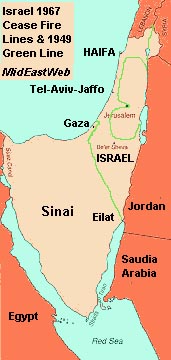
Map
of Israel-Arab Cease Fire Lines 1967 |
The Israeli
government was undecided concerning its plans for the territories. The
United States pressured Israel to make a statement calling for withdrawal from
the conquered territories in return for peace. On June 19, 1967, the government
decided to offer Egypt and Syria return of the Sinai Peninsula and Golan Heights
for a peace settlement to be negotiated directly. The offer apparently did not
include the Gaza strip, and called for demilitarization of Sinai. In the Golan,
Israel offered to withdraw to the international border rather than the 1949
armistice lines, not including the territory conquered by Syria in 1948. J
ordan and the West Bank were not mentioned. The offer was transmitted in secret
through the United States, but was turned down. Egypt and Syria refused to
negotiate with Israel.
At
the request of Jordan's King Hussein, Ya'akov Herzog met with him in the offices
of his physician in London, on the evening of July 2, 1967. According to
Herzog's notes of the meeting, Hussein discussed the reasons why he had been
forced to go to war at length. He said that if there were to be peace, there
would have to be peace with honor, however he did not ask for peace. He did not
reply when Herzog asked him if he was offering peace, but said he would reply in
time. Israel did not have a concrete peace proposal for Jordan. Herzog offered
his private view, that there should be an economic confederation. (This meeting
is documented in Segev, Tom, Israel in 1967 (1967: Veharetz shinta et paneiha
- in Hebrew only), 2005, pp 530-536).
Religious
and nationalist groups began agitating for annexation and settlement of areas in
the West Bank and Golan heights. Some government ministers including Pinchas
Sapir, Zalman Aran of the Labor party and the NRP's Yaakov Shimshon Shapira
feared the demographic problems that would arise from conquering all those
Arabs. Shapira also pointed out that annexing the West Bank would lend credence
to claims that Israel was a colonialist enterprise. Menachem Begin and Yigal
Alon favored annexation. Moshe Dayan proposed that the Arabs of the West Bank
should be given autonomy, but Menachem Begin, who was later to favor the plan,
objected. He believed large numbers of Jews could now be brought to Israel to
settle the territories, and the Arabs would be given a choice between becoming
citizens or leaving.
The
Mossad had proposed a Palestinian state under Israeli protection in a report
dated June 14, 1967 (Segev, 1967, pp 537-538), but this was not accepted.
According to some sources, in the summer of 1967, Moshe Dayan received a
delegation of notables who proposed self-rule for the West Bank, but he rejected
the offer.
By
July 1967, Yigal
Alon had submitted his "Alon Plan" which called for Israeli
retention of large parts of the West Bank in any peace settlement for strategic
reasons. An increasing number of settlements were established as it
became evident that Arab states would not negotiate with Israel. A decisive
turning point was the Khartoum Arab summit, in August
and September of 1967, which seemed to shut the door on the possibility of
negotiations with Israel or recognition of Israel in any form. The Khartoum
resolutions may not have been an insurmountable barrier to peace. In 1970, King
Hussein of Jordan supposedly offered to make peace in return for Israeli
withdrawal from the West Bank and return of the holy places, but the offer was
politely turned down.
A
second landmark was the "Zionism
is Racism" resolution passed by the United Nations in 1975, which gave
credibility in Israel to claims of Israeli extremists that opposition to
settlements was opposition to Israel, and that Israel was essentially alone in a
hostile world and could expect no justice. The resolution was repealed in 1991,
but similar sentiments surfaced at a UN conference in Durban in 2001. Likewise
in November 1975, US
Deputy Assistant Secretary of State Harold H Saunders, told a US House Committee
that the US now recognized the importance of the Palestinian national issue in
the conflict, and hinted broadly that the US would be willing to facilitate a
solution that took account of Palestinian rights, if the PLO would recognize the
relevant UN resolutions, including Israel's right to exist, and would be
amenable to a reasonable compromise. This policy was to bear fruit
eventually in the Oslo Peace Process, after PLO Chairman Arafat announced PLO
acceptance of UN Resolution 242 in 1988.
Meanwhile
however, settlement expansion became official Israeli policy after the
opposition revisionist Likud party came to power in 1977, and continued during
the Oslo accords. As of 2003, about 220,000 Israelis had settled in areas
of the West Bank and Gaza, and an additional 200,000 were settled in areas of
Jerusalem and environs conquered in 1967. About 15,000 Jews were settled in the
Golan heights taken from Syria. (Click
for Map of Israeli West Bank Settlements-2002)
The
War of Attrition - After the 6-Day war,
Egyptian president Nasser launched the war of attrition on the Suez canal,
breaking the cease fire. In Israel, Prime Minister Levi Eshkol had died and was
replaced by the hawkish Golda Meir. The sides fought to a standstill in
increasingly bloody exchanges that included participation by Soviet pilots on
the Egyptian side. Under US pressure, a second cease fire was signed in August
1970, with both sides declaring officially their acceptance of UN Resolution
242. Nasser died shortly thereafter, and was replaced by Anwar Sadat. Sadat
tried repeatedly to interest Israel in partial peace deals in return for partial
Israeli withdrawal, and the US and UN tried to mediate peace through the offices
of Gunnar Jarring. Nothing came of these peace efforts, partly owing to the
stubborn attitude of Israeli PM Golda Meir, who insisted that Israeli troops
would not budge until there was a peace agreement in place. Sadat continued to
alternate peace plans with threats of war, but he was not taken seriously in
Israel. Israeli army intelligence as well as the government were convinced that
Israel had absolute military superiority and that Egypt would not dare to attack
until it had rebuilt its army. Therefore, the best course seemed to be to wait
until the Arab countries met Israel's terms.
The
October War (Yom Kippur War) - In October
1973, Egypt and Syria launched another war against Israel, after the Israeli
government headed by Golda Meir rebuffed Egyptian President Anwar Sadat's offers
to negotiate a settlement. The Egyptians crossed the Suez Canal on the afternoon
of October 6, Yom Kippur, the holiest day in the Jewish religious calendar. The
Israeli government had ignored repeated intelligence warnings. They were
convinced that Israeli arms were a sufficient deterrent to any aggressor. Sadat
had twice announced his intention to go to war, but nothing had happened. When
the intelligence reports were finally believed, on the morning of the attack, PM
Meir and Defense Minister Moshe Dayan decided not to mobilize reserves.
The
Israelis were caught by surprise in more ways than one. Egyptians poured huge
numbers of troops across the canal unopposed and began setting up a beachhead.
The Israel Army had neglected basic maintenance tasks and drill. As troops
mustered, it became apparent that equipment was missing and tanks were out of
commission. The line of outposts built as watch posts along the Suez canal - the
Bar Lev line, was used instead as a line of fortifications intended to hold off
the Egyptians as long as possible. A tiny number of soldiers faced the Egyptian
onslaught and were wiped out after stubborn resistance. The Soviets had sold the
Egyptians new technology - better surface to air missiles (SAM) and hand held
Sager anti-tank weapons. Israel had counted on air power to tip the balance on
the battlefield, and had neglected artillery. But the air-force was initially
neutralized because of the effectiveness of SAM missiles, until Israel could
destroy the radar stations controlling them. Futile counterattacks continued in
Sinai for several days as Israeli divisions coped with traffic jams that
prevented concentration of forces, and with effective Egyptian resistance.
Meanwhile,
less than 200 Israeli tanks were left guarding the Golan heights against far
superior numbers. Syrians made serious and at first unopposed inroads in the
Golan as Egyptians crossed the Suez canal and retook a strip of the Sinai
peninsula. After suffering heavily losses, Israel reconquered the Golan. Click
for map of Syrian Front
In
Sinai, Israel troops crossed the canal. General Ariel
Sharon, disobeying the orders of cautious superiors, tried to run
ahead of logistics and support to develop the bridgehead on the Egyptian side of
the Suez canal. This small force was reinforced after bridges were put across
the canal, and the Israelis cut off the entire Egyptian third army. (Click
for map of Egyptian front ) Cease-fires ended most of the
fighting within a month. About 2,700 Israeli soldiers and 8,500 Arab soldiers
died in the war As a result of the war, Golda Meir was forced to resign as Prime
Minister of Israel, making way for Yitzhak
Rabin, who had been Israeli ambassador to the US and previously Chief of
staff of the IDF. Click
for details of the Yom Kippur War
Oil
Embargo - In the aftermath of the Yom Kippur
war, Arab states led by Saudi Arabia declared an oil embargo, targeting the
United States and the Netherlands in particular for their support for Israel.
Oil production was reduced by 340 million barrels from October to December of
1973. Prices soared from $3 to over $11 a barrel, due to panic stockpiling as
well as actual shortages. Oil sold to European countries eventually made its way
to the United States and the Netherlands in any case, but there were nonetheless
long lines for gasoline and overnight price increases. The embargo continued
until March of 1974. The embargo heightened the perception that Arab countries
could exercise political leverage by controlling the oil supply. It probably
helped motivate European diplomatic moves that were conciliatory to the Arabs,
and played a part in the invitation of Yasser Arafat to address the UN General
Assembly, granting of a permanent observer status at the UN to the PLO and
passage of the Zionism
is Racism resolution in 1975.
Peace
With Egypt - Subsequent shuttle
diplomacy by US Secretary of State Henry Kissinger resulted in partial Israeli
withdrawals from the Sinai peninsula, under much less favorable terms than could
have been obtained before the war. Right-wing opposition leader Menahem Begin
was adamant in his opposition to any withdrawals. However, in 1978, Egypt led by
Anwar Sadat, and Israel, now led by Menahem Begin, signed the Camp David framework
agreements, leading to a Peace
treaty in 1979. Israel withdrew from the Sinai Peninsula in 1982.
The
PLO in Lebanon and the Lebanese Civil War -
Lebanon became increasingly unstable as Maronite Christians found their
once--dominant position threatened by demographic changes which gave Muslims an
increasingly large majority. Tensions between different religious groups were
exacerbated by clan rivalry. Lebanon also has a relatively large population of
Palestinian refugees, who incurred the animosity of native Lebanese, especially
the Christians. A revolt by the PLO against the Jordanian government led
to the expulsion of the PLO from Jordan in 1970. PLO fighters streamed into
Lebanon, incited tension between Muslims and Christians and turned Lebanon into
a base for attacks on Israel. In 1975, an attack by Christian Phalangist
militias on a bus carrying Palestinians ignited the civil war. the
Christian Phalangists and Muslim militias massacred at least 600 Muslims and
Christians at checkpoints, beginning the 1975-1976 civil war. Full-scale civil
war broke out, with the Palestinians joining the Muslim forces, controlling an
increasingly lawless West Beirut. Lebanese political and social life descended
into chaos, characterized by a grim routine of car bombs, assassinations and
harassment and killing of civilians at roadblocks set up by warring militias.
On
January 20, 1976, PLO fighters, possibly reinforced by a Syrian PLO
contingent that had entered Lebanon in 1975, destroyed the Christian towns of
Jiyeh and Damour, massacring about 500 people. In March, Major Saad Haddad
formed the Southern Lebanese Army (SLA), a militia intended to protect Christian
residents of southern Lebanon, which was allied with Israel In June, 1976,
with the Maronites on the verge of defeat, President Elias Sarkis called
for Syrian intervention. With the agreement of the Americans and the Israelis,
the Syrians entered Lebanon ostensibly to protect the Christians and the fragile
Lebanese multi-ethnic multi-religious constitution, but also to further
long-standing Baathist ambitions to make Lebanon as part of Greater Syria.
On August 13, 1976, under the protection and with the probable active
participation of the Syrian army, the Christian Phalangist militia attacked the
Tel al-Za'atar refugee camp and killed as many as 3,000 civilians.
After
an attack on a bus on the Haifa-Tel-Aviv road, in which about thirty people were
killed, Israel invaded Lebanon in March 1978. It occupied most of the area south
of the Litani River in Operation Litani. In response, UN Security Council
resolution 425
called for the immediate withdrawal of Israeli forces and the creation of a UN
Interim Force in Lebanon (UNIFIL), charged with maintaining peace.
Israeli
forces turned over positions inside Lebanon along the border to the SLA. The SLA
and Israel set up a 12-mile wide security zone to protect Israeli territory from
attacks across the border, and to protect local residents from the PLO, which
had been occupying their villages and using them as bases for shelling Israel.
This southern area became an "open border" area separated by the
"good fence," allowing Lebanese residents to find work in
Israel. Attacks and counter attacks along the northern border of Israel
continued. In July of 1981 a cease-fire between Israel and the PLO was brokered
by the US. It was generally honored by both sides. Nonetheless, the PLO
continued to gather strength and dig in in southern Lebanon.
The
1982 War in Lebanon (Peace for the Galilee) - On
June 3 1982, terrorists of the Abu Nidal faction, not controlled by the PLO,
shot Israeli Ambassador Shlomo Argov in the head in London. In response, Israel
invaded Lebanon in force. Most analysts believe that the shooting of Argov
served only as an excuse for an operation planned by defense Minister Ariel
Sharon with the tacit approval of the US administration. The Iranian Islamist
regime sent its Pasdaran revolutionary guards, who had previously organized the
takeover of the US embassy in Teheran, into Lebanon, and began organizing a
resistance movement, The Hizb Allah (party of Allah) or Hizbolla.
The
Israel invasion resulted in expulsion of the PLO from Lebanon to Tunis in
August. The war aroused furor in Israel as the army exceeded the official
war aims. On September 14, 1982, the Lebanese President-elect, Bashir Gemayel,
an Israeli ally, was killed by a large bomb that was apparently planted by
Syrian intelligence. Ostensibly to maintain order, the Israeli government
decided to move into West Beirut. They allowed or sent their Lebanese Phalangist
Christian allies into the Sabra and Shatilla Palestinian refugee camps.
The Phalangists committed a massacre in Sabra and Shatilla, killing about 700
people and exciting the wrath of the international community as well as the
Israeli public. An Israeli commission
of inquiry led by judge Kahan indirectly implicated Israeli Defense Minister
Ariel Sharon and several others in the massacres, noting that they could have
foreseen the possibility of the violence and acted to prevent it. The Kahan
report resulted in the resignation of Sharon as defense minister. Israel
subsequently extricated itself slowly from Lebanon. As Israel withdrew,
Lebanon became increasingly lawless. Beirut life came to be characterized by
gunfire, kidnappings and bombings. Attempts by the US to restore order
failed owing to large scale suicide bombings of a marine barracks and the US
embassy. The US withdrew and Lebanon, especially Beirut, deteriorated into
chaos. Order was restored only after Lebanon became essentially a satellite of
Syria. Israel continued to maintain a presence in south Lebanon until 2000, when
the last Israeli troops were withdrawn by PM Ehud Barak.
The
Pollard Affair - In November 1985, Jonathan
Pollard, a Jewish-American employee of the US Naval Anti-Terrorist Alert Center
was arrested for spying for Israel. He pleaded guilty in a plea bargain deal,
but the US government apparently reneged on the deal and Pollard was sentenced
to life imprisonment in 1987, an exceptional sentence relative to similar cases.
The affair was a severe embarrassment to US-Israeli relations and raised the
specter of "double loyalty" accusations for American Jews. At the same
time, Pollard became a cause celebre of the Zionist right, who pointed
out that he had been used and abandoned by the Israeli government, which did
little to secure his freedom.
The
First
Intifada - While the fortunes of
the PLO waned, Palestinians in the occupied territories took their fate into
their own hands. Beginning in 1987, a revolt called the Intifadeh began in the
Gaza Strip and the West Bank. The revolt was initiated by local residents and
involved mostly low-level violence such as rock throwing, winning sympathy for
the struggle of the Palestinians against the Israeli occupiers. By 1991
the Intifadeh had all but ended, but massive Israeli repression in this period
laid the seeds for future violence (see First
Intifada).
Current
History - Click here for The
history of the Israeli-Palestinian Conflict since the Oslo Accords.
(Latest
revision June 10, 2009) http://www.mideastweb.org/middle_east_center.htm
https://www.jpost.com/j-spot/these-women-fought-in-the-palmah-these-are-their-stories-669987
Women of the Palmah
The Palmah was the elite
fighting unit of the Hagana, the underground army of the Jewish
community in Israel during pre-state times.
YOCHEVED BEN-SHMUEL
(photo credit: Courtesy)
From Yocheved Ben-Shmuel’s point of view, the battles of 1948
in which she took part as a
Palmah
combat medic along the road winding up the hills into Jerusalem,
still remain etched in her memory as if they were part of a war
movie.
“During one battle, Shimeleh – who was only 16-and-a-half
– was injured badly in the fighting,” Ben-Shmuel says,
recalling how in one hand she held her Sten gun, and with the
other helped Shimeleh take a sip of water from her canteen.
“The Arabs had thrown a grenade at us, and I’d been injured
by shrapnel in my leg and my back. I continued fighting, even
though I was covered in blood. What choice did I have?”
The Palmah was the elite fighting unit of the Hagana, the
underground army of the Jewish community in Israel during
pre-state times. At first the Palmah had been kind of like a
men’s club, but after a couple of years, women began joining
in large numbers and soon made up one-third of the force.
Although few took on combat positions, women contributed
tremendously to the success of the Palmah.
Ben-Shmuel (née Mizrachi), 93, was born in Iraq. At age eight,
she immigrated to Israel with her family, even though it was
illegal at the time.
“I joined the Palmah after training with the Noar HaOved
VeHalomed at Kibbutz Ein Gev,” remembers Ben-Shmuel.
“Following the November 29, 1947 UN Resolution, when the Arabs
began disrupting intercity transportation, I began escorting
convoys. To hide our weapons so the British wouldn’t
confiscate them, we would wear baggy jackets. They never patted
down the women. The first convoy I escorted ended up being quite
a unique experience. It turned out that [David] Ben-Gurion and
Golda [Meir] were traveling to the Jewish Agency in Jerusalem.
The two of them were in a taxi, and we were following in an
armored vehicle. Ben-Gurion didn’t say hello to me or even
take notice of me there.”
Ben-Shmuel was later sent on a medic’s course.
“In just one week, we learned all the basic skills we needed
to know,” she recalls. “We learned how to bandage wounds so
they wouldn’t get infected.” Looking back, Ben-Shmuel finds
it hard to believe she functioned under all that stress.
“I wore a backpack with the first-aid kit, a canteen full of
water, a stretcher with a blanket, a Sten gun and three
cartridges full of bullets. The most difficult moment was when I
was escorting a convoy and many of our fighters got injured. All
of a sudden, so many of them were screaming at me, ‘Yocheved,
help me!’ I tried to calm everyone down as quickly as possible
so I could treat each one of them, even though they were still
shooting at us.
“People always ask me if I was scared, but there hadn’t been
time to think about being scared. It was my job to save their
lives, so that’s what I spent all of my energy doing and
thinking about. I was completely focused on my job.”
What do you think about the current controversy over
women serving in IDF combat positions?
“There’s no question in my mind: I salute every girl who
serves in a combat position. I was so proud of my granddaughters
who live in Italy – my daughter is married to an Italian man
– since they all came back to Israel to carry out their IDF
military service. One of them fought hard to become accepted to
the combat medic corps. I’m so proud of her.
“I’m also proud of myself for what I did to protect the
State of Israel during the War of Independence. Many people hid
and were killed anyway. But I feel so much pain in my heart when
I see all of the horrible things taking place in Israel today,
where the strong are taking advantage of the weak. This is not
the kind of country we worked so hard to build.”
WHEN RINA KALMAN (née Meushar), 91, is asked what attracted her
to the Palmah, she replies that it was 100% her Zionist outlook.
“The day I finished my studies at the agricultural high school
for girls in Petah Tikva, I joined the Palmah’s training
program,” recounts Kalman. “I loved the Palmah emblem, which
has two stalks of wheat protected with a sword. Just before the
British departed from Israel, I was assigned to serve as
secretary for the Third Battalion. When I arrived there, I
discovered that the commander was Shalom Havali, who was later
replaced by Mula Cohen and then Moshe Kalman, whom I later
married. We had a common goal: to establish a kibbutz and
protect it. It’s natural that you would become emotionally
involved with someone in times such as these, since you’re
working together under intense circumstances and engaging in
social and cultural activities together.”
Kalman was injured during the War of Independence, but not in
the midst of battle.
“In early January 1948, when our battalion moved from the
Galilee to Tzrifin, which at the time was a British base called
Sarafand, I was injured in a bombing in Rishon Lezion carried
out by Egyptian warplanes. I couldn’t use my right arm for an
entire year afterward, but that didn’t prevent me from
continuing with my military service – I just took on a
different position.”
What was the atmosphere like in the Palmah?
“Just like people describe. We would all sit around a
campfire, since that was the easiest way to maintain a feeling
of equality among all the members. That way, everyone gets
warmed to the same extent and no one feels left out. We’d pass
around the finjan, and everyone would pour a little coffee for
themselves. We’d sing songs for hours; The Palmah songs are
such an important part of that era. We had an old gramophone,
and we’d listen to classical music. If we had books, we’d
read them and then pass them on to others. We spent lots of time
sitting together on the grass. It was a wonderful feeling always
spending time together.”
Did any of the women experience any harassment?
“I never kissed any of the guys in the Palmah, and I wasn’t
the only one. One Palmah fighter, one of our most talented
fighters, once told me I was part of this important mission,
then asked me if I’d like to be his girlfriend. But we had
very different political views, and for me that was a line I
wouldn’t cross. Although for most Palmahnikim, once you joined
the Palmah, everyone was treated like family regardless of your
political association. Very strong friendships were formed among
Palmah members.”
YONA ARBEL (née Shatel), 92, was born in Switzerland.
“When I joined the Palmah, I was sent to Beit Ha’arava,
which was the hottest but also the most magical place in the
world,” Arbel recalls. “It was hard, but also wonderful. We
would sing while we sat around the campfire, and then someone
would tell a scary story.
“Our induction ceremony was held on top of Masada. The snake
path hadn’t been created yet, and it was really hard climbing
up to the top. I was given the job of hiding the weapons, which
we would stash in locations outside of our campsite. It was my
job was stand guard with a Luger pistol, which I’d never
fired, and make sure no one came near our weapons cache.
“Another one of our responsibilities was to smuggle in Jews
over the Jordan River who were arriving from Iraq. On one of my
missions, one man lost consciousness just as we were crossing
and died. Once, in 1947, I was taken to Jerusalem. I had no idea
why. We arrived at some place where we snatched a bunch of
documents belonging to the Etzel [Irgun]. Only afterward did I
realize I’d just participated in a raid on Etzel headquarters.
The same night, we freed one of our comrades whom they’d
captured. He died not long afterward in the War of
Independence.”
Arbel later took a secret wireless communications course, and
still later during the war, served as a radio operator in
southern Israel. After the war, Arbel became a teacher.
 HASIDA PA’IL served as a Morse code wireless operator in the
Negev Brigade. (Courtesy)
HASIDA PA’IL served as a Morse code wireless operator in the
Negev Brigade. (Courtesy)
HASIDA PA’IL, 91, was born in Jerusalem. She joined the Palmah
as a member of the Young Maccabi Gar’in on Kibbutz Givat Haim.
“We would go out on excursions from there,” Pa’il recalls.
“When we heard about the UN Partition Plan, we didn’t have
any time to celebrate because we heard immediately afterward
that many of our comrades had been murdered by Arabs.”
Pa’il ended up playing an extremely important role in the war.
“I was chosen to start a medic course in Tel Aviv, but when I
arrived at the Histadrut building, I was told that instead I was
to participate in the Morse code wireless course. I had
absolutely no clue what it was. That’s how secret it was. In
the end, I became the Morse code wireless operator in the Negev
Brigade that was under the command of Nahum Sarig. I served as
the signal operator in the battles at Beersheba and Eilat. I
participated in many operations: Yoav, Lod, Horev and Uvda. In
the meantime, the British forces left and Israel became an
independent state, so we could finally use our communications
equipment openly.”
Hasida married Meir Pa’il, a Palmah commander, and later
became a historian and a politician. They were among a number of
famous couples who met each other while serving in the Palmah
together.
“Meir and I met while we were serving in the Negev Brigade,
but there wasn’t anything between us then,” Hasida explains.
“Meir was the brigade’s Agam officer, and we rarely saw each
other. Our romantic relationship only began after the war ended.
We got married in March 1950, after dating for six months.”
After the war, Hasida ran a puppet theater and wrote a few
children’s books.
“It’s not the same nowadays,” Hasida says. “We
volunteered and enlisted in the Palmah because we yearned to
have a Jewish state. Today, all people care about is money and
power. The inequality and animosity I see in modern Israeli
society makes me so sad.”
 TOVA
OFER: Inspired by commander Yitzhak Sadeh. (Courtesy)
TOVA
OFER: Inspired by commander Yitzhak Sadeh. (Courtesy)
TOVA OFER, 92, was a combat medic. Even before she joined the
ranks of the Palmah, Ofer was active in clandestine efforts for
the Hagana, including transporting secret material from Tel Aviv
on her bicycle.
“In 1947, I joined a Palmah training course and then I was
sent to Kibbutz Negba, where I helped to construct security
infrastructure,” Ofer remembers. “One of our jobs was to
shine spotlights on the Iraq Suwaydan Egyptian-held police fort
so that we could monitor British activity there.”
A speech given by Palmah commander Yitzhak Sadeh just before
they were to leave Kibbutz Hulda left a great impression on Ofer.
“Sadeh was so inspiring when he told us resolutely that we
were going to help raise the morale of Jewish residents in
Jerusalem who’d been living under siege,” Ofer recalls.
“He wished us safe travels, but already at Sha’ar Hagay,
Arabs who’d climbed down the mountain began throwing Molotov
cocktails at us. Luckily, our truck made it through to Beit
Hakerem. This was April 20, 1948, which happened to be Seder
night. From there we were brought to Schneller Camp. That night,
they wanted to separate the men and women into separate sleeping
quarters, but we refused, demanding that we were a united
fighting group.”
Later, Ofer was involved in a battle near Kibbutz Tzova.
“A man had been wounded and I needed to reach him,” Ofer
recalls. “So I descended quickly, bringing a stretcher with
me. He was bleeding badly. I cleaned his face and gave him a
drink of water, and then I heard more gunshots. I wasn’t
scared, though, since I was focused on the job I had to do there
and I knew that our forces were going to get us out of there,
that we weren’t alone.”
 RIVKALEH
KRAMER: It was all very simple (ARIEL BESOR)
RIVKALEH
KRAMER: It was all very simple (ARIEL BESOR)
RIVKALEH KRAMER, 91, was a soloist in the Israeli folk music
group HaChizbatron. She is known for singing the famous song
“Hen Efshar,” which is associated with the War of
Independence.
“In August 1948, I was a young clerk at Palmah headquarters on
Yarkon Street in Tel Aviv,” remembers Kramer. “One day, in
walks Shmulik Bonim, the director of HaChizbatron. He’d also
been my director when I was in the Shomer HaTzair.
“‘I’ve been looking all over for you!’ he exclaimed. The
group’s truck had driven over a mine near Kibbutz Nirim in the
Negev, and Ohala Halevi, their backup soloist, had been injured.
He asked me to replace her for one month, but I ended up
staying. Some people say this was my Cinderella story, but I
don’t agree, because I think I was pretty talented, although
no one could compete with Nomi, she was so far above everyone
else!
“Our IDF troupe was nothing like it had been depicted in the
movie The Band. No differentiation was made between the boys and
girls in the group. We traveled from place to place in trucks or
whatever kind of transportation was available. We’d perform
without electricity or microphones. It didn’t look anything
like the concerts that are held these days. We never used any
makeup or did up our hair. It was all very simple.”
At times she would lock horns with commander Haim Hefer.
“Haim was very strict with us, and it was important to him
that we never forgot that he was our commander. Nonetheless, at
heart he was a poet and a very special soul. The song ‘Hen
Efshar’ was in my opinion the first peace song, and it moved
the hearts of so many people.”
Were there difficult times?
“Of course. Not everything was rosy. I’ll never forget the
day we reached a military post in Faluja. There we encountered a
bunch of soldiers who were suffering severely from shell shock
after seeing many of their comrades die in battle. They were so
sad, but we were able to get them singing with us, which helped
a little, I think. That’s what a military troupe is supposed
to do.
“Many other singing troupes came after us, but not one was
like HaChizbatron. We sang and dreamed about having our own
country. Now that we do, we must do everything in our power to
protect it.”
Ottoman Empire 1300 - 1924
Ottoman
Empire- The Ottoman Empire was the last of a series of Turkish Muslim
empires. It spread from Asia minor beginning about 1300, eventually encompassing
most of the Middle East, most of North Africa, and parts of Europe, including
modern Albania, Bulgaria, Greece, Hungary, Rumania and Yugoslavia. In the Middle
East, the Ottomans ruled Syria, Palestine, Egypt, parts of Arabia and Iraq. Only
Persia (Iran) and the Eastern part of the Arabian peninsula remained free of
Ottoman rule. The empire reached around the Black sea and into the
Caucasus in Central Asia, including Aremenia. The Ottoman armies reached as far
as the gates of Vienna, where they were repulsed for a second time in 1683, the
height of their expansion on land. The map below shows the extent of the
Ottoman Empire in 1683.
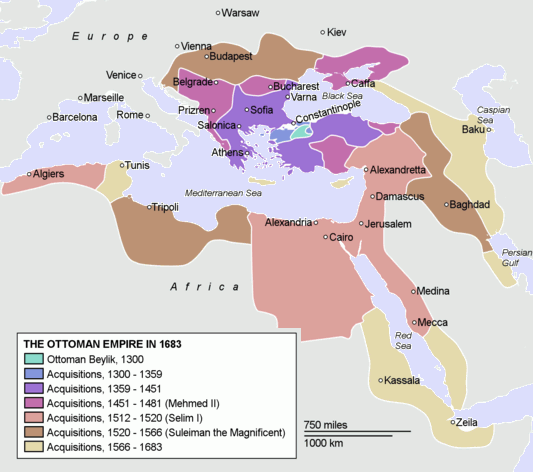
The
Ottoman Empire was founded about 1307 by Osman I, whose father Ertuğrul was
a Ghazi
mercenary who migrated from central Asia to Western Asia minor, as part of the
migration of Turkic peoples under pressure of Mongol expansion in central Asia.
In return for services, the Seljuk Turks gave Ertuğrul, a territory in
Eskisehir. Osman expanded his Ghazi territory. and conquered a significant
portion of Asia minor, dying before he captured Bursa. Bursa was captured by his
son, Orkhan, who made it his capital. Subsequent rulers continued the expansion.
The ruler of the Ottoman Empire after its rise assumed the title of Sultan. The
Sultan also assumed the role of the Muslim Caliph.
The Ottoman Turks were fierce fighters, supplementing their Muslim troops with
an elite corps of converted Christian slaves, the Yeni Chery (new troops) or in
English, Janissaries.
The
progress of the empire was explosive. In 1453, the Sultan Mohamad II
conquered Constantinople (renamed Istanbul) putting an end to the Eastern Roman
Empire. The Sultan Suleiman the Magnificent conquered modern Yugoslavia in 1521,
and conquered Hungary after his victory at the battle of Mohacs in 1526.
However, he failed to take Vienna after winter forced an end to his siege in
1529. The Ottomans went on to take Transylvania and Wallachia as well. The
Ottoman Empire had become a significant part of European politics. It entered
into a military alliance with France, England and the Netherlands against
Habsburg Spain, Italy and Habsburg Austria. The Ottoman navy aided Francis the I
to take Nice from the Holy Roman Empire.
The
Ottoman fleet attracted the attention and antagonism of Portugal and other sea
powers. In 1571, Ottoman forces suffered a temporary setback when their fleet
was defeated at the battle of Lepanto. Authorities differ on whether this battle
had a permanent effect on Ottoman power.
In
1683, Ottoman power was checked at its final zenith when the siege of Vienna
failed. The empire began a decline marked by increasing backwardness relative to
Europe as well as corruption and dissipation and poor judgment of several of the
Sultans. The Janissaries became corrupt and ineffective as soldiers and used
their power to dictate political affairs. For a time, the empire was ruled
essentially by the women of the Harem, mothers of the Sultans.
The
victories of Napoleon at the beginning of the 19th century and exposure to
Western armaments close to home served as a wake up call. Several attempts were
made at reform, including the Tanzimat reforms of 1838 and 1858. Ottoman Turkey
was clearly in decline however, and Western powers decided to prop it up in
order to maintain the balance of power in the Middle East. However the decline
accelerated. The Ottomans lost Egypt and then Greece, Serbia and other
territories in the nineteenth century. Attempts at modernization and profligate
spending bankrupted the empire, which was forced to find financial support where
it could. Attempted reform (the Tanizmat) which was aimed primarily at raising
new taxes, failed. The backward agrarian lands ruled by the Ottomans did not
produce enough, and the tax farmers were too greedy and oppressive. Investment
of borrowed capital and new infrastructure failed to modernize the country or
the army sufficiently to make it competitive with the West or able to hold its
own against European armies.
In
1908, a revolution of Young Turks put into power the government of Enver Bey and
the Committee of Union and Progress (CUP). They promised greater autonomy to
Arabs and to minorities, and efficient constitutional government, but were
unable to keep their promises. The Ottoman Empire became involved in several
disastrous wars under the CUP, with the usual inevitable loss of territory.
Despite
constitutional reforms, the new government failed to check the decline, which
was particularly evident in the army, and Turkey lost Bulgaria to the Bulgarian
independence movement. The Turks sided with the Central Powers in World War I.
They were pressed by the Russians and Armenians from the North, and by British
and allied forced from the south. The Russians recruited the Armenians to
revolt, and the Turks responded by perpetrating large scale indiscriminate
murder of Armenians. Between 600,000 and 1.4 million Armenians are said to have
died. The Turks officially deny that any genocide took place.
The
British fleet missed an opportunity to open the Bosporus with their navy and
allied ships at the beginning of World War I. Had they acted quickly, they might
have separated European and Asiatic Turkey and possibly taken Istanbul and
removed Turkey from the war. Instead, they chose to attack by land on the
Gallipoli peninsula, wasting nearly two years in a very bloody campaign that
achieved nothing. Turkish and Arab troops fought bravely and stubbornly at
Gallipoli and inflicted huge losses on British, Australian and New Zealand
(ANZAC) forces. At Gallipoli, the Ottoman army proved that when properly
supplied and officered, it could be a very formidable fighting force.
Failure
to open the Bosporus doomed Russia, which could not sell its wheat and could not
be resupplied. The British organized an Arab revolt in the Turkish rear however,
and ultimately a British expeditionary force under General Allenby conquered
Palestine and Syria and forced the Turks to sue for peace under very unfavorable
conditions granted at the treaty of Sevres. The Turks were to lose a large part
of western Asia minor to the Greeks, leaving a rump Turkey in Eastern Anatolia.
However,
an opposition Turkish government was organized by a young army officer who had
distinguished himself at Gallipoli, Mustafa
Kemal Ataturk. The allies overextended themselves, and Ataturk won victories
over the Greeks in particular. The British had neither the troops nor the will
to retrieve the over-extended Greek position and a more favorable peace was
granted at the Lausanne conference in 1919, leaving Turkey with all of Asia
Minor Ataturk abolished the Caliphate
and the Sultanate and set up a Turkish secular republic. The breakup of the
Ottoman Turkish empire resulted in about 40 new countries, including 22 Arab
states.
Society
in the Ottoman Empire
The
Ottoman Empire was not really the barbarian despotism that is often pictured in
Western accounts. However, Ottoman society remained isolated and more or less
frozen in time. What was innovative in 1300 was reactionary and dangerously
inefficient by 1700. The Ottoman Empire virtually stood still, while Europe
progressed. The agricultural economy was based on tenant farming and plagued by
rapacious tax farmers. Slavery was legal in the Ottoman Empire and there were
slaves in most Ottoman lands until well after the end of the empire. Women were
veiled and repressed, though the mothers of the Sultans and prospective Sultans
in the Harem played an important role in deciding the future of the empire at
times.
Books
and printed matter in Turkish and Arabic were unknown before the end of the 18th
century, and even then they were of limited impact because of widespread
illiteracy. Jewish refugees from the Spanish Inquisition established a Hebrew
printing press about 1494. Armenians had a press in 1567, and Greeks had
press in 1627. These presses were not allowed to print in Turkish or in Arabic
characters, owing to objections of the religious authorities. One result
of this delay was to give Greeks, Armenians and Jews an advantage in literacy,
and therefore an advantage in commerce, and in having a means to preserve and
propagate their culture, that was denied to Turks and Arabs. The major result
was to retard the development of modern literate society, commerce and industry.
The first Turkish printing press in the Ottoman Empire was not established until
1729. It was closed in 1742 and reopened in 1784. The press operated under heavy
censorship throughout most of the Ottoman era. Elections were unknown of course,
though government decisions were usually reached by consultation of the
government, provincial chiefs and religious authorities.
Understanding
the Rise and Decline of the Ottoman Empire
The
rapid rise of Ottoman Turkey was due to opportunity as well as merit. The
Ottomans arrived when the Byzantine empire was in decay. Asia Minor and Eastern
Europe were up for grabs. Europeans had not yet devised centralized monarchical
states, and were slow to unite against the Turks. Ottoman advances were met by
shaky feudal coalitions and took advantage of the divisive political quarrels of
the Italian republics and European principalities. The Ottomans were the only
power with a standing army for hundreds of years, the Janissaries,
which made them the world's only superpower in effect.
The
motives for conquest were probably a mixture of three factors: ordinary greed
and power lust, religious fervor, and a system that must rely on expansion to
perpetuate itself. Many of the wars, like the siege of Vienna, were declared to
be "Jihads"
but this may have been in part a political move, to enlist the support of Muslim
allies and client states, rather than an expression of true religious fervor. It
is hard to draw the line between the motivations or to really separate them.
Like the Roman Empire, the Ottoman empire relied to an extent on slavery. It
also tended to spend more money than it could get in revenue. Slaves tended to
become integrated into society. Their children and grandchildren often were
freed, especially if they became Muslims. This progression is generally natural
in a slave society and necessitates the constant import of slaves, That is
accomplished most cheaply by conquest. Slaves could also be purchased from
African slave traders, but this used up foreign exchange. More generally, the
opulence of the court and the funds to maintain an army could not be produced by
the agriculture-based economy of the Ottoman Empire, providing an important
motive for expansion. Ottoman Turkey controlled the overland spice routes
through parts of central Asia. For a while, they benefited from the revival of
European commerce as the Middle ages waned. However, the conquest of
Constantinople and the hostility of the Ottomans to foreign merchants and
foreign influence in general encouraged the search for alternative sea routes to
China, which were soon developed by the Portuguese, Dutch and British. Central
Asia became an unimportant backwater.
Ottoman
Turkey never developed extensive industry, though the lands it controlled had
extensive natural resources. There were no universities or technical schools
that could teach either the basic skills or the theoretical knowledge needed for
an industrial revolution and a modern economy. Banks could not develop because
of the Muslim prohibition on interest. Turkish guns and ships and railroads had
to be purchased from France, Germany and Britain, who vied with each other for
the lucrative trade. The Ottoman Empire did not produce much that could pay for
these purchases and eventually went bankrupt, forcing its rulers to conclude
disadvantageous terms with its European creditors.
In
the much of the Middle East, there were no real challenges to Turkish rule at
first. But in Europe it met the rising power of nationalism and the industrial
economy, and in central Asia it met Russia. Russia was very much like the
Ottoman Empire in some ways, but it was nonetheless more developed, and the
Turks began to lose some of their over-extended possessions around the Black
Sea. In North Africa, Ottoman possessions were picked off one by one by greedy
European colonialist powers, or they became independent or semi-independent.
The
Ottoman empire built a bureaucratic centralized state, in many ways resembling
the Byzantine Roman state it had replaced. Given the vast distances to be
traversed and the poor means of communications and transport, as well as the
lack of literate personnel to man official posts, this state was vulnerable in
the same ways, and for the same reasons, as the Byzantine and ancient Roman
empires had been. The means of ensuring that orders were being carried out at
remote outposts were meager. There were few clerks to tabulate and report on
remote administrators, or auditors to check the collection of taxes and
disbursement of funds. A message could take weeks in reaching its destinations,
especially as the Ottomans, unlike the Romans, did not develop an adequate
system of roads and relay messengers. Local administrators were open to
"liberal" interpretation of the laws, especially unpopular ones, since
unrest at home was preferable to incurring the ire of the very remote and often
weak central government, more especially if the administrators were of the same
ethnic group as the local inhabitants, and most especially if they were offered
a bribe. The word "Bakshish" - the bribe - became an integral and very
essential part of the workings of Ottoman administration.
Attempts
at reform were repeatedly frustrated by the Ulema, the religious authorities,
who had considerable influence over the empire, and by various regional and
essentially feudal lords. Having virtually no industry or commerce, the Ottoman
Empire had no middle class that could oppose the feudal classes or the religious
establishment. While the rest of the world had progressed, the Ottoman
Empire stood still.
Timeline
of the Ottoman Empire
1326:
Sultan Orkhan conquers Bursa.
1338: Ottomans drive tje Byzantines out of all of Anatolia save
Constantinople and environs.
1354: The region of Ankara is conquered.
1355: Turks conquer Gallipoli (Gelibolu) peninsula. It becomes an important
staging post for the Ottoman's European expansion.
1361: Adrianople (Edirne) on the western side of the Bosphorus, is conquered.
1393: Capture of northern Greece.
1402: Ottomans are heavily defeated by Timerlane near Ankara,
1453: After a long siege, the Ottomans conquer Constantinople.
1466: Conquest of Albania.
1475: Crimea becomes a vassal state.
1514: Iran is defeated at the battle of Chaldiran.
1517: Mamelukes of Egypt and Syria are defeated, and their territories are
annexed, including western Arabia and the holy cities. i.
1519: Algiers becomes a vassal state.
1521: Barka (northeastern Libya) is added to the empire; capture of Belgrade
1526: Victory over Hungary at the Battle of Mohacs.
1529: Sultan Süleyman 1 besieges Vienna, but fails.
1531: Tunis becomes a tributary.
1547:
Most of Hungary under Ottoman power.
1551: Tripoli becomes a tributary.
1534: Mesopotamia (modern Iraq) is annexed.
1571: - Turkish fleet defeated at Lepanto
1683:
Turks fail to take Vienna.
1699:
Turks cede Hungary.
1718:
Treaty of Passarowitz. The Ottoman Empire lost the Banat of Temeswar (in
Transylvania), northern Serbia (including Belgrade), northern Bosnia and Lesser
Walachia (Oltenia) to Austria. Venice lost its possessions on the Peloponnesus
peninsula and on Crete, gained by the Treaty of Karlowitz, retaining only the
Ionian Islands, cities of Preveza and Arta and Dalmatia.
1739:
Turks regain Northern Bosnia, northern Serbia including Belgrade and Lesser
Walachia.
1798-1801:
Napoleon in Egypt and Palestine
1829:
Greece ceded autonomy
1830: Serbia ceded autonomy; Northern Algeria is taken by France.
1831:
Revolt of Mehmet Ali in Egypt.
1832: Greece becomes independent.
1839: Beginning of Tanzimat reform.
1853:
Crimean war demonstrates Turkish backwardness.
1862:
United Romania established.
1875:
The Ottoman empire is bankrupt, and stops paying interest on its debt.
1876: Sultan Abdülhamid II grants the first Ottoman constitution.
1877: Second Russo-Turkish war (1877- 1878); Romania, Serbia, Montenegro and
part of Bulgaria become independent by the Treaty of San Stefano.
1878:
The constitution is suspended.
1881: The Ottoman empire accepts European financial control; Tunisia is taken by
the French.
1882: Egypt is occupied by Britain.
1908:
Bosnia occupied by Austro-Hungary, without a fight; Bulgarian independence.
1912: Libya is annexed by Italy.
1914: The Ottoman empire enters the World War 1 in alliance with Germany,
1915-16:
Between 600,000 and perhaps 1.4 million Armenians died during deportation or
were massacred in what is known as the Armenian genocide
1917: Beginning of British campaigns in Iraq, Palestine and Syria. This leads to
several Ottoman defeats, and the following year the loss of the Middle Eastern
territories.
1919: Greece attacks Anatolia at Smyrna, conquers part of Western
Anatolia.
1920: The Ottoman empire is forced to sign the Treaty of Sèvres, losing
all Middle Eastern territories and part of Anatolia.
1922: Turks drive the Greeks out of western Anatolia under the leadership of Mustafa
Kemal Ataturk; The Ottoman empire is abolished;
1923:
Turkish Republic declared.
1924:
March 3: Caliphate abolished.
Sultans
of the Ottoman Empire
01
- Sultan Osman Khan Ghazi I (1300-1326)
02 - Sultan Orkhan Khan Ghazi I (1326-1360)
03 - Ghazi Sultan Mourad Khan I (1360-1389)
04 - Ghazi Sultan Yldirim Baiezid I (1389-1413)
05 - Ghazi Sultan Muhammed Khan I (1413-1421)
06 - Sultan Mourad Khan II (1421-1451)
07 - Ghazi Sultan Muhammed Khan II (1440-1481)
08 - Sultan Baiezed Khan II (1481-1512)
09 - Ghazi Sultan Selim Khan I (1512-1520)
10 - Sultan Suleyman Khan I (1520-1566)
11 - Ghazi Sultan Selim Khan II (1566-1574)
12 - Sultan Mourad Khan III (1574-1595)
13 - Ghazi Sultan Muhammed Khan III (1595-1603)
14 - Sultan Ahmed Khan I (1603-1617)
15 - Sultan Mustapha Khan I (1617-1623)
16 - Sultan Osman Khan II (1617-1622)
17 - Ghazi Sultan Mourad Khan IV (1623-1640)
18 - Sultan Ibrahim Khan I (1639-1648) (deposed)
19 - Sultan Muhammed Khan IV (1648-1687) (deposed)
20 - Sultan Suleyman Khan II (1687-1691)
21 - Sultan Ahmed Khan II (1691-1695)
22 - Ghazi Sultan Mustapha II (1695-1703)(abdicated)
23 - Sultan Ahmed Khan III (1703-1730) (abdicated)
24 - Sultan Mahmoud Khan I (1730-1754)
25 - Sultan Osman Khan II (1754-1757)
26 - Sultan Moustapha Khan III (1757-1774)
27 - Sultan Abdulhamid Khan I (1774-1789)
28 - Sultan Selim Khan III (1789-1807)deposed)
29 - Sultan Moustapha Khan IV (1807-1808)(deposed)
30 - Ghazi Sultan Mahmoud Khan III (1808-1839)
31 - Sultan Abdul Majid Khan (1839-1861)
32 - Sultan Abdul Asis Khan (1861-1876) (deposed)
33 - Sultan Mourad Khan V (1876-1876) (abdicated/deposed)
34 - Sultan Abdul Hamid Khan II (1876- April 1909) (deposed, 1909)
35 - Sultan Mehmed VI (1909-1926) (Sultanate abolished, 1922)
http://www.mideastweb.org/Middle-East-Encyclopedia/ottoman.htm
Statements of the Prime Minister David Ben-Gurion
Regarding Moving the Capital of Israel to Jerusalem
In the fall of 1949 the General Assembly of the
United Nations began debating how to implement its decision of 29 November 1947
regarding the establishment of Jerusalem as a separate international entity
under the auspices of the United Nations. The Soviet Union supported this
proposal. On the eve of the debate, on 5 December 1949, the Prime Minister
announced, in a Knesset session, that Jewish Jerusalem is an organic and
inseparable part of the State of Israel. He added that Israel could not even
conceive that the United Nations would attempt to tear Jerusalem from the State
of Israel, especially considering what Jerusalem went through during Israel's
War of Liberation.
This announcement, however, made no impression on most of
the members of the United Nations and they voted by a large majority to
internationalize Jerusalem. On December 13 1949 Ben Gurion declared that Israel
"would not permit the forced disconnection of Jerusalem from Israel".
He requested forthwith that the Knesset conduct its sessions in Jerusalem.
Consequently, the Knesset decided that after Hanukah 1949 it would renew its
sessions in Jerusalem. In the following months most of the government offices
were moved to Jerusalem, the capital of Israel.
Statement of the Prime Minister on 5 December 1949
As you know, the U.N. is currently discussing the issue of
Jerusalem and the holy places. The State of Israel is a member of the U.N., not
because of political convenience but because of its traditional, deep-seated
commitment to the vision of world peace and the brotherhood of nations, as
preached by our prophets and accepted by the U.N.
This membership obliges us, from the podium of Israel's
First Knesset, to tell all the nations assembled at the U.N. and all those who
love peace and justice in the world what has been in Israel's heart since it
became a united nation under King David three thousand years ago as regards
Jerusalem its holy city and as regards its attitude to the places which are holy
to the other religions
When we proclaimed the establishment of the renewed State
of Israel, on 14 May 1948, we declared that, "The State of Israel will
guarantee freedom of religion and conscience, of language, education and
culture. It will safeguard the Holy Places of all religions. It will be loyal to
the principles of the United Nations Charter." Accordingly, our delegation
to the U.N. announced that Israel would honor all the existing rights regarding
the holy places and sacred buildings in Jerusalem, assure freedom of worship and
free access to all the holy sites under its control, recognizing the rights of
pilgrims of all religions and nations to visit their holy places and assuring
freedom of movement for clergymen. We agreed to allow effective U.N. supervision
of the holy places and the existing rights in a way that would be agreed to
between Israel and the United Nations.
At the same time we see fit to state that Jewish Jerusalem
is an organic, inseparable part of the State of Israel, just as it is an
integral part of Jewish history and belief. Jerusalem is the heart of the State
of Israel. We are proud of the fact that Jerusalem is also sacred to other
religions, and will gladly provide access to their holy places and enable them
to worship as and where they please, cooperating with the U.N. to guarantee
this.
We cannot imagine, however, that the U.N. would attempt to
sever Jerusalem from the State of Israel or harm Israel's sovereignty in its
eternal capital.
Twice in the history of our nation were we driven out of
Jerusalem, only after being defeated in bitter wars by the larger, stronger
forces of Babylon and Rome. Our links with Jerusalem today are no less deep than
in the days of Nebuchadnezzar and Titus Flavius, and when Jerusalem was attacked
after the fourteenth of May 1948, our valiant youngsters risked their lives for
our sacred capital no less than our forefathers did in the time of the First and
Second Temples.
A nation that, for two thousand and five hundred years, has
faithfully adhered to the vow made by the first exiles by the waters of Babylon
not to forget Jerusalem, will never agree to be separated from Jerusalem. Jewish
Jerusalem will never accept alien rule after thousands of its youngsters
liberated their historic homeland for the third time, redeeming Jerusalem from
destruction and vandalism.
We do not judge the U.N., which did nothing when nations,
which were members of the U.N., declared war on its resolution of 29 November
1947, trying to prevent the establishment of Israel by force, to annihilate the
Jewish population in the Holy Land and destroy Jerusalem, the holy city of the
Jewish people.
Had we not been able to withstand the aggressors who
rebelled against the U.N., Jewish Jerusalem would have been wiped off the face
of the earth, the Jewish population would have been eradicated and the State of
Israel would not have arisen. Thus, we are no longer morally bound by the U.N.
resolution of November 29, since the U.N. was unable to implement it. In our
opinion the decision of 29 November regarding Jerusalem is null and void.
The attempt to sever Jewish Jerusalem from the State of
Israel will not advance the cause of peace in the Middle East or in Jerusalem
itself. Israelis will give their lives to hold on to Jerusalem, just as the
British would for London, the Russians for Moscow and the Americans for
Washington.
This is the first time in this country's history that the
state controlling Jerusalem willingly accepts the principle of the international
supervision of the holy places. It is no coincidence that it is being done by
the nation that made Jerusalem an internationally sacred center and by the first
government elected by the inhabitants of Jerusalem.
We hope that the religions which honor Jerusalem's sanctity
and the nations which share our belief in the principles of peace and justice
will honor Israel's rights in Jerusalem, just as Israel honors those of all the
religions in its sacred capital and sovereign state.
Prime Minister's Statement on 13 December 1949
Mr. Speaker, Distinguished Knesset. One week ago today, in
the name of the Government of Israel, I made a statement on Jerusalem before the
Knesset. I need hardly say to you that this statement retains its full force,
and that no change in our attitude has occurred or can possibly occur.
As you know, the General Assembly of the United Nations
has, in the meantime, by a large majority, decided to place Jerusalem under an
international regime as a separate entity. This decision is utterly incapable of
implementation - if only because of the determination and unalterable opposition
of the inhabitants of Jerusalem themselves. It is to be hoped that the General
Assembly will in the course of time amend the error which its majority has made,
and will make no attempt to impose a regime on the Holy City against the will of
its people.
We respect and shall continue to respect the wishes of all
those States which are concerned for freedom of worship and free access to the
Holy Places, and which seek to safeguard existing rights in the Holy Places and
religious edifices in Jerusalem. Our undertaking to preserve these rights
remains in force, and we shall gladly and willingly carry it out, even though we
cannot lend our participation to the forced separation of Jerusalem, which
violates without need or reason the historic and natural right of the people who
dwell in Zion.
From the establishment of the Provisional Government we
made the peace, the security and the economic consolidation of Jerusalem our
principal care. In the stress of war, when Jerusalem was under siege, we were
compelled to establish the seat of Government in Tel Aviv. But for the State of
Israel there has always been and always will be one capital only - Jerusalem the
Eternal. Thus it was 3,000 years ago - and thus it will be, we believe, until
the end of time.
As soon as the fighting stopped, we began transferring
Government offices to Jerusalem and creating the conditions the capital needed -
effective communications, economic and technical arrangements. We are continuing
with the transfer of the Government to Jerusalem and hope to complete it as soon
as possible.
When the First Knesset convened in Jerusalem on 14 February
1949 the necessary arrangements to enable it to function normally in the capital
did not yet exist, and we had to hold the Knesset sittings temporarily in Tel
Aviv. Now that the necessary arrangements have nearly been completed in
Jerusalem there is no longer any reason to prevent the Knesset from returning to
Jerusalem. We propose that you take a decision to this effect.
In all these arrangements there is, of course, nothing that
alters in the slightest degree any of the existing rights in the Holy Places,
which the Government of Israel will respect in full, or our consent to effective
supervision of these Holy Places by the United Nations, as our delegation to the
General Assembly declared.
http://www.knesset.gov.il/docs/eng/bengurion-jer.htm
The impact of the coming rise of Israel as a regional energy superpower
plainly heralds significant and imminent changes in the Middle East, and
beyond (4/5/13)

Israel’s transformation from a land of milk and honey into a land awash
with oil and gas money is under way. When the country’s offshore Tamar field
finally started pumping domestic natural gas direct to Haifa on the last day
of March 2013, it meant that Israel was no longer in the thrall of its Arab
neighbours for gas imports. And it also signalled the beginning of Israel’s
rise to energy superpower status.
But don’t take my word for it. Take the words of Russia’s Vladimir
Putin or, much more significant, his recent actions. Shaken by the success of
the US shale gas revolution and the threat to Russia’s stranglehold on
European gas supplies that a prospective eastern Mediterranean supply carries,
Putin’s Kremlin has, in recent months, feted Israel as never before.
In February this culminated in Russia’s Gazprom signing a landmark deal
giving Russia a major stake in the future distribution of massive Israeli gas
resources. It is also likely to be just an entree deal now that Moscow has a
place at the Israeli energy table.
In early 2012, Noble Energy, the US partner of the major Israeli energy
companies, announced a new find of 1.2 to 1.3 trillion cubic feet of gas in
the Tamar prospect. Noble is confident that there may be up to a dozen more
such gas discoveries to be made in the Tamar field. Yet the Tamar and Dalit
offshore Israeli gas fields are just the beginning.
Others are showing signs of significant quantities of gas, including the
Aphrodite 2 field, 100 miles from Haifa. But the enormous Leviathan gas field
overshadows them all. Leviathan is estimated to have twice the amount of gas
of Tamar and should come online between 2016 and 2018. But Leviathan and Tamar
also hold out the further tantalizing prospect of significant amounts of oil.
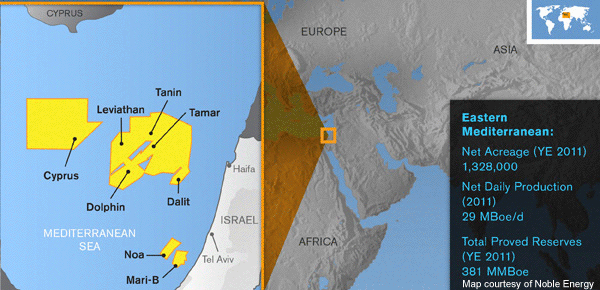
Then there is Israel’s eastern Mediterranean partner, Cyprus. In February
2013, the Israeli energy companies Delek and Avner signed an agreement to
acquire a 30 percent stake in exploration rights off the southern coast of
Cyprus. With equally large gas prospects around Cyprus, the eastern
Mediterranean basin is on the path to becoming a major player in global energy
production, and soon.
All this has not been lost of the energy giants as the Russia Gazprom deal,
which includes a commitment to build a floating LNG terminal off Cyprus, makes
clear. That hub will convert Israeli and Cypriot gas for onward transmission
to Europe or Asia.
For all its mounting gas and oil discoveries, Israel has been having
trouble in attracting the investment of the energy majors who fear the threat
of their energy investments in Arab states. But that is changing.
Recently the French energy major Total signed an exploration contract to
explore two blocks of southern Cyprus. In February, Woodside Petroleum,
Australia’s second largest oil and gas producer announced it would pay as
much as $2.3 billion for a stake in Israel’s giant Leviathan field. All of
this is highly significant as it signals a very real change in the geopolitics
of the region.
But it’s not just enormous reserves of natural gas that is set to see the
Star of David rising to global energy prominence offshore. Israel has oil too
– and a world class amount of it. Most importantly, as well as the great
potential for oil finds in its deep offshore reservoirs, Israel is set to
develop a major shale oil prospect the Shefla Basin, south-east of Jerusalem
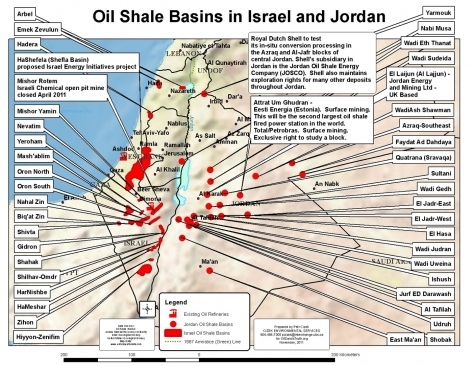
It’s where David slew Goliath. The Valley of
Elah lies thirty miles to the south-west of Jerusalem. The World Energy
Council estimates that Israel’s Shefla Basin shale oil deposits could yield
a cool 250 billion barrels. To put that in perspective, it’s a figure that
would catapult Israel into the elite with the world’s third-largest proven
oil reserves, just behind Saudi Arabia and Venezuela.
Such is the significance of the amount of oil in
the Shefla Basin that it didn’t take long for big hitting private investors,
including Jacob Rothschild and Rupert Murdoch, to take a major stake in Genie
Oil and Gas, the parent company of Israel Energy Initiatives who are running
the project.
In February, the state owned Israel Natural Gas
Lines announced that it was seeking $1 billion to fund new pipelines. Whilst
developing a vital energy infrastructure has become a priority for Israel, the
security implications are only too well understood.
But if OPEC’s members, already feeling the heat
of the US shale gas and oil revolution, feel inclined to consider military
action, it could only be in the form of utilizing proxy terrorist groups.
Anything else would mean taking on a possible grand alliance of Israel,
Russia, Greece and Cyprus. Equally, the rise of an energy-driven non-Muslim
alternative powerbase in the Middle East offers a serious counterpoint to help
offset the growing Islamist threat posed by the growing instability in North
Africa.
Neither do the ramifications of the Israeli-led
energy developments end there. Some Arab states are already breaking ranks.
The fledgling Arab state of South Sudan, which sits on top of around 80
percent of Sudan’s oil reserves, signed a new deal in January to keep Israel
supplied with oil while developing its own reserves. Jordan too is reportedly
in secret talks to buy some of Israel’s Tamar gas to power a potash plant on
the Jordanian side of the Dead Sea. The State Oil Company of Azerbijan (SOCAR)
has also turned to Israel as a “proving ground” to help its own
development as a major energy producer.
Last Autumn, the Caspian Drilling Company, a
subsidiary of SOCAR, bought a five percent stake in Israel’s small Med
Ashdod oil field. It proposes to utilize the deal to draw on growing Israeli
technical expertise.
Israeli’s reputation for high-tech expertise is
already a recognized phenomenon. As one of Israel’s oil pioneers, Tovia
Luskin, has pointed out, Israeli tech could “solve the world’s energy
crisis if red tape doesn’t tie it up”. Luskin wants to use some of the
revenue to fund a university as a global centre of excellence able to train
engineers in oil exploration and energy management. Until the bureaucratic
issues – how much does the Government take in revenues – are resolved in
Israel that vision remains on hold however. But the point is nevertheless well
made: Israel is in prime position to give a lead in a new era of Middle East
energy developments.
Even so, the impact of the coming rise of Israel
as a regional energy superpower plainly heralds significant and imminent
changes in the Middle East, and beyond. First, for the fast-diminishing
tyranny that is OPEC. Second, in the geopolitical re-alignment the new eastern
Mediterranean energy alliance represents. Third, the literal shift of power
away from the world’s oil and gas ‘tyrannies’ that the new energy
realities – including Israel’s rise to energy superpower status –
represent for the democratic world.
Peter C Glover is co-author of the
bestselling Energy
and Climate Wars and is a contributing editor at The Commentator. For
more: www.petercglover.com
http://www.thecommentator.com/article/3168/israel_the_coming_energy_superpower
The truth about Israel and Palestine
Thursday,
February 3, 2011
“Do the Jews even have a right to be in the Middle East at all?
Wasn’t there a group of indigenous people called the Palestinians, living
there since the beginning of measured history? Didn’t Jews arrive after
World War Two and conquer land that did not belong to them?”
This is utterly and completely false! The Jews lived in that land since
the time of Moses and despite some upsets from the Syrians and Babylonians,
remained in the land for some two thousand years until the Romans displaced
them. Prince Titus destroyed the temple in 70 AD. Then in the second century,
Emperor Hadrian crushed a new Jewish rebellion. This time, many of the Jews
were banished and others were made slaves of the Romans. A small number of
Jews did stay in the land and remained there right up through the twentieth
century. However, the name of the land at this time was changed because
Hadrian wanted to destroy Jewish identity. He renamed the land
“Syria-Palestinian.” Palestine was a Latin version of the word Philistine,
an ancient enemy of the Jews who were now extinct as a people. Hadrian was
deliberately insulting the Jews. There has never been a country called
Palestine. This was a nickname for the Holy Land under the Romans. The people
who today call themselves Palestinians are Arabs and they referred to themselves
as Arabs for centuries until they were dubbed “Palestinians” as a
publicity ploy by the terrorist and founder of the PLO, Yassir Arafat, who
himself did not use the title “Palestinian” until after the year 1964.
“Even if this is true, well then, OK. These Arabs lived in the land
for centuries.”
In ancient times Arabs could be found in many places but they did not
occupy the Holy Land in any significant number until after the time of
Mohammad and the spread of Islam. Muslims conquered the land from the
Byzantine Church (remnants of the converted, Roman Empire) Through the years,
with Crusades and other wars, the land switched ownership back and forth
between the Catholic Church and the Muslims. Eventually it fell into the hands
of another Muslim empire, the Ottomans. After defeating the Ottomans in World
War One, the Middle East found itself under the domain of Great Britain.
Even though the Middle East became a prize of the British Empire,
England had neither the desire nor ability to run that region of the world
forever. For this reason, they began working to create a series of new states
in which the Arabs (who had helped them defeat the Ottoman Empire) could
administer their own affairs. Although the term “Arabia” was already a
general description for a large part of this area, many of the Middle East
countries we know of today did not officially become independent nations until
the British occupation and subsequent withdrawal from this turbulent region of
the world.
While working to create new, multiple states, Great Britain (with the
cooperation of the League of Nations, an early proto-type of the United
Nations) decided they would also offer an opportunity for Jews all over the
world to return to their homeland. This invitation was called the Balfour
Declaration. Needless to say, grateful Jews responded with terrific
enthusiasm. Indeed, many children of Abraham did migrate from Russia, Western
Europe, and other corners of the globe where they had lived for some two
thousand years in ghettos at the mercy of pogroms or harsh policies of
Ant-Semitic governments. A homeland of their own had been a hopeful vision to
the Jews for two millennia. The most familiar Jewish toast (common at Passover
celebrations) said “Next year in Jerusalem.” But few thought they were
reciting much more than a pipe dream. Now they could really, truly return to
Jerusalem! Just imagine how this must have felt! The Jews were going to
sojourn to a country of their own, and not just any country; the very land of
their ancestors, a land where a remnant of Jews had remained since ancient
times, living side by side with Muslims and Christians who also had interests
in Palestine and who viewed it as their Holy Land too.
"What exactly was offered to the Hebrew immigrants by the League of
Nations?"
Everything we would today call Israel, everything we would
today call Jordan and most of what we would today call “the
occupied territories.”
When the Jews arrived, many of them purchased land from Arab lords. In
time, a terrain that had been little more than a desolate, flee bitten
combination of swamp and desert, swiftly turned green with farmland and
transplanted trees. The economy also boomed, transforming this area in
such an amazing way, that the term metamorphoses barely does justice.
New jobs were created, resulting in an influx of Arabs from other regions who
now saw Palestine as a land of opportunity and employment made possible by
Jewish farmers and businessmen recently arrived from Europe.
"What was the proportion of Arab and Jew in Palestine prior to the
Balfour Declaration? "
More Arabs than Jews inhabited the land at this time (resulting from
previous Muslim expansion) but the truth is, there was really only a handful
of each people group, because again, the swamp like conditions limited the
kind of life one could realistically enjoy in the Holy Land. The famous
author, Mark Twain wrote as much after his own personal visit. He was
surprised how desolate the Holy Land looked, how little was going on there and
how few people inhabited the area.
All of this changed when the League of Nations invited Jews to resettle
their ancient home. Ironically, it was after Jewish business created
a surplus of jobs that Arabs flooded into the territory in mass, creating a
situation where the Arabs greatly outnumbered the Jews.
In paradoxical fashion, the British, after inviting the Jews to return,
sold over 75 percent of Palestine to the Arabs, creating a new country called,
Trans-Jordan. This is an extremely important and seldom taught fact.
Please catch this: 75 percent of what had been offered to the Jews
was sold behind their backs to the Arabs instead! Not only were the Arabs
offered a “separate Palestinian state,” long ago, but they have been
living in one since the early part of the Twentieth Century. It’s called Jordan,
a country three times the size of what remained for the Jews.
The Jews accepted this betrayal, only because they had no choice. After,
all a sliver of the promise was better than no land at all.
But the Arabs didn’t want the Jews to have even a sliver and fresh
controversy broke out over what to do with the remaining 25 percent.
To appease the Arabs, the United Nations voted to divvy up the remaining
25 percent between the Jews and the Arabs. The Jews accepted this partition.
The Arabs did not.
After the partition vote from the United Nations, Israel declared its
Independence on May 14, 1948. One day later, five Arab armies invaded Israel
from Egypt, Tran Jordan, Syria, Lebanon, and Iraq.
Important Note: This war had nothing to do with allowing a two state
solution. Indeed, the Arabs waged war because they were rejecting a two state
solution. Their stated goal was the complete extermination of Israel!
From Abid Saud King of Saudi Arabia 1947:
“ There are fifty million Arabs. What does it matter if we
lose ten million people to kill all of the Jews. The price is worth
it.”
From Azam Pasha, Secretary General of the Arabs League 1947:
“This will be a war of extermination and momentous massacre, which
will be spoken of like the Mongolian Massacres.”
From Haj Amin El Hussein Mufti of Jerusalem 1947
“ I declare a holy war my Moslem brothers. Murder the Jews!
Murder them all!”
Jews pleaded with Palestinian Arabs to remain in their homes.
Although many of the Arabs did flee or join the invading armies, a
considerable portion of Arabs remained in Israel. This interesting fact
is seldom discussed. About 300,000 Arabs fled Israel and about 160,000
remained. Today Israel still contains a vital Arab population and these Arabs
have more rights in Israel than any other Arab in any Arab country! In fact,
shortly before Yassir Arafat’s death, when there was talk (once again) under
the Bush administration, of a “separate Palestinian state” the Arab
citizens in Israel were asked if they wanted to move, renouncing their Israeli
citizenship, and live in the Palestine sector. Guess what they decided!
Some of them probably fell on the floor laughing before saying to the Israeli
government, “Oh, I’m sorry. You were serious.”
In 1948, when Israel beat the odds and defeated five invading nations,
the problem of refugees came up. We always hear about the Arab refugees
from Israel. But they were not the only refugees. Hundreds of thousands
of Jews were kicked out of Arab lands too. All of the Jewish refugees were
welcomed into Israel where as Arabs who wanted to resettle in Arab countries
were (for the most part) denied admission. Jordan was an exception but
even in Jordan most of the refugees were confined to camps. They lived in that
condition all the way up to 1967, when Israel annexed Jordan’s West Bank.
Prior to 1967 there was no significant ongoing discussion amongst the
countries of the world regarding Jordan’s treatment of the “poor
Palestinians.”
On December 11, 1948, the United Nations drafted and ratified Resolution
194. This was a call for the Arab states and Israel to resolve the
refugee/resettlement issues but the condition was that all returning citizens
would agree to live in peace. Receiving no such guarantee from the Arabs,
Israel decided to postpone repatriation until her neighbors would recognize
her right to exist.
In 1967, 9 different nations (Egypt, Jordan, Syria, Lebanon, Algeria,
Kuwait, Sudan, Saudi Arabia, and Iraq), declared war on Israel and promised to
exterminate every Jew.
“Egypt is ready to plunge into a total war that will be the end of
Israel” (Radio Cairo, May 17, 1967).
Surprising the world with a preemptive strike, Israel defeated the Arabs
in just six days. At that time, their territory was expanded to the West Bank,
The Golan Heights, The Gaza Strip, the Sinai, and the remainder of Jerusalem
(half of which had been taken over by Jordan after the 1947 war.) This
territory is frequently referred to as a part of Israel’s “illegal
occupation.” I tend to hate that term and I argue against it for the
following reasons:
1) When we think of occupying countries, what usually comes to mind is
an aggressive empire seeking to conquer and expand, not a tiny little nation
that expanded its borders only as a means of survival, to prevent her
untrustworthy neighbors from attacking again.
2) Most of this land had been legally offered to Israel in the Balfour
Declaration anyway, before Great Britain sold it behind Israel’s back.
3) Historically, the land had been the home of the Jews for literally
thousands of years.
4) The United Nations has become so corrupt, I no longer accept their
standard as to what is legal or illegal.
This is not to say that Israel has not given back land or made peace
treaties. The Sinai has been returned and other territories have been slowly
transferred to the Palestinian authorites. But, when two nations make a peace
treaty, there is supposed to be give and take on both sides. Israel’s deal
(brokered by the U.S) always goes like this. “You give the Palestinians back
some land and here is what they will do: They’ll promise to stop
killing you.” That’s the deal. Then, shortly after the deal, the
promise is broken and missiles are fired into Israel from Gaza (where the
Palestinians were finally offered their own autonomous rule) or a suicide
bomber kills women and children on a bus.
Let me be as straight with my readers as I possibly can. Nothing
Israel does, no gesture, no concession, no discussion, will make a hill of
beans of difference. They can sign a peace treaty. They can jump on board for
a two state solution. It doesn’t matter. Hezbolah wants Israel dead.
Al-Qaeda wants Israel dead. Hamas wants Israel dead. But it isn’t limited to
the terrorist groups. Muslim Brotherhood wants Israel dead. Palestine
itself wants Israel dead. The surrounding Arab nations want Israel dead. The
Persian nation of Iran wants Israel dead.
My advice to Israel: Just do what you have to do. Do what you need to
do. Do what is right. The world will hate you no matter what action you take
and the Arabs will try to kill you no matter how much flowery talk you
participate in with our State Department. You may as well just do
what’s right.
Bibliography
1) Middle East Conflict by Mitchell G. Bard, Ph.D
2) Philistine, by Ramon Bennett.
NOTE: For a fuller, lengthier, documented look at the history of the
Jews and the Palestinians, just clink into the link below and read a 12 part
series by Bob Siegel:
The
Truth About Israel And Palestine
http://communities.washingtontimes.com/neighborhood/forbidden-table-talk/2011/feb/3/
rare-history-lesson-truth-about-israel-and-palesti/
Palestinian Terrorism
Palestinian terrorism has a decades-long pedigree that far predates
Israel's nationhood. In 1929,
Haj Amin al Husseini—the grand Mufti of Jerusalem and the official leader of
the Palestinian people—ordered his followers to murder hundreds of elderly
Jews in Hebron and other cities and towns where Jews had lived for millennia.
During World War II,
Husseini moved to Berlin where he met with Adolf Hitler and Adolf Eichmann. At
Eichmann's trial for war crimes in 1961, it came out that Husseini had
personally prevented nearly 1,000 Hungarian-Jewish children from being sent to
neutral countries. Instead he insisted that they be sent to Auschwitz, where
they died.
In 1948, Palestinians
refused to accept the compromise two-state solution proposed by the U.N., and
instead they engaged in the Arab states' genocidal war in which 1% of Israel's
population, including many civilians, were killed.
In 1968, a Jordanian-born
Palestinian, Sirhan Sirhan, educated to hate anything associated with Jews or
Israel, assassinated New York Sen. and presidential candidate Robert Kennedy.
Five years later, Palestine Liberation Organization head Yasser Arafat
arranged to have three American diplomats kidnapped and offered in exchange
for Kennedy's assassin. When the U.S. refused to release Sirhan, Arafat
personally ordered the torture and murder of the Americans.
In 1972, Arafat ordered
the terrorist attack on the Olympics in which several Israeli athletes and
coaches were murdered. There followed decades of airplane hijackings,
synagogue bombings and other attacks that attracted the attention of the
world. These attacks continue, the most recent being this week's killing of
Egyptian soldiers near the border with Israel, apparently carried out with the
complicity of Palestinian terrorists from Gaza.
Israel left Gaza in 2005
unilaterally, without a deal or agreement. It left behind farming and other
equipment in the hope that the Palestinians would use their new-found autonomy
to build a prosperous homeland that could live side-by-side in peace with
Israel. Hamas exploited this autonomy to conduct a violent coup, followed by
repeated rocket attacks against Israeli civilians. http://www.gatestoneinstitute.org/3342/terrorism-palestinian-statehood
9/11/12
JERUSALEM
July 27, 2012 at 4:30 am
http://www.gatestoneinstitute.org/3212/bbc-olympics-israel
Politics and religion have
always been intertwined in Jerusalem, a city that bears the weight of a
history that started about 3000 years ago. David became the king of Judea
around 1010 B.C.; he unified the Israelite tribes, and established Jerusalem
as his capital in the City of David. In 964 B.C., during the reign of David's
son, Solomon, the Israelites built a Temple to establish a physical expression
of their religion in the city they considered sacred. Jerusalem thus became
both the political capital and the religious capital: the Holy Place for Jews.
Although Jerusalem was
captured again and again by invading armies, the Jewish people maintained its
identity until the Second Temple was finally destroyed in 70 A.D.
After a revolt led by Bar
Kokba in 132 A.D. against the Roman Empire, and his creation of a State of
Israel, the Romans made a determined effort to "dejudaize" the area.
They renamed the area of Israel Syria Palaestina. and the city of
Jerusalem became Aelia Capitolina.
In 135 A.D., Jews were banned
from the city. Since then, their liturgy, every day, has repeated their
yearning for a return to the Temple and to Jerusalem.
The First Temple was destroyed
in 586 B.C. during the Babylonian invasion, which led to the exile of many
Jews, whom King Cyrus of Persia allowed to return only in 539. Immediately,
they began building the Second Temple in their sacred city, an edifice that
became the political symbol of a Jewish state.
Two other religions,
Christianity and Islam, also established a presence in Jerusalem. Even though
it was the place where Jesus was crucified, the city only became holy for
Christians in the 4th century A.D, after the Emperor Constantine
and his mother, Helen, converted to Christianity and, in 326 A.D., ordered the
building of the Basilica of Saint-Sepulcre, which has become for many
Christians the most important destination for pilgrimages. It was with
Constantine that the city once again became Jerusalem.
Muslims, commemorating the
Prophet's experience in the city about which there are different versions,
began building there in 638 A.D, on the Temple Mount, the Dome of the Rock.
Although this is not a mosque, the Al-Aqsa mosque has been built close to it.
Mecca and Medina are the two important Holy Places for Muslims; only in recent
years have some Muslims regarded Jerusalem as a third Holy Place.
For many years especially
during the Abbasid Caliphate starting in the 8th century, Jerusalem
had little significance for Muslims. After a brief period of rule by the
Christian Crusaders, started by Geoffrey of Bouillion in 1099 after repelling
Muslim invaders, the city was retaken by Saladin in 1187 and remained under
various kinds of Islamic control until the end of the Ottoman Empire after
World War I.
Political rivalries over the
Middle East have always existed among the great powers. With the demise of the
Ottoman Empire, the Holy Places became rallying points for both Zionists and
Arab nationalists. Political passions were shown at both the Western Wall and
at the Dome of the Rock. But, after Britain was given the League of Nations
Mandate for Palestine in 1920 at the San Remo conference, it established
Jerusalem as the capital of the British Mandate in 1922.
The decisive proposal for
settlement of the Arab-Israel conflict was the UN General Assembly Resolution
181 of November 29, 1947, which partitioned the entire area between Jews and
Arabs, with Jerusalem as a corpus separatum [separate body] under a
special international regime, and under the administration of the United
Nations. Whether this was a feasible solution or not was never tested: the
armies of five Arab nations invaded the new state of Israel immediately after
it declared its birth in May, 1948.
As a result of this 1948-49
war, Jerusalem was divided by the so-called Green Line of April 1949 -- an
armistice line between Israel and Jordan where the fighting had stopped.
Between 1949 and 1967, Jordan controlled the old city, including the Jewish
quarter, and used ancient Jewish gravestone from the Mount of Olives as floors
for their latrines. Moreover, Arabs controlled the Holy Places of all three
religions,
West Jerusalem was officially
declared the capital of Israel; in January 1950. the Israeli Parliament,
called the Knesset, moved to Jerusalem.
During the Six Day War in June
1967, after Jordan invaded Israel on the fifth day of the war, despite
warnings from Israel not to, Israeli paratroopers landed in east Jerusalem,
which remains in Israeli hands. Although the area was not annexed, on July 27,
1967, Israeli law and jurisdiction were extended to east Jerusalem and to a
few miles of the West Bank. On July 30, 1980, a fundamental law adopted by the
Knesset declared that, "Jerusalem complete and unified is the capital of
Israel." It is the seat of the President of the state, the Knesset, the
government, and the Supreme Court.
Two Faces: Israel’s Prime Ministers
Two former Prime Ministers of Israel are in the news
these days. They represent two of the many faces of Israel.
They also raise a universal question: which is preferable – an honest
fanatic or a corrupt pragmatist?
Yitzhak Shamir died two weeks ago and was buried in the
cemetery of the “Great of the Nation” in Jerusalem. He was 97 years old
and had been vegetating for years in a state of dementia. Most Israelis did
not know that he was still alive.
When I described him on TV as “the most successful
terrorist of the 20th century”, the interviewer raised his eyebrows. But
it was an accurate description.
Shamir was not a great thinker. In his teens he joined
the right-wing Zionist youth organization of Vladimir Jabotinsky in Poland,
and since then he did not change his world-view one iota. In this respect he
was absolutely immovable. He wanted a Jewish state in all of the historical
country. Period. No nonsense about Arabs and such.
We both joined the Irgun underground at the same time.
I was too young to take part in actual terrorist actions, he, eight years my
senior, carried them out. At the time, the Irgun killed scores of Arab men,
women and children in attacks on Arab markets, in retaliation for Arab
attacks on Jewish civilians. We defied the policy of “self-restraint”
ordered by the Zionist leadership.
In the summer of 1940 the Irgun split. One of the
commanders, Avraham Stern, founded the organization known to the British as
the “Stern Gang”. (Eventually it was called LEHI, acronym for Fighters
for the Freedom of Israel.)
Stern was a logical person. The aim was to set up a
Jewish state in all of Palestine. The enemy was the British Empire. The
enemy of my enemy is my friend. Therefore we must cooperate with the Nazis.
He sent several emissaries to contact the Germans. Some were intercepted by
the British, the others were ignored by the Nazis.
I could not accept this atrocious logic and did not
join, though the temptation was there. Shamir did.
He was caught and imprisoned (unlike Stern himself, who
was caught and shot on the spot). Within a short time, virtually all the
members of the organization were killed or arrested. The group ceased to
exist – until Shamir and a colleague, Eliahu Giladi, broke out. The two
acted together and brought LEHI to life again. One day Shamir had Giladi
tried and shot.
Giladi was not accused of treason, but, on the contrary
– of excessive zeal. He made plans for revolutionary actions, such as
killing David Ben-Gurion and the entire Zionist leadership. Shamir decided
that his adventurous nature endangered the organization and that he must be
removed. Afterwards Shamir named his daughter Gilada.
Many years later I asked him which historical
personality he admired most. He answered without hesitation: Lenin. I
understood that he admired him because Lenin ruthlessly followed the maxim
“the end justifies the means”.
Shamir was one of LEHI’s three leaders. He was
responsible for operations and organization, meticulously building a
deliberately small group of selected individuals, executing incredibly
daring actions. He himself planned every single operation in the greatest
detail. The most famous was the assassination of Lord Moyne, the senior
British functionary in the Middle East, in Cairo.
He was arrested again when the British shut down Tel
Aviv and conducted a house-to-house search. Shamir was well disguised but
could not hide his most obvious characteristic: he was very small, almost a
dwarf, with a big, strong head. The soldiers were instructed to arrest every
man below a certain height. This time he was sent to a detention camp in
Africa, from which he duly escaped. He reached French Djibouti, was brought
by a French warship to Paris where he stayed until Israel came into being.
LEHI never amounted to more than a few hundred members. But it played a
major role in driving the British out of this country.
In Israel, Shamir disappeared from view. For years he
worked for the Mossad. It was rumored that his speciality was sending letter
bombs. When he resurfaced, he joined the party of his erstwhile competitor,
Menachem Begin. He was appointed Knesset chairman. Once I decided to stage a
small demonstration in the Knesset. I wore under my jacket a t-shirt saying
“Peace is better than a Greater Israel”. During the plenary session I
took the jacket off. After some minutes of shock, an usher asked me politely
to see the chairman in his office. Shamir received me with a big smile and
said: “Uri, where would we be if every member did something like that? Now
that you have made your point, would you please put your jacket on again?”
Which I did, of course.
When Begin made peace with Egypt and even I voted for
him, Shamir abstained. After Lebanon War I, when Begin resigned saying “I
can’t go on any more”, Shamir took his place. As prime minister, his
most outstanding achievement was to do nothing, except building settlements
– quietly and unobtrusively. Under American pressure, he attended the
Madrid peace conference, determined not to budge an inch. As he remarked
later, he was quite ready to negotiate with the Arabs for any length of
time. He did not dream of making peace, which would have drawn frontiers and
barred the way to Greater Israel. His ideology was summed up by his most
famous dictum, alluding to the old adage that the Arabs want to throw the
Jews into the sea: “The Arabs are the same Arabs and the sea is the same
sea.” Another famous statement: “It is permissible to lie for the
fatherland.”
Remarkably, this man, who joined the Irgun (like me) in
protest against “self-restraint”, exercised self-restraint par
excellence when Saddam Hussein rained missiles on Israel during the Gulf
War. Shamir was content to let the Americans do the job. His other great
achievement was preventing Jews from reaching the US. When the Soviet
leadership allowed Jews to emigrate, almost all of them proceeded straight
to the US. Shamir persuaded the White House to shut the gates, and thus
compelled more than a million Russian Jews to come to Israel (where they now
swell the ranks of the extreme right.) For a short time he was the mentor of
the young Binyamin Netanyahu, but then he came to detest him. After
Netanyahu made a small tactical concession to the Arabs, he called him
“Angel of Destruction”. One may assume that he was also disgusted by
Netanyahu’s penchant for luxury.
When not lying for the fatherland, Shamir was straight
as a ramrod, living in utmost modesty. There never was – or could be –
even the slightest hint of corruption. Which leads us straight to Ehud
Olmert.
Once upon a time there was a Minister of Education,
Zalman Aran, who was known for his dry humor. A party functionary once came
up to him and said: “Ziama, you can congratulate me. I have been
acquitted!” “Strange,” Aran replied, “I have never been
acquitted!”
Olmert has been acquitted many times. During his entire
career, he has danced from one acquittal to the next. This week it happened
again. After a long trial, in which he was accused on five different counts
of corruption, he was acquitted of four. One concerned his habit of letting
himself be invited by several charity organizations to lecture in the US,
and letting all of them pay separately for the same first class ticket
(using the surplus for his family’s private outings.) Another count:
reporting to the State Comptroller that his collection of expensive pens was
worth a tenth of its real value. The district court decided to acquit him on
all counts for lack of proof, except one: that as Minister of Industry he
had favored the clients of his close friend, who obliged him by keeping a
large amount of cash stashed away in his safe. Olmert celebrated his partial
acquittal as a great victory. The media – the same media which celebrated
his indictment when it all started – are taking part in the celebration.
He is still awaiting the outcome of an even bigger trial. The accusation,
this time: taking bribes for the building of a huge multi-billion
architectural monster in the center of Jerusalem when he was mayor of the
city. Everybody expects that he will be acquitted, as usual. Among the
outcries against the Attorney General in the media was the accusation that
he, a mere civil servant, had toppled an incumbent Prime Minister on
trumped-up charges. Worse, that he had done so just when Olmert was about to
make peace with the Palestinians. Nonsense. In his years in the Prime
Minister’s office, during which he initiated two dirty wars (Lebanon War
II and Operation “Cast Lead”), he had plenty of time to make peace. He
did indeed produce a peace plan – but only on the eve of his expected
political demise. With peacemakers like this, who needs warmongers? However,
Olmert is already hinting that after his next acquittal he will return to
political life.
Shamir, the dead honest fanatic, has many followers.
Olmert, the living corrupt pragmatist, has very few. Netanyahu, their
current successor, has the vices of both and the virtues of neither.
Canada:
Anti-Semitic Church Attack on Israel
by Christine
Williams
June 22, 2012 at 5:00 am
http://www.gatestoneinstitute.org/3126/canada-united-church-israel
The United Church of Canada has released the
26 page report
of its Working Group on Israel/Palestine Policy, which the church will
consider introducing as policy when the denomination's 41st General Council
convenes in Ottawa August 11-18. The Working Group indicates that its
recommendations were put forth in search of truth, justice and reconciliation
when in fact it does little or nothing of the sort. It refers to Israel as the
"thief," the "occupier," and the "oppressor,"
and compares Israeli policies to those of South Africa under apartheid, and
more shockingly to Sudan, despite the fact that people from Africa risk their
lives to get to Israel to escape the Islamist apartheid rampant throughout
African countries such as Sudan, South Sudan and Nigeria, to name but a few.
While acknowledging Israel's right to exist,
this biased and scathing report against Israel calls for "Christian
economic action" against it, and points out that Canada does not
recognize permanent Israeli control over territories occupied in 1967.
Nevertheless it omits that these territories -- under dispute -- were taken by
Israel in a defensive war, the second that united Arab countries had
initiated against it since Israel's founding in 1948. It is difficult to
imagine a view advanced by the United Church working group, along with the
automatic majority of autocracies in the United Nations, that countries which
start wars and then lose them should be rewarded. The Group also omits that
Canada is the greatest friend to Israel and that it opposes anti-Israel
labels, as well as attempts to exterminate Israel economically by means of
divestment, boycotts and sanctions [BDS].
Canada's Foreign Affairs Minister John
Baird recognized immediately what this working group failed to recognize:
he stated in May that "the world cannot take the words of Hamas,
Hezbollah and Iran as mere rhetoric and risk appeasing these malicious actors
in the same way the world appeased the Nazis.… Under our prime minister, and
under this foreign minister, Canada will stand with the Jewish state and
people as they struggle to protect their very right to exist."
The three-member working group exerts a
feeble attempt to justify the contents of its report by stating that
anti-Semitism does not entail calling Israel into so-called accountability. In
addressing the report's repeated referral to Israel as the
"occupier," the so-called "occupation" must be understood
through the lens of the historic 1967 six day war of which an inevitable
preventative strike by Israel against the nations of Syria, Egypt, Jordan and
Iraq occurred as these nations were preparing for a united attack upon the
Jewish State.
The Syrian Defense Minister, Hafez Assad, and
President Abdur Rahman Aref of Iraq had both
declared that it was time to wipe out Israel's existence (reminiscent of
Iran today), and Egypt -- preparing for war -- had illegally closed off the
Gulf of Aqaba in preparation for attack. In response, Israel launched a
preventative strike and won the strategic territories of the Gaza
Strip, the Sinai
Peninsula (Egypt), the West
Bank and East
Jerusalem (from Jordan), and the Golan
Heights (from Syria) – all land which it is accused today of
"occupying," even after giving back to Egypt 100% of its land in
exchange for a peace treaty that as of this writing might be in danger of
being abrogated by Egypt.
Israel's having taken this land in war was
not from greed, but for Israel's strategic survival against mortal enemies
that sought its destruction. With this in mind, it is worth remembering that
nearly every state has achieved its current existence as a result of wars,
most from greed. Our continent is no exception. According to the criteria of
the stone-throwers against Israel, we too are "occupiers" on native
lands, which includes the three-member United Church working group, who, being
themselves "occupiers," have their own Christian "sins" to
contend with.
Another historic event alluded to by the
working group is the war that broke out when the British withdrew from the
Palestinian region in 1948. The
British Response to Jewish immigration in fact set a precedent of
appeasing the Arabs – a practice followed for the duration of the Mandate
for Palestine. The British placed restrictions on Jewish immigration while
allowing Arabs freely to enter the country. As the British withdrew from the
region in May 1948, Israel was attacked immediately (the next day) by five
surrounding Arab nations. While acknowledging the attack on Israel, the
working group report nevertheless emphasizes the Palestinian refugees created
by this war, while leaving out the fact that Palestinian Arabs continued to
refuse to recognize Israel, and instead began launching terrorist attacks from
the Palestinian Arab community that became increasingly organized and
dangerous through the course of time with the creation of the Palestinian
Liberation Organization of which Yasser Arafat would eventually become
Chairman. The Palestinian Authority in its revised charter still calls for the
elimination of Israel, by stating that the revised charter incorporates
everything in the previous version.
As the Working Group zeroes in on Palestinian
victimhood, the exponentially growing number of Palestinian refugees each year
is, in fact, a
calculated scam -- one that is costing Western nations tens of billions of
dollars per year in mandatory "donations." The number of refugees is
projected to balloon to 20 million in the next 50 years, and would, at that
time, include something like the great-great-great-great grandchildren of the
original refugees, who by then would long since have died. By that token, is
everyone in Greece now a refugee from the Peleponnesian
War?
Although there are indeed poverty stricken
areas in the Palestinian territories -- and often shocking discrimination
against the Palestinians in (and by) their Arab host countries -- according to
the Palestinian Central Bureau of Statistics, GDP growth in the Palestinian
Territory of the West Bank was astronomically high at 9.9% in 2011, and the
Gaza strip a staggering 23%. Ironically, the Palestinian Territories are, at
this moment, enjoying greater growth than the North American taxpayers who are
funding them.
The most basic problem at the root of the
Palestinian-Israeli issue is not the so-called "occupation," as
stipulated by this working group, but the refusal by Hamas and the Palestinian
Authority to recognize Israel's right to exist, and the murderous
hatred expressed by these leaders against the state of Israel and the
Jewish people.
Even as Egypt was preparing itself for a
runoff election, Hamas leader Ghazi Hamad said a win by Muslim Brotherhood
candidate Mohammed Morsi would be a boon to Palestinians, ending the frosty
relationship between Hamas and Egypt. Hamad
added that no one in Hamas supports recognizing Israel as a nation.
While the United Church Working Group
acknowledges Israel's right to exist, it does so only in lip service, without
taking into consideration Israel's need to protect itself. Israel has long
faced threats of suicide
bombers seeking to inflict as much injury as possible on victims, as well
as trying unsuccessfully to cripple them with fear. The Working Group's
objectives do not even take into account the Jihadist call to war against
Israel , and children being taught in Palestinian
schools to hate and kill Jews. This hatred has nothing to do with the
so-called "occupation," as Palestinian children are indoctrinated to
believe, but is instead fuelled by Israel having a different ideology of true
Democracy and Human Rights in a region where most leaders are hostile to both.
Israel is not an Islamic caliphate and herein lies the problem. The the
Grand Mufti of Jerusalem, Haj Amin al-Husseini, worked hand in hand with
Hitler during World War II and during the Holocaust to destroy the Jewish
people simply because they were Jewish. Al-Husseini blocked attempts to rescue
thousands of Jewish children from several countries under German control,
effectively sentencing them to death. Few know that Yasser Arafat was a blood
relative of the Grand Mufti; and that Arafat's his real name was Mohammed
Yasser Abdel Rahman Abdel Raouf Arafat al-Qudwa Al-Husseini. Few also know
that Arafat, whose mother was a cousin of the Grand Mufti, was a great admirer
of this work.
As this working group attacks Israel, there
are those Christians in abundance who support
Israel, understand the struggles it faces, and also recognize the plight
of the Palestinians as they are used as pawns by their own leadership to feed
an agenda of hatred against the Jews and against the West in an effort to
distract their people from the true source of their misery: the corrupt and
wretched governance at home. Israeli Prime
Minister Netanyahu has lauded such Christian support, which even includes
Mosab Yousef, the eldest son of Sheikh Hassan Yousef, a founding member of
Hamas.
Mosab Yousef, who converted to Christianity,
now exposes what is truly behind the "peace process." And speaking
of conversions, an admirable moderate Muslim in Canada refers to what happened
to a Christian convert in a Muslim regime as he discusses the
brutality in Muslim societies where a " young man is pinned to the
ground, his head is twisted and a knife held against his throat. In a few
minutes the head is severed and held up for display to the public, who are
loudly chanting, "Allahu Akbar!" ["Allah is Greatest!"].
In the video of this gruesome public execution of an apostate, the victim had
converted to Christianity from Islam."
This brutality seen in Muslim societies
brings us to a critical point outlined by the United Church working group: "holding
Israel, like any other modern democratic state, accountable for its actions is
one way civil society strengthens democracy and justice;" and, further,
that Israel should be held to a higher standard than the surrounding
non-democratic countries. This is nothing short of a highly racist statement,
implying that the surrounding "barbarians" are capable of nothing
more than savagery, so why expect anything of them or hold them accountable?
In other words, they are the brown people from whom we should expect little
more than violence and brutality. "Those Muslims" are quite capable
of being civilized and should be called to the same -- admittedly flawed but
higher -- standard as any other Western nation -- as many Muslim Reformists
are trying to do today in efforts to protect the rights of women and human
rights overall.
By contrast, in Israel, which is branded
apartheid, Arabs are allowed full voting rights; positions in Knesset;
employment rights, and for that matter, the freedom to be homosexual – the
last, in their own countries, grounds to be murdered.
While all evidence attests to Christians
having been driven out of Bethlehem by Muslims, the Working Group asserts,
in yet another misinformed allegation, that it was the "occupation"
that has driven out the Christians. The Hamas and the Palestinian Authority in
fact violated – and continue to violate -- the human rights of Christians
through beatings, intimidation, fire-bombings of their institutions, torture,
kidnapping, and sexual harassment, thus leading to their exodus from
Bethlehem: the very place honored as the birthplace of Christ.
In conclusion, the United Church working
group needs to do its homework along with some other Church groups that
condemn Israel. Israel is increasingly bullied by the OIC-dominated United
Nations, as well as surrounding enemies that have historically sought its
destruction. There are still many maps that exclude Israel, including one
which was displayed
at the U.N. and which was used to mark the commemoration of
"International Day of Solidarity with the Palestinian People" on
November 29, 2005. "The working group takes seriously questions
about why Israel is currently the only country in the world being challenged
by a global boycott, divestment, and sanctions movement (BDS)." In
asserting this, the United Church would do well to observe its own faith by
remembering that Christ, too, was ganged up against; so it is a moot argument
to inquire why Israel is being challenged by a global BDS movement -- that is
unjust and reprehensible -- as this small nation continues to fight for its
existence.
The UN
Sham Pampers The Palestinian Sham
by Guy
Millière
November 1, 2011 at 5:00 am
http://www.hudson-ny.org/2550/un-palestinian-sham
In his speech to the UN General Assembly last
month, Israel's Prime Minister, Benjamin Netanyahu, spoke of the United
Nations as the «house of lies » and the «theater of the absurd.» One
could go farther and state the whole truth: The United Nations has become a
sham.
The new United Nations Human Rights Council is
composed overwhelmingly of countries in perpetual violation of human rights,
and should more accurately be called the Council against Human Rights and
for the Promotion of Global Anti-Semitism.
The General Assembly is a place where
dictators and tyrants have an automatic majority to pass absurd motions and
obscene texts, such as the one that defines Zionism as racism, adopted in
1975, and repealed only sixteen years later with the greatest difficulty,
thanks to U.S. Ambassador John Bolton. The US veto in the UN Security
Council is the sole obstacle to the enactment of equally racist decisions.
Originally intended to foster peace on earth
and to end totalitarian regimes, the UN has become a place where Western
democracies are hostages to brutal, barbaric regimes. No one has yet even
been fired for « the biggest heist in history », over $117 billion, the
Oil-for-Food scandal of 2004, in which the UN set up a program supposedly to
provide food for impoverished Iraqis under the regime of Saddam Hussein, but
instead accepted kickbacks from the Iraqi regime while the food never
reached the people. Supposed UN peacekeepers in Africa still continue to
distribute goods to underage children in exchange for sex.
The tribune from which Benjamin Netanyahu
spoke is the same from which other world leaders also spoke. The President
of the Islamic Republic of Iran, Mahmoud Ahmadinejad, uttered genocidal
recommendations to cheers. The Prime Minister of Turkey, Recep Tayyip
Erdogan, was acclaimed as he accused Israel of using « excessive force »
against a Turkish flotilla's attempt to break a perfectly legal naval
blockade.
But, as UN recognition of a Palestinian state,
or at least an upgrade from which to continue making Israel's existence as
unpleasant as possible, was the featured act this year, Palestinian
President Mahmoud Abbas addressed the General Assembly with lies -- about
everything from who was responsible for stalling negotiations for the past
two years (the Israelis had agreed to a requested construction freeze, after
which the Palestinians still refused to come to the table until few weeks
before the deadline, and then demanded another construction freeze) -- to
who had failed to fulfill its side of the Oslo accords (the Palestinians had
agreed to stop incitement, but, among other violations since day one, never
even tried). Abbas descended from the podium to sanctimonious applause.
Western representatives walked out when
Ahmadinejad spoke, but when it was Abbas's turn, they remained. Many even
applauded. Does this mean they endorse lies? It appears they do, and that is
a shame.
Who can fail to understand that when Abbas
describes the creation of Israel in 1948 as a « Nakba » [catastrophe] for
Palestinians, he deliberately obscures the war of extermination waged
against Israel the day of its birth by five Arab nations: Egypt, Jordan,
Syria, Lebanon and Iraq?
At the time, the Western countries remained passive observers of the war,
and Israel's survival seemed a form of miracle.
Who can fail to see that when Abbas speaks of
occupation of Palestinian lands for « sixty-three years, » he is saying
the whole of Israel is an « occupied land »?
Who can fail to feel addled hearing Abbas
describe the security fence as an « annexation Wall » against
Palestinians, when everyone knows - or should know - that it was precisely
incessant terrorist attacks committed by Palestinian Arabs that forced
Israel to erect the barrier?
Who can fail to know, hearing Abbas refer to
« return of all refugees » to Israel as a condition for peace, that
Palestinian leaders -- both of the Palestine Liberation Organization and
Hamas -- have made clear both in their charters and every day on their media
as well as every outlet available [see www.pmw.org],
that their aim is to drown Jewish Israel in a stream of millions of Muslim
Arabs?
Why would anyone accept Abbas's references to
« Palestinian territories » and « Palestinian people » ? The term «
Palestinian people » is of recent coinage. The
« Palestinian people » was a term invented in the mid-1960s, when
the Egyptians and Soviets decided to market the war against Israel as a war
of « national liberation .» What was to be "liberated," it
turned out, was all of Israel, "from the [Jordan] River to the
[Mediterranean] Sea, " as Faisal al-Husseini, the Palestinian Authority
Minister for Jerusalem Affairs, put it.
There has
never been a « Palestinian territory » belonging to a « Palestinian
people, » let alone a Palestinian nation.
Palestine was an area controlled for hundreds of years by the Ottoman Empire
until it was disbanded in the 1920s. The area was then governed as the
British Mandate of Palestine until Israel was declared a state in 1948, and
Arab armies immediately went to war to try to destroy it. Between 1920 and
1948, Jews had « Palestine » stamped on their passports as their country
of origin, and were « Palestinians » every bit as much as the Arabs were.
The people who now call themselves « Palestinians » are those Arabs who
left that land when the war
started: some fled not to be in the middle of the fighting; others were told
on bullhorns to leave to make it easier to kill the Jews so the Arabs could
sooner come back.
After Israel beat back the invaders, the Arabs
who had fled from Palestine wanted to return; the Israelis refused on the
grounds that, as they had not stayed to help, they had not been loyal and
could therefore considered fifth-columnists. The Arabs who did stay, the
Israeli Arabs -- in this allegedly « apartheid » state -- still make up
about 20% of the population, over a million and a half. They have their own
political parties; their own members elected to the Israeli parliament, the
Knesset; sit on the Supreme Court; hold senior positions in the Israeli
diplomatic corps; work as physicians in the top hospitals and as professors
at the leading universities, and even serve in the Israeli army only if they
wish.
If they are not as integrated into the society as they might wish to be, it
is because they have chosen so -- not because any opportunities have been
denied them. As the late Senator Daniel Patrick Moynihan used, to say, «Everyone
is entitled to his own opinion, but not to his own set of facts .»
When Abbas returned to Ramallah from his
September trip to the UN, the slogans chanted by the crowd were clear: « A
million martyrs marching to Jerusalem! » and, « We will liberate Palestine
in blood! »; but it seems no Western diplomat heard them and drew the
undisguised conclusion.
Most Western countries – the United States
apart – have rarely conducted themselves other than disgracefully
regarding Israel, right from the beginning. The United Nations is where much
of this conduct not only takes place, but is pantingly encouraged.
When the PLO carried out waves of terror
attacks that culminated in the Munich massacre of Israeli athletes in 1972,
the Western world could see it was dealing with terrorists and murderers.
When, however, two years later, Yasser Arafat was invited to the UN, and
gave a speech as distorted as that recently given by Mahmoud Abbas, no
Western UN representative seemed to recall that Arafat was, at that time,
chief of all the terrorists and murderers who not only killed athletes in
Munich, but also, among other acts, had an elderly, wheelchair-ridden man
thrown off a boat into the sea.
When the PLO was admitted to the UN as an
observer, no representative of any Western country refused to sit alongside
the representative of this terrorist organization. When, in Madrid in 1991,
the discussions that would lead to the Oslo Accords were initiated, Western
pressure was instrumental in pushing Israel toward a « peace process,»
opening the door to the legitimization of the Palestinian Authority and a
decade of suicide bombings that killed more than 1,400 Jews. Israeli leaders
have bowed to pressure; this does not excuse those who exerted the pressure.
Meanwhile, in speech after speech, the PLO
leaders have spread a falsified version of history describing Israel as an
artificial and colonial state. After 1921, however, and the fall of the
Ottoman Empire, virtually all the states in the region -- The Republic of
Turkey, Yemen, Syria, Lebanon, Iraq, Transjordan, Saudi Arabia, and the
British Mandate of Palestine -- were born, a fact that seems to have been
forgotten. Jordan, formerly Transjordan, and now consisting 70% of
Palestinians, was created then, too, on 80% of the land of the British
Mandate that was supposed to become the Jewish national home -- another fact
that seems to have been forgotten.
At that time, what is now called the West Bank
was annexed by Jordan, and Gaza by Egypt.
If the PLO had ever spoken about a plan to "liberate" these
territories, or had called them « occupied Palestinian territories, » it
would immediately have been crushed by the Arab armies.
For many years, the PLO, founded in 1964, was
nothing more than an instrument in the Arabo-Soviet aggression against
Israel. When the Soviet Union fell in 1991, the Western world became the
PLO's major financier; while the PLO could then have disappeared, the West
did everything to save it.
It was at this point that the West gave the
PLO massive financial aid that makes the «
Palestinians » the world's most subsidized « people .»
The Palestine Liberation Organization agreed
in 1993 to Israel's right to live in peace, and accepted the UN Security
Council Resolutions 242 and 338, rejecting "violence and
terrorism." Since that moment, however, the PLO has never ceased
embodying terror, hatred, and a rabid desire to destroy Israel. It pretends
to be less radical than Hamas, but, as its own charter, which was never
rescinded, and Mahmoud Abbas's UN speech guilelessly attest, cherishes the
same goal: to exterminate Israel as a Jewish state..
Israeli leaders are constantly badgered to
reach out to adversaries who will never sign a peace agreement, not only
because they are at war, but because they are committed to wage the war
until, they hope, Israel is wiped off the map, just as it is in all of their
maps [www.pmw.org].
The United Nations, meanwhile, not only has
never even attempted to enforce its own resolutions, but has been
enthusiastically working with the PLO to subvert them. If the UN, or the
Quartet, or anyone now accepts the unilateral creation of a "judenrein"
[cleansed of Jews: in other words, really apartheid] ], anti-Semitic,
Palestinian state that still calls for annihilation of Israel, it would be a
pitiful surrender, as well as a negation of all the values that both the UN
and the West claim to embody.
Although the American position makes creating
a Palestinian state impossible at this time, no doubt the pressure on Israel
will continue on, as always.
Which leaders in the West, seized by an onset
of moral dignity, will have the courage to affirm that just as the UN has
become a sham, the « Palestinian cause » is itself just a sham? The
problem could be solved overnight if the Arabs cared as much about their
people as the Jews do about theirs. In 1948, 800 000 Jews were expelled from
Arab lands and arrived in Israel, while at the same time around 700 000
Arabs left Israel for Arab lands. The Jews took in every one of their
people; the Arabs, instead, preferred to consign their « brothers » to
squalid refugee camps, and let the West pick up the bill.
To maintain the current situation may seem to
be the lesser evil, but is not a solution. It might be an worthwhile idea to
ask Western countries to suspend funding the Palestinian Authority if it
continues to ask for a State, as the Foreign Affairs Committee of the US
Congress recently discussed.
Western countries might be asked to suspend
funding any branch of the UN that promotes the unilateral creation of a
Palestinian State, as the Foreign Affairs Committee of the US Congress also
recently discussed.
Western countries might also be asked to set
strict conditions for continued funding, and to refuse to pay if
anti-Semitic propaganda and the glorification of terrorism continue to
appear in Palestinian media and classrooms, or there is no doubt that
anti-Semitic propaganda and glorification of terrorism will never disappear.
The territories conquered by Israel in the
defensive war of 1967 are not occupied territories; they are disputed
territories. Should Israel seriously be expected to hold them in perpetuity
for countries that repeatedly wage war on it until such a time as perhaps
its militant neighbors might feel like reclaiming them?
As a country constantly threatened and
regularly attacked by its neighbors, Israel's right to set its borders in
accordance with its security requirements and apply Israeli law within the
resulting area, should be recognized. The Palestinian Authority, especially
if it links up with Hamas, is a rogue entity and should be treated as such.
The status of the Arab population in Judea and
Samaria will have to be resolved from there. Pre-1967, these Arabs had the
same status as Palestinian Arabs in Jordan. They are fundamentally one and
the same population. Palestinian Arabs constitute the vast majority of
Jordan's population, The Arabs living in Judea and Samaria are the same
people as Palestinian Arabs living in Jordan -- where millions more
Palestinian Arabs live than in Judea and Samaria -- although they have been
dispossessed of their rights. They should recover them. Jordan is a
Palestinian state already. As Muhdar Zaran recently wrote, « It is not
certain that King Abdullah's regime will be able to survive a revolt from
the frustrated and angry Palestinian majority, should one take place.» He
added, « It might be time to start at least considering a Plan B for
Jordan.». I would add: It might be time to consider a Plan B for
Palestinian Arabs.
At present the Middle East is a zone of
turbulence and extreme Islamist agitation. Nobody in the area cares about
the « Palestinian cause » except as a pretext for whipping up hatred
toward Israel. What really should concern Western leaders today is Islamist
imperialism and the deeper meaning of the hatred of Israel.
Appeasement and cowardice will not decrease
Islamist agitation. No one ever won a confrontation by abandoning the
battlefield to the enemy.To abandon Israel would not be without far-reaching
consequences, resulting in yet another Islamist terrorist State based on
heavy Islamist supremacy, malicious lies and anti-Western racism.
The United
Nations Should Not Recognize an Apartheid, Judenrein, Islamic Palestine
by Alan
M. Dershowitz
September 21, 2011 at 11:30 am
http://www.hudson-ny.org/2442/united-nations-palestine
The draft constitution for the new state of
Palestine declares that "
Islam
is the official religion in Palestine."
It also states that Sharia
Law
will be "the major source of legislation." It is ironic that the
same Palestinian leadership which supports these concepts for Palestine
refuses to acknowledge that Israel is the nation state of the Jewish people.
Israel, in contrast to the proposed Palestinian state, does not have an
official state religion. Although it is a Jewish state, that description is
not a religious one but rather a national one. It accords equal rights to
Islam, Christianity and all other religions, as well as to atheists and
agnostics. Indeed, a very high proportion of Israelis describe themselves as
secular.
The new Palestinian state would
prohibit
any Jews
from being citizens, from owning land or from
even living in the Muslim state of Palestine.
The Ambassador of the PLO to the United States was asked during an interview
whether "any Jew who is inside the borders of Palestine will have to
leave?" His answer: "Absolutely!" After much criticism, the
Ambassador tried to spin his statement, saying that it applied only to Jews
"who are amid the occupation." Whatever that means, one thing is
clear: large numbers of Jews will not be welcome to remain in Islamic
Palestine as equal citizens. In contrast, Israel has more than 1 million Arab
citizens, most of whom are Muslims. They are equal under the law, except that
they need not serve in the Israeli army.
The new Palestine will have the very
"law of return" that it demands that Israel should give up. All
Palestinians, no matter where they live and regardless of whether they have
ever set foot in Palestine, will be welcome to the new state, while a Jew
whose family has lived in Hebron for thousands of years will be excluded.
To summarize, the new Palestinian state will
be a genuine apartheid state. It will practice religious and ethnic
discrimination, it will have one official religion and it will base its laws
on the precepts of one religion. Imagine what the status of gays will be under
Sharia law!
Palestinian leadership accuses Israel of
having roads that are limited only to Jews. This is entirely false: a small
number of roads on the West Bank are restricted to Israelis, but they are
equally open to Israeli Jews, Muslims and Christians alike. The entire state
of Palestine will have a "no Jews allowed" sign on it.
It is noteworthy that the very people who
complain most loudly about Israel's law of return and about its character as
the nation state of the Jewish people, are silent when it comes to the new
Palestinian state. Is it that these people expect more of Jews than they do of
Muslims? If so, is that not a form of racism?
What would the borders of a Palestinian state
look like if the Palestinians got their way without the need to negotiate with
Israel? The Palestinians would get, as a starting point, all of the land
previously occupied by Jordan prior to the 1967 War, in which Jordan attacked
Israel. This return to the status quo that led to the 6 Day War is
inconsistent with the intention of Security Council Resolution 242, which
contemplated some territorial changes.
The new boundaries of this
Palestinian
state would include Judaism's holiest place, the Western Wall.
It would also include the access
roads to Hebrew University,
which Jordan used to close down this great institution of learning founded by
the Jews nearly 100 years ago. The new Palestinian state would also
incorporate the
Jewish Quarter of Jerusalem,
in which Jews have lived for 3000 years, except for those periods of time
during which they were expelled by force.
It is contemplated, of course, that Israel
would regain these areas as part of a land swap with the Palestinians. But
there is no certainty that the Palestinians would agree to a reasonable land
swap. Palestinian leaders have already said that they would hold these
important and sacred sites hostage to unreasonable demands. For example, the
Western Wall covers only a few acres, but the Palestinian leadership has
indicated that these acres are among the most valuable in the world, and in
order for Israel to regain them, they would have to surrender thousands of
acres. The same might be true of the access road to Hebrew University and the
Jewish Quarter.
When Jordan controlled these areas, the
Jordanian government made them Judenrein—
Jews
could not pray at the Western Wall, visit the Jewish Quarter, or have access
to Hebrew University.
There is no reason to believe that a Palestinian state would treat Jews any
differently if they were to maintain control over these areas.
The 'Jewish' President
Don't believe Obama when he says he has Israel's back.
Should Israelis and pro-Israel Americans take President Obama at his
word when he says—as he did at the American Israel Public Affairs
Committee policy conference in Washington, D.C., on Sunday—"I have
Israel's back"?
No.
Here is a president who fought tooth-and-nail against the very
sanctions on Iran for which he now seeks to reap political credit. He
inherited from the Bush administration the security assistance to Israel he
now advertises as proof of his "unprecedented" commitment to the
Jewish state. His defense secretary has repeatedly cast doubt on the
efficacy of a U.S. military option against Iran even as the president
insists it remains "on the table." His top national security
advisers keep warning Israel not to attack Iran even as he claims not to
"presume to tell [Israeli leaders] what is best for them."
Oh, and his secretary of state answers a question from a Tunisian
student about U.S. politicians courting the "Zionist lobbies" by
saying that "a lot of things are said in political campaigns that
should not bear a lot of attention." It seems it didn't occur to her to
challenge the premise of the question.
Still, if you're looking for evidence of Mr. Obama's disingenuousness
when it comes to Israel, it's worth referring to what his supporters say
about him.
Consider Peter Beinart, the one-time Iraq War advocate who has
reinvented himself as a liberal scourge of present-day Israel and mainstream
Zionism. Mr. Beinart has a book coming out next month called "The
Crisis of Zionism." Chapter five, on "The Jewish President,"
fully justifies the cover price.
Mr. Beinart's case is that Mr. Obama came to his views about Israel
not so much from people like his friend Rashid Khalidi or his pastor
Jeremiah Wright. Instead, says Mr. Beinart, Mr. Obama got his education
about Israel from a coterie of far-left Chicago Jews who "bred in Obama
a specific, and subversive, vision of American Jewish identity and of the
Jewish state."
At the center of this coterie, Mr. Beinart explains, was a Chicago
rabbi named Arnold Jacob Wolf. In 1969, Wolf staged a synagogue protest in
favor of Black Panther Bobby Seale. In the early 1970s, he founded an
organization that met with Yasser Arafat's Palestine Liberation
Organization—this being some 20 years before Arafat officially renounced
terrorism. In the early 1990s, Wolf denounced the construction of the
Holocaust Museum in Washington.
And, in 1996, the rabbi "was one of [Mr. Obama's] earliest and
most prominent supporters" when he ran for the Illinois state Senate.
Wolf later described Mr. Obama's views on Israel as "on the line of
Peace Now"—an organization with a long history of blaming Israel for
the Arab-Israeli conflict.
Mr. Obama had other Jewish mentors, too, according to Mr. Beinart. One
was Bettylu Saltzman, whose father, developer Philip Klutznick, had joined
Wolf in "his break with the Israeli government in the 1970s." Ms.
Saltzman, writes Mr. Beinart, "still seethes with hostility toward the
mainstream Jewish groups" and later became active in left-wing Jewish
political groups like J Street. Among other things, it was she who
"organized the rally against the Iraq War where Obama proclaimed his
opposition to an American invasion."
Ms. Saltzman also introduced Mr. Obama to David Axelrod, himself a
longtime donor to a group called the New Israel Fund. For a flavor of the
NIF's world view, a WikiLeaks cable from 2010 noted that an NIF associate
director told U.S. embassy officials in Tel Aviv that "the
disappearance of a Jewish state would not be the tragedy that Israelis fear
since it would become more democratic."
Other things that we learn about Mr. Obama's intellectual pedigree
from Mr. Beinart: As a student at Columbia, he honed his interests in
colonialism by studying with the late pro-Palestinian agit-Prof. Edward
Said. In 2004, Mr. Obama "criticized the barrier built to separate
Israel and its major settlements from the rest of the West Bank"—the
"barrier" meaning the security fence that all-but eliminated the
wave of suicide bombings that took 1,000 lives in Israel.
We also learn that, according to one of Mr. Beinart's sources,
longtime diplomat Dennis Ross was brought aboard the Obama campaign as part
of what Mr. Beinart calls "Obama's inoculation strategy" to
mollify Jewish voters apprehensive about the sincerity of his commitments to
Israel. Not surprisingly, Mr. Ross was a marginal figure in the
administration before leaving last year.
In Mr. Beinart's telling, all this is evidence that Mr. Obama is in
tune with the authentic views of the American Jewish community when it comes
to Israel, but that he's out of step with Jewish organizational leadership.
Maybe. Still, one wonders why organizations more in tune with those
"real" views rarely seem to find much of a base.
But the important question here isn't about American-Jewish attitudes
toward Israel. It's about the president's honesty. Is he being truthful when
he represents himself as a mainstream friend of Israel—or is he just
holding his tongue and biding his time? On the evidence of Mr. Beinart's
sympathetic book, Mr. Obama's speech at Aipac was one long exercise in
political cynicism. [WSJ, 3/6/12]
---------------------------
While courting the Jewish vote for his re-election, President Obama
promised AIPAC (3/4/2012) that he has "Israel's back" and will use
force to "prevent Iran from obtaining a nuclear weapon."
Can Israel risk its existence on Obama's false promises. While
running for election on 6/4/08, Obama promised AIPAC that, "Jerusalem
will remain the capital of Israel, and it must remain undivided.
" On 5/19/11, Obama reversed policy and said that the 1967
borders should be used and Jerusalem should be divided between Arabs
and Jews. Can we believe anything that Obama promises. Fool me once, shame
on you. Fool me twice, shame on me. [Letter to OCR]
British Methodists Distort History
June 13, 2011 at 5:00 am, Hudson Institute
In 2010, the Methodist Church in Britain produced a report entitled
"Justice
for Palestine and Israel". The report was adopted as official
Methodist policy. Consequently, British Methodists are now called upon to
boycott certain Israeli products and support the pro-Palestinian initiatives
of the World Council of Churches and Christian Aid.
We have looked at this report, which relies heavily upon a purported
history of Palestine in the twentieth century, supported by a bibliography
that makes no pretense to impartiality. Anyone who has any genuine
acquaintance of that history will be amazed at the continual
misrepresentations. In particular, the report repeatedly uses statistics that
will mislead an unknowing reader. The report is not the first example of this
genre of semi-fact, but perhaps it is the greatest masterpiece to date.
Some time ago, we reviewed a miniature product of the genre in our exposé
of the Myth
of Palestinian Christianity. To do the same for the Methodist report would
require a substantial monograph, not a mere article. Moreover, the task would
be a waste of time, since such a report can hardly have come from people who
might be prepared to change their minds.
But if the British Methodists ever show interest in salvaging their
reputation, they should engage a respectable historian (say Benny Morris) to
review the report and list its falsities. Moreover, they should pay that
historian handsomely for the mental torture involved. Cheaper and more
befitting a Christian institution would be to throw it officially into the
waste-paper basket. If that sounds exaggerated, consider just a sample of the
report's statements.
Of the Arab revolt (1936-1939), the report says that it "was put
down with brutal ferocity by British
forces during which 5000 Palestinians were killed and 10,000
wounded". Not mentioned is that up to half of the fatalities were Arabs
killed by other Arabs on various pretexts. This includes the fighting between
the Husseini and Nashashibi clans, in which the Nashashibi leadership was
largely wiped out. Jewish casualties are not mentioned at all.
Similar omissions occur where the report mentions the first Palestinian
intifada. It is described in this sentence: "This Intifada, which lasted
from 1987 to 1991, was mainly associated with stone throwing and popular
unrest within the Occupied territories, together with a corresponding firm
response by Israeli forces."
Not mentioned is that as many
Arabs were killed by other Arabs as by Israelis, on various accusations
of being collaborators and prostitutes, etc. The PLO and Hamas also ordered
the resignation of the entire local Jordanian-created police, which Israel had
left in place since 1967. As a result, crime multiplied without control and
various Palestinian organizations could rob the population in the name of
resistance. Those organizations also ordered endless strikes that deprived the
middle classes of income. A lot more happened than mere stone throwing.
The 1947 resolution of the United Nations General Assembly is described
as a plan "to partition the territory, with 56% going to the third of the
population who were Jewish." Sounds very unfair, if you do not know that 82%
of the Jewish part was the Negev desert. Its then
population, apart from Beersheba (6,490) and 510 in Jewish villages,
consisted of uncounted Bedouin nomads. It was allocated to the Jews on the
assumption that they alone might make it less of a desert, as indeed happened.
The UN plan, continues the report, "ignited a civil war" in
which "750,000 Palestinians" were "forced from their
country." Here the report is guilty of the most elementary of mistakes,
or rather deceptions: equating the total number of refugees with the number
that left the area of the British Mandate. In fact, it is estimated
that about a third went to the West Bank, a third went to the Gaza Strip and only
a third actually went away "from their country" to Lebanon,
Syria or Transjordan. Two-thirds, that is, of the Arab refugees were displaced
not from Mandatory Palestine but merely within it. The Jordanians and
Egyptians put them in refugee camps; the Palestinian Authority and Hamas, too,
keep them in those same camps.
Thus, adds the report, "Israel secured its independence on 78% of
the territory, having expelled around 80% of the Arab population." Only
it omits to note that 100% of the
Jewish population was expelled from the areas that came under Jordanian
and Egyptian rule. As for the 78%, three-fifths of it (4,700 out of 8,019 sq
miles) was the Negev desert. Once again, the percentages mentioned by the
report serve to deceive rather than to inform.
The description of the origins of the Six Day War is even more laconic:
"tensions culminated in the Six Day War in which Israel fought against
Egypt, Jordan and Syria." In fact, the first
belligerent act was committed by Egypt, when Nasser ordered a blockade
of the Israeli port of Eilat and told the UN buffer force to leave the border
between Egypt and Israel. It was also Jordan that initiated hostilities
against Israel, not the reverse. So it was Egypt and Jordan who made war on
Israel, who lost, and who thereby gave Israel control of the West Bank and
Gaza. The Arab League, meeting in Khartoum on September 1, 1967, thereupon
adopted its "Three 'No's": "no peace with Israel, no
recognition of Israel, no negotiations with Israel."
Thus the "Occupied
Territories" were born in a war of Arab aggression, after which the Arabs
refused to make peace because they refused to accept Israel in any form.
That was the permanent reality in which Israel was left to decide alone what
areas were necessary for its long-term security and began to settle them. Not
that the Methodists would tell you.
Of the origins of the PLO, the report merely declares: "In 1964,
the Palestinians finally achieved an independent political voice, through the
establishment of the Palestine Liberation Organization." No mention of
the fact that the PLO adopted a charter calling for the destruction of the
State of Israel by armed force, etc. This was before the Six Day War, when all
that prevented the creation of a Palestinian state in the West Bank and Gaza
was Arab opposition.
The opposition included the PLO itself, since the PLO
charter of 1964 stated: "Article 24: This Organization does not
exercise any territorial sovereignty over the West Bank in the Hashemite
Kingdom of Jordan, on the Gaza Strip or in the Himmah Area..."
Israel alone must be the target. Only after the war, in 1968, did the PLO
revised the charter to eliminate that restriction. Indeed, the Methodist
report contains no explanation whatsoever of the Fatah and Hamas ideologies,
nor of the constant incitement against Israel today in the Palestinian
media and educational system.
And so on and so on. Now, we are familiar with this sort of repetitive
deception from banal Palestinian propaganda. But what is left of the
reputation of a church that adopts such a strategy?
So let us go on to a further example of the elementary statistical
blunders: "There are currently around 125,000 Palestinian Christians in
Israel/Palestine." Here they may be quoting a figure recently given by
Israel's Central
Bureau of Statistics of 122,000 Arab Christians in Israel, including
Jerusalem. But they forget that there are another 40,000 or so Arab Christians
in the West Bank and a few in Gaza. Add to that some tens of thousands, at
least, of non-Arab Christians in Israel.
This invalidates the report's central claim that there are
"declining numbers" of Christians in "Israel/Palestine."
In fact, their numbers have slowly but steadily increased since 1948. It is
simply their percentage in the total population that has decreased; for the
details see my Myth
of Palestinian Christianity. Thus the Methodist report not merely repeats
the frequent confusion between absolute numbers and percentages, it sloppily
fails to get the absolute number correct in the first place.
Note that the great majority of the Arab Christians live in Israel. From
there, during 1948-1967, the Jordanians rarely let them visit the holy places
in Jerusalem. After 1967, they could go there whenever they wanted to. But
what did the Six Day War mean for Christians, according to the Methodist
report? "To Christians, the loss of the Church of the Holy Sepulchre was
of great significance."
Think, Methodists, what you mean by that. Christians have
"lost" the Holy Sepulchre, which is visited by thousands upon
thousands of Christians every day? Well, the Holy
Sepulchre is technically owned by the Muslim Waqf, while the local
churches have to request the key from two
Muslim families in order to open the door – and pay
for the privilege. But in that sense the Holy Sepulchre was
"lost" centuries ago. Some Christians might call it a demeaning and
intolerable situation, but not our Methodists.
As for the Muslims themselves, the report complains that "Muslims
lost de facto control of their third holiest Mosque – the Al Aqsa Mosque –
as well as the Dome of the Rock or Haram-al Sharif." Here the Methodists
show that, without any examination of the facts, they are merely capable of
making baseless pronouncements of politico-theological dogma.
After the Six Day War, the Muslim
Waqf was immediately permitted by Israel to retain its control of the Temple
Mount, while Jews were forbidden to pray there. The problem is the very
opposite: the State of Israel has been far too hesitant to exercise any
authority there, despite grossly irresponsible activities of the Waqf. The
Israeli police is satisfied if it can prevent rioting on the Temple Mount and
the hurling of rocks from there on Jews down below at the Western Wall. And
that is all.
In particular, the Waqf has
carried out unauthorized and unsupervised excavations in order to add
a third mosque underground. This cultural
vandalism also dangerously weakened the support walls of the Temple Mount.
The excavated material was dumped outside in the Kidron valley, where the
Israeli archaeologist Gabriel
Barkay belatedly rescued 400 lorry loads of it. He is supervising a
multi-year project to sift through it all. Extremely valuable
artefacts going back to the First Temple period have emerged.
The Waqf cares nothing for this, since it claims that any
talk of a Jewish temple there is a Zionist fabrication; this is a
purely Muslim site. Such claims belie the New Testament along with the Old
Testament, since Jesus and the apostles are often described as visiting the
Temple. But the Methodists ignore those Muslim claims that their Bible is
replete with lies.
The report has a section bemoaning "The Plight of Palestinian
Israelis." Among its complaints is that "despite being 20% of the
population, only 3.5% of Israeli land is in Arab-Palestinian ownership."
What it does not mention is that only about 7% of Israeli land altogether is
in private
ownership. This is yet another item of statistical trickery that features
widely in Palestinian propaganda, but disgraces a church that employs it.
The issue is rather who can live on state land. A landmark
decision of Israel's Supreme Court in 2000 cemented the principle that
state land must be available to all citizens. The petitioners, the Kadaan
family, moved into their newly-built house in Katzir in December 2010. This is
an issue on which the last word has not been said, yet it has involved
hypocrisy that was not limited to Jewish right-wingers.
Nothing would rouse greater fury in the Israeli Arab sector than a
concerted attempt by Jews to buy up houses in Arab villages. Last year, a Jew
who bought a house in the Arab village of Ibillin was forced to leave
within days after neighbours openly threatened to kill him. Here, by the way,
is where the much celebrated Elias Chacour made his name. His intervention
would have been appreciated.
There is just one village in Galilee, Peki'in,
where for centuries Jews lived
alongside Druze and Christian Arabs. In recent years, however, Arab
gangs harassed the Jewish families and all the last Jews were driven out in
2007 except for one lady who looks after the synagogue. Basically, it is impossible
for Jews to live in an Arab village in Israel.
In its call for boycotts of Israel, the report relies heavily upon the
so-called Kairos Palestine Document, which it recommends to all Methodists as
coming from "church leaders in Palestine." But apart from Bishop
Munib Younan, who subsequently withdrew his signature, the listed authors of
the document are a group of minor figures, dissidents and retirees. Note also
that one of the authors, Rifat
Odeh Kassis, has made it clear that the document does not claim that the
Heads of the Churches in Jerusalem support boycotts.
We have exposed the real agenda of the document elsewhere.
It has also been severely criticised by a number of leading German
theologians, including Rolf Schieder (Neukirchener Theologische Zeitschrift
25/2, 2010, pp. 191-194), Michael Volkmann (also
in English) and Klaus Wengst (lecture
in Bonn on May 13, 2011). Methodist theology must be at a low ebb in the
UK if this sort of material is its staple.
We shall omit the further litany of complaints against Israel (with a
couple of token mentions of Palestinian terrorism). They use the familiar
propaganda trick of describing incidents without any mention of context. Nor
shall we review the long list of variously absurd demands made of Israel, nor
the calls upon Methodists to act to enforce those demands. Thus the Methodists
uphold "the rights of the refugees," that is, the "right"
of the Palestinians to create an Arab majority in the State of Israel. As we
said, the Methodists should pay someone to clean up the mess.
http://www.hudson-ny.org/2190/british-methodists-palestine-germany
Hamas
spiritual leader Sheik Ahmed Yassen issued a religious edict permitting women to
carry out suicide bombings. (OCR, 1/16/04, News 16) ..... Spain
sentenced Iman Mohamed Kamal Mostafa to 15 months in prison because he told
Muslim men how to beat their wives, in his book "Women in
Islam." (OCR, 1/15/04, News 26) ..... Mahmoud Youssef Kourani, 32, a
Lebanese man living in Dearborn, MI, has been accused of fighting. recruiting,
and raising money for Hezbollah. He entered
the U.S. illegally through Mexico in 2001, resided in the Detroit area,
and hid his Muslim identity. His
brother is security chief for Hezbollah in southern Lebanon. (OCR, 1/16/04, News
14)
After ethnic cleansing of Jerusalem and West
Bank between 1948 and 1967, Arabs now claim the land as theirs. fanciful
Arab myths to sway world opinion. ..... A few
hundred years BC, the Egyptians, who had enslaved the Jews, allowed them to
leave Egypt after a series of plagues. The Jews fled through the Sinai, the
Exodus. "After 40 years in the wilderness, they emerged to settle in
Canaan, the ancient territory that is now Israel, the occupied
territories, and Lebanon." (USN&WR, 10/20/03, 47) [The Jews had
settled in the so-called occupied territories more than 2000 years ago.] ..... Arafat's
Mufti: No such thing as a 'Wailing Wall':
On the same day that Palestinian Authority Chairman Yasser
Arafat was quoted as saying that he recognizes Jewish sovereignty over the
Western Wall, his mufti, Ikremah Sabri, said on Friday that there is no such
thing as a "Wailing Wall." The
mufti, who was appointed by Arafat, told thousands of worshippers attending
Friday prayers at the Al-Aqsa mosque that the Western Wall is part of the Al-Aqsa
mosque and that it belongs to the Muslim Wakf (trust). "Seventy years ago
the Committee of the League of Nations recognized the Al-Buraq Wall (Western
Wall) as being part of the walls of the Al-Aqsa mosque," Sabri said.
(Jerusalem Post Online Edition, 12/13/03) ..... With the exception
of Egypt, all the countries of the Middle East are artificial creations. After
World War I, England and France carved up the Ottoman Empire, with England
retaining what are now Saudi Arabia, Jordan, Israel and Iraq, and France being
in possession of what are now Syria and Lebanon. In 1917, the Balfour
Declaration, proclaimed by the British mandatory power, established all of
Palestine, east and west of the Jordan River, as the reconstituted homeland for
the Jewish people. This was ratified by the 52 countries of the League of
Nations. Insistence that these are Arab lands and that the Jews are
“occupiers” is a myth. http://www.factsandlogic.org/ad_88.html
..... In the “peace” accord with Egypt, Israel foolishly yielded the vast
Sinai peninsula to Egypt, together with two thriving cities [partially developed
by Israel]; producing oil fields (developed by Israel, of course), that would
have made Israel independent of oil imports and would have represented huge
savings; the strategic port of Sharm-el-Sheik; two militarily indispensable
mountain passes, and more. http://www.factsandlogic.org/0704_mailing_gen.html
In 1948, when the army of the
Kingdom of Transjordan, together with five other Arab armies, invaded the Jewish
state of Israel, on the very day of its creation. The ragtag Jewish forces
defeated the combined Arab might, but Transjordan stayed in possession of the
territories of Judea and Samaria and the eastern part of the city of Jerusalem.
The Jordanians promptly expelled all the Jews from the area that they occupied,
destroyed all Jewish institutions and houses of worship, used Jewish cemetery
headstones to build military latrines, and renamed as "West
Bank" the territories that had been Judea and Samaria since time
immemorial. In the 1967 Six-Day War, Israel regained possession of
Judea/Samaria (now renamed "West Bank"), which the Jordanians had
illegally occupied for 19 years; of the Gaza strip, which had been occupied by
the Egyptians but which (hundreds of miles from Egypt proper) had never been
part of their country; and of the Golan Heights, a plateau the size of Queens
(NY), which, though originally part of Palestine, had been assigned to Syria by
British-French agreement. The last sovereign in Judea/Samaria and in Gaza was
the British mandatory power - and before it was the Ottoman Empire. All of
Palestine, including what are now the Kingdom of Jordan and Gaza, was, by the
Balfour Declaration, destined to be the Jewish National Home. How then could the
Israelis possibly be "occupiers" in their own territory? The concept
of "occupied territories"
in reference to Judea/Samaria and Gaza is a myth created by Arab propaganda. The
concept of "Palestinians" is one that did not exist until about 1948,
when the Arab inhabitants, of what until then was Palestine, wished to
differentiate themselves from the Jews. Until then, the Jews
were the Palestinians. There was the Palestinian Brigade of Jewish
volunteers in the British World War II Army (at a time when the Palestinian
Arabs were in Berlin hatching plans with Adolf Hitler for world conquest and how
to kill all the Jews); there was the Palestinian Symphony Orchestra (all Jews,
of course); there was The Palestine Post (now The Jerusalem Post); and so much
more. The Arabs who now call themselves "Palestinians" do so in order
to persuade a misinformed world that they are a distinct nationality and that
"Palestine" is their ancestral homeland. factsandlogic.org
Jerusalem: Never an Arab capital. But the city of Jerusalem — in contrast to Baghdad, Cairo, and Damascus — has never played any major role in the political and religious lives of the Moslem Arabs. It was never a political center, never a national or even a provincial or sub-provincial capital of any country since biblical times. It was the site of one Moslem holy place, but otherwise a backwater to the Arabs. The passion for Jerusalem was not discovered by the Moslem Arabs until most recent history. Jerusalem has stood at the center of the Jewish people’s national life since King David made it the capital of his kingdom in 1003 BCE. It remained the capital until the kingdom was conquered by the Babylonians 400 years later. After the return from Babylonian exile, Jerusalem again served as the capital of the Jewish people for the next five and a half centuries.
Jews are not the usurpers in Jerusalem. They have been living there since the Biblical era and have been the majority population since the 19th century. Jews have synagogues and other holy sites in most cities of the world. But do they claim sovereignty over those cities because of it? Of course not! It would be preposterous and people wouldn’t accept it. And the Moslem Arab claim to Jerusalem, based on the mosques on the Temple Mount, is just as untenable. Jerusalem has been the center of Jewish life, of Jewish yearning, and of Jewish thinking for over 3000 years. That is the reason that the State of Israel has rededicated the Jewish holy city to be its indivisible capital.
http://www.factsandlogic.org/ad_07.html
In 1948, five Arab states invaded Israel, and urged the Arabs
to flee the war zone, so as not to impede the invading armies. Once victory was
achieved and after all the Jews had been killed or had fled, the Arabs could
return, reclaim their property and loot that of the Jews. About 600,000 Arabs
followed the call of their leaders and became refugees. About 200,000 accepted
the promises of the Israeli authorities that they would not be harmed and that
they would become citizens of the new state, with the same rights as the Jews.
Hardly any of the original 600,000 refugees are still alive. But five million
who claim to be their descendants clamor to “return” to Israel. With the
single exception of Jordan, none of their Arab brethren have allowed them to
settle in their countries and to become citizens. They have confined them to
squalid refugee camps, supported by UNWRA (a dependency of the U.N. and financed
mostly by the USA). Those refugee camps are seething hotbeds of hatred against
Israel and are the sources for terrorists and suicide bombers. Migrations of
populations are nothing new in world history, especially after major wars. About
15 million Germans were (often brutally) expelled from what became western
Poland, from what used to be East Prussia and from the Sudetenland. Millions of
Muslims and Hindus, following bloody battles, migrated to India and to what
became Pakistan. Other major migrations following the World Wars were those of
the French from Algeria, Armenians, Turks, Greeks, Cypriots, Kurds and others.
It is only the “Palestinians” who insist on being “repatriated.” But
more to the point, Israel has absorbed over 600,000 Jews who were expelled from
Arab countries and millions of others from all over the world. All of them are
productive citizens of their new country. The “right of return” is the one
concession that Israel can never grant and can never accept. Israel would be
swamped by Arabs, and Israel would cease to exist as a Jewish state. http://www.factsandlogic.org/ad_80.html
There is no such
thing as a “Palestinian people. The so-called Palestinians are
the same Arabs that live in Syria, Jordan and Lebanon. Never at any time in
history did the “Palestinians” have a homeland, nor did they ever demand
one. In 1947, the United Nations General Assembly voted to set up both a Jewish
and an Arab state within the borders of the territories. The Arabs were allotted
three contiguous areas and the enclave of the city of Jaffa. The Jews were
allotted three discontiguous areas. Jerusalem was to be an international city.
In order to get their homeland, the Jews reluctantly accepted the unfavorable
deal. The Arabs rejected it out of hand and instead invaded the nascent Jewish
state with the armies of six nations. The ragtag Jewish forces decisively
defeated the aggressors and stayed in control of most of the area. Egypt
retained control of the Gaza Strip, and Jordan occupied Judea/Samaria (the
“West Bank”). Had the Arabs accepted the United Nations partition plan, they
would have had their “Palestinian homeland” for almost 60 years. They
spurned the opportunity when it was available to them. For nineteen years, until
the Six-Day War, the territories involved were under the control of Jordan and
Egypt. Never during those years was there ever a demand for a “Palestinian
homeland.” Only after the Six-Day War in 1967, when the territories reverted
to Israeli control, did the insistent clamor for a “Palestinian homeland”
arise. The declared goal of the Arabs, a goal never rescinded, is the
destruction of Israel. Were they granted an independent state, it would
geographically and strategically dominate all of Israel. Within a very short
time, this “Palestinian homeland” would be bristling with the most advanced
weaponry, in all likelihood including weapons of mass destruction. Arab armies
would be invited to participate in what they would hope to be the final
onslaught against Israel and against the hated Jews. The quest for an
independent homeland for the Palestinians is unwarranted because the
Palestinians are not a distinct people which never had or even claimed such a
homeland, and because the creation of such a homeland would be an existential
threat to Israel. The world and especially the Europeans don’t really care
about self-determination – they don’t lose any sleep over the Basques, the
Kurds, the Tibetans or others who yearn for a homeland. They care about their
own political and economic interests, which they cloak in the language of
political morality. And of course, there are quite a few who wouldn’t shed a
tear if, at the end of the day, Israel were indeed wiped from the face of the
earth. http://www.factsandlogic.org/ad_91.html
Arabs have been
slaughtering Jews long before the “occupation,” long before the
creation of the State of Israel in 1948. In 1929, for instance, Arabs killed 133
Jews and wounded 399 in Hebron. Those who were not killed fled, making the city,
where Jews had lived for centuries, judenrein. The Mufti of Jerusalem met in
1941 with Adolf Hitler and declared his kinship with Nazi Germany because “we
have the same enemy as Germany, namely the Jews.” Palestine, which
incorporated what is now the Kingdom of Jordan, had been part of the Ottoman
(Turkish) Empire for centuries. After World War I, Britain was given the Mandate
over Palestine, which, in accordance with the Balfour Declaration, was to be the
homeland for the Jewish people. This was formalized by the League of Nations and
by the 52 nations that comprised it. In 1922, in violation of its Mandate, the
British severed all the lands east of the Jordan River – 80 per cent of the
Mandate – and gave it to the Arabs who, under the Hashemite rulers, created
the Kingdom of Jordan. The Jews acquiesced to this betrayal. Britain finally
relinquished its Mandate in 1947 and turned its responsibility over to the
United Nations. They came up with a partition plan, by which the Arab sector was
to be a contiguous land mass and the Jewish sector three discontiguous pieces.
Jerusalem, located in the very center of the Arab sector, was to be
“internationalized.” Most of the Jewish sector was the desolate Negev
desert. The Jews accepted this plan. But the Arabs rejected it out of hand and
invaded the nascent Jewish state with the armies of six nations. It cost
thousands of lives and caused over 650,000 Arabs to flee. Had
the Arabs compromised, they would now have had their state since 1948. In
the Six-Day War of 1967, Israel again defeated the combined Arab might and
remained in possession and administration of the Golan Heights, of Gaza, of
Judea/Samaria (the “West Bank”), of the Gaza Strip and of the entire city of
Jerusalem. Israel had no intention of staying in possession of these
territories. It waited for the Arabs to make proposals for peace, but that was
not forthcoming. On the contrary, the Arab League met at Khartoum and
promulgated their “three no’s”: no peace with Israel, no negotiation with
Israel, and no recognition of Israel. On Yom Kippur of 1973, Egypt and Syria
once again attacked Israel. And again, the heroic people of Israel defeated the
combined Arab armies and drove across the Suez Canal and to within miles of
Cairo. In the aftermath of that war, Egypt’s president Anwar Sadat came to
Jerusalem and spoke to the Knesset, Israel’s parliament. He offered a peace
treaty, but imposed very tough conditions, among others, the return of the
entire Sinai, with the cities that Israel had built; the return of the oil
fields that Israel had developed (and which would have made it
energy-independent for the foreseeable future); and relinquishing the strategic
mountain passes and early warning systems that protected Israel against any
future attack. It was the first time in recorded history that the vanquished
imposed conditions on the victor. In what was obviously a major act of folly,
and once again in its incessant quest for peace, Israel agreed to recognize the
murderous PLO, invited it back into Palestine from its exile in Tunis and signed
the Oslo Accord, by which governmental authority was to be bestowed on the
Palestinians. But instead of accepting the outstretched hand of peace, the
Palestinians launched their “intifadas,” which have cost thousands of lives
and which have left the Palestinians impoverished and with their economy in
shambles. The above is a mere outline of the “peace process.” In 2000,
Israeli Prime Minister Ehud Barak made unprecedented concessions for the sake of
peace: 98 per cent of the land that the Palestinians requested, control over
most areas of eastern Jerusalem, and authority over the Temple Mount. To the
dismay of Clinton, Arafat curtly
rejected this dramatic offer. http://www.factsandlogic.org/ad_93.html
http://www.jajz-ed.org.il/100/maps/index.html
has maps showing the changes in
the Middle East from the start of WWI to the present time. Of particular
interest is the UN 1947 partition, which gave the Arabs more than they are
demanding now, all the West Bank with all of Jerusalem internationalized, enlarged Gaza, plus
northern areas near Lebanon. Most (75%) of the Jewish land was desert, and the Jewish land
was divided into three parts, easily severed from each other. The Arabs rejected
the partition and existence of Israel, attacked with five armies, trying to take all the area and drive
the Jews into the sea. Compare the Partition map to the 1949 Armistice map.
The Arabs refused to accept Israel and live in peace. They attacked, and despite
overwhelming superiority, the Arabs lost land. Now they blame the Jews, and
seemingly have convinced the world that the Jews are the
aggressors. More Middle
East maps: http://www.dartmouth.edu/~gov46/
http://www.mideastweb.org/Mewcom.htm
(slow loading) http://directory.google.com/Top/Regional/Middle_East/Maps_and_Views/
The
1947 partition awarded 5 times the land
to the Arabs as to the Jews. [80 million Arabs attacked 1/2 million Jews.]
The Arabs lost the West Bank and Gaza in their 1967 war against Israel, but
refused a land-for-peace deal offered by Israel. In 2000, the Arabs refused
95% of what they said they wanted, and started the second violent
intifada. (OCR, 1/31/06, Local 9)
| 1947-48
Partition
|
1949
Armistice
|
1967 Six-Day War
|
In November 1947 the United Nations ordered the partition of
Palestine into a Jewish state and an Arab state, and the end of the British
Mandate by May 15, 1948. The above left map shows the Jewish state divided into
three hard-to-defend separate areas. Access to internationalized Jerusalem was
through Arab territory. The Arab powers of the Middle East rejected the
partition plan, and hours after Zionist leader David Ben-Gurion declared Israel
a state on May 14, the forces of Egypt, Iraq, Syria, Transjordan and Lebanon
invaded the new country. In a series of armistices with Egypt, Jordan, Syria and
Lebanon in 1949, Israel established borders similar to those of Palestine during
the British Mandate. Jordan retained the West Bank of the Jordan River, Egypt
had the Gaza Strip, and Jerusalem was divided under Israeli and Jordanian rule.
The Jews were not allowed access to the Wailing Wall. The above center map shows
the borders now demanded by the Arabs. In late October 1956, instigated by
Britain and France during the crisis over Egypt's seizure of the Suez Canal,
Israel invaded the Sinai Peninsula to destroy military bases. Israel captured
Gaza and Sharm el Sheikh at the tip of the Sinai Peninsula that controls access
to the Gulf of Aqaba. It also occupied most of Sinai east of the canal.
According to plan, the British and French intervened in the conflict to enforce
a U.N. cease-fire. The crisis ended in December when the United Nations
stationed a peacekeeping force in Sinai. Israel withdrew in March 1957. As
Egypt, Syria and Jordan mobilized their forces in spring 1967 for an evident
impending attack, Israel launched a preemptive strike. Starting on June 5, the
Israeli air force destroyed Egypt's planes on the ground; then Israeli tank
columns and infantry overran the Golan Heights, the West Bank of the Jordan
River, including the Old City of Jerusalem, Gaza and the Sinai Peninsula. The
war was over by June 10, ended by a U.N.-arranged cease-fire, see above right
map. Egypt and Syria attacked Israel in October 1973 (during Yom Kippur, the
Jewish holy day). Israel suffered heavy casualties but managed to repulse the
attacks. It even pushed Egyptian forces back across the Suez Canal and occupied
its west bank before the belligerents agreed to another cease-fire arranged by
the United Nations. In a series of 1974 agreements Israel withdrew its forces
back across the canal into Sinai and came to cease-fire terms with Syria. In the
Camp David Accords of March 1979, Egypt and Israel finally ended the war between
them. Israel returned the Sinai Peninsula to Egypt, and Egypt recognized
Israel's right to exist. The above three maps and much of the text is from
cnn.com,
direct link below.
http://www.cnn.com/SPECIALS/2001/mideast/
In 1956, President Eisenhower made commitments to get Israel to withdraw
from the Sinai. In 1967, President Johnson failed
to implement those commitments, and the Six-Day War followed. In
1970, President Nixon made promises to end the war of attrition between Israel
and Egypt. Egypt violated the agreement, and the United States failed to live up
to its commitments. The 1973 Yom Kippur War followed, which killed 2,800
Israelis. In 1996 and again in 1998, President Clinton promised to refrain from
pressuring Israel into making further concessions until the Palestinian
Authority altered its charter, which calls for the elimination of Israel. The
charter was not altered, but Israel was expected to honor its promises. In 2000,
Clinton committed $800 million in special assistance to induce Israel to
withdraw from southern Lebanon. Israel withdrew, and Hezbollah quickly filled
the geographic and military vacuum, increasing terrorist attacks. The promised
assistance never arrived. Now President Bush has made a new commitment to
Israel. The depth of the problem is revealed in a new study by the Center for
Monitoring the Impact of Peace, which has been examining what the next
generation of Egyptian children are
learning about Israel. In Egypt's regular and religious educational
system, the books celebrate jihad, or Islamic war, and exalt those who die in
the fight against "nonbelievers." The center says jihad is described
in military terms, not as a spiritual endeavor, as so many Muslim leaders claim.
"Jihad is encouraged and those who refrain from taking part in it are
denounced," says the report. http://www.jihadwatch.org/archives/2004_04.php
Israel: A Vision of Oil in the Holy Land
John Brown formed Zion Oil in 2000 and bought rights from the Israeli government to explore a 100,000-acre plot in northern Israel. After raising $7 million, mostly from other evangelicals eager to support the Jewish state, he chose a spot near Kibbutz Maanit to begin the 4,500-yard drill based on his reading of the Old Testament. Brown, a born-again Christian, began with Gen. 49:22-26, where he believes a verse about God's giving Joseph "blessings of heaven above [and] blessings of the deep that couches beneath" refers to the presence of oil in an area of ancient Canaan named after the tribes of Joseph's two sons, Manasseh and Ephraim. (The verse also includes reference to a well or spring—evidence, in Brown's mind, of underground treasure. A similar blessing "for the precious things of heaven ... and for the deep that couches beneath" appears in Deut. 33:13-17.) Brown traced the geographic location of the two tribes on a Biblical map he superimposed on a map of modern Israel. A wide area around Maanit corresponded to his interpretation of the texts. It also linked with research by Stephen Pierce, a geologist who had studied the area. Now Brown's consulting geologist, Pierce says there's a Triassic reef deep below the surface of Maanit, a strong sign of oil. The site where they're drilling has been excavated before, but John's team is going much deeper than a previous crew. Some Israelis politely scoff at the project. Zvi Alexander, a veteran of the Israeli oil business, says Brown's chances of hitting pay dirt are slim. He says nearly 500 holes have been drilled in Israel in the past 50 years by geologists looking, unsuccessfully, for oil. "I don't know of any other area in the world this small that has been poked so many times," he says. Brown says God won't let him fail. If no oil is found at Maanit by the time he reaches bottom later this month, Brown has plans to drill at least three more holes. That will require more money, which he says evangelical Christians will gladly provide. "Finding oil will give Israel a huge strategic advantage" over its Arab enemies, he says. "It will change the political and economic structure of the region overnight."
(Newsweek, 6/13/05, 10)
Life After Gaza
The mutual anguish of Jewish families in Gaza and the Israeli military forcing their removal from their long-cherished homes was intensely moving to witness, even as it was an inspiring demonstration of democracy and the rule of law. Nearly 10,000 Israeli citizens from two dozen thriving towns and agricultural villages in the Gaza Strip and the West Bank now have to start their lives all over again.
heir prime minister, Ariel Sharon, shares the anguish and deserves the congratulations he has received for his bold but risky attempt to change the political dynamic of the region. But will it? The response of the Palestinians to a heroic act of statesmanship is contemptible. Not only have their leaders been demanding more, but they have endorsed the baldfaced lie of the extremist Hamas group that "the blood of our martyrs" drove the Israelis out of the Gaza settlements.
The implication is that more bloodshed will produce more Israeli
concessions. Palestinian leader Mahmoud Abbas, also known as Abu Mazen, has said all the right things in English for a western audience, but what is he doing to counter the notion that terrorism pays? Not a thing. On the contrary. He asserted that the credit of the Israeli withdrawal from the Gaza Strip and northern West Bank goes to the Palestinians who were killed, wounded, and are present during the struggle--the credit for the retreat, he said, goes to the martyrs.
This is not just false. It is an incitement to more violence and terrorism. Most Israelis expect that Gaza, after a period of diplomatic quiet, will once again be a base for terrorism aimed not to adjust borders but to drive Israel from its biblical lands into the sea. Indeed, the idea of a Palestinian state living in peace with Israel is not credible to anyone who experiences the demonic nature of the hatred or reviews the threats continuously promulgated by the Palestinian leaders in every forum--mosques, schools, radio, newspapers, television, the Internet--everywhere.
Friends like these. Since all this poison passes largely unnoticed in the West, it is necessary to spell out a few declarations of intent. Abbas himself, on the occasion of Israel's 57th birthday, proclaimed that the
creation of the Jewish state was the "greatest crime in human history." More recently, he said: "Today we are beginning the march of the fishermen towards freedom. Soon you will be able to fish along the whole coast of Palestine." What could he mean when the rest of the coast of Palestine is Israel?
Yes, yes, Abbas is busy selling the idea that his strategy is to bring Hamas into peaceful politics, but what kind of people does he think he's dealing with? Just look at some of the recent statements by Hamas leaders. Mahmoud Zahar: "We are part of a large global movement called the International Islamic Movement. . . . [Gaza is] proof that the armed struggle has borne fruit. Neither the liberation of Gaza nor the liberation of the West Bank will suffice [for] us. . . .
We don't recognize the State of Israel or its right to hold on to one inch of
Palestine. . . . After the victory in Gaza we will transfer the struggle first to the West Bank and later to Jerusalem." The armed struggle is the only strategy that Hamas possesses. Radio al-Aqsa: "[Our] battalions will make you tremble in Haifa, in Tel Aviv. They will strike you in Zefat and Acre. Wait for us in Jaffa, Haifa, Tel Aviv. . . . The knights of Gaza are coming. Our beloved sons of Palestine, we make no distinction between [Israeli-controlled] Palestine and [the West Bank and Gaza Strip] Palestine." Jihad leader Muhammad Hindi: "The resistance will continue until the expulsion of the occupation from all our lands, including the West Bank, Jerusalem, and all of Palestine." The war isn't over, in other words, until there is
no more Israel. The truth is Abbas is not so much trying to smash the terrorist organizations as he is trying to reconcile with them, including paying some that engage in acts of terrorism, like the al-Aqsa Martyrs Brigades in Jenin, mostly former members of Palestinan security forces, who continue to receive salaries from the Palestinian Authority. Jamal Abu Samhadana, the head of the Popular Resistance Committees in Gaza, announced that at least 500 members of his group have been recruited to the PA. He himself was offered a senior "intelligence" position by the PA. There are over 700 armed gangs like this in Gaza, all connected with Fatah, that have made murder, kidnapping, and extortion a part of everyday
life. Whatever emollient words may be uttered on the occasion of the Gaza withdrawal, the violence from the Palestinian side simply cannot be ignored. In the five months between the February cease-fire and July, Palestinians carried out 812 attacks on Israeli targets, and thousands more were disrupted by Israeli security efforts. No fewer than 47 percent of those attacks were claimed by Fatah, the ruling group in the Palestinian Authority, which is headed by Abbas--yet no one was arrested or
expelled. How long can Israel negotiate a peace with people who in fact are coconspirators in the efforts to destroy the Jewish state? Diplomacy fails if one side does not deliver on its word. Where is the pro-peace, pro-prosperity, and pro-freedom wing of the Palestinian people determined to dismantle the terrorist groups, as called for by President
Bush? Pressure. Far from being disarmed, the terrorist forces are being rearmed, and now they're trying to transfer their technical knowledge on how to build rockets to groups in the West Bank, in order to attack nearby Israeli
cities. So what does Israel get in return for giving Palestinians Gaza? An Islamic terrorist state? Even a liberal think tank like the Jaffee Center for Strategic Studies has concluded that the disadvantages and the risks of disengagement outweigh the benefits and that it will lead to more terrorism. In a recent paper, the center's scholars concluded: "After the disengagement, terrorism's center of gravity will shift to the West Bank . . . while Gaza will serve as a rear echelon and support base for this activity" and will "offer safe harbor for wanted terrorists and senior commanders," thus providing a place for Hamas and other terrorist groups to build larger militias with a greater degree of immunity.
In these circumstances, Israelis will be wholly justified if they refuse to make any more concessions until the Palestinians change their behavior over an extended period of time. And they will deserve the strongest international support for that. Western sympathy and aid for the Palestinians should now be conditioned on the Palestinians' unequivocal answers to six questions:
1. Will there be a decline in incitement to hatred or a change in the rhetoric of Palestinian officials when speaking in Arabic to their
people? 2. Will the Palestinians continue to be directed toward the destruction of Israel, or will they seek to build up their own
nation-state? 3. Will there be a stable government with real control of the territory that will stop terrorism and disarm radical groups like Hamas and Islamic Jihad, as well as the al-Aqsa Martyrs' Brigades, a terrorist paramilitary group ruled by
Fatah? 4. Will Palestinians continue to claim Israeli withdrawal as a victory through terrorism, thereby justifying more
terrorism? 5. Will the billions of dollars of new aid disappear into the private bank accounts of their leadership groups, as it has for years, or instead be put into programs for the welfare of their
people? 6. Will they dismantle the refugee camps that, despite all the foreign aid, have been a permanent condition of Gaza life and resettle their people in decent
housing? Without the right answers to these questions, it will be impossible for Israel to make further concessions and withdrawals, especially when the message from the international community is always that they are never enough--no matter what the Palestinians do.Fortunately, President Bush has long insisted that meaningful negotiations with the Palestinians cannot be held as long as Palestinian terrorism persists and the terrorist organizations are not dismantled and disarmed. His instincts will be to hold to that, but the instincts of a second term in any administration are similar to those of the last Clinton administration--namely, to accomplish some great diplomatic coup in this part of the world before the president's final term ends. The Bush administration would be wise to look not just at the failures of the Clinton administration to hold the Palestinians accountable but also at the Carter administration's participation in the ouster of the shah of Iran in 1979 because of Iran's poor human-rights record. The ensuing revolution brought the ayatollahs to power--a strategic catastrophe for America, for the region, and for Israel, since now the world must contend with a nuclear-ambitious and terrorist-sponsoring regime. Similarly, the danger is that Gaza will become a worldwide terrorist training base, much as Afghanistan was for the Taliban and al Qaeda.The assistant secretary of state for Near Eastern affairs, David Welch, said last week that it is critical that the Palestinian Authority disarm Hamas and other terrorist organizations. "In the road map," Welch said, referring to the U.S.-backed plan for peace in the region, "there is a requirement to take steps toward the dismantlement of the terror organizations. Hamas is, for us, a terror organization. I would expect that the PA would do those things. . . . Security is the beginning, the middle, and the end."Until now, Abbas has shown neither the willpower nor the firepower to stop the extremist terrorist groups from resuming terrorism. The next few years will determine whether President Bush continues with his policy of moral, strategic, and diplomatic clarity or abandons it in the pursuit of an illusory solution, pressuring Israel for more concessions, before knowing whether Abu Mazen presides over a Palestinian state or a terrorist state.
(USN&WR, 9/5/05, 70)
Israel voluntarily removed roadblocks; so terrorists in a Fatah group, the al-Aqsa Martyrs Brigades, put stolen Israeli license plates on a car, sped by a crowd at a hitching post, and opened fire with automatic weapons. Three young Israelis, including a 15-year-old, were killed, and four others were wounded. Now the entire Palestinian population will have to bear the burden of tighter Israeli security. To protect its citizens, Israel has to ban all private Palestinian cars from the main roads, rebuild roadblocks and barriers throughout Judea and Samaria, and end the turnover of West Bank towns (especially Bethlehem) to the Palestinian Authority. The sickening story of Hasan al-Madhoun is worth a little attention, you'd think. At the Sharm al-Sheikh summit in February, Prime Minister Ariel Sharon told Abbas about the former Palestinian security officer who organized a suicide bombing at Ashdod in March 2004. He even gave him his address. Abbas promised an arrest within 48 hours. More than 48 days later, Secretary of State Condoleezza Rice repeated the request to Abbas, who again promised to arrest Madhoun. Madhoun was called into a police station, spent the evening there on his cellphone, and left the next day. No punishment. It gets worse. A few months later, Madhoun persuaded a Gaza woman to blow up the very hospital, Soroka, where she was receiving burn treatment. She was caught with explosives attached to her underclothes. And worse: After extremists killed three Americans working for the State Department in Gaza in October 2003, they were put on trial for relatively minor offenses, then allowed to escape. All we get from Abbas are nice interviews to the western media explaining how he will persuade the militias to give up their guns, and the media write upbeat stories without bothering to note that in the meantime no terrorist has been arrested, tried, or sent to prison. The lawless, virtually feudal, criminal and terrorist factions within Gaza simply refuse to obey Abbas or to stop attacking Israel. He is so scared of them he has even rejected international appeals to dismantle the armed militias, saying the world should stop meddling in Palestinian internal affairs. Gaza will almost certainly determine the future of the region's peace prospects. Sadly, it is essentially becoming a Hamas base for launching missiles into Israeli communities. When Israel pulled out, it left behind, at no cost, thriving greenhouses. Hamas looters stripped a significant portion of them, depriving their own people of the windfall.
Hamas's leader, Mahmoud al-Zahar, said, "If we win the elections, Hamas will not shake Sharon's hand; we will continue to aim our gun barrels at his head."
(USN&WR, 10/31/05, 92) ..... TEHRAN, Iran (10/26/05, AP) -
Iranian Leader: Israel Will Be Destroyed.
Iran's hard-line president called for Israel to be "wiped off the map" and said a new wave of Palestinian attacks will destroy the Jewish
state. Mahmoud Ahmadinejad also denounced attempts to recognize Israel or normalize relations with it.
JERUSALEM (AP, 11/08/05) - Israel's Magen David Adom
rescue service currently uses a red Star of David to identify its ambulances and
medical workers, rejecting the red cross used by most countries and the red
crescent preferred by Muslim nations. But Israel has not been permitted to use
its symbol on international humanitarian missions, and has been denied full
membership in the international Red
Cross for 57 years because of the issue. The Red Cross has said Israel
was excluded because it did not use an accepted symbol, but Israeli officials
have suggested the policy reflected international hostility toward the Jewish
state. The last major attempt to include Israel was five years ago and failed
because of increased Arab-Israeli tensions. The red crystal depicts a square
standing on one corner, with a blank white interior and a thick red border. Dr.
Noam Yifrach, chairman of Magen David Adom, said Israeli aid workers would be
able to insert a Star of David symbol into the crystal when working overseas.
The American Red Cross has also been campaigning for full Israeli membership for
years. It has withheld six years' of payment owed to the International
Federation of Red Cross and Red Crescent Societies - totaling approximately $34
million - since May 2000 in protest. The American Red Cross itself faces the
prospect of being excluded for not paying its dues, a gesture not lost on its
Israeli colleagues. "We are a small organization, and if they did not help
us, we simply would not be part of the Red Cross," Yifrach said. "We
are happy to go to sleep at night, knowing that overseas somebody is thinking
about us."
Israel
withdrew from every last inch of the Gaza Strip. The Israelis dismantled all
military bases, destroyed all their settlements, turned over functioning
greenhouses that could employ 4,000 people, expelled all 7,500 Israeli
settlers--all at a huge financial and political cost. Prime Minister Ariel
Sharon even went a step further, declaring the lines that divide Israel from
Gaza an international frontier, making Gaza the first independent Palestinian
territory ever. Everyone hoped then that the Palestinians would show the world
what they could achieve with freedom as a template for a future independent
state. Alas, they have shown us all too well. Not one day of peace has followed
since then. The pattern was set on the very day of Israel's pullout. Palestinian
militants fired rockets from Gaza into Israeli towns on the other side of the
border, targeting innocent civilians living in the pre-1967 Israel recognized by
the international community. The final straw came last month, with the Hamas
attack that killed two Israeli soldiers and resulted in the kidnapping of a
third. Last week, inspired by the rhetorical threats of Iran's incendiary
president, Mahmoud Ahmadinejad, Hezbollah--like Hamas, another Iranian
proxy--attacked Israel from the north, killing eight Israeli soldiers and
abducting two more, and then began raining rockets down onto Israel civilians.
The Palestinians failed to begin building schools, roads, and hospitals; they
made no effort to turn Gaza into a thriving state, nor did they create villages
of their own out of the settlements the Israeli government forced its settlers
to abandon. They vandalized the greenhouses not once, but twice. They elected a
radical Islamic Hamas government; they breached the border with Israel,
permitting the smuggling of huge quantities of weapons and creating new bases
for terrorism. Not only did Hamas fail to become more moderate; Fatah and the
Palestinians became even more radicalized, moving closer to Hamas's extremist
position, choosing to interpret Israel's voluntary evacuation not as a gesture
of peace but as a victory for the armed struggle. Terrorism in Gaza flourished,
tunnels were dug, more weapons were imported, militants trained, more Kassam
rockets were produced and fired at Israel. At first, the Israelis tried
nonlethal deterrence--diplomatic warnings, then sonic booms from fighter jets to
remind the Gazans that Israel has the power to retaliate. Those failed. It was a
sad demonstration of the truth in the metaphor that in the Middle East the law
of nature prevails--an animal perceived as weak invites only attack. The
Israelis fell back on targeted assassinations against the terrorist
leaders--exactly what America did against Abu Musab Zarqawi in Iraq, despite the
risk that innocents might be killed because the terrorists hide among civilians,
moral shields for immoral men.
The core of the Israeli-Palestinian dispute stems not from Israel's
unwillingness to compromise, but from the desire among Palestinians to eliminate
Israel is too powerful, the adherence to violence too pervasive, to overcome.
As the leading Egyptian paper, Al-Ahram, pointed out: "The
Palestinians must be aware by now that they can no longer count on Arab help,
economically, politically, or militarily . ... Arab nations have had enough ...
of the slogans and rhetoric that have gotten us nowhere. ... The Palestinians
have lost Arab backing both on the official and nonofficial levels." And
the CEO of the Arab News Agency Al Arabiya wrote, "Was the result
worth all the damage it caused?" The Middle East equation today could
hardly be more stark or depressing. It reveals once again that Hamas and the
Palestinians, now joined by Hezbollah, armed and financed by Iran, wish to get
rid of Israel. This will be a "long war" in which victory will be the
culmination of a series of unavoidable catastrophes. (USN&WR, 7/24/06, 60)
Israel: A brief history of the fight over a land the size
of New Jersey
WASHINGTON, April 15, 2011, Washington Times — According to
the U.S. State Department, Israel is about the size of New Jersey at 7,850
square miles. It’s bordered by the Mediterranean Sea (170 mile coastline),
Egypt, Jordan, Lebanon and Syria. Over half of the country is dominated by the
4,633 square mile Negev desert. The areas most vehemently fought over today
include the approximately nine-mile Gaza Strip on the Mediterranean; the 2,270
square mile West Bank which includes the cities of Jericho and Bethlehem; a 27
square mile area called East Jerusalem; and the Golan Heights at 444 square
miles bordering Syria.
The struggle began about 3,700 years ago when
descendents of Abraham called Israel (the Jews) departed slavery in Egypt bound
for a land promised to them by God called Canaan. This land was already
inhabited by people generally called Arabs, many who were also descendents of
Abraham. The Jewish line comes from Abraham’s son Isaac while the Arab line
and future Muslims, in general, comes from another son, Ishmael. After many
years of war and assimilation, the Jews formed the first ever recorded
constitutional monarchy about 1000 B.C. (Before Christ). Their King David made
Jerusalem the nation's capital.
This same land area would eventually be called Palestine after the Roman
General Pompey put an end to Jewish sovereignty in 63 B.C. "Palestine"
is likely derived from the Philistines who dominated what is now called the Gaza
Strip until they were conquered by the Jews between 1200 B.C. and 1000 B.C. Between
1000 B.C. and 63 B.C. the land and people, including both Jews and Arabs,
experienced rule by various aggressor nations including Cyrus of Persia, the
Greek Alexander the Great, the Ptolemies of Egypt and the Seleucids of Syria.
The Romans, from the classical to the Byzantines, held power from 63 B.C.
to 638 A.D. (Anno Domini, Latin for “in the year of the Lord”) when
Muslim armies from Arabia invaded. During the long Roman rule, the Jews
attempted revolt on several occasions. The most notable being the Jewish-Roman
War of 66 – 73 A.D. leading to destruction of the Temple of Jerusalem and
banishment of the Jews. It was not until 317 A.D., that the emperor Constantine
legalized Christianity in the Roman Empire. The Jews were still technically
banished. Jerusalem had already become a holy place of worship and pilgrimage
for Jews, Christians and Muslims.
Around 1096 A.D., Christian Crusaders came from Europe, defeated the Muslims,
and re-established Christian rule in the land until around 1290 A.D. At this
point, Muslims re-conquered the whole area and would dominate until the end of
World War I. In 1917 the League of Nations’ Balfour Declaration gave the
region to Great Britain with a mandate to re-establish a national home for the
Jewish people. By 1937 the United Nation’s Peel Commission, concluded that a
sharing of the land by Jews and Arabs was unworkable.
During World War II, Nazi Germany killed six million Jews and displaced
many more across Europe. In 1947 the United Nations would pass a partition
resolution dividing the region into a Jewish and Arab state. In 1948 the British
left and the armies of Egypt, Transjordan (now Jordan), Syria, Lebanon, Iraq and
other Arab forces joined Arabs living in Palestine in a full-scale war against
the Jews. The war ended with a Jewish state and four United Nations arranged
armistice agreements between Israel and Egypt, Lebanon, Jordan, and Syria. Gaza
was under Egyptian control and the West Bank under Jordan. Mideast Web says,
“Of the more than 800,000 Arabs who lived in Israeli-held territory before
1948, only about 170,000 remained. The rest became refugees in the surrounding
Arab countries, ending the Arab majority in the Jewish state.”
Israel was admitted to the United Nations in
1949. The Arab states refused to make peace with Israel. Wars broke out in 1956,
1967, 1973 and 1982 accompanied by a long string of terrorism and reprisals that
continue through today. Palestinian Arab nationalism became a serious political
movement after the 1967
Six-Day War and Israel's capture of the West Bank.
http://communities.washingtontimes.com/neighborhood/truth-be-told/2011/apr/15/israel-brief-history-fight-over-land-size-new-jers/
The true nature of Hamas must be fully understood. It is not just another nationalist political party. It is a radical Islamist terrorist group with a totalitarian DNA, just as it has been since its inception. Its leaders continue to support suicide-bombing terrorism. They describe the random murder of innocent civilians as a legitimate form of "self-defense," but they have also made it clear that they will not obstruct those who wish to attack Israel. According to the Arab newspaper al-Hayyat, their leading terrorist, Mohammed Deif, is even holding discussions with al
Qaeda. Hamas supported the Popular Resistance Committee, a terrorist group in Gaza, and appointed its leader, Jamal Abu Samhadana, as the head of the new security force, despite the fact that the PRC killed three Americans in the Gaza Strip in 2003--not to mention dozens of Israelis. Samhadana immediately restated his goal, "We have only one enemy. They are Jews. We have no other enemy. I will continue to carry the rifle and pull the trigger." Thus, a self-declared terrorist has been put in command of the Palestinian police force for the first time. Equally telling, the interior minister, Said Sayyam, has stated that Hamas will not sanction any security cooperation with Israel. On the contrary, it will coordinate terrorist activity against Israel.
Hamas is preparing to get rid of the Palestinian leader, Mahmoud Abbas, and it is collecting intelligence on the houses of the senior Fatah commanders in the security service who support him. When Abbas is gone, according to the Constitution, the parliamentary speaker, who is a Hamas member, would then become president in his stead. Eliminating Abbas is the last obstacle preventing Hamas from achieving full control of the Palestinian Authority--its security forces, its commercial authorities and monopolies, and other business interests and associations. It wants the gun and the
wallet. No one who knows the Hamas leaders expects them to mellow in office. If they exhibit any restraint at all, it will be short term, merely to improve their military equipment and deployment for the next round of confrontation. They cannot accept a lasting peace with Israel because they cannot accept Israel. The question beyond that, of course, is whether the Palestinian people can accept Israel. Palestinians have known all along what Hamas stands for. Now they are being so incited by Hamas, it seems less and less likely that, for years or even decades, any Palestinian government will be able to make the concessions necessary for a negotiated outcome with Israel.The surprise plan proposed last week by Abbas, giving Hamas 10 days to endorse the establishment of a Palestinian state alongside Israel, is not to be taken seriously. Rather than a credible peace plan, it is a transparent effort to stop the internal political squabbling among the Palestinians.
The Israelis were moving closer to a real two-state solution. Israel's leadership and public opinion have declared a willingness to realign their borders and remove all Israeli civilians from 85 to 90 percent of the West Bank. Hamas, to no one's surprise, favors a one-state solution--that is, no Israel. Its hostility, however, also jeopardizes Israel's original scheme for pulling back: To leave Hamas in control of the West Bank would bring the terrorists and their Katyusha rockets within range of Israel's urban population centers and strategic targets. In danger would be Tel Aviv, Jerusalem, and the major highways between them, along with Ben Gurion Airport.
For Hamas, nationalism exists only "as part and parcel of the religious faith." To Hamas, Palestine is Islamic land, and its covenant states: "God decreed Palestine to be a Muslim Trust for perpetuity," making the dispute not about territory and boundaries but about the need for Muslims to wage jihad until Israel no longer exists. The attitude of Hamas members toward Israel was captured by their foreign minister, who declared, "I dream of hanging a huge map of the world on the wall at my Gaza home, which does not show Israel on it." Hamas has rejected prior agreements reached with Israel with such contempt as to exasperate even the dovish former prime minister, Shimon Peres. "If they don't honor agreements," said Peres, "what is the point in negotiating with them?"
The Israeli settlers will have to be moved to settlement blocks cushioned from attack behind the security fence and beyond the range of terrorist rockets and guns. Israel will also have to retain a presence along the Jordan River so as to preclude the inflow of terrorists and weaponry, in order to respond on a timely basis to its intelligence. To continue its remarkable success in thwarting the vast majority of terrorist attacks, Israel must retain its security bases in the West
Bank. It is a modern-day version of the policy of David Ben-Gurion, Israel's founding prime minister. As he put it: "When it was a question of all the land without a Jewish state or a Jewish state without all the land, we chose the Jewish state without all the land."
(USN&WR, 6/5/06, 60)
Why
Israel Needs the Bomb
OCTOBER
18, 2010, WSJ
It's
the only country whose right to exist is routinely
questioned, and its
conventional military superiority in the region is being challenged.
Sixty-five
years after Germany's campaign to exterminate the Jews, of the many
countries in the world Israel is the only one repeatedly subjected
to calls for its extinction. Though Pakistan and India, like Israel
and the Arabs, have suffered population exchange and territorial
wars, neither questions the other's right to exist. So rare and
extreme is such a position that one might think the countries of
Europe, so many of which cooperated in hunting down their Jews,
would do more to recognize its endemic presence in the Middle East.
They
don't—their publics having largely accepted that, in regard to the
question of Palestine, Arabs were the victims and Jews the
victimizers and colonialists to boot. Even though, strangely for
colonialists, the Jews had no mother country and it was their armed
struggle that ejected Great Britain from the Levant. Conveniently
forgotten is that the Jews accepted partition and the Arabs did not;
that half the Palestinians who left in 1948 did so of their own
volition; that more Jews left and were expelled from Arab countries
than Arabs left and were expelled from Palestine; that Arabs were
able to remain in Israel whereas the Arab states are effectively
Judenrein; that Israel ceded the Sinai for a paper treaty, and Gaza
in return for nothing but rockets and bombs; that, amidst a sea of
Islamic states, it has accepted a Palestinian state while the
Palestinians indignantly refuse to recognize it as a Jewish state;
and that it was ready to compromise even on Jerusalem had Yasser
Arafat been willing to take yes for an answer.
And
conveniently forgotten in fallacious references to a cycle of
violence is that—following from their oft-stated call for the
destruction of Israel— Hamas, Hezbollah (which is more or less an
Iranian expeditionary force), Iran itself, and the Arab
confrontation states are the parties that want to change the status
quo, by violence and by their own flamboyant admission.
It
exists, they assert that it has no right to exist, they act to
destroy it, and then they claim that they are resisting it. Last
week, the Iranian president traveled 1,000 miles from Tehran to
stand on Israel's border and threaten annihilation. One can only
imagine the hysteria—not only in Iran but in London and Paris—if
Israel's prime minister were to go to the Iranian border and do the
same.
In
many quarters, such startling asymmetricality in regard to the
question of Palestine, which is also the question of Israel, is made
acceptable by the conviction that as long as the Palestinian
refugees remain unassimilated by their brethren, and as long as
their flag doesn't fly from the Mediterranean to the Jordan, they
are the underdog. Of course, the underdog is not always right, and
nor are the Palestinians, backed by the power of the Arab states and
Iran, exactly the underdog.
The
popular view of Israel as a "regional superpower" that at
little cost to itself rolls over its opponents has for decades been
sustained by Arab propaganda, Western anti-Semitism, and Israeli
braggadocio. It exempts those who subscribe to it from the burden of
knowing the orders of battle and the geography and history of the
conflict, and—in regard to Israel's ongoing casualties or in the
event of its destruction—serves as a preset moral salve.
But
Israel has seldom gotten off easily. In the 1948
War of Independence it had 30,000 casualties, including 6,000 dead,
which given its population was proportionally as if today 2.6
million Americans were killed, more than all the deaths in all the
wars in our history. In the 1967
War, in just six days of battle that created the legend of its
invincibility, the proportional figure is 118,000—20 times the
number of Americans killed in Iraq and Afghanistan since 2001. The
numbers for the subsequent War of Attrition are much the same,
higher for the October War of 1973,
and civilian and military deaths continue even through relatively
peaceful interludes.
In
1973, having
overwhelmed the Bar-Lev Line, crossed the Suez Canal, downed a
significant portion of the Israeli Air Force, and penetrated deep
into the Sinai, an elated Egyptian army found itself with virtually
nothing between it and Israel's heartland. The accepted narrative is
that the Egyptians could not conceive of going forward, were
frightened, and had insufficient supply. They could conceive
fighting in Israel. They had fought there in 1948, and sat on the
border for all but six years since. Having beaten back the Israelis,
they were anything but frightened, and their lines of supply were
adequate. But knowing that had they continued, their concentrations
of armor would have been vulnerable to tactical nuclear weapons,
that if Israel's existence hung in the balance so would Cairo's and
Alexandria's, and that the whole of Egypt could drown in the flood
of a breached Aswan Dam, they went no farther.
Partly
as a result of the steady development of Saudi air power in response
to Iraq and Iran, Israel's potential antagonists are closing the gap
in numbers and quality, and the Israeli Air Force does not offer the
same margin of safety that once it did. With the Arabs' approaching
1.3/1 advantage in first-line aircraft, 2.9/1 in second-line
aircraft, and an enormous 12/1 advantage in mobile air defense, many
new options open if Arab unity coalesces as it did prior to the
three major Arab- Israeli wars, in all of which Israel's existence
was at stake and the result unpredictable. If Turkey is included, as
it might be, Israel's prospects become seriously darker.
Other
than a direct nuclear strike, what it most has to fear is that a
combination of states will throw all their aircraft against it at
once while advancing a surface-to-air-missile umbrella to threaten
Israeli planes and provide sanctuary for its own. Though the Israeli
Air Force is qualitatively superior and its imaginative responses
cannot be counted out, the steadily improving professionalism of the
Arab air forces, their first rate American and European equipment,
their surface-to-air-missile shield, and most importantly their
mass, are potentially a mortal threat. For if the Israeli Air Force
is sufficiently degraded, Israel's prospects on the ground will
follow proportionately.
In
light of the fact that the conventional balance can change and is
changing, one of the many purposes of Iran's drive for nuclear
weapons is not merely to wait for a lucky shot at Tel Aviv but to
neutralize Israel's nuclear deterrent so as to allow a series of
conventional battles to advance Israel's downfall incrementally.
The
military strategy of Israel's enemies is now to alter the
conventional balance while either equipping themselves with nuclear
weapons or denying them to Israel, or both. Their calls for equation
of the two sides in a nuclear-free Middle East leave out the lack of
equation in aims. Israel cannot dream of conquering its adversaries
and replacing them with a Jewish state. But from war to war its
adversaries have made their intentions clear, and as their mass and
wealth are applied to their militaries over time, Israel's last line
of defense in a continual state of siege is the nuclear arsenal
devoted solely to preserving its existence.
Mr.
Helprin, a senior fellow at the Claremont Institute, is the author
of, among other works, "Winter's Tale" (Harcourt), "A
Soldier of the Great War" (Harcourt) and, most recently,
"Digital Barbarism" (HarperCollins).
http://online.wsj.com/article/SB10001424052748703673604575550020606362444.html
ISRAEL (11/9/05,
from an e-mail, unverified)
The Middle East has been growing date palms for centuries. The average Israeli
date trees are now yielding 400 pounds/year and are short enough to be harvested
from the ground or a short ladder.
The cell phone was developed in Israel by Israelis working in the Israeli branch
of Motorola, which has its largest development center in Israel.
Most of the Windows NT and XP operating systems were developed by
Microsoft-Israel.
The Pentium MMX Chip technology was designed in Israel at Intel.
Both the Pentium-4 microprocessor and the Centrino processor were entirely
designed, developed and produced in Israel.
The Pentium microprocessor in your computer was most likely made in Israel.
Voice mail technology was developed in Israel.
Both Microsoft and Cisco built their only R&D facilities outside the US in
Israel.
The technology for the AOL Instant Messenger ICQ was developed in 1996 by
four young Israelis.
Israel has the fourth largest air force in the world (after the U.S., Russia and
China). In addition to a large variety of other aircraft, Israel's air force has
an aerial arsenal of over 250 F-16's. This is the largest fleet of F-16 aircraft
outside of the U. S.
Israel's $100 billion economy is larger than all of its immediate neighbors
combined.
Israel has the highest percentage in the world of home computers per capita.
According to industry officials, Israel designed the airline industry's most
impenetrable flight security. US officials now look (finally) to Israel
for advice on how to handle airborne security threats.
Israel has the highest ratio of university degrees to the population in
the world.
Israel produces more scientific papers per capita than any other nation by a
large margin - 109 per 10,000 people --as well as one of the highest per capita
rates of patents filed.
In proportion to its population, Israel has the largest number of startup
companies in the world. In absolute terms, Israel has the largest number of
startup companies than any other country in the world, except the U.S. (3,500
companies mostly in hi-tech).
With more than 3,000 high-tech companies and startups, Israel has the highest
concentration of hi-tech companies in the world -- apart from the Silicon
Valley, U. S.
Israel is ranked #2 in the world for venture capital funds right behind the U.
S.
Outside the United States and Canada, Israel has the largest number of NASDAQ
listed companies.
Israel has the highest average living standards in the Middle East.
The per capita income in 2000 was over $17,500, exceeding that of the UK.
On a per capita basis, Israel has the largest number of biotech startups.
Twenty-four per cent of Israel's workforce holds university degrees, ranking
third in the industrialized world, after the United States and Holland and 12
per cent hold advanced degrees.
Israel is the only liberal democracy in the Middle East.
In 1984 and 1991, Israel airlifted a total of 22,000 Ethiopian Jews (Operation
Solomon) at risk in Ethiopia, to safety in Israel.
When Golda Meir was elected Prime Minister of Israel in 1969, she became the
world's second elected female leader in modern times.
When the U. S. Embassy in Nairobi, Kenya was bombed in 1998, Israeli rescue
teams were on the scene within a day -- and saved three victims from the rubble.
Israel has the third highest rate of entrepreneurship -- and the highest rate
among women and among people over 55 - in the world.
Relative to its population, Israel is the largest immigrant-absorbing
nation on earth. Immigrants come in search of democracy, religious freedom, and
economic opportunity. (Hundreds of thousands from the former Soviet Union)
Israel was the first nation in the world to adopt the Kimberly process, an
international standard that certifies diamonds as "conflict
free."
Israel has the world's second highest per capita of new books.
Israel is the only country in the world that entered the 21st century with a net
gain in its number of trees, made more remarkable because this was achieved in
an area considered mainly desert.
Israel has more museums per capita than any other country.
Medicine... Israeli scientists developed the first fully computerized,
no-radiation, diagnostic instrumentation for breast cancer.
An Israeli company developed a computerized system for ensuring proper
administration of medications, thus removing human error from medical treatment.
Every year in U. S. hospitals 7,000 patients die from treatment mistakes.
Israel's Givun Imaging developed the first ingestible video camera, so small it
fits inside a pill. Used to view the small intestine from the inside, cancer and
digestive disorders.
Researchers in Israel developed a new device that directly helps the heart pump
blood, an innovation with the potential to save lives among those with heart
failure. The new device is synchronized with the camera helps doctors diagnose
heart's mechanical operations through a sophisticated system of sensors.
Israel leads the world in the number of scientists and technicians in the
workforce, with 145 per 10,000, as opposed to 85 in the U. S., over 70 in Japan,
and less than 60 in Germany. With over 25% of its work force employed in
technical professions. Israel places first in this category as well.
A new acne treatment developed in Israel, the Clear Light device, produces a
high-intensity, ultraviolet-light-free, narrow-band blue light that causes acne
bacteria to self-destruct -- all without damaging surrounding skin or tissue.
An Israeli company was the first to develop and install a large-scale
solar-powered and fully functional electricity generating plant, in southern
California's Mojave desert.
All the above while engaged in regular wars with an implacable enemy that seeks
its destruction, and an economy continuously under strain by having to spend
more per capita on its own protection than any other county on earth.
. . . AND THE FRENCH AMBASSADOR IN ENGLAND SAYS : "ISRAEL IS
NOTHING BUT A SHITTY LITTLE COUNTRY"
Special Report: Why Hezbollah Fights
To understand Hezbollah, it is important to begin with this point: Almost all
Muslim Arabs opposed the creation of the state of Israel. Not all of them
supported, or support today, the creation of an independent Palestinian state or
recognize the Palestinian people as a distinct nation. This is a vital and
usually overlooked distinction that is the starting point in our thinking.
When Israel was founded, three distinct views emerged among Arabs. The first was
that Israel was a part of the British mandate created after World War I and
therefore should have been understood as part of an entity stretching from the
Mediterranean to the other side of Jordan, from the border of the Sinai, north
to Mount Hermon. Therefore, after 1948, the West Bank became part of the other
part of the mandate, Jordan.
There was a second view that argued that there was a single province of the
Ottoman Empire called Syria and that all of this province -- what today is
Israel, Jordan, Lebanon and the country of Syria -- is legitimately part of it.
This obviously was the view of Syria, whose policy was and in some ways
continues to be that Syria province, divided by Britain and France after World
War I, should be reunited under the rule of Damascus.
A third view emerged after the establishment of Israel, pioneered by Gamal Abdel
Nasser in Egypt. This view was that there is a single Arab nation that should be
gathered together in a United Arab Republic. This republic would be socialist,
more secular than religious and, above all, modernizing, joining the rest of the
world in industrialization and development.
All of these three views rejected the existence of Israel, but each had very
different ideas of what ought to succeed it. The many different Palestinian
groups that existed after the founding of Israel and until 1980 were not simply
random entities. They were, in various ways, groups that straddled these three
opinions, with a fourth added after 1967 and pioneered by Yasser Arafat. This
view was that there should be an independent Palestinian state, that it should
be in the territories occupied by Israel in 1967, extend to the original state
of Israel and ultimately occupy Jordan as well. That is why, in September 1970,
Arafat tried to overthrow King Hussein in Jordan. For Arafat, Amman, Jerusalem
and Tel Aviv were all part of the Palestinian homeland.
After the Iranian revolution, a fifth strain emerged. This strain made a general
argument that the real issue in the Islamic world was to restore religious-based
government. This view opposed the pan-Arab vision of Nasser with the pan-Islamic
vision of Khomeini. It regarded the particular nation-states as less important
than the type of regime they had. This primarily Shiite view was later
complemented by what was its Sunni counterpart. Rooted partly in Wahhabi Sunni
religiosity and partly in the revolutionary spirit of Iran, its view was that
the Islamic nation-states were the problem and that the only way to solve it was
a transnational Islamic regime -- the caliphate -- that would restore the power
of the Islamic world.
That pedantic lesson complete, we can now locate Hezbollah's ideology and
intentions more carefully. Hezbollah is a Shiite radical group that grew out of
the Iranian revolution. However, there is a tension in its views, because it
also is close to Syria. As such, it is close to a much more secular partner,
more in the Nasserite tradition domestically. But it also is close to a country
that views Lebanon, Jordan and Israel as part of greater Syria, the Syria torn
apart by the British and French.
There are deep contradictions ideologically between Iran and Syria, though they
share a common interest. First, they both oppose the Sunnis. Remember that when
Lebanon first underwent invasion in 1975, it was by Syria intervening on behalf
of Christian friends and against the Palestine Liberation Organization (PLO).
Syria hated Arafat because Arafat insisted on an independent Palestinian state
and Syria opposed it. This was apart from the fact that Syria had business
interests in Lebanon that the PLO was interfering with. Iran also opposed the
PLO because of its religious/ethnic orientation; moreso because it was secular
and socialist.
Hezbollah emerged as a group representing Syrian and Iranian interests. These
were:
- Opposition to the state of Israel
- An ambiguous position on an independent Palestine
- Hostility to the United States for supporting Israel and later
championing Yasser Arafat
Hezbollah had to straddle the deep division between Syrian secularity and
Iranian religiosity. However the other three interests allowed them to postpone
the issue.
This brings us to the current action. Three things happened to energize
Hezbollah:
First, the withdrawal of Syria from Lebanon under pressure from the United
States undermined an understanding between Israel and Syria. Israel would cede
Lebanon to Syria. Syria would control Hezbollah. When Syria lost out in Lebanon,
its motive for controlling Hezbollah disappeared. Syria, in fact, wanted the
world to see what would happen if Syria left Lebanon. Chaos was exactly what
Syria wanted.
Second, the election of a Hamas-controlled government in the Palestinian
territories created massive fluidity in Palestinian politics. The Nasserite
Fatah was in decline and a religious Sunni movement was on the rise. Both
accepted the principle of Palestinian independence. None made room for either
Syrian or Iranian interests. It was essential that Hezbollah, representing
itself and the two nations, have a seat at the table that would define
Palestinian politics for a generation. But Hezbollah was more a group of
businessmen making money in Beirut than a revolutionary organization. It had to
demonstrate its commitment to the destruction of Israel even if it was ambiguous
on the nature of the follow-on regime. It had to do something.
Third, the Sunni-Shiite fault line had become venomous. Tensions not only in
Iraq, but also in Afghanistan and Pakistan were creating a transnational civil
war between these two movements. Iran was positioning itself to replace al Qaeda
as the revolutionary force in the Islamic world and was again challenging Saudi
Arabia as the center of gravity of Islamic religiosity. Israel was a burning
issue. It had to be there. Moreover, in its dealings with the United States over
Iraq, Iran needed as many levers as possible, and a front in Lebanon confronting
Israel, particularly if it bogged down the Israelis, would do just that.
Hezbollah is enabled by both Syria and Iran. But precisely because of both
national and ideological differences between those two countries, Hezbollah is
not simply a tool for them. They each have influence over Hezbollah but this
influence is sometimes contradictory. Syria's interests and Iran's are never
quite the same. Nor are Hezbollah's interests quite the same as those of its
patrons. Hezbollah has business interests in legal and illegal businesses around
the world. It has interests within Lebanese politics and it has interests in
Palestinian politics. As a Syrian client, it looks at the region as one entity.
As an Iranian client, it looks to create a theocratic state in the region. As an
entity in its own right, it must keep itself going.
Given all these forces, Hezbollah was in a position in which it had to take some
significant action in Lebanon, Israel and the Islamic world or be bypassed by
other, more effective, groups. Hezbollah chose to act. The decision it made was
to go to war with Israel. It did not think it could win the war but it did think
it could survive it. And if it fought and survived, it would have a seat at the
Palestinian and Lebanese tables, and maintain and reconcile the patronage of
Syria and Iran. The reasons were complex, the action was clear.
Hezbollah had prepared for war with Israel for years. It had received weapons
and training from Iran and Syria. It had prepared systematic fortifications
using these weapons in southern Lebanon after Israel's withdrawal, but also in
the Bekaa Valley, where its main base of operations was and in the area south of
Beirut, where its political center was. It had prepared for this war carefully,
particularly studying the U.S. experience in Iraq.
In our view, Hezbollah has three military goals in this battle:
1. Fight the most effective defensive battle ever fought against Israel by an
Arab army, surpassing the performance of Egypt and Syria in 1973.
2. Inflict direct and substantial damage on Israel proper using conventional
weapons in order to demonstrate the limits of Israeli power.
3. Draw Israel into an invasion of Lebanon and, following resistance, move to an
insurgency that does to the Israelis what the Sunnis in Iraq have done to the
Americans.
In doing this, the U.S.-Israeli bloc would be fighting simultaneously on two
fronts. This would place Jordan in a difficult position. It would radicalize
Syria (Syria is too secular to be considered radical in this context). It would
establish Hezbollah as the claimant to Arab and Islamic primacy along the
Levant. It also would establish Shiite radicalism as equal to Sunni radicalism.
The capture of two Israeli soldiers was the first provocation, triggering
Israeli attacks. But neither the capture nor the retaliation represented a break
point. That happened when Hezbollah rockets hit Haifa, several times, presenting
Israel with a problem that forced it to take military steps -- steps for which
Hezbollah thought it was ready and which it thought it could survive, and
exploit. Hezbollah had to have known that attacking the third largest city in
Israel would force a response. That is exactly what it wanted.
Hezbollah's strategy will be to tie down the Israelis as long as possible first
in the area south of the Litani River and then north in the Bekaa. It can, and
will, continue to rocket Haifa from further north. It will inflict casualties
and draw the Israelis further north. At a certain point Hezbollah will do what
the Taliban and Saddam Hussein did: It will suddenly abandon the conventional
fight, going to ground, and then re-emerge as a guerrilla group, inflicting
casualties on the Israelis as the Sunnis do on the Americans, wearing them down.
Israel's strategy, as we have seen, will be to destroy Hezbollah's
infrastructure but not occupy any territory. In other words, invade, smash and
leave, carrying out follow-on attacks as needed. Hezbollah's goal will be to
create military problems that force Israel to maintain a presence for an
extended period of time, so that its follow-on strategy can be made to work.
This will be what determines the outcome of the war. Hezbollah will try to keep
Israel from disengaging. Israel will try to disengage.
Hezbollah sees the war in these stages:
1. Rocket attacks to force and Israeli response.
2. An extended period of conventional combat to impose substantial losses on the
Israelis, and establish Hezbollah capabilities to both Israel and the Arab and
Islamic worlds. This will involve using fairly sophisticated weaponry and will
go on as long as Hezbollah can extend it.
3. Hezbollah's abandonment of conventional warfare for a prepared insurgency
program.
What Hezbollah wants is political power in Lebanon and among the Palestinians,
and freedom for action within the context of Syrian-Iranian relations. This war
will cost it dearly, but it has been preparing for this for a generation. Some
of the old guard may not have the stomach for this, but it was either this or be
pushed aside by the younger bloods. Syria wanted to see this happen. Iran wanted
to see this happen. Iran risks nothing. Syria risks little since Israel is
terrified of the successor regime to the Assads. So long as Syria limits
resupply and does not intervene, Israel must leave Damascus out.
Looked at from Hezbollah's point of view, taking the fight to the Israelis is
something that has not happened in quite a while. Hezbollah's hitting of Haifa
gives it the position it has sought for a generation. If it can avoid utter
calamity, it will have won -- if not by defeating Israel, then by putting itself
first among the anti-Israeli forces. What Hezbollah wants in Israel is much less
clear and important than what it opposes. It opposes Israel and is the most
effective force fighting it.
Fatah and Hamas are now bystanders in the battle for Israel. They have no love
for or trust in Hezbollah, but Hezbollah is doing what they have only talked
about. Israel's mission is to crush Hezbollah quickly. Hezbollah's job is to
survive and hurt Israel and the IDF as long as possible. That is what this war
is about for Hezbollah. (stratfor.com, 7/22/06)
Why Bush embraces Israel's hard line
While past presidents struggled with how far
they backed Israel, he is one of its staunchest friends.
In the long history of US-Israel relations, President Bush
may rank as one of the staunchest friends in the White House that the tiny
Jewish state has ever had.
In part, this attitude appears to stem from Mr. Bush's
travel in Israel and his personal relationships with its leaders. In part, it
reflects the feelings of the US public, which is generally more pro-Israeli
than is the population of Britain, say, or France.
But - as the White House reaction to the recent fighting
makes clear - it may also stem from a stark view of Middle East conflicts. The
overall administration calculus may run like this: There are good guys, and
there are bad guys, and the role of the United States is not to manage
negotiations between them but to facilitate the bad guys' defeat.
"The Bush administration [has] hoped to change the
strategic equation in the region by eliminating or neutralizing regional
troublemakers," writes Michele Dunne, a senior associate in the Middle
East program at the Carnegie Endowment for International Peace, in a recent
report on the current crisis.
Sunday, the Israeli Cabinet approved a UN cease-fire
plan, scheduled to take effect Monday morning. The Lebanese government has
also approved the truce, which calls for the deployment of about 15,000
foreign troops and an equal number of Lebanese soldiers in southern Lebanon.
Despite the cease-fire plan, however, Israeli warplanes and troops continued
fighting in Lebanon, and Israeli officials said their country would still be
entitled to use force to prevent Hizbullah from rearming.
American presidents have long struggled to balance
support of Israel with other Middle East diplomatic objectives. The balancing
act, in fact, goes as far back as Harry Truman, who quickly recognized Israel
in 1948 over the objections of Secretary of State George Marshall.
In 1956, Dwight Eisenhower faced down Israel, France, and
Britain in the Suez Crisis, a convoluted scheme by the trio to unseat Egypt's
Gamal Abdel Nasser and reseize control of the Suez Canal.
In 1973, Richard Nixon rushed supplies such as ammunition
and fighter jets to the Israeli military to bolster its fight for existence in
the Yom Kippur War.
In the 1980s, Ronald Reagan embraced Israel as a
strategic partner in the cold war. But Vice President George H.W. Bush didn't
entirely share that attitude. He thought the US should be more of a neutral
arbiter between Israel and Arab nations, which held vast reserves of oil.
When the first President Bush succeeded Reagan in the
Oval Office, he for a time withheld US loan guarantees from Israel in an
effort to force the curtailment of settlements in Israeli-occupied territory.
The second President Bush has broken with his father and
warmly supported Israel, as Mr. Reagan did. One of the most repeated anecdotes
of Bush's political biography is his 1998 helicopter flight over Israel with
then-Foreign Minister Ariel Sharon. Bush marveled at how thin and fragile
Israel seemed from the air, noting that there were "driveways in
Texas" as long as the nation was wide.
Critics have charged that Bush's support of Israel is a
result of his Christian faith and its attitude toward the Holy Land -
something administration officials have long denied. Others point to the power
of the Jewish vote. Bush received almost a quarter of Jewish votes in 2004, up
from 19 percent in 2000. That's a significant increase, but Jews as a
political group remain predominantly Democratic.
Critics also say Bush may be under the sway of
pro-Israeli interest groups, long a potent Washington force.
Overall, "the 'special relationship' with Israel ...
is due largely to the activities of the Israel lobby - a loose coalition of
individuals and organizations who openly work to push US foreign policy in a
pro-Israel direction," write political scientists John Mearsheimer and
Stephen Walt, authors of a recent cover story on the subject in the journal
Foreign Policy.
Administration supporters reply that, whatever the
wellsprings of Bush's attitudes, he's merely reflecting US public opinion.
They say Americans generally see Israel as a plucky democracy in a sea of
autocracies - and a friend that, like the US, has endured terrorist attacks.
A recent Los Angeles Times/Bloomberg poll found that 59
percent of respondents judged Israel's actions in the current conflict
"justified." That's a stark contrast to opinion in Europe. In
Britain, a Daily Telegraph poll found that only 17 percent of respondents
agreed that Israeli attacks were "appropriate and proportional." In
Germany, a similar survey found only 12 percent approval.
Then there is the 9/11 factor. Over the past five years,
the administration has increasingly seen all Middle East conflicts through the
lens of the war on terror. Given the stakes, that's the right choice, say
administration officials. But others say longstanding regional conflicts don't
lend themselves to an us-against-them style of analysis.
"I think the administration has had a rather
militant and absolutist notion of how to achieve peace in the Middle East,
laced with overtones of black-and-white morality," said former National
Security Adviser Zbigniew Brzezinski at a recent Center for Strategic and
International Studies conference.
(The Christian Science Monitor,
August 14, 2006 edition - http://www.csmonitor.com/2006/0814/p03s03-usfp.html
Paper: Israel, Syria
Reach Understanding
JERUSALEM (AP, 1/16/07) - Israel and Syria have reached understandings on
a future peace deal between the two countries following a series of secret
talks between its representatives, the Israeli daily Haaretz reported
Tuesday. According to the report, Israeli and Syrian officials met secretly
in Europe several times between September 2004 and July 2006, reaching a
framework for a deal that would include an Israeli withdrawal from the Golan
Heights, which it captured in the 1967 Mideast war. David Baker, an official
in the Prime Minister's office, said "the Israeli government is unaware
of any such meetings." Former Foreign Minister Silvan Shalom told
Israel's Army Radio that he first learned of the talks by reading Tuesday's
paper. He said the last contact Israel had with a Syrian representative was
in 2003. Haaretz reported that Israel was represented in the talks by Alon
Liel, a former top diplomat, and that former Prime Minister Ariel Sharon was
briefed on the meetings and that Prime Minister Ehud Olmert had been
informed. The Syrian representative in the talks was Ibrahim Suleiman, an
American citizen, who had visited Jerusalem and delivered a message on
Syrian interest in an agreement with Israel. The report said Syrian
President Bashar Assad initiated the meetings, and that Turkish mediators
came the first contacts between the two sides. The Turkish involvement ended
in the summer of 2004, when an unknown European took over as the leading
go-between. Official peace talks between Israel and Syria broke down in
2000. According to the report, Israel agreed to withdraw to the lines of the
Sea of Galilee, but would retain control of its waters and those of the
Jordan River. A park that will cover a significant portion of the Golan
Heights will be set up for joint use by Israelis and Syrians. The border
area will be demilitarized along a 1:4 ratio in Israel's favor. According to
the terms, Syria also will agree to end its support for Hezbollah and Hamas
and will distance itself from Iran
, the report said. Not all matters were agreed upon as the timetable
for the withdrawal remained open. Syria demanded the pullout be carried out
over a five-year period, while Israel asked for the withdrawal to be spread
out over 15 years, Haaretz reported. Haaretz published a text of the agreed
upon document, described as a "non-paper," which outlines the
understandings but is not signed and lacks legal standing. It was prepared
in August 2005 and has been updated during a number of meetings in Europe,
the last of which took place during last summer's war between Israel and
Hezbollah guerrillas in Lebanon, the report said.
COMPANIES SUPPORTING ISRAEL
[Heavily edited to remove Arab propaganda]
Motorola
They produce:
- 980 Low Altitude Proximity Fuses for the MK-80 series of high-explosive
bombs used against civilian and other non-combatant targets with devastating
effect;
- the "Mountain Rose" secure cell phone communication system,
used exclusively in Occupied Palestine;
- Wide Area Surveillance System (WAAS) to monitor and secure the
Separation Wall, built on about 12% of stolen West Bank land; and
- radar detection devices and thermal cameras for dozens of illegal West
Bank settlements.
Morotola consumer products are sold globally, including its cell phones,
cordless and corded phones, the Droid phone, accessories, cable modems, digital
video equipment, and more.
Estee Lauder
Board Member Ronald Lauder chairs the Jewish National Fund and is former a
JNF president. In 1901, the Fifth Zionist Congress established it to
"purchase, take on lease or in exchange, or otherwise acquire any lands,
forests, rights of possession and other rights....for the purpose of settling
Jews ."
JNF calls itself "Caretakers of the land of Israel for over a century
(and) a global environmental leader by planting 240 million trees, building over
200 reservoirs and dams, developing over 250,000 acres of land, creating more
than 1,000 parks, providing infrastructure for over 1,000 communities (and)
bringing life to the Negev Desert," exclusively for Jews.
JNF develops land. It doesn't sell it, but can lease it to Jews or any
Jewish-controlled company, organization or entity. It holds these lands on
behalf of "the Jewish People in perpetuity." Non-Jews are entirely
excluded from renting or buying property, getting financing, opening a business,
or doing virtually anything on Jewish land under a strict apartheid policy. JNF
policies have been legally challenged, so far without success.
Besides Ronald, other Lauders are also involved - Leonard, Evelyn and
William. The company produces skin care, makeup, fragrance and hair care
products that include Clinique, Aramis, Lab Series, Prescriptives and Origins.
Acquired brands include M*A*C, Bobbi Brown, La Mer, Jo Malone, Aveda, Bumble and
Bumble, Darphin, and Ojon. It's also the fragrance and beauty products licensee
for Kiton, Tommy Hilfiger, Donna Karan, Michael Kors, Sean John, Missoni, Tom
Ford, and Mustang.
Other products sold through alternative channels include American Beauty,
Flirt!, good skin, Daisy Fuentes, Coach, and Eyes by Design. The company is
headquartered in New York, with many stores nationally and in Canada operating
Estee Lauder "counters."
L'Oreal/Body Shop
L'Oreal Israel makes a line of Natural Sea Beauty products using Dead Sea
minerals. In July 2008, the company also gave a $100,000 "lifetime
achievement" award to an Israeli Weizmann Institute scientist, a research
center that clandestinely develops nuclear, chemical, and biological weapons for
the IDF war machine.
In addition, L'Oreal Israel's chairman, Gad Propper, is the founding
chairman of the Israel-EU Chamber of Commerce, and was heavily involved in
promoting trade with Australia and New Zealand. Since the mid-1990s, Israel has
been L'Oreal's regional commercial center.
Its brands include Maybelline, Lancome, Matrix, Redken, Vichy/Dermablend,
and Helena Rubinstein. It also owns the Body Shop, a company reputed to be
socially conscious.
Intel
The technology giant produces computer processors and other hardware
components employing thousands of Israelis. It's been one of Israel's major
supporters since opening its first development center outside America in Haifa
in 1974. Ever since, it's heavily invested in the country and operates an annual
billion dollar export business. It has a microprocessor plant in Har Hotzvim,
Jerusalem, another development center there as well, a plant in Lachish-Qiryat
Gat, a branch for the development of network communications products in Omer,
close to Beersheba, as well as other operations.
McDonald's
It's the world's largest fast food retailer, operating in about 120
countries globally, including in Israel since 1993, with about 150 restaurants. McDonald's
is also a major partner of the Jewish United Fund (JUF) and Jewish Federation.
Through its Israel Commission, JUF "works to maintain American military,
economic and diplomatic support for Israel; monitors and, when necessary,
responds to media coverage of Israel."
Coca-Cola
The company is the world's largest soft drink maker, with numerous brands
sold virtually everywhere globally. Since the mid-1960s, it's been been a
staunch Israel supporter, and in 1997, the country's Chamber of Commerce and
Economic Mission praised its chairman, Roberto Goizueta, for 30 years of support
and for refusing to honor an Arab boycott at the expense of lost regional
business. In 2002, Coca-Cola announced plans to build a Kiryat Gat plant, and in
2005, raised its investment in the Israeli-based Tavor Winery to 51%.
Disney
The company's Florida Epcot Center Millennium exhibition depicts
Jerusalem as Israel's capital, a joint effort by Tel Aviv and Disney to Judaize
the city preparatory to legitimizing Israel's claim. Israel's Foreign Ministry,
in charge of the exhibit, says it highlights the city's importance to Muslims,
Christians and Jews alike, but a formal statement asserts:
"There is no doubt that Jerusalem is the capital of Israel (and)
the position of Jerusalem as the key component to the Israeli
pavilion....speaks for itself without a clearer or stronger statement being
necessary."
Home Depot
As the world's largest home improvement retailer, it's second only to
Wal-Mart in total retail sales. Its founder and former chairman, Bernard Marcus,
actively supports Israel, including through the Marcus Foundation promoting
Jewish issues.
In addition, he's a board member of Emet (Hebrew for "truth")
News Service, reporting pro-Israeli propaganda, analysis and commentary to
ensure all US media are on board, and why not with a board of directors
including Marcus; Lex Wexner, The Limited's founder; Edgar Bronfman Sr.,
Seagram's former head; Lou Ranieri, a major Wall Street figure and Israeli bank
owner; and former UN ambassador Jeane Kirkpatrick. Before he died, Jack Kemp
also served on the board.
IBM
The company invests heavily in Israel, and according to former executive,
Lawrence Ricciardi, "This wedge of land and the huge ideals it represents
are very important to IBM."
In June 2001, the American-Israel Friendship League praised the company
and two others at its Partners for Democracy Award dinner. In May 2002, the
Israel-America Chamber of Commerce gave IBM the Ambassador's Award "in
recognition of its outstanding contribution to the development of the Israeli
high-tech industry and (for) advancing trade between the US and Israel."
IBM began its regional operations in 1949 and was the first large US
company with a wholly owned Israeli subsidiary. Its Haifa Research Laboratories
employs over 2,000 people doing extensive research cooperatively with the
US-based operations. For decades, it's also been involved with Israeli start-ups
and venture capital funds.
Revlon
Billionaire Ronald Perelman controls the company, a major producer of
cosmetics, skin care, fragrance and personal care products. He also supports
Israeli causes, and is a trustee of the Simon Wiesenthal Center, with over
300,000 global members and support from prominent figures like himself, George
W. Bush, Barack Obama, Senator Charles Schumer, Hillary Rodham Clinton, and many
others.
Starbucks
Chairman Howard Shultz is staunchly pro-Israel. In 1998, the Jerusalem
Fund of Aish HaTorah gave him "The Israel 50th Anniversary Friend of Zion
Tribute Award" for "playing a key role in promoting a close alliance
between the United States and Israel." In 2002, Israel's Foreign Ministry
praised him for being key to the country's long-term PR success, asking
Americans to back Israel against a common enemy, and sponsoring fund raisers for
Israeli causes. Jointly with the Israeli-based Delek Group, Starbucks Coffee
International operated a joint venture in Israel, opened six stores, then shut
them after heavy losses.
The Limited
The company is a major retailer with five specialty brands, including
Express, The Limited, Lane Bryant, Lerner New York and Structure as well as the
major ownership of Intimate Brands.
Its founder and CEO, Leslie Wexner, is a board member of the pro-Israeli
Emet News Service, and through his Wexner Foundation promotes
"strengthening Jewish Leadership in North America and Israel." One of
its initiatives finances up to 10 Israeli officials at Harvard annually for a
year-long Master in Public Administration program (MPA) combined with intensive
leadership development. Many alumni return home to high ministerial positions
and similar IDF ones. Wexner also sponsors "Birthright Israel" that
brings young American Jews to the country for intensive indoctrination. He
supports Hillel, Israel's bastion on college campuses.
News Corporation
It's the Rupert Murdoch-owned media giant that includes dozens of print
publications, motion pictures, book publishing, and Fox News, what Fairness
& Accuracy in Reporting (FAIR) calls "the most biased name in
news....with its extraordinary right-wing tilt" that includes one-sided
Israeli support, and no wonder.
Murdoch invests heavily in Israel and was one of three US companies the
American-Israel Friendship League honored for their support at their June 2001
Partners for Democracy Awards dinner. Murdoch, in fact, co-chaired the dinner,
was a close friend of Ariel Sharon, calls himself a lifelong ally of Israel, and
shows it through one-sided reporting allowing no wiggle room for staff
deviation.
Sara Lee
It's the world's largest clothing manufacturer, owning in whole or in part
familiar brands, including Hanes, Playtex, Champion, Leggs, and Wonderbra. Its
food brands include Sara Lee, Ball Park, Hillshire Farm, and Jimmy Dean, and its
global businesses include Fresh Bakery, North American Retail, Foodservice,
International Beverage, International Bakery, and International Household and
Body Care. It also owns a 30% stake in the Israeli company Delta Galil. More on
it below.
In 1998, Israeli prime minister Benjamin Netanyahu awarded Sara Lee
Personal Products executive Lucien Nessim (from its European subsidiary) its
highest honor, the Jubilee Award, in recognition of those individuals or
organizations who've helped Israel's economy most through trade and investments.
Many other companies and/or their officials have also won it, including
Johnson and Johnson, the UK retailer Marks & Spencer, the French food
company Danone, Kimberly-Clark, L'Oreal, Nestle, Lockheed Martin, Boeing, Pratt
& Whitney, Volkswagon, De Beers, Goldman Sachs, Archer Daniel Midland, Cisco
Systems, Motorola, AOL, formerly AOL/Time Warner, and numerous others.
Major Israeli companies include:
Delta Galil Industries Ltd.
Israel's largest textile manufacturer produces clothing and underwear for
popular brands including, Gap, J-Crew, JC Penny, Calvin Klein, Playtex,
Victoria's Secret, Hugo Boss, Banana Republic, Ralph Lauren, and others.
Ahava
From its Mitzpe Shalem settlement facility, the company produces cosmetics
using Dead Sea salt, minerals, and mud, natural substances extracted from the
Dead Sea.
Dorot Garlic and Herbs
Established in 1992 in Kibbutz Dorot, the company is now Israel's largest
frozen seasonings supplier to food retainers, hotels, and restaurants in
America, Canada and Europe.
The Strauss Group and Its Subsidiaries
Israel's second largest food and beverage company supports the Golani
reconnaissance platoon, infamous for its decades of slaughtering Palestinians,
most recently during Operation Cast Lead.
In the "corporate responsibility" section of its website, a
sub-heading titled "In the Field With Soldiers" states:
"Our connection with soldiers goes as far back as the country, and
even further. We see a mission and need to continue to provide our soldiers
with support, to enhance their quality of life and service conditions, and
sweeten their special moments....at the front to spoil them with our best
products," including Max Brenner Chocolates.
Sabra is another Strauss company in a joint venture with Pepsico. It
produces traditional Arab salads like hummus, baba ghanoush, and fried eggplant.
Agrexco
The company is half Israeli state-owned, exporting fresh fruits,
vegetables, and herbs from Israel and the Occupied Territories, operating under
the Carmel, Jaffa and Coral brands.
Hadiklaim
The Israeli Date Growers' Cooperative sells 65% of all Israeli and West
Bank settlement-produced dates under the brand names King Solomon and Jordan
River. They also supply supermarkets and retail chains that market them under
their own private brands. Customers include UK-based Marks & Spencer,
Sainsbury, Tesco and Waitrose.
In July 2006, Israeli settlement-made consumer products/factories:
- Avaha cosmetics;
- Aphrodite cosmetics;
- AMB cosmetics;
- Adora Screens;
- Aladin cleaning products;
- Abadi "Mizrahiot" salted bagel cookies;
- Ahva halva and candy;
- Adanim Tea;
- Arava Grapes;
- Areva Herbs;
- Barken Cellars wine makers;
- Bel Efri jewelery;
- Barken Sweets;
- Barshap cosmetics;
- Better and Different health food;
- Beigel & Beigel pretzel bakery;
- Beitili furniture and carpets;
- Ben-Or toys;
- Doron Furnitures;
- Dotan leather goods;
- Eden Springs Ltd. mineral water;
- Edumim fish processed food;
- Euro Veavers carpets;
- Ever & Levin jewelry;
- Gilad spices;
- Golan Cheese;
- Golan Wines;
- Gush Ezion Wines;
- Harduf Eggs;
- Hebron Wines;
- Hlavin Industries;
- InterCosma cosmetics;
- Kedem Herbs;
- Keter Plastics plastic furniture;
- Kravitz stationery;
- Keisaria Carpets;
- Lankry foods;
- Luiza herbal tea;
- Lital furniture;
- Meirtecs blankets;
- Motola Preservers pickles;
- Malchi-Jourden Industries cosmetics;
- Modan satchels and handbags;
- Netanel Spices;
- Nimrod Cheese;
- Noah Winery;
- Of Habira chicken;
- Openheimer chocolate and sweets;
- Organica spices;
- Ramat Hagolan Cellars wine makers;
- Ramat Hagolan Dairy;
- Shamir Salads;
- Sharp Delicatessens sausages;
- Soda Club home soda water devices;
- Shemesh Spices;
- Shomron Meat;
- Super Drink drinks;
- Sus Etz toys;
- Tekoa Mushrooms;
- Tekoa Wines;
- Tel Arza Wines;
- Tohikon arts and crafts;
- Winter Carpets;
- Yenon processed food;
- Zion Wines; and
- Zivanit shoes and sandals.
http://baltimorechronicle.com/2010/020210Lendman.shtml
(Baltimore Chronicle, 2/2/10)
Comprehensive
history
Gary Katz, CBC News Online
IN THE BEGINNING
The land that the State of Israel sits on is small enough to fit into New
Brunswick (Canada) three and a half times, but you can't get from Mesopotamia to
the Nile by chariot without crossing it. It's been controlled by Canaanites,
Israelites, Assyrians, Babylonians, Persians, Greeks, Egyptians, Romans, Arabs,
Turks, and the British and it's deeply embedded into the passions and the
history of Muslims, Christians, and Jews.
When the Israelites travelled eastward across the Sinai Desert in their exodus
from Egypt over three thousand years ago, the land they were aiming for was
called Canaan. Their tradition was that God had promised the land to the
patriarch Abraham and his descendants. Jericho, the first town in the West Bank
lands to be given Palestinian self-rule by Israel (1994), is famous for its
place in an Old Testament story involving Joshua, trumpets and tumbling walls.
It goes back 10,000 years and is the oldest settlement ever uncovered.
Around 1000 BC, after successful conquests, the land became the Hebrew state of
Israel, named after the patriarch Jacob who was renamed Israel by God. Its first
kings were the famous trio of Saul, David, and Solomon. A century later, after
Solomon's death, the country was divided into two and the southern portion named
Judah. In 721 BC, Israel was destroyed by the Assyrians and its inhabitants
disappeared from history as "The Ten Lost Tribes of Israel".
In 587 BC, Judah was conquered by the Babylonians, and the Jews (from the name
"Judah") were deported into exile. 50 years later, when the Persians
under Cyrus the Great overcame the Babylonians, the Jews were permitted home
again to rebuild Solomon's Temple in Jerusalem which the Babylonians had
destroyed.
Between the Persians and the Roman occupation around the time of Christ, the
land was under the control of Alexander the Great, the Ptolemies of Egypt, and
the Seleucids of Syria. A brief Jewish dynasty resulted from a national uprising
by Judas Maccabeus (the source of the festival of Hannuka) but by the middle of
the century Before Christ, Romans were in control of the province they called
Judea. In 70 AD the Romans destroyed Jerusalem (and the Temple) and again most
of the Jews were dispersed from the land.
In the early seventh century a new religion came blazing out of Arabia fueled
with the word of the prophet Mohammed and afire with his admonition to spread
it. Islam (meaning "submission" or "surrender" to Allah's
will) was seen by Mohammed as a continuation of Judaism and Christianity, and
his God was the same as in both the Old and New Testaments. His followers spread
quickly throughout the middle east (and much further). Except for several years
of Christian control during the Crusades, Palestine remained in Muslim hands,
first Arab then Turk, for 1300 years until the end of World War One.
The Twentieth Century
The empire of the Ottoman Turks had existed since the middle of the fifteenth
century and included the ancient land of Palestine and much that surrounded it.
Turkey had sided with losing Germany in World War One and was carved up
afterward by victorious Britain and France. By that time- the early 1920s-
Jewish immigration into Palestine had already begun on a small but regular
scale. There were 85,000 Jews in Palestine by the beginning of the war. By 1925
it was closer to 110,000.
Zionism, an organized movement to settle Jews in Palestine, had increased its
activity in the late nineteenth century as a result of growing, violent
anti-Semitism in Russia and Eastern Europe. Zionists were immensely hopeful
when, in 1917, the British foreign secretary Lord Balfour put into writing
Britain's support for "the establishment in Palestine of a national home
for the Jewish people." He didn't, however, suggest turning the country
into a Jewish state. When the League of Nations made Palestine a British mandate
after the war, Lord Balfour's declaration was assumed as part of the deal and
the allied powers of the Great War all agreed.
It was the people whose land it was that objected.
Britain quickly discovered that the idea of a Jewish homeland in Palestine was
immensely unpopular among the residents of the area (except the Jewish settlers
already there). For the years between the World Wars Jewish immigration and Arab
hostility to it both continued while Britain tried to avoid doing anything
wrong, which meant avoiding doing anything at all. By 1935 there were 300,000
Jews in Palestine. Tel Aviv, founded in 1909, had 100,000 people.
As conditions in Nazi Germany worsened throughout the thirties, the need for
Jewish sanctuary in Palestine grew but conflicted with British needs to woo Arab
support in case of war. In 1939 Britain declared that Jewish land purchases in
Palestine would be cut back sharply for the next five years and then stopped
altogether.
Then came the War. When it was over in 1945, the case for a Jewish homeland was
stronger than it had ever been. The problem was both practical and emotional.
The practical issue was the hundreds of thousands of Jews in Europe who had no
homes to return to and little or no family left alive. 2.3 million of the eight
million Jews who had lived in German- occupied Europe were still alive. They had
to go somewhere. The emotional problem was the guilt and sadness that resulted
from the revelation of the millions who hadn't survived. The Jewish homeland
question was front and centre.
In 1947 Britain, which had been handed the Palestine problem by the now-defunct
League of Nations passed it on, with relief, to the newly born United Nations.
The UN agreed to partition Palestine into a Jewish state, an Arab state, and a
neutral UN zone containing Jerusalem, a city sacred to three religions. The Jews
were thrilled, the Arabs adamantly opposed.
In late 1947 the plan was ratified by the UN, and the State of Israel proclaimed
on May 14, 1948. Hundreds of thousands of Palestinians fled the country or were
evicted, the British pulled out completely, and most of the Arab world- Egypt,
Transjordan (now Jordan), Syria, Iraq, and Lebanon, as well as Palestinians-
immediately attacked in an attempt to destroy Israel. By the time of armistice
in 1949 Israel held three quarters of Palestine- twice as much land as the UN
had proposed- Jordan had taken the land on the West Bank of the Jordan River,
and Egypt had taken the Gaza Strip. The Palestinians had nothing.
TWO HISTORIES
Israel
The year of Israel's twenty-fifth anniversary, 1973, marked the fourth all-out
war in the area. The state was one day old when the first assault occurred.
Surrounded by Egypt on the west, Jordan on the east, Syria and Lebanon on the
north, and with Iraq close enough to be a danger, Israel managed to end that war
with more land than it started with. Among it was the new section of the city of
Jerusalem that was to be part of an international zone administered by the UN.
Jordan took the old city, also meant to be in the neutral area.
In 1956 Egypt moved to nationalize the Suez Canal (up until then owned by a
corporation dominated by France and Britain) and, as well, prevent Israeli
shipping through the Strait of Tiran into the Gulf of Aqaba, the country's
access to the Red Sea. Israel allied with France and Britain and, by the
cease-fire, had taken the Gaza Strip and the Sinai Peninsula from Egypt. They
were convinced by the UN, which set up a peacekeeping force in the area, to
return the land to Egypt in return for assurances that Israeli shipping rights
would be protected.
By 1967 Arab nationalism and Egyptian anger toward Israel had both increased
dramatically. Egypt demanded removal of the UN troops which had been stationed
in the area since the Suez Crisis and, when they were gone, again threatened
Israeli shipping by blocking access to the Gulf of Aqaba. In what became known
as the 'Six Day War' Israel destroyed the Egyptian air force on the ground and,
with military supremacy assured, headed west across Sinai. Though they again
faced the circle of their Arab neighbours, they gained more ground, capturing
Gaza, parts of the Egyptian Sinai desert, taking the West Bank lands and old
Jerusalem from Jordan, and the Golan Heights on Israel's northern border with
Syria. This time, they refused to return any part of their spoils of war.
The Arab world responded with a united policy on Israel: no peace, no
negotiation, and certainly no recognition. Guerrilla violence in Israel
escalated with neighbouring countries, chiefly Jordan, used as bases for attack.
In 1973 (the Yom Kippur War), Egypt attacked Sinai while Syria attacked the
Golan Heights. Other Arab countries contributed troops and aid. Israel again
prevailed, driving further into Syria and encircling the entire Egyptian Third
Army in Sinai, clearing a path to Cairo.
But finally, after a quarter century of warring, everyone seemed to accept the
futility of looking for a military solution. Israel was not about to be driven
into the Mediterranean. In December, the first Arab-Israeli peace conference was
convened in Geneva, Switzerland and the expression "shuttle diplomacy"
soon entered the language.
Palestine
Ten years after hundreds of thousands of Palestinians left their homes they were
still homeless and no one seemed to care. Some had been taken in by surrounding
countries but many lived in camps. In the West there was support for the Jewish
state based on political expediency (the U.S. needed allies in the region),
affiliation (the Jewish population outside of Israel supported the state
politically and financially), and humanitarianism (the Holocaust was still
vividly and appallingly recent). The West also seemed to think that the
Palestinians who left should have been absorbed easily into the lands of their
neighbours. That's a bit like giving Saskatchewan to the Kurds and expecting the
displaced to be absorbed effortlessly into Alberta and Manitoba.
In the late fifties an underground group was formed to push for the destruction
of the state of Israel. It was called al-Fatah and its leader was a 29-year-old
engineer named Yasser Arafat. Arafat was born in Jerusalem and had been involved
in '48 smuggling guns to the Arabs, and in '56 as a soldier in the Egyptian
army. He'd also trained commandos and edited an anti-Zionist magazine.
In 1964 the Palestine Liberation Organization was formed to co-ordinate the
growing number of Palestinian groups fighting against Israel. In 1969 Arafat
became chairman of the PLO. It was a PLO group, Black September, that murdered
11 Israeli athletes at the Munich Olympics in 1972. Though the organization was
an umbrella for a wide range of pro-Palestinian groups, it was perceived clearly
in the West as a purely terrorist organization. It's avowed objective was the
total removal of Israel from Palestine.
In 1974, less than a year after the first Arab-Israeli talks began, the PLO was
given official status by the UN and the Arab world accepted it as a Palestinian
government in exile.
ROAD TO WYE PLANTATION
From Camp David to Wye Plantation
It was Henry Kissinger, U.S. Secretary of State under President Richard Nixon,
who made "shuttle diplomacy" a buzzword. Kissinger was already an
acclaimed negotiator when he got between Egypt and Israel, having shared the
Nobel Peace Prize for his efforts in Vietnam. In December of 1973, in the
aftermath of the "Yom Kippur War," the first Arab-Israeli peace
conference opened in Geneva, Switzerland.
By early 1974, with Kissinger flitting from side to side, Israeli and Egyptian
troops were disengaged, and by May the Israelis and the Syrians were
disentangled. Israel returned some of the land it took from Syria and UN buffer
zones were created between the antagonists.
In 1977 a dramatic step was taken toward peace in a region that had known
nothing but war for far too long. Egyptian President Anwar al-Sadat visited
Jerusalem - an unthinkable idea just a short period before - and within a year
Egypt and Israel began discussions on implementing a continuing peace between
the former bitter enemies. The Arab world was appalled.
In 1978 Sadat shared the Nobel Peace Prize with Israeli Prime Minister Menachim
Begin for his courageous initiative but paid dearly for it as well. In 1981 he
was assassinated by a Muslim extremist for exactly the act which most of the
world applauded.
The agreement between Egypt and Israel was negotiated at the American
Presidential retreat in Camp David, Maryland with President Jimmy Carter as host
and witnessing signatory. Israel agreed to return the Sinai to Egypt, but an
equally important part of the talks involved the Palestinian problem. Both sides
agreed to negotiate Palestinian autonomy in Gaza and in the West Bank lands.
Sadat was killed, however, before any headway was made on the issue.
But, for the first time since Israeli statehood, Palestinian self-rule was an
issue on the table.
Intifada
A decade after Sadat's historic visit to Jerusalem, the Palestinians were no
further ahead. In fact, it had been 10 years in which the situation appeared to
be getting worse, not better.
By the early 1980s the PLO, which had been driven from Jordan in 1970 after a
brief civil war, was based in Lebanon, on the north of Israel. In 1982, Israel,
in response to PLO missile attacks on Israeli settlements, invaded Lebanon in an
attempt to drive the PLO out. Before the war was over several hundred
Palestinians living in Lebanese camps had been massacred and, though the actual
killing was done by Christian militia members, Israel was in control of the
camps during the murderous event and had permitted the militia to enter.
International condemnation of Israel was small comfort to the Palestinians.
The Arabs in Gaza and the West Bank were still living in poverty, mostly in
squalid camps, and under Israeli rule. To make the situation even worse, Israeli
settlements were being constructed throughout the lands occupied since the 1967
war, the lands on which the Palestinians hoped, demanded, to create their own
state. Increased Soviet Jewish immigration to Israel (sometimes at the rate of
1000 people a day) had made new housing an absolute necessity, and there were
many Israelis who thought of the lands not as "occupied" but as
"retrieved."
In December of 1987, the Palestinians in Gaza, followed immediately by those in
the West Bank, erupted with four decades of anguish and anger. The Intifada, the
spontaneous uprising of a people with nothing to lose, had begun. Israeli
military presence was increased, curfews imposed, the Palestinians answered with
a general strike. Violence became as common as poverty. Rocks and homemade
explosives faced rubber bullets and tear gas. Over the next several years
hundreds of Palestinians were killed and thousands more put into detention
camps. The economy of the areas, always poor, worsened. Construction of Israeli
settlements continued at an ever-advancing rate as immigrants flooded into the
country.
In 1990, the U.S., in response to Iraq's invasion of Kuwait, formed an
international coalition of 28 countries to force them out. The Gulf War, early
in 1991 achieved that end. In a wave of international fellow feeling that
followed, peace talks were planned to grapple, finally, with the Palestinian
situation. A conference in Madrid, Spain, in October of 1991 included
representatives from Israel, Egypt, Syria, Lebanon, Jordan, and the
Palestinians. Both American president George Bush and Soviet president Mikhail
Gorbachev addressed the meeting. The issue was clear even if the solution was
anything but: both Israel and the Palestinians wanted to live in peace in their
own country. Though the Madrid conference settled nothing it had started
something and that was a major victory.
By 1993 Israel and the PLO had met in Washington and signed an agreement that
all parties hoped would end almost half a century of violence and hatred. It had
been worked out beforehand in secret, in Norway. Prime Minister Yitzhak Rabin of
Israel and PLO leader Yasser Arafat met and shook hands on the White House lawn,
though it must have been a mixed pleasure for both of them. Gaza, and the West
Bank town of Jericho were to be transferred to Palestinian rule. The agreement
wasn't broad but, to use a word that has so many meanings in the Middle East, it
was historic.
The peace process took a terrible turn when, in November of 1995, the left-wing
Rabin was assassinated by a right-wing Jewish law student who was opposed to
peace talks with the Palestinians. The election, in June, 1996 of right-wing
Prime Minister Benjamin Netanyahu made the peace situation even more tenuous.
The convoluted history of the agreement regarding the West Bank city of Hebron
gives some insight into how tortuous the process can be.
But a series of talks have followed, most recently at the Wye Plantation in
Maryland with President Clinton presiding and, bit by bit, land on the West Bank
has been returned to the Palestinians. In return Israel wants to stop sleeping
with one eye open as it has for the last fifty years and spending an enormous
amount of its economy on fighting. Unfortunately, half a century of hatred is
not erased by a contract.
After Israel under Netanyahu stalled on implementing the Wye accord, the
election in May 1999 of Ehud Barak breathed new live into the peace process.
Barak's first move was to call for peace with Israel's Arab neighbours, pledging
to carry out the terms of the U.S.-brokered agreement. Then, in March 2000, the
Israeli cabinet voted to withdraw its soldiers from the zone they had occupied
in southern Lebanon for 15 years.
The Problems
The two biggest obstacles remaining to settling the land-for-security issue are
that the two sides loathe and mistrust each other, and that both sides -- like,
say, Canadians -- are made up of people with a range of conflicting needs and
opinions.
Israeli politics remain divided left and right, while in Palestine, Arafat's
leadership has been uneasy for at least twenty years. Hamas, a militant Islamic
group, wants an end to negotiations and a resumption of the Intifada. Israelis
who have settled on the West Bank consider a return of the lands to Palestine a
betrayal of them and of the entire nation. Every time a small step toward
resolution is planned extremists on one side or the other try to commit acts so
heinous as to replace the movement toward settlement with renewed hatred.
A total absence of good will makes every agreement, every word of every
agreement, slippery to handle. The Wye accord, for instance, called for Israeli
release of some Palestinian prisoners along with the return of land. Since the
Israeli purpose in the plan is to achieve peace and security, they don't want to
release from prison Palestinians whom they consider a danger to them. Since the
Palestinian requirement is freedom and self-government, they demanded the
release of those they consider political detainees.
From the Israeli perspective there's nothing worse than giving neighbouring land
to an enemy who then uses it as a base to destroy you. For the Palestinians,
getting back land only to find themselves overrun by Israeli settlements is
barely better than their current situation.
If politics is the art of doing the best you can under the circumstances, then
the negotiators on both sides are trying hard to be rational politicians. But
the conflicting nationalism of two peoples, a life-long memory of loathing and
suspicion, and a list, thousands of names long, of dead and broken relatives,
friends and countrymen, can obscure pragmatism.
BUILDING THE FUTURE
What a difference a few bulldozers can make.
The leaders talk, shake hands, sign documents and sometimes they agree. Then
real life and real emotions get in the way. An Israeli housing project on a
rural hillside in East Jerusalem is a good example. It helped derail a peace
process that had seemed on track just months before.
The land is known to Jews as Har Homa, and to Arabs as Abu Ghnaim. Though news
reports often mention that the plot of land has religious significance for both
Muslims and Jews, archaeologists refer to it mainly as the setting for Christian
monuments on an old road to Bethlehem. Whoever can lay claim to the most symbols
on the site, the real issue is much larger than a plot of new houses on historic
lands. The issue is Jerusalem itself, the sacred city of three religions and the
centre of the most disputed land in a much-disputed country.
The Lure of Jerusalem
Jerusalem is considered among the holiest of cities by Christians, Jews and
Muslims, and it contains many of the most revered locations in all three
traditions.
To Jews, Jerusalem is the central and most emotional place in the religion, home
of Solomon's Temple which was destroyed twenty-seven hundred years ago then
rebuilt. It is the City of David, from which they were driven in 70 AD, when the
Romans destroyed the Temple yet again. Jerusalem is the centre of the Jewish
dream of return. According to Muslim tradition, Jerusalem the third holiest
place in Islam. The Dome of the Rock is there, the place where Mohammed was
elevated to heaven, and also the Mosque of Al Aqsa, one of the religion's most
sacred shrines.
For Christians, Jerusalem is the place where Jesus was crucified and
resurrected. The city contains the Church of the Holy Sepulchre, built over the
traditional tomb of Christ. As well, Palestinian Christians have expressed
concern about the Har Homa development's proximity to Bethlehem, Christ's
birthplace.
In 1947 when the UN drew their partition lines in Palestine, the city of
Jerusalem wasn't part of the deal. Because of its intense importance to three
religions, the UN's plan called for the city to be an international enclave
administered by the UN. However, after armistice was declared in 1949, ending
the Israeli War of Independence, Jerusalem was a divided city, with the new, or
western, section in Israeli hands and the old, or eastern, part annexed by
Jordan. By the end of the Six Day War in 1967, the entire city of Jerusalem was
in Israeli hands. It remains for the ongoing Israeli-Palestinian peace process
to decide its future, both in terms of who controls the city and in terms of who
lives there. It's not a dispute either side will give up on.
The Last Suburb
Har Homa/Abu Ghnaim covers only 2 square kilometres, but the parcel of land is
one of the last rural spots in an area of dense suburban development. It is a
small piece of land that symbolizes the larger struggle for Jerusalem.
In the early 1900s, Arabs farmed the territory known as East Jerusalem and
established some rudimentary buildings on Abu Ghnaim. In the 1930s and '40s,
some of the land was purchased by Jewish businesses. From 1949 until 1967 the
Jordanians were in control.
Since 1967 Israel has initiated a series of settlements in East Jerusalem. The
state has provided financial incentives and encouraged immigrants to Israel to
move to these suburbs. In 1991 Jewish developers who owned some of the rural Har
Homa land asked the Israeli government to expropriate the rest of the land in
preparation for development. Both Israeli and Palestinian land owners appealed,
but to no avail. Har Homa completes a ring of Jewish-owned homes around the old
city. There is a housing shortage for Palestinians in Jerusalem, and fewer
Palestinian housing projects have been approved than Jewish projects.
Palestinians claim that construction of a controversial thoroughfare, called
Road 45, isolates many of their communities in Jerusalem from their neighbors on
the West Bank.
The Diplomatic Crisis
The Israeli population in the East Jerusalem has swelled since 1967. It is
estimated there were 50,000 Israelis in East Jerusalem in 1979. By 1993, there
were 168,000 Israelis and 154,000 Palestinians. Palestinians believe the future
of the city and control of the West Bank will be determined by local politics,
and they believe control of those politics, by virtue of numbers, has shifted to
the Israelis. That's one of the reasons they don't want new construction in the
area.
In the Oslo II peace agreement of 1995, Israel agreed that Palestinians- who are
residents but not citizens in Jerusalem- would have a vote in future elections.
More Israeli citizens means the balance of power shifts in their favour. Jews,
of course, believe this is desirable. Arabs will fight strenuously against it.
So the bulldozers arrive to do their work. To one community they are building a
rightful future. To the other, they are machines of destruction of a homeland.
JORDAN'S KING HUSSEIN
Hussein played major role in peace process
Hussein ibn Talal, whose line stretched back to the prophet Mohammed, ascended
the throne of Jordan at the age of 17.
The Hashemite Dynasty to which he belonged proudly traces their lineage thirteen
hundred years back to the founder of Islam. The dynasty had endured through the
centuries of Turkish Ottoman control of the Mideast, and the Hashemite Prince
Faysal ibn Husayn had fought alongside Colonel T.E. Lawrence during the First
World War to overthrow Ottoman control in the area.
After the war Faysal's brother, Abdullah, became the Hashemite ruler of the
newly formed nation of Trans-Jordan, which, like Palestine, was a British
mandate.
Full independence came to Jordan after World War II and in 1946 Abdullah
proclaimed himself king.
From the beginning of King Hussein's rule in 1953 he perpetually found himself,
like his country, caught between conflicting forces: Israel and the West on one
side, Arabs-- in particular Palestinians-- on the other. And Jordan always
between them.
When the State of Israel was born in May of 1948 on the land that had been
Palestine, the Arab world rose up in immediate attack.
When the fighting was over only Jordan emerged as a significant Arab victor. The
lands on the west bank of the Jordan River that were, according to the UN plan,
meant to form part of the Palestinian portion of the partitioned country ended
up in Jordanian hands.
In 1950 Jordan officially annexed the West Bank. Israel and Britain quietly
agreed to King Abdullah keeping the area, but the Arab countries objected
loudly, and the new arrangement was recognized by only two countries: Britain
and Pakistan.
In part it was Jordan's affiliation with the West that was responsible for its
victories in the Israeli War of Independence.
The Arab Legion, formed in Trans-Jordan in the 20s under British influence, and
taken over in 1939 by Sir John Bagot Glubb (a.k.a. Glubb Pasha), was the most
effective military force in the Arab world. But Jordan's annexing of the West
Bank, though it nominally expanded the Hashemite Kingdom, provided few benefits
for Hussein.
The Palestinians were not supporters of the Hashemite Dynasty and an increase in
Palestinian population could only be seen as a threat to Hussein's control. As
well, the West Bank lands were at the centre of Palestinian hopes for their own
homeland.
Because Jordan is not a nation rich in resources, Hussein knew that satisfying
foreign interests in return for economic support was an absolute necessity. The
West has been an enormous source of support for Jordan.
On the other hand-- there was always the other hand for Hussein-- the Arab world
demanded Jordan's allegiance. After the armistice ending the Israeli War of
Independence, Jordan's control of the West Bank was accepted by Israel and
relations between the two countries were tolerable, though intermittent acts of
violence on both sides kept tensions always near the surface.
Jordan retained its claims over the West Bank lands even after Israel occupied
them during the Six Day War in 1967.
Jordan didn't finally relinquish its claims until 1988. But whatever Jordan's
relationship to the West Bank, their histories were intertwined and Hussein was
never far from whatever battlefield, military or political, was at the centre of
the Israeli-Palestinian conflict.
During the 50s, Hussein bowed to nationalism and Arab pressure by purging
Western advisors and removing Glubb as head of the Arab Legion.
He was also talked out of joining in a Western defence arrangement called the
Baghdad Pact even though he had been instrumental in initiating it. But an
attempted coup d'etat in 1957 by members of the National Guard, many of them
Palestinians from the West Bank, caused Hussein to act decisively against the
Palestinian nationalists in his legislature. Caught in the middle of too many
conflicting demands, he banned political parties and set up a dictatorship.
When the Iraqi branch of the Hashemite Dynasty was killed in a coup in 1958--
engineered by Egypt-- Hussein turned to the West for protection.
With the financial and military aid of the U.S. and Britain, Hussein resisted
the anti-Hashemite forces-- largely Palestinians supported by Egypt-- and hung
on to power.
His next crisis was the rise of the Palestine Liberation Organization in the
1960s. This new force in Palestinian affairs threatened Jordan's sovereignty on
the West Bank and caused the Israelis to respond to PLO raids, many launched
from Jordan, with violence of their own. It was Israel's hope to force Jordan to
stop the PLO. Relations between Jordan and the Palestinians worsened.
Hussein, understanding the potential for violence and political disintegration,
attempted to quiet the situation by stopping guerilla use of his country and, in
the process, he strained relations with both Syria and Egypt. But as tensions
boiled ever higher, he joined with Egypt and Syria in 1967, putting Jordanian
military forces under Egyptian command.
In the Six Day War in June of 1967, Israel occupied the West Bank, pushing
Jordan back to the east side of the Jordan River. Jordan not only suffered heavy
casualties but also lost much of its best farmland and, as well, had to cope
with hundreds of thousands of Palestinian refugees who fled the Israeli-occupied
West Bank.
Hussein had gambled and, though he lost, he may have lost less than he otherwise
might have. His reasoning was that if he didn't support Egypt and Syria, they in
turn might well have supported a Palestinian coup in Jordan. He lost the West
Bank but he kept his kingdom.
The post-Six Day War period provided several major problems for Hussein. The
increase in Palestinian population in Jordan--angrier than ever at their
situation-- threatened his Hashemite throne. The losses in the war had been
crippling. And Israel now occupied the West Bank.
Ever the pragmatist, Hussein kept up negotiations with Israel but out of sight
of the Arab world. He refused to sign a peace treaty with Israel and their
relationship subsisted as neither friends nor enemies.
The PLO, under the chairmanship of Yasser Arafat was a constant challenge to
Hussein's power.
In September 1970, PLO guerrillas hijacked several airliners and blew them up on
a landing strip in Jordan. Later that month, civil war erupted in Jordan and
Hussein was forced to ask for Western help in combating the threat, which
included several hundred Syrian tanks sent to aid the PLO.
By the next year the PLO had been forced from Jordan. When Egypt and Syria
attacked Israel in 1973 (the Yom Kippur War), Hussein kept out as much as
possible though he sent tanks to help Syria. When the war was over Hussein
demanded the return of the West Bank and East Jerusalem from Israel but with no
success.
By August 1974, however, Jordan and Israel were discussing a new proposal that
would see Jordan representing the Palestinians. Arab leaders disagreed and with
a largely unified voice the Arab world proclaimed the PLO as the only official
representatives of the Palestinian people. Their objective was a Palestinian
State. Hussein recognized that a federation between Jordan and a Palestinian
state would give the Palestinian population a majority and he declared that he
would never agree to such an idea.
In the late 70s Hussein, meeting with American President Jimmy Carter, and
Egyptian President Anwar Sadat, discussed the issue of a Jordan-Palestine link
but this time it was Arafat, speaking for the Palestinians, who demurred.
Relations between Jordan and Israel soured with the election of Menachem Begin
as Israeli Prime Minister in May 1977. Begin clearly was in favour of keeping
all of the West Bank. He sped up construction of Jewish settlements in the land
still claimed by both Jordan and the Palestinians.
Hussein put an end to 15 years of secret negotiations with Israel and for
several years, until 1984, Jordan and Israel stopped talking. In the early 1980s
Hussein tried to settle with Arafat and the PLO, whose bases in Lebanon had been
destroyed by Israel. Hussein needed the Palestinian situation resolved if Jordan
was to achieve either peace or prosperity. He also needed to end the continuing
threat to his Hashemite throne.
Hussein let the Palestine National Council meet in Amman, and in 1985 he agreed
to aid the PLO in coordinating a joint peace initiative. Hussein wanted a
confederation of the West and East Banks with autonomy for the Palestinians but
under Jordanian rule. Arafat was happy to agree to confederation between a
future Palestinian state and Jordan, but his vision included independence for
the West Bank.
In February 1986 talks between Hussein and Arafat broke down. Hussein needed
assurances from Arafat that he would renounce violence and recognize Israel but
such an undertaking was never given. Hussein declared that Jordan would be
responsible for the economic welfare of the West Bank Palestinians and, as well,
he raised the number of Palestinian seats in the National Assembly.
If he could squeeze out the PLO and reach some accord with Israel, he hoped, he
might still hang on to some of the disputed land.
In April 1987 Hussein and Shimon Peres, Israel's foreign minister, agreed to a
UN-sponsored conference that would include Palestinian representatives as part
of a Jordanian-Palestinian delegation. In spite of American assent to the plan,
Israeli prime minister Yitzhak Shamir refused, wanting the conference to include
only Jordan.
Hussein's stature rose with the 1987 Arab League summit meeting in Amman though,
interestingly, the Palestinian issue wasn't the main topic of discussion. The
Iran-Iraq War, already eight years old, took the floor.
In December of 1987 the Intifada, the Palestinian uprising on the West Bank and
in Gaza, changed the entire situation for Jordan. Hussein supported the Intifada
publicly and offered aid in an attempt to keep, or regain, Palestinian
confidence.
Hussein's attempts at being seen as a friend of the Palestinians were rejected
as Arafat became the spokesman for the Palestinians.
Any hopes of a Jordanian-Israeli resolution to the Palestine problem were
effectively ended and Hussein renounced all claims to the West Bank. He
dissolved the Jordanian parliament, half of whom were West Bank representatives,
and stopped paying salaries to over 20,000 West Bank civil servants. When the
Palestine National Council recognized the PLO as the sole legal representative
of the Palestinians, Hussein immediately gave them official recognition.
With Iraq's invasion of Kuwait in 1990 and the subsequent Gulf War, Hussein was
again stuck between two worlds, able to please only one. Hussein favoured Iraq
over the US. Saddam Hussein of Iraq was an Arab who was widely supported within
Jordan. As well, Iraq was one of Jordan's major trading partners. Jordan
suffered condemnation and blockades. With the end of the war, however, all was
forgiven as Jordan was again solicited to support a peace initiative in the
perpetually troubled area.
With the Gulf War behind them, all the parties involved in the mid-east stepped
up attempts to reach a solution to the Palestinian situation, at that point
almost half a century old. King Hussein of Jordan, whose land and life had both
been in the centre of the controversy for so long, clearly had as much interest
in a settlement as the principals themselves.
In 1991 a conference was convened in Madrid, with Jordan as a major player, at
which the PLO and Israel were both in attendance and first steps toward
resolution were taken. Israel and the PLO went on to arrange a secret peace plan
in Oslo in 1993 and Hussein signed a peace treaty with Israel in 1994.
In 1997 when President Clinton needed some prestigious heft to break the
deadlock at the Wye Plantation talks, he invited King Hussein, in the US for
treatment of the cancer that finally took his life, to attend. Though the
agreement hashed out at Wye has followed the usual, complex course of
mid-eastern affairs, Hussein's input at the conference helped to sway the
participants to at least begin to agree.
Hussein was King of Jordan for over 45 years and in that time was plagued by a
single problem that overshadowed every other in his political life. He did not
live to see its resolution though he will be remembered as one whose efforts
helped his neighbours, the Israelis and the Palestinians, to live in the peace
that eluded him most of his life. http://www.cbc.ca/news/background/middleeast/questforpeace.html
(links to more info)
http://www.mideastweb.org/timeline.htm
excellent concise and detailed middle east historical timeline
The Temple: The
crowning achievement of King
Solomon's reign was the erection of a magnificent Temple (Beit ha-Midkash)
in Jerusalem.
His father, King
David, had wanted to build a great Temple for God a generation earlier, as a
permanent resting place for the Ark
containing the Ten
Commandments. A divine edict, however, had forbidden him from doing so.
"You will not build a house for My name," God said to him, "for
you are a man of battles and have shed blood" (I
Chronicles 28:3). The Bible's description of Solomon's Temple suggests that
the inside ceiling was was 180 feet long, 90 feet wide, and 50 feet high. The
highest point on the Temple that King Solomon built was actually 120 cubits tall
(about 20 stories or about 207 feet). He spares no expense in the building's
creation. He orders vast quantities of cedar from King Hiram of Tyre (I
Kings 5:2025), has huge blocks of the choicest stone quarried, and
commands that the building's foundation be laid with hewn stone. To complete the
massive project, he imposes forced labor on all his subjects, drafting people
for work shifts lasting a month at a time. Some 3,300 officials are appointed to
oversee the Temple's erection (5:2730).
Solomon assumes such heavy debts in building the Temple that he is forced to pay
off King Hiram with twenty towns in the Galilee (I
Kings 9:11). When the Temple is completed, Solomon inaugurates it with
prayer and sacrifice,
and even invites nonJews to come and pray there. He urges God to pay
particular heed to their prayers: "Thus all the peoples of the earth will
know Your name and revere You, as does Your people Israel; and they will
recognize that Your name is attached to this House that I have built" (I
Kings 8:43). Until the Temple was
destroyed by the Babylonians
some four hundred years later, in 586 B.C.E.,
sacrifice
was the predominant mode of divine service there. Seventy years later, a second
Temple was built on the same site, and sacrifices
again resumed. During the first century B.C.E., Herod greatly enlarged and
expanded this Temple. The Second Temple
was destroyed by the Romans
in 70 C.E., after the failure of the Great
Revolt. During the centuries
the Muslims
controlled Palestine, two mosques
were built on the site of the
Jewish Temple. (This was no coincidence; it is a common
Islamic custom to build mosques on the sites
of other people's holy places.) Since any attempt to level these mosques would
lead to an international Muslim holy war (jihad) against Israel, the Temple
cannot be rebuilt in the foreseeable future.
http://www.jewishvirtuallibrary.org/jsource/Judaism/The_Temple.html
JERUSALEM (3/31/05, AP) - Israel's Supreme Court
agreed Thursday to recognize non-Orthodox
conversions to Judaism that are at least partly performed in Israel,
giving a limited victory to the Reform and Conservative Jewish movements, which
had been marginalized by the religious establishment here. Under current
practice, Israel recognizes only those conversions performed by Orthodox rabbis
inside Israel, although people converted by non-Orthodox rabbis outside the
country are eligible for citizenship under Israel's "Law of Return."
The court ruled on a case brought in 1999 by 17 foreigners who studied for
Reform or Conservative conversions in Israel but had the ceremonies performed
abroad in an attempt to get around the limitations. Israeli authorities objected
to their conversions, saying the Law of Return does not apply to foreigners
already living in Israel. The ruling Thursday accepted the conversions, granting
legal recognition to those who study for conversions in Israel but go through
the actual conversion process abroad. The court did not rule on whether those
who complete their conversions in Israel would be recognized as Jews. "This
is a great ruling. On one hand, all the petitioners received the status of new
immigrants, a status they have been waiting for over more than eight
years," Nicole Maor, a lawyer for the petitioners, told Israel Radio.
"Secondly, while this is limited to overseas conversions, the court ruled
emphatically that the government could not create a monopoly on conversions
here. If the they want a monopoly for Orthodox conversions, they have to
legislate it." The conversion battle cuts to the heart of the identity of
the Jewish state and was being watched by Jews outside Israel, where the Reform
and Conservative movements are more widely accepted than they are here. The
Reform and Conservative movements are the two largest streams of Judaism in the
United States, but they have been largely sidelined in Israel. The dominant
Orthodox establishment has a virtual monopoly over issues such as marriage,
divorce, and burial, as well as sizable budgets from the government for schools
and other programs.
JERUSALEM (4/6/05, AP) - Israel's
Arabs will make up 25% of the country's population by the year 2025,
according to a projection published Wednesday by the government's Central Bureau
of Statistics. The survey predicts that the overall population will rise over
the next 20 years to just over 9.2 million from its present 6.6 million, of
which 2.3 million will be Arabs and 6.5 million will be Jews. About 435,000
people will be from other groups, the projection says. Israeli Arabs currently
make up about 19 percent of the population. The report, covering population
growth only inside Israel's pre-1967 frontiers, assumes an average annual growth
of 2.7 percent in the Arab population and 1.1 percent for the Jewish community.
The Palestinian Central Bureau of Statistics estimates the current population of
the West Bank and Gaza Strip at about 4.0 million. Israeli demographers have
said Arabs will outnumber Jews between the Jordan River and the Mediterranean
Sea in the coming decades.
Thomas Sowell notes that Jews are not the only
minority hated for economic success. Armenians in the Ottoman Empire, overseas
Indians and Chinese, Lebanese in Africa, have served as middlemen minorities,
intermediaries between producers and consumers, as retailers or lenders.
Typically, they start with little capital, put the whole family to work, and
eventually prosper. They then are resented by the society that they have done so
much to facilitate. This accounts for much historic anti-Semitism.
(OCR, 6/5/05, Commentary 4)
In
1967, a change of strategy
took place. No one, the PLO decided, would speak of a "war for the
destruction of Israel". Instead, they would call it a "war of
national liberation". From then on, the PLO was presented as a
"liberation movement".
"Arabs
who had left Israel in 1948-49, many of whom remained in refugee camps, were
defined as the "Palestinian
people"; in this way were the Palestinian people invented. As
PLO Executive Council member Zuheir Mohsen said in 1977: "The
Palestinian people does not exist... Only for political and tactical reasons
do we speak today about the existence of a Palestinian people..."
(Gatestone, 8/30/19)
How
Israel Won a Major War in Just 6 Hours
It was June 5, 1967, and the Six-Day War was
about to begin. The conflict, which would shape the Middle East as we know
it today, had been simmering for months between Israel and its neighbors.
Outnumbered by the combined Arab armies, and surrounded by enemies on three
sides and the deep blue Mediterranean on the fourth, Israel had resolved to
strike first and win quickly.
Six hours or so after the first IAF aircraft had
soared into the morning sky, Israel had won the Six-Day War. Not that the
tank crews and paratroopers on the ground wouldn’t face some hard fighting
in the Sinai, the Golan and Jerusalem. But destroying the Arab air forces
didn’t just mean that Israeli troops could operate without air attack; it
also meant that Israeli aircraft could relentlessly bomb and strafe Arab
ground troops, which turned the Egyptian retreat from Sinai into a rout.
At 7:10 a.m. Israeli time, sixteen Israeli Air
Force Fouga Magister training jets took off and pretended to be what they
were not. Flying routine flight paths and using routine radio frequencies,
they looked to Arab radar operators like the normal morning Israeli combat
air patrol.
At 7:15 a.m., another 183 aircraft—almost the
entire Israeli combat fleet—roared into the air. They headed west over the
Mediterranean before diving low, which dropped them from Arab radar screens.
This was also nothing new: for two years, Egyptian, Syrian and Jordanian
radar had tracked Israeli aircraft—though never this many Israeli
aircraft—taking off every morning on this same flight path, and then
disappearing from their scopes before they returned to base. But that
morning, instead of going home, the Israeli armada of French-made Mirage and
Super Mystere jets turned south toward Egypt, flying under strict radio
silence and just sixty feet above the waves.
It was June 5, 1967, and the Six-Day
War was about to begin. The conflict, which would shape the Middle
East as we know it today, had been simmering for months between Israel and
its neighbors. Outnumbered by the combined Arab armies, and surrounded by
enemies on three sides and the deep blue Mediterranean on the fourth, Israel
had resolved to strike first and win quickly.
That meant controlling the skies. But the Israeli
Air Force could pit only two hundred aircraft, almost all French models (the
United States wouldn’t sell aircraft to the IAF until 1968), against six
hundred Arab planes, including many Soviet-supplied MiG fighters. Israeli
leaders also worried over Egypt’s thirty Soviet-made Tu-16 Badger bombers,
each of which could drop ten tons of bombs on Israeli cities.
Thus was born Operation Moked (“Focus”), a
preemptive strike aimed at destroying the Arab air forces on the
ground—and one of the most brilliant aerial operations in history. The
plan had been worked out and practiced for several years. IAF pilots flew
repeated practice missions against mock Egyptian airfields in the Negev
Desert, while Israeli intelligence collected information on Egyptian
dispositions and defenses.
Would all the effort pay off? The answer would
become clear minutes after the Israeli aerial armada banked over the
Mediterranean and arrived over Egypt.
Jordanian radar operators, troubled by the unusual
number of Israeli aircraft in the air that day, sent a coded warning to the
Egyptians. But the Egyptians had changed their codes the day before without
bothering to inform the Jordanians.
Not that the warning would have made a huge
difference. “Rather than attacking at dawn, the IAF decided to wait for a
couple of hours until 0745hrs, 0845hrs Egyptian time,” writes
author Simon Dunstan . “By this time, the morning mists over the Nile
Delta had dispersed and the Egyptian dawn patrols had returned to base where
the pilots were now having their breakfast, while many pilots and ground
crew were still making their way to work.”
Meanwhile, the commanders of the Egyptian armed
forces and air force were away from their posts on an inspection tour,
flying aboard a transport as the Israeli aircraft came in (scared that their
own antiaircraft gunners would mistake them for Israelis and blast them out
of the skies, the commanders had ordered that Egyptian air defenses not fire
on any aircraft while the transport plane was in the air).
The Israeli aircraft climbed to nine thousand feet
as they approached their targets: ten Egyptian airfields where the aircraft
were neatly parked in rows, wingtip to wingtip. Almost totally unhindered by
Egyptian interceptors and flak, the Israeli aircraft, in flights of four,
made three to four passes each with bombs and cannon. First hit were the
runways so planes couldn’t take off, followed by Egyptian bombers, and
then other aircraft.
It was here that the Israelis deployed a secret
weapon: the “concrete
dibber” bombs, the first specialized anti-runway weapons. Based
on a French design, the bombs were braked by parachute, and then a rocket
motor slammed them into the runway, creating a crater that made it
impossible for Egyptian aircraft to take off.
The first wave lasted just eighty minutes. Then
there was a respite, but only for ten minutes. Then second wave came in to
strike an additional fourteen airfields. The Egyptians could have been
forgiven for thinking Israel had secretly managed to amass a huge air force.
The truth was that Israeli ground crews had
practiced the rearming and refueling of returning aircraft in less than
eight minutes, which allowed the strike aircraft of the first wave to fly in
the second. After 170 minutes—just under three hours—Egypt had lost 293
of its nearly five hundred aircraft, including all of its Soviet-made Tu-16
and Il-28 bombers that had threatened Israeli cities, as well as 185 MiG
fighters. The Israelis lost nineteen aircraft, mostly to ground fire.
The day still wasn’t over for the Israeli Air
Force. At 12:45 p.m. on June 5, the IAF turned its attention to the other
Arab air forces. Syrian and Jordanian airfields were hit, as was the Iraqi
H3 airbase. The Syrian lost two-thirds of their air force, with fifty-seven
planes destroyed on the ground, while Jordan lost all of its twenty-eight
aircraft. By the end of the 1967 war, the Arabs had lost 450 aircraft,
compared to forty-six of Israel’s.
Six hours or so after the first IAF aircraft had
soared into the morning sky, Israel had won the Six-Day War. Not that the
tank crews and paratroopers on the ground wouldn’t face some hard fighting
in the Sinai, the Golan and Jerusalem. But destroying the Arab air forces
didn’t just mean that Israeli troops could operate without air attack; it
also meant that Israeli aircraft could relentlessly bomb and strafe Arab
ground troops, which turned the Egyptian retreat from Sinai into a rout.
To say that Operation Moked is unique is incorrect.
On June 22, 1941, the Luftwaffe pounded Soviet airfields during Operation
Barbarossa, Hitler’s surprise invasion of the Soviet Union. The Soviets
may have lost almost four thousand aircraft in the first three days of the
offensive—many destroyed on the ground—at a cost of less than eighty
German aircraft.
But Operation Moked stands out for its meticulous
preparation and split-second timing. It is a mark of respect that Israel’s
air offensive has become the gold standard for preemptive air strikes to
destroy an enemy air force.
Saddam Hussein began Iraq’s 1980 invasion of Iran
with an Israeli-style strike on Iranian airfields. It failed miserably.
Had
Israel attempted this against North Vietnam in 1967, the outcome would also
have been very different. For that matter, had Operation Moked failed to
achieve surprise, or if the Israeli pilots had missed their targets, Israel
would have gone down in history as reckless and foolish. That’s exactly
what happened to the IAF six years later, in the 1973 October War.
But
the gamble paid off. Yet there was nothing magical about the Israeli
triumph. Careful preparation, abetted by Arab carelessness and a bit of good
luck, had been rewarded.
Operation
Moked changed the course of the 1967 war—and of history.
https://nationalinterest.org/blog/buzz/how-israel-won-major-war-just-6-hours-41192
(1/10/19)
Israel's
Daring 1981 Raid On Iraq's Nuclear Program
In 1981, Israel
decided to act unilaterally to prevent an Iraqi nuclear bomb, targeting an
Iraqi nuclear reactor located outside Baghdad. The Israeli Air Force was
tasked to develop a plan to destroy the facility, known as Osirak, in what
would be the IAF’s longest mission ever. Meanwhile, members of the Israeli
government secretly deliberated about the pros and cons of launching such an
attack. While the attack could well be successful, the diplomatic fallout
could isolate Israel even from its allies in the West. Officials also
deliberated whether or not the attack would create another kind of fallout,
the radioactive kind, opening up Israel to charges of endangering nearby
civilians.
After months of
practice and deliberation, Israel launched the attack in June 1981. Eight
F-16A Fighting Falcon fighter bombers, escorted by six F-15A Eagles, took
off from an air base in southern Israel. The need for secrecy meant the
airborne strike force couldn’t refuel in midair and the jets were forced
to briefly cross Jordanian and Saudi Arabian airspace. The planes flew low
over western Iraq to stay off the country’s air defense radar network,
flying as low as 150 feet. Once near the target the eight F-16As, each armed
with two unguided 2,000 pound Mk.84 bombs, gained altitude and began their
attack run.
The F-16s swooped
down on the Osirak complex at 6:35 p.m. Iraqi time. From first bomb to last,
only 80 seconds elapsed. Smoke and flames rose into the air as 14 of the 16
bombs hit inside the dome and destroyed the reactor. The attack on Osirak
carried a stiff diplomatic price for Israel, but there was no doubt it
derailed Hussein’s nuclear ambitions. In 2007, Israel would later launch
yet another airstrike to stop a nuclear program, this time against
Syria, flattening a nuclear reactor under development with North Korean
assistance.
One of the veterans
of the Osirak strike was a young F-16 pilot named Ilan
Ramon. Ramon was tasked to create the navigation plan and was the last
pilot to drop bombs on the reactor dome, as the Times of Israel noted back
in 2016. Although his fellow pilots feared he would catch the most flak, it
turned out that all of the Iraqi air defense personnel guarding the facility
were in the cafeteria and what air defense fire the defenders finally
managed to put up was completely ineffectual. Ramon later became Israel’s
first astronaut, and perished during the Space Shuttle Columbia
accident.
https://foxtrotalpha.jalopnik.com/how-israels-daring-1981-raid-on-iraqs-nuclear-program-h-1832211988
(2/7/19)
____________________________________________________________________________________________________________________________________________________________________
Radical
Islam, Israel and Agitprop
Many Europeans who would laugh at the idea of
negotiating with ISIS or al-Qaeda say that Israel should negotiate with
Hamas.
Almost nobody sees that the invention of the
"Palestinian people" has transformed millions of Arabs into a
genocidal weapon to be used against the Israelis, and even, as in Europe
recently, the Jews. Transforming people into a genocidal weapon is a
barbaric act.
Israel was urged to find ways to coexist peacefully
with people who did not want to co-exist with it. Terrorism against Israel
fast became acceptable: a "good" terrorism.
Hamas's stated aim is the destruction of Israel. Its
stated way to achieve this aim is terror attacks, called "armed
struggle" by Hamas leaders. To this day the Palestinian Authority has
not ceased praising and promoting terrorism.
If hatred of Israel is increasing in the U.S., it is
largely confined to academics and other extreme radical circles, many of
which are funding or receiving funding from Soviet-style agitprop
organizations. Journalists are recruited to disseminate descriptions of
"facts" as if they were real facts. Pseudo-historians rewrote
the history of the Middle East. The falsified version of history replaced
history.
Understanding radical Islam requires going back to its
roots.
The Christian idea of rendering "unto Caesar that
which is Caesar's and unto God that which is God's" never existed in
Islam. Its absence has had consequences, including, possibly, the decline of
the Muslim civilization and the feeling of humiliation that resulted.
During the late eighteenth and early nineteenth
centuries, when Muslim clerics observed that that the Islamic world was not
keeping pace with the West and was on the verge of collapse, they may have
decided they needed answers.
Some of these clerics turned to the West, where they
chose to study Western political ideas. They spoke of necessary reforms, and
created secret societies and nationalist organizations.
Other clerics chose dogmatic, strict readings of the
Quran. They found inspiration in the writings of Muhammad ibn Abd-al-Wahhab
and in the established fundamentalist movements.
Several secret societies gained strength and came to
power: the Young Ottomans staged a coup d'état in 1876; the Young Turks
ruled the Ottoman Empire from 1908 to 1918.[1]
Nationalist revolts took place: Colonel Ahmed Urabi led
a mutiny in Egypt in 1879. A secret society, calling Arabs to recover their
"lost vitality," was created in Beirut by Ibrahim al-Yaziji in the
late 1870s.[2]
The House of Saud, led by Wahhabis, mounted military
campaigns against other tribal rulers and the Ottomans in order to seize
the Arabian Peninsula. From 1855-56 until his death in 1897, Sayyid
Jamāl ad-Dīn al-Afghānītravelled throughout the
Muslim world to call desperately for a return to the "original
principles" of Islam.
But the decline did not stop and the collapse occurred.
The First World War led to the dismantling of the Ottoman Empire, the
emergence of modern Turkey, and the creation of kingdoms and Mandates in the
Arab World.
In 1923, the Ankara-based Turkish regime, founded by
Mustafa Kemal Pasha [Atatürk], became the officially secular Republic of
Turkey. Arab
nationalists, whom Britain had used as a weapon against the Ottoman
Empire, felt betrayed when Britain and France settled on the division of
Arab territories and did not satisfy Arab demands. The leader of the Arab
revolt, Emir Faisal ibn Hussein, for example, asked during the 1919 Paris
Peace Conference in Versailles that, "the Arabic-speaking peoples of
Asia" be recognized as "independent sovereign peoples," and
that "no steps be taken inconsistent with the prospect of an eventual
union" of Arab "areas under one sovereign government."
As Arab nationalists grew bitter, pan-Arab nationalism
emerged throughout the Arab world.
The House of Saud united the kingdoms of the Hejaz and
Nejd, and created the Kingdom of Saudi Arabia in 1932.
Around the same time, radical Islam arose. The Muslim
Brotherhood (al-Ikhwān al-Muslimūn), established in 1928,
quickly became the main radical movement.[3]
Radical Islam soon took on a different color. Although
it is sometimes described as a by-product of fundamentalism, it is really
fundamentalism influenced by Western totalitarian dogmas: Marxism, Leninism,
fascism, National-Socialism.
The borders between radical Islam, Islamic
fundamentalism, and Arab Nationalism have always been porous. Fundamentalist
Islam "must have power in this world. It is the true religion—the
religion of God—and its truth is manifest in its power…. [I]f Muslims
now return to the original Islam, they can preserve and even restore their
power."[4]
In the late 1950s, the political landscape of the
Muslim world was relatively easy to describe. Saudi Arabia was
fundamentalist. Some moderate kingdoms existed: Jordan, Morocco, Iran.
Turkey was a secular republic. Lebanon was a "unitary confessionalist"
Republic: a Republic resting on a power-sharing mechanism based on religious
communities.[5] Arab
nationalists had taken power in Egypt, Syria, Iraq, Tunisia, and were about
to take power in Algeria.
The major Muslim countries in Asia -- Pakistan and
Indonesia -- were not especially present in the news. Pakistan declared
Islam as its state religion in 1949: most Pakistani Muslims belonged at the
time to the Barelvi movement, much influenced by Sufism.[6] The
Deobandi movement, inspired by Wahhabism, was not politically influential.
And in Indonesia, the main Muslim groups -- Nahdlatul Ulama and Muhammadiyah
-- advocated religious moderation.[7]
Meanwhile, radical Islam was growing in the shadows.
In the 1960s, Arab nationalism was still gaining
ground: Libya and Algeria were added to the list of countries ruled by
people calling themselves Nationalists.
In the 1970s, a civil war erupted in Lebanon.
Palestinian militias were expelled from Jordan. They settled in South
Lebanon and began fighting Christian militias. As central government
authority quickly disintegrated, Shi'a militias that were beginning to form
joined in the fighting.[8]
The great change occurred on April 1st 1979:
Iran, with its version of radical Shi'a Islam, became an Islamic Republic.[9] From
then on, radical Islam spread rapidly. In 1985, various violent Lebanese
Shi'a extremist groupsfounded
Hezbollah, apparently in the hope of establishing an Islamic State in
Lebanon. Two years later, in 1987, Hamas, an offshoot of the Egyptian Muslim
Brotherhood, was founded in Gaza City. Al-Qaeda, a radical Wahhabi movement
calling for global jihad, was
created in 1988-1989 by
Osama bin Laden and Abdullah Yusuf Azzam. In Algeria, the Islamic Salvation
Front started its bloody activities in 1989. Afghanistan became an Islamic
State in 1992. The Taliban established the Islamic Emirate of Afghanistan in
1996. Countless more violent and deadly developments have taken place since.
Radical Islam is now present on every continent. It has
many names, various appearances, and is now a global threat.
***
In the meantime, as nationalism was on the rise all
over the world and the idea of national liberation filled the atmosphere,
Zionism emerged as the national liberation movement of the Jewish people,
urging Jews scattered all over the earth to come back to "the Land of
Israel."
The movement began during the collapse of the Muslim
world. The First Aliyah [lit. "going up"] to Israel took place in
1881; the First Congress of the World Zionist organization took place in
Basel, in 1897, and the Second Aliyah began in 1904.[10]
In the 1920s, as the Ottoman Empire was dismantled, and
the secret societies, nationalist organizations and fundamentalist movements
rose in the Muslim world, Zionism also gained strength.
In 1917, the Jewish Legion, a group of Zionist
volunteers, assisted the British Army in Palestine (the name given to the
land by Roman Emperor Hadrian in 135 A.D., to try to rid it of its Jewish
roots). The same year, the Balfour Declaration confirmed support from the
British government for "the establishment in Palestine of a national
home for the Jewish people." In 1922, the League of Nations granted
Britain a mandate over Palestine to establish the "national home for
the Jewish people." The official document explicitly states that
"a recognition has been given to the historical connection of the
Jewish people with Palestine."[11]
Zionism was compatible. It could coexist with moderate
kingdoms, such as Morocco, with secular republics such as modern Turkey, and
with republics such as Lebanon before its civil war.
Islamic fundamentalism and Arab Nationalism, however,
are not compatible
with Zionism. In the eyes of Islamic fundamentalists, Jews are ahl
al-ḏimmah, people of the dimmah: inferiors
who are allowed to survive in an Islamic-conquered land only if they accept
being subjugated and deprived of any legal or human rights.
Further, in fundamentalist Islam, the entire
world is divided into
either the Dar al-Islam [The House of Islam] or the Dar al-Harb [The House
of War], where Islam does not yet dominate. In the eyes of Islamic
fundamentalists, therefore, every territory -- whether Israel or Spain's al-Andalus
-- that has ever been under the rule of Islam must remain irreversibly under
the rule of Islam -- a waqf, or
religious endowment, held in trust for Allah as part of his dar
al-Islam [the House of
Islam].
Originally, Arab nationalists wanted to end the Ottoman
domination of Arab lands; then, after the Ottoman Empire was dissolved in
1918, they wanted the end of all Western presence in the Arab world.
The Zionist project was first viewed as a continuation
of this Western presence. Then the influence of Marxism and Leninism,
fascism and National-Socialism led them to start describing Zionism as
"imperialist" and "colonialist," or as part of some
alleged "world Jewish conspiracy" -- still how they see it today.
Radical Islam is also not compatible with Zionism.
Radical Muslims are outspoken about wanting to destroy all that is not
radical Islam and kill all those who do not submit to it, as can be seen now
in the "Islamic State" in Iraq and Syria, in the Hamas
Charter and in groups
such as Boko Haram.
In such conditions, Zionism would seem to have no
chance of succeeding.
But succeed it did -- despite unbelievable adversity
and despite the cowardice and the opportunism of Western leaders. Although Britain
was granted a Mandate over Palestine in 1922 with the clear objective of
supporting the Jews, the British never respected the spirit and the letter
of the Mandate. They gradually closed the doors to Jewish immigrants who
were trying to flee Hitler's Europe before, during and after World War II.
The British government did not even try to save Jews at the time when the
extermination was taking place in Auschwitz; and no member of the League of
Nations issued any objection to the British behavior.[12]
In parallel, the
British kept the doors wide open to Arab immigration. In 1939, the British
government issued a policy paper ("White
Paper of 1939") providing for the creation of an "independent
Palestine" to be governed by "Palestinian Arabs and Jews" in
"proportion to their numbers in the population." The result of the
British immigration policy was that Jews were made a minority, and
"Palestine" would be an Arab Muslim State.
Despite British complicity with Amin al Husseini, an
Islamic nationalist, violent anti-Semite and friend of Adolf Hitler, Zionism
succeeded. Husseini, thanks to the approval of the British authorities, was
appointed Mufti of Jerusalem in 1921. But in order to be able to appoint
him, the British High Commissioner, Sir Herbert Samuel, first had to pardon
Husseini for having incited riots. The British also chose Husseini despite
his having received, in the election for Mufti, the least number of votes.[13]
British authorities received the results that could be
expected: Arab riots and a pogrom in Hebron in 1929; the 1936-1939 Arab
revolt; hundreds of Jews killed, and a widespread atmosphere of anti-Semitic
hatred in the Arab population. Ironically, in 1921 Herbert Samuel was
regarded as a British Zionist leader.
Then came the
abandonment of the European Jews by every Western country at the Evian
conference in July 1938.
Before the conference, Hitler had said that if other countries would agree
to take the Jews, he would help them leave. But when the United States and
Britain refused to accept Jewish refugees, other countries at the conference
followed suit, and any mention of the British Mandate of
"Palestine" as a possible destination for Jewish refugees was
excluded from the agenda. The decision-making process which led to the
"final solution to the Jewish problem" began immediately after the
conference and was a direct result of it.
Despite the Holocaust, the murder of six million Jews
trapped in Europe, and the complicity of Western powers with the enemies of
Israel to destroy Israel the day it was established, November 29, 1947 --
just a few months after the adoption of the United Nations Partition Plan
for Palestine -- Zionism succeeded. Although most Western countries had
voted in favor of the Partition Plan, no Western country helped the newborn
state. Only one country, and not a powerful one, provided weapons:
Czechoslovakia.
The Arab armies that attacked Israel on the day of its
birth were equipped and supplied by the British and the French. Most Western
leaders did not think Israel would last long. All of them were sure that
Arab armies would win and wipe out both Israel and its population.
In the 1950s, Israel had almost no allies. The British
and the French temporarily signed alliances and cooperation agreements with
Israel -- for opportunistic reasons: as nationalists in the Arab world were
choosing the side of the Soviet Union, the British and the French could only
choose the other side: the United States. But the United States, apparently
wanting to have good relations with Turkey and fundamentalist Saudi Arabia,
were prone to appeasement. Eisenhower did not support the action of France,
Britain and Israel against the nationalization of the Suez Canal in 1956;
instead, he granted victory to Egypt's President, Gamal Abdel Nasser.[14]
During the 1960s, the French -- after the Algerian War
of Independence from French colonization, which ended in March 1962 --
switched sides again. That period was the beginning of the so called
"Arab policy of France," which later became the Arab and Muslim
policy of Europe.
The British also switched sides again, strengthening
their ties with Jordan and the Gulf countries. "Eurabia," as the
Egyptian writer, Bat Ye'or, has called it, took shape: "a geo-political
reality envisaged in 1973 through a system of informal alliances between, on
the one hand, the nine countries of the European Community (EC) which,
enlarged, became the European Union (EU) in 1992, and on the other hand, the
Mediterranean Arab countries."[15]
All members of the European Community started to
distance themselves from Israel and instead to align their interests with
those of the Arab world.
At the same time, the United States saw that Israel
could be a strategic asset in the Middle East. America started to help
Israel seriously in 1967, and during the next decades, its help increased.
The alliance between Israel and the United States,
however, often fluctuated; frequently Israel found itself under American
pressure too heavy to resist.
When Egypt's President, Anwar al-Sadat, for instance,
decided to cut Egypt's ties with the Soviet Union and align his country with
the United States, the Carter
Administration encouraged Israel in
the direction of a peace treaty that could be acceptable to Sadat. In 1978,
therefore, Israel's Prime Minister, Menachem Begin, signed a text
acknowledging the "legitimate rights of the Palestinian people."
Peace with Egypt is a strategic asset for Israel, but the recognition by
Israel of the "legitimate rights of the Palestinian people" has
had complicated consequences.
When George H.W. Bush ("Bush 41") thought
that he could establish a "new world order," he tried to force the
Israeli government to sign a peace agreement allowing the fulfillment of
"Palestinian rights." The result was the Madrid conference of 1991
from which, two years later, the Oslo Accords followed, under the presidency
of William Jefferson Clinton.
The Oslo Accords, supposed to bring peace, brought
anything but peace. Instead, they led to countless
attacks on Israelis by
Palestinians, and hundreds of injuries and deaths.
A separate peace treaty was signed with Jordan in 1994,
but the price Israel had to pay was the de facto recognition of the PLO's
demand to create and take administrative control over an independent
"Palestinian state" in Judea and Samaria, on the "West
Bank" of the Jordan River. The Palestinian Authority [PA] was formed
the same year, 1994 -- the PLO acquired a "self-governing body" --
but, in total contravention of the Oslo Accords, it did not renounce
violence. Terrorist attacks from territories ruled by the PA stopped only a
decade later when the Israelis finally built a security barrier to make it
more difficult to blow up buses, hotels, cafés, and discotheques. To this
day, the PA has not ceased praising and promoting
terrorism.
President Clinton, although a friend of Israel,
witnessed more Israelis killed by terrorist attacks under his watch than all
U.S. presidents from Harry Truman to George H.W. Bush combined.
Ronald Reagan, also a friend
of Israel, had as his main concern the danger posed by the Soviet Union.
Even though he treated Israel as a reliable ally and fought to free Jews
from the Soviet Union, in 1981 he decided temporarily to suspend the
delivery of F-16 jet fighters to Israel, after an Israeli raid on a nuclear
reactor in Osirak, Iraq, purchased from France by Saddam Hussein.
In 1982, Reagan announced a two-stage plan: to pull
Israeli troops out of Lebanon, and to force Israel into withdrawing from the
West Bank and Gaza. Israel eventually completed a full withdrawal from south
Lebanon in 2000, but the second stage of the plan was killed by resistance
from the Israeli government.
Under the presidency of George W. Bush ("Bush
43"), also a friend of Israel, the "peace process" that was
to have emerged from the Oslo Accords had ground to a total halt.
After the attack on the World Trade Center and Pentagon
on September 11, 2001, Bush understood that radical Islam was a global
threat, that the mix of ideas roaming the Muslim world was dangerous, and
that Arab nationalism, as well as Islamic fundamentalism and radical Islam,
did not seem to be producing world peace. He tried to reshape
the Middle East to
prepare it for democracy and to break the backbone of radical Islam, but he
was not successful.
Under his presidency, a majority of European leaders
acted according to the unwritten rules of Eurabia. They placed themselves on
the side of the most extreme form of Arab nationalism, such as the hellish
dictatorship of Saddam Hussein, and did all they could to appease radical
Islam. When they could see that Arab nationalism and Israel were not
compatible, they chose Arab nationalism. When they could also see that
radical Islam and Israel were not compatible, they chose radical Islam. When
they could see the aims of George W. Bush, they chose to defeat him.
President Barack Obama, from the beginning of his term,
adopted policies toward Israel and Islam that most Europeans were ready to
love. As he seems to be basically "anti-imperialist," he shares
the fundamentals of Arab nationalism. As, according to his two books, he
identifies with the history of "African Americans," he seems to
think he understands radical Islam's vision of the world as an expression of
a Muslim rage coming from the abuses committed by "American
imperialism."[16]
Obama appears to think that if the alleged abuses were
corrected, and if radical Islam gained power, the world would be a more fair
and friendly place. He may not have approved of Osama Bin Laden, but he very
much approved of the Muslim Brotherhood in both Turkey and Egypt, and as it
has infiltrated the U.S., according to U.S. "official sources."
Obama apparently held up, as a "role
model" of Muslim leadership, Turkey's Islamist Prime Minister,
Recep Tayyip Erdogan, who said,
"Democracy is like a streetcar. You ride it until you arrive at your
destination and then you step off," and, quoting
a poem, "Mosques are our barracks, the domes our helmets, the
minarets our bayonets, the faithful our soldiers."
In 2010, Obama issued a "Presidential Study
Directive 11," ordering an assessment of the Muslim Brotherhood and
other "political Islamist" organizations; he concluded that the
U.S. should shift
from its policy of
supporting stability in the Middle East to a policy of backing
Islamic political movements. He encouraged the overthrow of Egypt's
President Hosni Mubarak in 2011 and, despite massive protests, supported
President Mohamed Morsi and
his government until the last moment. Obama also did his best to not support
Morsi's successor, President Abdel Fattah al-Sisi.
Obama also seems to think he understands the grievances
of the Islamist regime in Tehran. If he regards Israel as an ally of
"American imperialism", he possibly considers it yet another
reason for America to be embarrassed.
On June 4, 2009, in the address
to the Muslim world Obama
delivered in Cairo, he analogized Palestinian "daily humiliations that
come with occupation" to the "humiliation of segregation" of
black people in America. He has said several times that he supports a
"solution" based on the Arab Peace Initiative promulgated at the 2002
Beirut Summit of the
Arab League, and has called many
times for Israel's return to indefensible pre-1967 borders. He seems not to
be a friend of Israel.
Meanwhile, despite the supine pro-Arab and Muslim
policy of Europe; despite fluctuations in the alliance between Israel and
the United States, despite Israel's sometimes making costly concessions to
yield to pressure, despite the circumstance that some American presidents
were not friends of Israel, and despite the present U.S. president's not
being a friend of Israel, Zionism has continued to succeed.
It has persisted despite the pretext that Europeans
have used to justify their anti-Israeli policies, and despite the so-called
"Palestinian cause" which stands behind the pressure exerted by
several U.S. administrations, the 1979 Camp David Accords, the Madrid
Conference in 1991, the Oslo Accords in 1992, and all that followed the Oslo
Accords until today.
In 1948-49, in
1967, and in 1973, the Arabs states used conventional armies to try to
destroy Israel. They attacked Israel, mostly in the name of Arab
nationalism, partly in the name of Islamic fundamentalism. In 1948-49, they
had the implicit support of Western powers. In 1967 and in 1973, the U.S.
was on the side of Israel. European powers were not, but could not come
right out and say they supported the eventual destruction of Israel. In
1948-49, the "Palestinian cause" did not exist; and in 1967 and
1973, it was embryonic.
The Fatah movement, founded in 1959, remained marginal
and unimportant until the creation of the Palestine Liberation Organization
[PLO] in 1964 by a decision of Arab nationalist leaders in Egypt and Syria,
in coordination
with the Soviet Union. Its aim was to create a "national liberation
struggle" and a "people" fighting for its liberation. It was
only then that the "Palestinian people" and the "Palestinian
cause" started their existence, but it took time for them to reach
center stage.
The PLO, structured according to the codes of Arab
nationalism, used the vocabulary of Arab nationalism with touches of the
Soviet propaganda apparatus. Israel began to be described as a by-product of
"colonialism," and as a bridgehead of "American
imperialism" in the region. A Middle Eastern, romanticized Che
Guevara-type of terrorist was created: the leader of the Fatah movement, Yasser
Arafat. The aim was apparently to seduce as many people as possible in
the West, and many in the West were seduced.
Suddenly forgotten was that Israel had been born from a
genuine national liberation movement of the Jewish people. It was now buried
under the new "national liberation struggle," presented as
"more authentic", emanating as it did from Arab Muslims, the
ultimate victims of European "imperialism" and
"colonialism."
Little by little, Israel was no longer perceived as a
small country threatened by 22 powerful and bloodthirsty armies, but as a
"strong" power trying to "cruelly crush" a "small
people" who "only" aspired to be free. European leaders found
in this tale a good excuse to distance themselves from Israel and to accuse
Israel of all types of crimes, whether it was guilty of them or not, such as
in the non-stop accusations against Israel in the United Nations, as opposed
to nations who are daily committing real violations of human rights.
Israel was pushed to sign peace treaties with leaders
who were molded to make
war, not to sign peace.
Israel was urged to find ways to coexist peacefully
with people who did not want to coexist with it. The people Israel was asked
to coexist with had been invented, literally, in order to be a weapon of war
against Israel. Their entire reason for being was as a weapon of war against
Israel.
Terrorism against Israel fast became acceptable: a
"good" terrorism, a "resistance," a sign of
"despair." Even attacks against children in a toy store or a
restaurant were considered "comprehensible". Every time Israel
accepted a compromise and the "Palestinian leaders" said it was
not enough, Israel was treated as the guilty party. The huge number of
Israelis killed under Clinton's presidency was treated as a detail.
When fewer Israelis were killed under the presidency of
George W. Bush than in earlier years, he was accused of being
"indifferent" to the "suffering" of the
"Palestinians".
The global rise of radical Islam in the 1980s saw the
creation of Hamas. Hamas is not a nationalist Arab movement: it is an
integral part of radical Islam.[17]
Hamas's stated
aim is the genocidal
destruction of Israel. Its stated way to achieve this aim is terror attacks,
called "armed struggle" by Hamas leaders.
For many years, European countries did not define Hamas
as a terrorist organization. As Hamas was fighting for the
"Palestinians," it was considered by European leaders a
"resistance movement." Hamas only started to beconsidered
a terrorist organization by
the European Union in 2005. Many European leaders who would laugh at the
idea of negotiating with ISIS or al-Qaeda, say that Israel should negotiate
with Hamas. In other words, they are saying that Israel should negotiate
with an organization dedicated to its genocidal destruction.
***
Although Zionism succeeded despite the
"Palestinian cause" and its consequences, it did not lead to
peaceful coexistence between Israel and the rest of the Middle East, or even
the Western world. Each time Israel was attacked by Arab conventional
armies, Western media generally spoke of the wars in a neutral tone. Some
commentators had sympathy for Israel, but not many.
In 1948-49 and in 1967, those who had no sympathy for
Israel did not explicitly say what they thought.
In 1973, those who did not like Israel and the Jews
hoped that Israel would be defeated; when Israel won, most of them did not
openly express their disappointment.
Then, Israel was seen as the underdog, a tiny state set
upon by 22 Arab and Muslim countries trying to obliterate it. But in 1973,
that perception began to change -- the start of a process that has not
stopped.
The first "Palestinian" terrorist attacks[18] against
Israel occurred in 1968, four years after the creation of the PLO, and one
year after the unexpected victory of Israel in the Six Day War.
Even though the Western media talked of
"Palestinian terrorism," the phrase did not last. From the moment
that "Palestinian" terrorism was associated with the
"Palestinian cause," Palestinian terrorist acts were described as
noble and brave. Terrorists were portrayed as "militants" or
"activists." Killing Israeli Jews came to be considered by more
and more journalists as logical, making sense.
Terror attacks went hand in hand with diplomatic
attacks and attacks of disinformation. Arab diplomats worked closely with
"Palestinian" organizations. European diplomats who wished to
establish economic strategic links with the Arab world worked with Arab
diplomats, and warmly received leaders of "Palestinian"
organizations. They adopted the Arab vision of the Middle East and the
"Palestinian" vision of Israel. Most American diplomats followed
suit.
Since the early 1970s, some U.S. administrations have
been supportive of Israel, others not as much. All of them have said they
support the rights of the "Palestinian people".
The Soviet propaganda apparatus produced all the
elements of disinformation necessary[19]:
"Pro-Palestinian" movements were created, existing
"pacifist" movements were mobilized and protests were organized.
Journalists were recruited to disseminate elements of language and
descriptions of "facts" that other journalists used as if they
were real facts. Pseudo-historians rewrote the history of the Middle East.
The falsified version of history replaced history.
After a few years, all Western media were using the
elements of language and the descriptions of "facts" that had been
disseminated, and no Western media outlet was free of bias.
Not all of them became fully hostile to Israel. But
most did.
As a result, Western opinion on Israel, especially in
Europe, evolved in a negative direction.
The Soviet propaganda apparatus disappeared when the
Soviet Union collapsed, but what had been sown remains, and continues its
momentum.
Today, Israel is wrongly described almost everywhere in
the West as an "aggressor," an "occupier," a
"colonizer" or as a country that treats its minorities badly. Few
bother to compare how Israel treats Palestinians to how their own
"brothers" in Arab and Muslim countries treat them. The
"Palestinian people," who officially organized in 1964, are
presented as a people as old as the Jewish people, as if a country called
"Palestine" had ever existed in the past and as if
"Palestine" had been illegitimately and arbitrarily displaced by
Israel seven decades ago. The Gaza Strip, Judea and Samaria are defined as
"occupied Palestinian territories", even though much of Judea and
Samaria are ruled by the Palestinian Authority and Fatah, and every Jew was
forcibly removed from the Gaza Strip by the Israelis themselves in 2005. The
very existence of a Jewish people is questioned by bestselling authors[20] and
the ties of the Jewish people to their historic homeland are challenged.
"Palestinian" terrorism is still almost never
described as terrorism. Violence against Israel is almost never condemned.
Israel's responses in self-defense are almost always defined as
"disproportionate," "barbaric," "criminal."
"Zionism" has become a dirty word. Being an
"anti-Zionist" and fighting to erase Israel off the map -- and the
Israeli Jews off the earth -- has become a widely-accepted attitude.
"Anti-Zionists" again spread old anti-Semitic stereotypes, in new
clothes.
In every Western country today, except the United
States, a majority of the people regards Israel as one of the most
despicable countries in the world and has a positive view of the
"Palestinians".
In every Western country, even in the United States,
almost nobody sees that the raw invention of the "Palestinian
people" transformed millions of Arabs into a genocidal weapon to be
used against Israelis and even, in Europe this year, the Jews. Almost nobody
sees that transforming people into a genocidal weapon is essentially a
barbaric act.
Terror attacks have not stopped and will not stop so
long as Arab nationalism and radical Islam exist. Israel will continue to
exist at the price of eternal and strict vigilance.
Diplomatic attacks have not stopped and will not stop
so long as Western countries do not break with the Arab vision of the Middle
East and the "Palestinian" vision of Israel.
Disinformation attacks also have not stopped and will
almost certainly increase. They could stop if, and only if, Western media
admitted they had lied or been lied to -- not a high probability.
There is no sign that European countries will change
course. No sign indicates that European media will change discourse. The
Arab and Muslim policies of Europe exist.
Multiple economic ties connect European countries to
Arab Muslim countries and to the Muslim world in general. The Islamic
influence on Europe is growing, despite the horrors of Syria, Libya and
especially the "Islamic State." Hostility toward Jews has never
really disappeared in Europe; it just adapted to new circumstances. The
Jewish State now plays the role of the "collective Jew," with
European Jews treated as its "henchmen."
There is no sign even that most American leaders,
diplomats and journalists will change course and stop talking about the
rights of the "Palestinian people".
Some American leaders and journalists speak the truth:
a majority of the American people do not see Israel as a despicable country,
and have a deeply skeptical view of the "Palestinian cause".
One hopes that the United States will remain an
exception. Although the Soviet propaganda machine has infiltrated academia
and is increasingly inciting Americans to become "anti-Zionist",
most Americans are still impressed by what Israel has accomplished despite
the diplomatic, political and economic pressures on it, despite the
Soviet-style propaganda cooked up against it and despite the wars inflicted
on it.
The Obama Administration is the most hostile
administration to Israel in history -- the dismaying result of the old
Soviet-style propaganda to demonize America and the values of economic
freedom, decentralized government and the individual liberties it promotes.
The decline of the Muslim world started at least one
century before Zionism emerged. Fundamentalism, Arab nationalism, and
radical Islam were born decades before the birth of Israel. Historical and
cultural trends show that a Middle East without Zionism and Israel would not
have evolved very differently.
The Arab world has used -- and is still using -- Israel
as a decoy to hide its multiple failures and to channel the frustration of
Muslim populations. But these failures and frustrations are not the result
of the existence of Israel. The success of Israel so nearby only highlighted
the sense of failure and frustrations of authoritarian governance in the
Middle East. It did not create those failures or the authoritarian
governance.
Israel has no responsibility for what happened to the
Muslim world or for what the Muslims have done to their own societies.
Israel could not have done more to be tolerated and accepted by the Muslim
world, apart from ceasing to exist altogether. Israel could not bring
democracy and liberty to countries with no experience of, or appetite for,
either. Israel could have created links and partnerships that allow for
evolution in the Muslim world towards more democracy and liberty only if the
Muslim world were not what it is. But the Muslim world is what it is.
Israel also has no responsibility for the choices that
led to the policies of Europe toward Arabs and Muslim. The choices made in
Europe are the result of the cynical and short-sighted political
calculations of European leaders.
Israel had no oil to offer to Europe in the 1970s.
Israel did not threaten to plant bombs in European cities. And as Jews are a
tiny minority in every European country, their votes do not matter.
Israel also has no responsibility for the choices made
by the administrations in the United States. America is a superpower and can
dictate terms to smaller countries. The ability of small countries to resist
has limits.
The Camp David Accords brought a peace with Egypt that
is now strengthening. The Madrid Conference and the Oslo Accords were
disasters that have led to many deaths, and are causing painful consequences
to this day. Many Israeli politicians were naïve and enthusiastic when the
agreements were signed. Others, who could see what a "Trojan
Horse" Oslo was, were shouted down.
Israel has no responsibility for the emergence and the
global spread of the "Palestinian cause;" the disinformation
campaigns either against Israel or in support of the
"Palestinians;" the demonization of Israel, or the return of
anti-Semitism in Europe.
Maybe Israel could have done more to counter the
disinformation campaigns or have found better ways to sound the alarm about
the return of anti-Semitism in Europe. But there are limits to what a small
country, beset by terrorism, constant rocketing and wars every few years can
do against propaganda, especially when it is financed by petrodollars.
The main achievement is that Israel not only exists but
is flourishing, open, free and independent -- despite setbacks that might
have crushed any of the comfortable nations now criticizing and pecking at
it. Despite all the dangers, attacks, hatred, enemies and threats, Israel
and the Jewish people are better than ever.
It is better than in 1921, when the Jewish Agency for
Palestine was created. It is better than in 1948 when the Arab armies
attacked the tiny, newborn State of Israel.
It is better than in 1956, 1967 or 1973, when Arab
armies attacked Israel, and better than in the time of endless waves of
suicide bombings, before the security barrier was built.
Hamas and Islamic Jihad have been trying create
a small terrorist state in Gaza and
use it as a base for launching missiles into Israeli territory, but Israel's
military can defend it without asking anyone from abroad to risk his life
for it.
In the late eighteenth and early nineteenth centuries,
the Muslim world feared collapse. Muslim clerics and scholars looked for
answers. But the collapse occurred almost a century ago; we are still in the
aftershocks.
Fundamentalism survives in Saudi Arabia, in Yemen, in
the Gulf Emirates. Fundamentalists with their petrodollars try to buy
themselves a future with investments in the West. Many of the
fundamentalists help radical Islamists. But that still does not create
development or growth.
Arab nationalism is dying; it survives only in
countries where economies are crumbling. It has no future. Leaders such Egypt's
President al-Sisi seem
to understand the immense scale of the problem.
Lebanon sits unofficially under the dictatorship of
Hezbollah. The secular Republic of Turkey under Erdogan has been
increasingly sliding toward radical Islamism. Moderate monarchies survive in
Jordan and Morocco, but Jordan and Morocco are -- and will remain --
underdeveloped for years to come.
Radical Islam destroys and threatens. It is the most
destructive force of the twenty first century. It brings only chaos and
sterility; it is dangerous and has no future.
The only country in the Middle East that has a future
is Israel. Militarily, economically, legally and technologically, Israel is
strong. Even as birth-rates throughout the Muslim world, including the so
called "Palestinian territories," are going down, in Israel, they
are going
up.
If hatred of Israel is growing in Europe, then Israel
never had any real friends in Europe to begin with. Ties connecting European
countries to Arab and Muslim countries, and to the Muslim world in general,
are ties connecting European countries to losing countries. Islam's growing
influence in Europe is not exactly improving the continent. Europe continues
to deteriorate.
As more and more Jews leave Europe, they take with them
their cultural and intellectual capital. Israeli technological innovations
have been essential to the economic survival of Europe. European countries
cannot cut their ties with Israel without committing suicide, but it is not
sure if they will or not, either out of short-term political comfort, or
even out of spite.
If hatred of Israel is increasing in the United States,
it is largely confined to academics and other extreme radical circles, many
of which are funding, or receiving funds from, agitprop organizations trying
to increase this hatred. Israel still has many friends among Americans. Ties
to Arab and Muslim countries exist but have much less of an influence on
America's economy, politics and culture than they have in Europe.
If Jews leave the United States, it is because they
choose to, not because they are tormented there.
Many American companies work together with Israeli
companies and have branches in Israel. Many Israeli start-ups are bought or
financed by American companies. Virtually all American leaders know that
Israeli technology is essential to the U.S. economy. Even in the Obama
Administration, there are limits to what he can do: Congress will never pass
any law that could threaten the economic and strategic ties between the U.S.
and Israel. A new president will be elected in November 2016 and a new
administration will be formed. It almost certainly will not choose to harm
U.S.-Israel relations.
Other leaders of major countries in the world --
Russia, China, Brazil, India, Japan -- see the economic, technological and
military importance of Israel, and respect what it has brought to the world.
To too many countries, the rarity that is Israel -- a
democracy that constantly brings fruitful inventions to the world -- is not
recognized. Perhaps they are envious.
Millions of people dream of destroying Israel and
killing the Jews. What Jews brought to the world -- one of the earliest
codes of humanitarian law, social justice and respect for education -- is
not acknowledged. Yet Israel is respected by most leaders of the world and
feared by its enemies. Even leaders who despise Israel respect it.
As long as these views hold, and as long as Jews who
are persecuted elsewhere can find refuge and be able to build full lives in
Israel, those who created Israel will have achieved its goal.
[1] M.
Sükrü Hanioglu, A Brief
History of the Late Ottoman Empire, Princeton University Press, 2010.
[2] Kamal
Salibi, A House of Many
Mansions: The History of Lebanon Reconsidered, University of California
Press, 1990.
[3] Cf.
Carrie Rosefsky Wickham, The
Muslim Brotherhood, Evolution of an Islamist Movement, Princeton
University Press, 2013.
[4] Martin
Kramer, "Fundamentalist Islam at Large: The Drive for Power", Middle
East Quarterly, June 1996. Also, on radical Islam, cf. Daniel Pipes,
"The
Western Mind of Radical Islam", First
Things, December 1995.
[5] cf.
Kamal Salibi, op. cit.
[6] Gregory
C. Kozlowski, "Devotional Islam and Politics in British India: Ahmad
Raza Khan Barelwi and His Movement", Journal
of the American Oriental Society, Oct-Dec 1999.
[7] Cf.
M. C. Ricklefs, A History
of Modern Indonesia, Indiana
University Press, 1981.
[8] Itamar
Rabinovitch, The War for
Lebanon, 1970-1985, Cornell University Press, 1985.
[9] Amir
Taheri, The Spirit of
Allah: Khomeini and the Islamic Revolution, Adler & Adler, 1986.
[10] Cf.
Walter Laqueur, A History
of Zionism: From the French Revolution to the Establishment of the State of
Israel, Fine Communications, 1997.
[11] Isaiah
Friedman, The Question of
Palestine: British-Jewish-Arab Relations 1914-1918, Transaction
Publishers, 1991.
[12] Cf.
Efraim Karsh, Palestine
Betrayed, Yale University Press, 2010; Eli Kavon, "The
Balfour betrayal: How the British Empire failed Zionism", The
Jerusalem Post, November 2nd 2013.
[13] Cf.
Efraim Karsh, op.cit.
[14] Matthew
F. Holland, America and
Egypt: From Roosevelt to Eisenhower, Praeger, 1996.
[15] Bat
Ye'or, Eurabia: The Euro-Arab Axis, Fairleigh Dickinson University Press,
2010.
[16] Dinesh
D'Souza, The Roots of
Obama's Rage, Regnery Publishing, 2011
[17] Cf.
Matthew Levitt, Hamas:
Politics, Charity, and Terrorism in the Service of Jihad, Yale
University Press, 2006.
[18] Guerilla
raids were launched from de facto autonomous enclaves in Jordan Cf. Martin
Gilbert, Israel: a
history. Doubleday, 1998.
[19] Cf.
Galia Golan, Soviet
policies in the Middle East: from World War Two to Gorbachev, Cambridge
University Press, 1990.
[20] Cf.
Shlomo Sand, The
Invention of the Jewish People, Verso Books, 2008. The book was a
bestseller in many European countries.
The Crusades Reconsidered
One
of the idiocies passed off for decades among Western historians is bemoaning
the Crusades as evil. The Islamic world -- the Ummah -- has disseminated
this imaginary charge against the West, and like fools, we have absorbed
Arab lies and taken the blame to heart. But the most superficial reading of
Western history should put that canard to rest.
Shortly
before he died in June 632 AD, Mohammed ordered Muslims to prepare to wage
war against the Eastern Roman (Byzantine) Empire. Upon
his death, Mohammed's successor, Abu Bakr, planned to fulfill those instructions.
Plans were also made to conquer Zoroastrian Sassanid Persia. This
vainglorious troop of bandits should have been easily dispatched,
However.
Persia and Byzantine Rome had just come out of a savagely vicious war which
ended in 628
AD. Emperor
Heraclius had finally imposed the total defeat over Persia that had eluded
the earlier Roman Republic and the Caesars -- but Byzantine Rome, though
victorious, was severely mauled. Persia was reduced to a state of anarchy;
and forced to pay indemnities to Constantinople.
The
Persian and Eastern Roman empires were attacked almost simultaneously around
633 AD, while both were still licking their wounds. So frightening were the
Islamic advances that these former blood enemies made a sadly futile
alliance. By 644, Persia fell anyway. By 634 AD, Byzantine Palestine and
Syria were being attacked. The Battle of Yarmouk in August 636 AD would see
Eastern Roman forces beaten. Emperor Heraclius, the victorious warrior, a
mere 8 years earlier, would have to sneak out back to Constantinople in a boat.
Farewell,
a long farewell to Syria, my fair province. Thou art an infidel's
(enemy's) now. Peace be with you, O' Syria -- what a beautiful land you
will be for the enemy hands -- Emperor Heraclius,
after the defeat at Yarmouk.
Roman-held
Jerusalem was besieged in November 636 AD, and surrendered by the following
April. By
674 AD, the
Muslims had taken Egypt and much of Anatolian Turkey, and were besieging
Constantinople. The Byzantine Romans, unlike the Persians, still had some
fight left and managed to lift the siege using Greek
fire, a
fearsome weapon similar to a flamethrower. By 709 AD, all of Christian North
Africa had fallen to Islam. Though it took the Muslims centuries, eventually
all of Christianity was eliminated
in the Maghreb.
In
711 AD, the Muslims invaded Spain, again taking advantage of weakness caused
by internecine wars. It would be 781 years before Spain would be free. Among
Islamic Andalusia's contributions to civilization were the demanded tribute
of 100
white virgins every
year to staff their harems. Every other contribution was plagiarized from
other civilizations the Muslims had plundered. By 732, the Muslims had
advanced to central France, where they were finally repelled by Franks at
the battle of Tours. Western Europe had been temporarily spared.
Sicily
fell under Islamic rule for almost two centuries, until finally liberated by
Norman Franks around 1091 AD.
According to tradition, Malta fell to Islam in 870 AD. Islam's
contribution's to local culture was piracy. Malta became a staging point for
predatory raids on Southern Europe. After two centuries, Malta was finally
retaken in 1091 AD.
Later
on, historians would blame the Dark Ages on the Germanic Tribes, but the
Goths and Vikings readily Christianized and embraced the higher civilization
of the lands they conquered. The reality is that Islamic raiding is what
produced the Dark
Ages. Trade
and the economy collapsed under the Muslim threat, plunging Europe into
stagnation.
In
1095, after centuries of Muslim aggression, Pope Urban II finally had
enough, and called Christians to war. He did so after the Byzantine Empire,
now broken away from Roman Catholicism, appealed for fraternal help from the
Western Christians to save them from Islam. After over 4 centuries of war
with Islam, the Byzantines were on the verge of collapse. Most of Spain was
still under Islamic tyranny. Malta and Sicily had only been recently freed.
One
may condemn the atrocities of the Crusaders, but what infuriates the
objective student of history is that the far greater crimes of Islam are
ignored. The
Crusades was Christendom finally fighting back, not always honorably, but
against a foe which had plunged Europe into darkness for centuries. Instead
we allowed our students to be brainwashed, and force fed an Islamic line
that we have to feel guilty. The Muslims invaded Southern Europe, yet
somehow we Westerners are labeled the imperialists. Islamic aggression did
not end with the Crusades.
The
reason Columbus headed West was because the Muslims had blocked all trade
routes to the East. Yet, we are never told this. Up until the 16th century,
Italy was regularly invaded by Islam. Otranto was taken by the Turks in
1480, and held for only 10 months. Yet, it was time enough to behead over 800
Christians who
refused to convert. Piracy and kidnapping was so common that Catholic
Churches in Southern Europe had donation boxes where the faithful could
contribute to ransom hostages. One could go on and on. The Islamic
subjugation of Greece and the Balkans. The kidnapping of hundreds of
thousands of Christian boys, over the centuries, to be forcibly converted to
Islam, and compelled to serve in the Ottoman Army as Janissaries.
The
Islamic attempt to take Vienna.
Twice! In 1529 and 1683. A
half
million or
more slaves from the British Isles were kidnapped on the high seas by the
religion of peace. It was not until the U.S. Marines took on the Barbary
Pirates and the French razed Algeria that Islamic predation finally stopped
in the 19th century; but all of this is forgotten. Somehow, white Christians
are the only villains now.
We
hear the Muslims bewail about British imperialism; but the British do not
want to go back to Egypt. The Muslim do want Andulasia back. We hear about
French crimes in Algeria -- which were real -- but do we remember that
Islamic predation that was the real agent which caused the Dark Ages.
Europeans were in North Africa for only a century, but Islam pounded Europe
for 1200 years. Yet, it is the Arabs who claim victim status.
But
what do our politicians do, but apologize for the Crusades. Why?! Have the
Muslims apologized for 1400 years of their crimes?! Part of this idiocy
stems from a hyper-liberal view of history which views European Christianity
as inherently evil. It permeates the culture of academia; and refuses to see
the real evil of Islam. Sadly, a second cause is an ancillary residue of
historiography which has a tradition of exaggerating the real crimes of
Catholicism out of all proportion. The Spanish call this exaggeration the Black
Legend of the
Inquisition; and it results in a pseudo-acquittal of Islam, by blaming the
Crusades on Catholicism.
Let
us not forget that it was Catholic Europe which insulated Northwest European
Protestants from Islam's full fury. It was Catholic Spain which eventually
broke the Turkish fleet at the Battle of Lepanto in 1571. It was Catholic
Poland's
Jan Sobieski who
saved Northwest Europe at Vienna in 1683 AD. It was the Catholic French who tamed
Algeria in
1830. Let us not forget either that it was Catholic France which saved the Christians
of Lebanon in
1860 while the Protestant British were arming the Druze. The time for
apologizing to Islam must end.
http://www.americanthinker.com/2013/08/the_crusades_reconsidered.html#ixzz2biWUXFAN
8/11/13
Creation of Israel
In 1947, the British, who had the
Mandate over Palestine, decided that they had enough of the decades of fighting
and slaughter between Arabs and Jews. They washed their hands of the Mandate and
turned it over to the United Nations.
A solution not accepted. Wishing to end the bloodshed and to
create a stable and, hopefully, permanent solution to the decades of conflict,
the U.N. decreed a partition of the country west of the Jordan River into an
Arab and a Jewish state. In deference to Arab Muslim insistence that it was
their “third holiest city,” the city of Jerusalem, the focus of all Jewish
aspirations for two millennia, was to be “internationalized.” For the Jews
this was bitterly disappointing. Still, in order to create their dreamed-of
state, to normalize the lives of the Jewish inhabitants, and to make possible
the ingathering of the Holocaust survivors, they accepted the partition plan.
They declared their state, Eretz Yisrael – the Land of Israel – and became a
nation. Forever to his credit, US President Harry Truman recognized the nascent
state of Israel within minutes of its declaration of independence.
The Arabs rejected the partition proposal out of hand.
Instead, six Arab armies invaded the country from all sides. They vowed to wage
a war of extermination. The Jewish population of only 650,000 people was lightly
armed and almost hopelessly outnumbered. But in an almost Biblical miracle, the
ragtag Jewish forces defeated the combined Arab might. They suffered horrendous
casualties – about 1 per cent of the population. It was as if the United
States were to lose 3 million people in a conflict. The Arabs also suffered
greatly. Goaded mostly by their leaders to make room for the invading armies,
about 650,000 fled the fighting. They were not accepted by their Arab brethren.
They were interned and live to this day in so-called refugee camps, slum cities,
in which they lead miserable and totally unproductive lives, dependent on the
dole of the world. They are consumed with hatred against the Jews who, they
believe, have deprived them of their patrimony.
At the end of Israel’s War of Liberation, Jordan remained
in possession of Judea and Samaria (which were renamed “The West Bank”) and
the eastern part of Jerusalem. Egypt remained in control of the densely
populated Gaza Strip.
Prosperity despite unending attacks. But Israel was not
allowed to live in peace. Virtually without interruption, it was victimized by
attacks from Syria, Jordan, Lebanon, and Egypt. There were two major wars: the
Six Day War of 1967 and the Yom Kippur War of 1973. Israel prevailed in both. It
acquired major territories, most of which, in its never-ending quest for peace,
it returned. Following these unsuccessful wars, the Palestinians subjected
Israel to almost uninterrupted “intifadas,” essentially one-sided civil
wars, in which suicide bombings and other assorted terrors were the main
weapons.
Despite these unending tribulations and absorbing close to 4
million migrants from all parts of the world, Israel prospered mightily. Its
population is now close to 8 million. Over 1 million of them are Arabs. They are
Israeli citizens, have all the rights of their fellow Jewish citizens, serve in
the Knesset (Israel’s parliament) and in the diplomatic corps. They are full
participants in the economic prosperity that permeates Israel. Israel’s
product per person is on the same or higher order as that of most European
countries. It is a center of science and of culture. Its industrial output
encompasses some of the most advanced technology and sophisticated production in
the world. Next to Canada, Israel is the most represented country on US stock
exchanges. Most major high-tech companies have facilities – factories and
research establishments – in Israel.
All of this is admirable, of course. But there is a flip side
to this edifying story. That is the fate of the Arab descendants of those who
fled Israel in the 1948 War of Liberation. Had they followed the example of the
Jews and agreed to the partition decreed by the U.N., they could today be in the
same advanced position as Israel, instead of the misery in which they live.
Because there is no question that Israel would have been more than willing to
enter into a federation with Palestine, in which citizens of both countries
could peacefully partake in common prosperity. Can that dream still come true?
Of course it can! Israel has accepted virtually all of the “conditions” for
reconciliation on which the Palestinians have insisted, with the sole exception
of the demand for the “right of return.” That “right” would swamp Israel
with hundreds of thousands or even millions of Arabs. The country could not
absorb them and it would with one stroke be the end of Israel as the Jewish
state. Even for the thorny question of Jerusalem a compromise could be found.
But, having been misled by the thuggish Arafat for decades, Arab Palestine needs
a wise leader in order to finally make peace with Israel. Arab children could
study at Israel’s splendid universities and technical schools, instead of
learning the “science” of martyrdom and the “skills” of suicide bombing.
Then the dream could finally be fulfilled and peace and prosperity could be
extended over all of the Promised Land. Milk and Honey could indeed flow
http://www.factsandlogic.org/ad_112.html
DON'T LOOK NOW, BUT THE MIDDLE East's old diplomatic game of make-believe is back. The peace process is hopelessly deadlocked, but the key players pretend otherwise, hoping that wishing will make it so. There's an old saying in the sands of Araby: "If you can't manage to get control of the camel, at least get control of its saddle." Israel has control of neither.
What everyone knows but doesn't like to admit is that the Palestinian Authority and its leader, Mahmoud
Abbas, have, once and for all, given in to the
gunmen. Abbas pledged to establish "one authority, one law, and one gun." He has failed on all counts. When radicals threatened to break the cease-fire several weeks ago, he caved, freeing nine of their jailed gunmen. He caved again when the radicals threatened to kill Fatah supporters unless he released another terrorist who had been firing rockets in Gaza. When Israel gave the Palestinian Authority the names of militants involved in a February suicide bombing in a Tel Aviv nightclub, he caved yet again, arresting several, then releasing them. Instead of living up to his promise to keep tabs on a "Most Wanted" list of 495 terrorists, he tried to slip many of them in as employees of the Palestinian security forces, to legitimize and launder their possessions of arms so they could attack again. When Israel provided the names of weapon smugglers, Abbas's security chiefs tipped them off that the Israelis were on their trail.
Now you have armed gangs playing pretend
democracy. Gunmen of the al-Aqsa Martyrs Brigades run Jenin. In Ramallah, dozens of wanted men, joined by 80 members of the presidential guard, opened fire in the courtyard of Palestinian Authority headquarters. In Tulkarm, another gang opened fire on the Palestinian governor's building. In Gaza, Hamas still fires scores of rockets and mortar shells at Israeli homes while Islamic Jihad defies the agreement for a "calm," saying, "We joined the tahdiya [calm] to give the combatants rest. . . . As far as we are concerned, the
intifada has not ended; it is still going on."
What is also still going on is the incitement of
hatred. In print and on broadcast media controlled by the Palestinian Authority--and subsidized by Europe and the United States--Israelis and Jews continue to be demonized, their murders blatantly encouraged. Palestinian kids are still taught that the greatest glory is dying for Allah in battle as jihadists. They save terrorist cards the way American kids save baseball cards.
What is Israel to do? It's amazing that Israelis have kept their patience for this long in the face of such betrayals. It would have been a dereliction of Israel's duty to its citizens not to respond as it has--retaining control of land, sea, and air access to Gaza; resuming arrests and the targeted killings of Hamas and Islamic Jihad terrorist leaders; and tightening security all around. The Palestinians have only themselves to blame for the fact that Israel is now slowing the withdrawal program and has delayed transferring more West Bank cities to Palestinian control.
Victimhood. The Palestinian Authority is in disarray and decline. Abbas ducked elections in Gaza that were scheduled for July 17. Hamas opposes a negotiated peace with Israel, but it is filling the void left by the PA. It provides health and education services, exploiting popular revulsion over the PA's corruption in siphoning off vast amounts of the aid donated to the Palestinian people by the international community.Abbas's strategy has been to present himself as a victim. His desire is that this will take the heat off him to confront terrorism, in the hope that the international community will force Israel to make still more concessions to help him out. But Israelis rightly ask: What's the point of strengthening a leader whose popularity is plummeting, who cannot or will not exert control over terrorists, and who has proved incapable of carrying out his promises?Israeli Prime Minister Ariel Sharon is determined to proceed with the disengagement despite the fact that the postponement of the Gaza election means Israel does not know the full extent of Hamas's political strength there, leaving open the risk that it may be transferring territory to enemies who will seek to destroy Israel.The sad fact is that everything is going wrong.
Terrorist groups like Hamas and Islamic Jihad are using the relative calm to rearm and regroup for the next
intifada. They smuggle longer-range missiles through dirt tunnels between Egypt and Gaza, for use after disengagement against Israelis now across the
fence. Sharon has taken a huge gamble with the Gaza withdrawal. But instead of playing weak, Sharon plays strong, determined to complete the disengagement. How sad that there is no comparable leader on the other side, someone with a vision of what a Palestinian state might be and with the courage to save the Palestinian Authority from being a fig leaf for an increasingly anarchic terrorist state.
(USN&WR, 8/15/05, 72)
DAYTON, Ohio (AP, 2/24/06) - Ohio Farmers Seeking
Israel's
Expertise. Farmers in Israel raise crops in conditions that couldn't
be more foreign to their Ohio counterparts. But the arid soils, limited
water and cramped spaces have turned Israeli farmers into experts at making
crops bloom in the desert. A group of Ohio farmers hopes to use that
expertise to improve productivity. A 29-person delegation is leaving Sunday
for a 10-day trip to Israel to learn everything from water management to
milk processing to handling urban expansion. "I'm extremely intrigued
by the ability of them to grow enough crops for 7 million people in the
desert," said Daniel Corcoran, 42, who raises soybeans, wheat and
alfalfa on his 4,000-acre family farm near Waverly in southern Ohio.
"Hopefully, there are things we can bring back here." Israel is
one of the most densely populated countries in the world. Only about 20
percent of the land can be farmed and half of that has to be irrigated. But
Israel not only produces most of its own food, it also has enough to export.
Fruit, vegetables and fertilizer are among the most successful exports.
Israeli farms have prospered by irrigating crops, seeding clouds to increase
rainfall, landscaping to redirect floodwaters toward crops and using drip
irrigation so that crops receive the precise amount of water and fertilizer.
The Israelis have also developed computer-controlled greenhouses that have
curtains, skylights and netting to control sunlight and temperature. The
trip is being hosted by the Ohio Department of Agriculture and the
Cleveland-based Negev Foundation, a group whose mission is to develop
agriculture in the southern, largely desert portion of Israel. The journey
is part of a larger initiative to help Israelis benefit from business
opportunities in Ohio and from sharing ideas with Ohio agricultural
researchers. Last fall, Israeli farmers promoted their products at the Farm
Science Review in London, Ohio. Ram Ben-Dor, 52, lived on an Israeli farm
for 20 years, raising poultry and fruit. He said the Ohio farmers should be
able to help Israelis with technologies that would increase their
productivity and make them more competitive in world markets. He said it
would be an opportunity to make contacts that could increase soybean imports
from Ohio. Sam Hoenig, foundation president, said Israeli farmers are also
interested in Ohio's expertise on turf as they seek to develop recreational
areas. Among those going on the trip are several Ohio fish farmers. John
Bechtel raises trout, perch and bluegill near Fredericktown in central Ohio.
He is most interested in how the Israelis prevent the spread of disease
among fish. He also wants to tap into their knowledge about fish nutrition,
genetics and water-quality management. "They use water over and over
again," Bechtel said. "That is the future of fish farming."
Bob Peterson raises hogs and grows corn, soybeans and wheat on his farm in
central Ohio. But residential and commercial development from Columbus,
Cincinnati and Dayton keeps creeping in. He hopes to see how Israeli farmers
manage to work in densely populated areas while increasing production and
profits. "I'm curious how they've handled that," said Peterson,
43. "How do they do that much agriculture surrounded by
people?"
Israel's population stands at 7,282,000
JERUSALEM POST, May 7, 2008 8:57
On the eve of Israel's 60th Independence Day, the country's population
stands at 7,282,000, according to figures released by the Central Bureau of
Statistics (CBS),
18,000 new immigrants have arrived in Israel since last
Independence Day. Some 5,499,000 of the population (75.5 percent) are Jews, 1,461,000
(20.1%) are Arabs and the remaining 322,000 (4.4%) are immigrants and their
offspring who are not registered as Jews by the Interior Ministry. According to the CBS statistics, since last Independence Day, the
country's population has risen by some 130,000, with most of this increase
being attributed to natural growth. 156,400 new babies have been born and
some 18,000 new immigrants have arrived. When the state was established, there were only 806,000 residents, with
this number reaching its first and second million in 1949 and 1958
respectively. In 1990, Israel's population hit five million and in 1998, after the wave
of immigration from the former Soviet Union, it numbered six million. According to the CBS forecast, the population is expected to reach 10
million by 2030.
Jews were driven out of Arab lands in roughly the same number as Arabs who
fled Israel at the time of the creation of the Jewish state. The difference was
the Jews were absorbed into the new state, given jobs and citizenship, while the
Palestinians were largely confined to squalid camps in order for their unwilling
Arab hosts to exploit them as political pawns to use against Israel. ( JERUSALEM POST, May
12, 2008)
http://www.jpost.com/servlet/Satellite?cid=1209627059753&pagename=JPost%2FJPArticle%2FShowFull
1967
BORDERS, 06/03/2011
In 1967, Syria occupied the Golan Heights and were
regularly firing artillery shells into Israel. Egyptian troops were moving
into the Sinai and massing near the Israeli border. Egyptian President
Nasser ordered the UN Emergency Force (UNEF), stationed to protect
Israel’s borders to withdraw and they promptly withdrew. Nasser
proclaimed, "Our basic objective will be the destruction
of Israel.”
Unbelievably,
President Lyndon Johnson imposed an arms embargo on weapon shipments to
Israel; while Russia, Iraq, Kuwait, Algeria and Saudi Arabia were rushing
arms and equipment or troops to Egypt and Syria.
On June 5, 1967, Israel
struck back.
The entire Israeli Air Force, with the exception of
just 12 fighters assigned to defend Israeli air space, took off at 7:14
a.m. to bomb Egyptian airfields while the Egyptian pilots were eating
breakfast (The story I heard while working at a defense company was that
Israeli Intelligence learned that Egypt’s air defense radars would be
shut down for regularly scheduled maintenance at 7 a.m. that day).
In less than two hours, roughly 300 Egyptian aircraft
were destroyed. A few hours later, Israeli fighters attacked the Jordanian
and Syrian air forces, as well as an airfield in Iraq.
By the end of the first day, nearly the entire Egyptian
and Jordanian air forces, and half the Syrians’ had been destroyed on
the ground. The battle then moved to the ground, and some of history’s
greatest tank battles were fought between Egyptian and Israeli armor in
the Sinai desert.
The war was over in six
days and Israel conquered enough territory to more than triple the
size of the area it controlled from 8,000 to 26,000 square miles.
The victory enabled Israel to unify Jerusalem. Israeli
forces had also captured the Sinai, Golan Heights, Gaza Strip and the West
Bank.
The war was
costly for Israel.
In six days they lost twice as many men in proportion
to their population as the U.S. lost in eight years of fighting in
Vietnam.
The Arabs
didn’t give up, and in 1973 they launched a Pearl Harbor like
sneak attack on the eve of Yom Kippur, the holiest day on the Jewish
religious calendar. This war caught Israel completely by surprise.
It took several weeks to turn the tide and Israel
gained a little more land on the Golan Heights.
When I visited Israel in 1988, burned out tank hulks
lining the roads was a constant reminder of their battles to defend their
country.
Asking Israel to go back to the pre-war 1967 borders is
shear lunacy.
http://www.morgancountycitizen.com/?q=node/17598
The West Bank is
Israel's to settle
The legal birth of modern Israel
was formulated at the end of World War I by the League of Nations. As a
part of the breakup of the defeated Ottoman Empire, Great Britain was
given supervision over what is now Israel, the Gaza Strip, the Golan
Heights, the "West Bank" and Jordan. The League's "Mandate
for Palestine" was finalized in 1922. Through provisions
activated under Article 25 of the Mandate, the Arabs were given 77 percent
of the mandated area (what is now Jordan) and the Jews willingly accepted
the remaining 23 percent - everything from the Jordan River to the
Mediterranean Sea. In other words, all of the above areas minus Jordan
were given to Israel.
For
the Arabs, 77 percent was never enough. The fact is, as verified by
declassified documents from the mandate period (1920-1948), Arab
leadership initiated first blood almost immediately against the Jewish
people, much of the time in complete opposition to the wishes of Muslims
who lived peaceably with Jews in the area. In the late 1940s, for example,
the district commander for the Muslim's mufti complained that he found the
Muslim populace indifferent and even hostile to his call to arms.
The
situation came to a head in 1947 after 10 years of terror attacks by Arabs
and revenge attacks by Jews. The U.N. made one last effort at compromise
through Resolution 181. R181 gave the Arabs another 45 percent of the
Jews' remaining 23 percent territory and made Israel's remaining 17
percent of the original mandate an indefensible patchwork of thirds. Arab
protagonists rejected the effort outright.
Since
Israel's 1948
War of Independence, the pattern has never changed. In the 1967
and 1973 wars, Arab states were pushed back, cease-fires were reached, but
hostilities continued. The only legal treaties signed by Israel and all
other involved parties were the 1922 two-state partition, the treaty
with Egypt in 1979 and
the treaty
with Jordan in 1994.
In
2013, the only other legal action came from a court of appeals in
Versailles, France, and was massively important but has been completely
ignored by the United Nations. The court obliterated Palestinian claims to
the West Bank and held Israel as the only legal resident and
administrator. It was a clarification of existing international legal
reality.
http://www.hollandsentinel.com/news/20170131/bob-ashby-west-bank-is-israels-to-settle
2/1/17
Israel's
Water Challenge
Summary
Israel's successful efforts to increase water security will
lessen one of the country's geographical constraints. But new
sources of water are more energy intensive, and this could increase
Israel's short-term dependence on energy imports unless domestic
energy sources are successfully developed.
Analysis
While Israel
enjoys relative national security compared to its
neighbors, which are struggling with internal fragmentation, this
will probably change eventually. Because concerted military
efforts have been required in the past to secure water resources,
Israel has had a strong incentive to develop technological solutions
to improve water security. Additional domestic water resources --
including increasing desalination capacity and continued efforts to
recycle water -- allow Israel to mitigate one of its inherent
geographic constraints.
Israel has substantially increased its capacity to desalinize
water over the last decade. The arid country of roughly 8 million
already has a number of desalination plants -- including the Sorek
plant, the world's largest desalination plant of its kind, which
became fully operational in October. Israel has plans to
increase total desalination capacity through 2020 such that it
approaches the estimated annual amount of internally generated
natural water resources.
Naturally Occurring Water
Israel's total annual internal renewable natural sources of
fresh water stand at 0.75 billion cubic meters. It has roughly 265
cubic meters per year of water per person available. This
is well below the U.N. definition of water poverty, which is
anything below 1,000 cubic meters per person per year.
For groundwater, Israel relies on two main aquifers: the
Coastal Aquifer and the Mountain Aquifer (which is further divided
into subaquifers). Both also lie under the Palestinian territory --
in Gaza and the West Bank, respectively.
Israel's surface water is concentrated mainly in the north and
east of the country. Israel is part of the Jordan River system,
which also includes Syria, Lebanon, Jordan and the West Bank. The
major rivers in the upper part of the basin include the Hasbani,
Banias and the Dan rivers. These rivers converge to form the Jordan
River near the border of Israel, Lebanon and Syria before flowing
into the Sea of Galilee. Downstream, the Jordan River is further fed
by the major tributaries of the Yarmouk and Zarqa rivers.
Crucially, more than half of Israel's total natural water
originates outside its borders: 310 million cubic meters come
from Lebanon, 375 million cubic meters come from Syria and 345
million cubic meters originate in the West Bank. All the countries
in this arid region compete for the limited resources of the basin.
The Palestinian Authority has between 51 cubic meters per person and
333 cubic meters per person per year depending on location, while
Syria and Lebanon receive water from additional river systems and
operate at 882 cubic meters per year per person and 1,259 cubic
meters per year per person, respectively. Jordan has 161 cubic
meters per year per person.
Allocations of water from transboundary river systems are
often disputed. The last basin-wide allocation scheme for the Jordan
River system came in 1955 with the Jordan Valley Unified Water Plan
(also known as the Johnston Plan, named after the American
ambassador involved in negotiations). By allocating water based
primarily on agricultural demand, the plan offered a compromise
between participating nations. However, because many of the Arab
states did not want to recognize Israel, the plan was never
ratified. Attitudes toward cooperative distribution strategies
continued to sour during the construction of Israel's National Water
Carrier, which diverted water from the Sea of Galilee to other
points in Israel. However, Jordan and Israel have used the Unified
Plan as the basis for subsequent negotiations.
As one of the downstream riparian nations in the basin,
protecting Israel's northern borders is essential to maintaining
control of surface water resources. Maintaining control of the Golan
Heights not only gives Israel a military advantage in dealing with
adversaries to the north, it also helps to guarantee access to the
Sea of Galilee.
Israel historically has demonstrated a willingness to use
military force to guarantee access to water resources. In 1964,
Syria, with the support of the Arab League, began devising plans to
divert the Banias River, threatening roughly 10 percent of Israel's
water supply at the time. From 1965-1967, Israel launched attacks to
destroy the diversion projects under construction in an effort to
maintain access to the water source.
Water rights and distribution parameters were included in the
1994 peace treaty between Israel and Jordan. The Oslo II agreement
in 1995 between Israel and the Palestinian National Authority also
outlined parameters for water cooperation in the West Bank, but in
practice, joint management has often failed and the Palestinian
population remains heavily dependent on Israel for access to
water.
These treaties also did not remove Israel's imperative to
ensure continued access to water resources, nor its willingness to
threaten military action to ensure it. In 2002, villages in southern
Lebanon installed small pumping stations and irrigation pipelines on
the Hasbani River. Ariel Sharon, Israeli prime minister at the time,
claimed these actions constituted a "case for war" and
threated military action. While no action was taken, the posturing
illustrates Israel's wariness of upstream water management
schemes.
Expanding Sources of Water: Conservation and Desalination
The foundations of Israel's current water infrastructure
system were laid in the 1950s and 1960s, when Israel faced a more
volatile security situation. Subsequent decades saw further
development of the efficient use of water and the development of
alternative sources. As a result, Israel has expanded internal water
resources without expanding its physical borders, helping mitigate
the risk of international confrontations over water.
To the same end, Israel has also developed a highly organized
water management system, effectively integrating the whole country.
An early project known as the National Water Carrier, which
comprises a series of canals, pipelines and pumping stations, moves
water from the Sea of Galilee in the comparatively water-rich north
to areas of higher demand and greater need in the central and
southern zones.
Israel is also a pioneer and global leader in water-efficient
irrigation technology. Because agriculture remains the largest water
consumer in the country, efficient use in this sector is necessary
for continued sustainable water management. In addition to the
irrigation technology, by effectively treating roughly 400 million
cubic meters of wastewater, using it mostly to irrigate crops,
Israel further reduces pressure on water resources.
Although Israel has used desalination technology on a smaller
scale since the 1960s, the push for a substantial increase in
desalination capacity began only after a major drought in 1998-1999.
Several droughts over the course of the last 15 years drove home the
vulnerability of Israel's water supply. Meanwhile, the overuse of
groundwater resources, especially of the Coastal Aquifer, is
degrading the quality of the water.
Israel currently consumes just under 2 billion cubic meters of
water per year, and while water management has the ability to
improve the efficiency of water usage, increasing populations in the
region will continue to pressure these limited resources. These
factors combined have pushed Israel toward desalination.
When the Sorek plant became fully operational in October,
Israel gained 150 million cubic meters per year of desalination
capacity. Total seawater desalination capacity is expected to reach
600 million cubic meters per year by 2015 and could reach 750
million cubic meters per year by 2020. The production cost of
desalinized water depends on the plant, but averages $0.65 per cubic
meter, with the new Sorek plant costing roughly $0.50 per cubic
meter. This is compared to $0.15-$0.45 for water from natural
sources. Advances in the technology that Israel uses, including
technologies that improve the energy efficiency of the plants, have
helped drive the costs down compared to previous desalination
technology. But desalinated water remains far more energy-intensive
than naturally sourced water, and it increases demands for power on
the national electricity grid and from independent natural
gas generators.
Short-Term Dependence on Imported Energy
Because Israel has traditionally been an energy importer,
increasing reliance on an energy-intensive water resource could in
turn increase Israel's dependence on energy-exporting nations.
Natural gas will likely be the predominant fuel used to produce
desalinated water. The Israeli electrical grid is projected to shift
further toward natural gas and away from coal in the coming years,
while the desalination plants often independently employ natural gas
generators.
The total fuel required will vary based both on the type of
desalination plant, as well as the type of power generation. Even
with newer, more efficient equipment, the operation of more than 500
million cubic meters of desalination capacity could require more
than 100 million cubic meters of natural gas or the equivalent
energy from some other fuel sources to produce the additional power
necessary to run the plants.
Israel had previously been an importer of natural gas, but the
total volume of imports has declined in recent years. As
of August 2013, imports were only accounting for 13 percent of
total consumption. Furthermore, offshore discoveries in the eastern
Mediterranean, including the Leviathan fields projected to come
online as early as 2016, mean Israel has the potential to become a
natural gas exporter. While there are many political and technical
constraints surrounding the development and subsequent use of these
fields, increased levels of domestic energy production
could reduce dependence on foreign partners in terms of energy. This
is especially important as Israel pursues a strategy of relying on
more energy-intensive water resources.
Outlook
Israel traditionally requires a third-party sponsor to
survive. And even with the added desalination capacity, Israel
may still need to use water from external sources. But it has
successfully adjusted to the environment and better insulated itself
from its neighbors, complementing an established military
superiority. And this could provide additional maneuverability in
future negotiations.
Israel is momentarily
in a secure strategic position. Syria will likely remain in a
state of civil war for an extended period, and Lebanon remains
fragile and fragmented. Israel maintains a working relationship with
other neighbors, such as the Hashemite regime in Jordan, as well as
Fatah and the Palestinian National Authority and the Egyptian
military. This status quo seems unlikely to change in the short
term. But although Israel is in a relatively stable position, it
knows how mercurial the surrounding region is and will likely still
behave proactively around national security issues.
Israel's proactive solution to ensuring water security is to
develop additional domestic resources. Though this will require more
imported energy in the short term, the continued development of
domestic energy resources could act as a counter-balance, even as
water resources become more energy-intensive.
THE JEWS TOOK
NOBODY'S LAND

-
The
ICC Prosecutor's Response seems to create new international law where
non-binding resolutions can change legally binding agreements in order to
prosecute Israeli leaders and Israeli Jews for war crimes....
-
The
limitations of the Palestinian Authority's jurisdiction in the Oslo
Accords do not permit transferring jurisdiction to the ICC. Those
limitations cannot be changed or disregarded.
-
There
is no crime and no case for the Prosecutor to investigate those who
returned to their ancestral land, who are the indigenous people. Judea and
Samaria are not occupied territories.
-
"Palestine",
according to the International Court of Justice (ICL), is not a state.
-
There
is no occupation by Israel of the territory of another state. There was no
"Palestinian" state before 1967. Israel liberated Judea Samaria
from Jordan after a war of aggression, in which Jordan attacked Israel in
1967 – for the second time (the first time being in 1948). Jordan
finally abandoned all claims to the territory in 1988.
-
The
Jews were expelled or killed during Jordan's 1948 aggression. Their houses
were taken by Arabs...."Palestine" is the Jewish Home as
codified in international law. It is not a terra nullius
["nobody's land"]. It belongs to the Jewish people. The
"Arabs" of Judea and Samaria are the settlers, colonizers, who
invaded the land.
-
The
Jews hold the right to that land from the Bible, the Qur'an, and from
several international instruments: the Balfour Declaration (1917), the
Treaty of Lausanne (1923), the British Mandate (1922), the San Remo
Resolution (1920), and the Treaty of Sèvres (1920) created International
law, recognized and re-established the historical indigenous rights of the
Jews to their Land.... Moreover, the Jewish people is entitled to its land
under the United Nations Declaration on the Rights of Indigenous
Peoples....
-
Contrary
to the Jewish people being the indigenous people, the "Palestinian
people" has been invented to oppose the Jewish people.
-
The
ICC cannot be a forum for the diversion of international law and for a
travesty of justice.... The Response of the Prosecutor follows a political
agenda and is based on law created by the Prosecutor to enable the
prosecution of Israeli Jews/leaders for crimes they never committed. Ms.
Fatou Bensouda's impartiality can reasonably be doubted and she should be
disqualified pursuant to article 42-7 of the Rome Statute and Rule 34 (d)
of the Rules of Procedure and Evidence.
(Gatestone, 6/17/20)
-
"The Palestinian people does not
exist. The creation of a Palestinian state is only a means for
continuing our struggle against the state of Israel for our Arab unity.
In reality today there is no difference between Jordanians,
Palestinians, Syrians and Lebanese. Only for political and tactical
reasons do we speak today about the existence of a Palestinian people,
since Arab national interests demand that we posit the existence of a
distinct "Palestinian people" to oppose Zionism.... [T]he
moment we reclaim our right to all of Palestine, we will not wait even a
minute to unite Palestine and Jordan." — PLO leader Zuheir Mohsen,
the Dutch newspaper Trouw, March 31, 1977.
by Joseph Farrah, (Nov 19, 2002, WorldNet Daily)
- As the most visible Arab-American critic of Yasser Arafat and the phony
"Palestinian" agenda, I get a lot of hate mail. I've even received
more than my share of death threats. Most of those who attack me - at least
those who bother to get beyond the four-letter words and insults - say I just
don't understand or have sympathy for these poor Arabs who were displaced,
chased out of their homes and turned into refugees by the Israelis. Let me state
this plainly and clearly: The Jews in Israel took no one's land.
WHEN MARK TWAIN visited the Holy Land in the 19th century, he was
greatly disappointed. He didn't see any people. He referred to it as a vast
wasteland. The land we now know as Israel was practically deserted. By the
beginning of the 20th century, that began to change. Jews from all over the
world began to return to their ancestral homeland - the Promised Land Moses and
Joshua had conquered millennia earlier, historians and Jews believe, on the
direct orders of God. That's not to say there wasn't always a strong Jewish
presence in the land - particularly in and around Jerusalem. In 1854, according
to a report in the New York Tribune, Jews constituted two-thirds of the
population of that holy city. The source for that statistic? A journalist on
assignment in the Middle East that year for the Tribune. His name was Karl Marx.
Yes, that Karl Marx.
A travel guide to Palestine and Syria, published in 1906 by Karl
Baedeker, illustrates the fact that, even when the Islamic Ottoman Empire ruled
the region, the Muslim population in Jerusalem was minimal. The book estimates
the total population of the city at 60,000, of whom 7,000 were Muslims, 13,000
were Christians and 40,000 were Jews. "The number of Jews has greatly risen
in the last few decades, in spite of the fact that they are forbidden to
immigrate or to possess landed property," the book states. Even though the
Jews were persecuted, still they came to Jerusalem and Represented the
overwhelming majority of the population as early as 1906. And even though
Muslims today claim Jerusalem as the third holiest site in Islam, when the city
was under Islamic rule, they had little interest in it.
As the Jews came, drained the swamps and made the deserts bloom,
something interesting began to happen. Arabs followed. I don't blame them. They
had good reason to come. They came for jobs. They came for prosperity. They came
for freedom. And they came in large numbers. Winston Churchill observed in 1939:
"So far from being persecuted, the Arabs have crowded into the country and
multiplied till their population has increased more than even all world Jewry
could lift up the Jewish population." Then came 1948 and the great
partition. The United Nations proposed the creation of two states in the region
- one Jewish, one Arab. The Jews accepted it gratefully. The Arabs rejected it
with a vengeance and declared war. Arab leaders urged Arabs to leave the area so
they would not be caught in the crossfire. They could return to their homes,
they were told, after Israel was crushed and the Jews destroyed. It didn't work
out that way. By most counts, several hundred thousand Arabs were displaced by
this war - not by Israeli aggression, not by some Jewish real-estate grab, not
by Israeli expansionism. In fact, there are many historical records showing the
Jews urged the Arabs to stay and live with them in peace. But, tragically, they
chose to leave.
FIFTY-FOUR YEARS LATER, the sons and daughters and grandsons and
granddaughters of those refugees are all-too-often still living in refugee camps
- not because of Israeli intransigence, but because they are misused as a
political tool of the Arab powers. Those poor unfortunates could be settled in a
week by the rich Arab oil states that control 99.9 percent of the Middle East
land mass, but they are kept as virtual prisoners, filled with misplaced hatred
for Jews and armed as suicide martyrs by the Arab power brokers. This is the
modern real history of the Arab-Israeli conflict. At no time did the Jews uproot
Arab families from their homes. When there were title deeds to be purchased,
they bought them at inflated prices. When there were not, they worked the land
so they could have a place to live without the persecution they faced throughout
the world. It's a great big lie that the Israelis displaced anyone - one of a
series of lies and myths that have the world on the verge of committing yet
another great injustice to the Jews.
ADDENDUM:
After 1948, the land of Arabs who left the territory of Israel was assigned to
an administrator of absentee lands, and under Israeli law the absentee Arabs
could return and reclaim their land. Thousands of them did so (the figures I
have seen are over 15,000). As to those absentee Arab land owners who refused to
deal with Israel, their land was taken by eminent domain (called
"compulsory purchase" in British law, or "expropriation" in
European civil law), and they were paid fair market value plus interest. This is
a story that for some reason has not received any publicity, an act of
informational neglect that from the point of view of hasbara is positively
criminal. This story should be told. Don't take my word for any of this. Check
it out with your Israeli sources. I believe that the Office of Administrator of
Absentee Property still exists in Israel. Gideon Kanner, Professor of Law
Emeritus, Loyola Law School
http://www.windowview.org/NEWS/2005/Q1/news.021905.bk.htm
Israel:
The Settlements Are Not Illegal
The
annexation of lands in Judea and Samaria is not contrary to international
law
-
Indigenous peoples have the right to the lands, territories and
resources which they have traditionally owned, occupied or otherwise
used or acquired (Art. 26.1) and that the exercise of these rights
shall be free from discrimination of any kind (Art. 2). — UN
Declaration on the Rights of Indigenous Peoples (UNDRIP), adopted by
the UN General Assembly on September 13, 2007.
-
Among others, Belgium, Britain, France, Germany, Israel and
Luxembourg voted in favor of the Declaration. Since 2007, Australia,
Canada, New Zealand and the United States, who voted against,
formally endorsed the Declaration in 2010. In their relations with
Israel, these states cannot claim that the Declaration does not
apply to Israeli Jews, since such position would amount to blatant
racial discrimination.
-
[I]t cannot seriously be contended, as the EU, France, Britain,
Russia, China and other states do, that Israeli settlements in the
West Bank are illegal and that annexation is contrary to
international law. This position is political, not legal.
-
Article 80 of the United Nations Charter (1945) recognized the
validity of existing rights that states and peoples acquired under
the various mandates, including the British Mandate for Palestine
(1922), and the rights of Jews to settle in the Land of Palestine
(Judea-Samaria) by virtue of these instruments. (Pr. E. Rostow).
These rights cannot be altered by the UN.
-
"Except as may be agreed upon in individual trusteeship
agreements...nothing in this Charter shall be construed in or of
itself to alter in any manner the rights whatsoever of any states or
any peoples or the terms of existing international instruments to
which Members of the United Nations may respectively be
parties." — Article 80, paragraph 1, UN Charter)
The United Nations Declaration on the Rights of Indigenous Peoples (
UNDRIP),
adopted by the UN General Assembly on September 13, 2007, by a majority
of 144 states in favor, 4 votes against, and 11 abstentions, recognized
that indigenous people (also known as first people, aboriginal people or
native people) have the right to the lands, territories and resources
which they have traditionally owned, occupied or otherwise used or
acquired (Art. 26.1) and that the exercise of these rights shall be free
from discrimination of any kind (Art. 2).
With domestic state practice, the legal status and rights of
indigenous peoples has evolved and crystallized into international
customary law.[1]
For example, the Inter-American Commission on Human Rights declared that
"there is an international customary law norm which affirms the
rights of indigenous peoples to their traditional lands". The
African Court on Human and Peoples' Rights affirmed that land rights of
indigenous people are protected and that these rights are "general
principles of law".
Among others, Belgium, Britain, France, Germany, Israel and
Luxembourg voted in favor of the Declaration. Since 2007, Australia,
Canada, New Zealand and the United States, who voted against, formally
endorsed the Declaration in 2010. In their relations with Israel, these
states cannot claim that the Declaration does not apply to Israeli Jews,
since such position would amount to blatant racial discrimination.[2]
According to international law, the Jews are the indigenous people of
the lands referred to as Judea, Samaria, Palestine, Israel and the Holy
Land, and therefore fulfill the criteria required by international law.
The Jews are the ethnic group that was the original settler of Judea and
Samaria 3,500 years ago, when the land was bestowed upon the Jews by the
Almighty. Leaders of this world, who chose to make abstraction of
history, misleadingly refer to Judea and Samaria as the "West
Bank" of the Jordan River (which includes Israel) or the
"Occupied Palestinian Territories".
After the Balfour Declaration of 1917, the Treaty of Lausanne (1923),
British Mandate for Palestine (1922), San Remo Resolution (1920), and
Treaty of Sevres (1920) created international law, and recognized and
re-established the historical indigenous rights of the Jews to their
land. The signatories of these treaties and the Mandate (Britain,
France, Turkey, Japan, Italy, etc.), are bound by them.
With the Mandate
for Palestine, accorded to Great Britain in August 1922, the League
of Nations recognized "the historical connection of the Jewish
people with Palestine and the grounds for reconstituting their national
home in that country". The Jewish people's right to settle in the
Land of Palestine, their historic homeland and to establish their state
there, is thus a legal right anchored in international law.
UNDRIP reaffirms the right of the Jewish people as the indigenous
people, and "especially their rights to their lands, territories
and resources."
Recent UN General Assembly Resolutions stating that the settlement of
Jews in Judea Samaria is contrary to international law are no more than
recommendations and have never led to amendments of existing binding
treaties. UN Security Council Resolutions, stating that Jewish
communities in Judea and Samaria are illegal, are not binding. Only
resolutions taken under Chapter VII of the UN Charter are binding on all
UN member states. For example, Security Council Resolution 2334 was
adopted on December 23, 2016 by a 14–0 vote. Four permanent members of
the Security Council -- China, France, Russia and the United Kingdom --
voted in favor; the US abstained. This resolution was not adopted under
Chapter VII of the Charter. It is not binding. That resolution states
that Israel's settlement activity constitutes a "flagrant
violation" of international law. It has "no legal
validity". This resolution violates the UNDRIP, the British Mandate
and the other treaties.
The right of the Jewish people to "settle" in the so-called
West Bank, and Israel's right to annex parts of Judea and Samaria (part
of Palestine) derive from the Mandate (Levy
Report of July 9, 2012). Pursuant to the Mandate, the right to annex
some parts of Judea and Samaria is a direct consequence of the right of
the Jews to settle in all Palestine i.e. the territory of the 1936
Mandate.
Article 80 of the United Nations Charter (1945) recognized the
validity of existing rights that states and peoples acquired under the
various mandates, including the British Mandate for Palestine (1922),
and the rights of Jews to settle in the land (Judea and Samaria) by
virtue of these instruments. (Pr. E. Rostow). These rights cannot be
altered by the UN.
"Except as may be agreed upon in individual trusteeship
agreements...nothing in this Charter shall be construed in or of
itself to alter in any manner the rights whatsoever of any states or
any peoples or the terms of existing international instruments to
which Members of the United Nations may respectively be parties."
(Article
80, paragraph 1, UN Charter)
In a series of decisions and advisory opinions on Namibia, the
International Court of Justice (ICJ) ruled that a League Mandate is a
binding international instrument like a treaty, which continues as a
fiduciary obligation of the international community until its terms are
fulfilled. In the case of Namibia, the Court upheld the Security
Council's ruling that South Africa had abandoned its rights as Mandatory
Power by breaching some of its fundamental duties. The Mandate survived
as a trust, based on legal principles confirmed by Article 80 of the
Charter.
Like the South West African Mandate, the Palestine Mandate survived
the termination of the British administration as a trust under Article
80 of the UN Charter (Pr. E Rostow).
Jewish rights of "settlement" in the so-called "West
Bank" therefore exist; it cannot seriously be contended, as the EU,
France, Britain, Russia, China and other states do, that Jewish
communities in the West Bank are illegal and that annexation is contrary
to international law. This position is political, not legal. Despite UN
resolutions to the contrary, the establishment of Israeli civilian
settlements in the West Bank is not inconsistent with international
law.
Israel, the Jewish State, as a member of the international community
has the right but also the duty to fulfill the Mandate that most nations
disregarded, fearing terrorism and the Muslim world, and animated by
2,000 years of religious hatred and anti-Semitism.
One hundred and three years passed since the Balfour Declaration, 73
years since the 1947 UNGA Resolution 181 was rejected by the Arab
states, 52 years since the 1967 Six Day War, and 27 years since the Oslo
Accord. The Oslo Accords of 1993 and 1995 were signed but did not lead
to peace. The Palestinian Authority (PA) does not want peace; they
refused Israel's offers, made in 2000 and in 2008, for a Palestinian
state and to live in peace.
The participation of the Palestinian Authority security apparatus in
the murders of Jews since 1993 is proof, as well as the pay-to-slay
program for prisoners implicated in terror-related offenses. PA
President Mahmoud Abbas' threats that the Palestinians will provoke an
"uprising" after the Bahrain Conference and after an
annexation should be taken seriously. Abbas is definitively not
interested in peace.
Israel has the duty to draw the logical consequences of this behavior
and annex all or some of the territories in Area C, to secure the
existence of its population within secure borders, and to be able to
receive those of the millions Jews still living in exile who wish to
settle in Israel.
Michel Calvo was born in Tunis, Tunisia. An expert in
international law, he was a member of the International Court of
Arbitration representing Israel. He is the author of The
Middle East and World War III: Why No Peace? with a preface by
Col.
Richard Kemp, CBE.
[1]
S. Wiessner, 'The United Nations Declaration on the Rights of Indigenous
Peoples' in A Constantines and N. Zaikos (eds.), The Diversity of International
Law (Brill, Leiden, 2009) at 343–362.
[2]
France, which voted for the Declaration, pushed for a tough EU response
to any Israeli annexation move. This is no surprise since on June 2015,
the Committee on the Elimination of Racial Discrimination remains
concerned by the failure of France to fully recognize the existence of
indigenous peoples in its overseas territorial collectivities.
Mainstream
Western media coverage of Israel is laced with expressions intentionally
crafted to delegitimize the Jewish State. The good news, is that these terms
weren't written in stone 3,300 years ago, but they are post-Israel
independence creations.
By
using this language, Israel's history is forfeited. Here are 13 phrases
people must stop repeating:
1.
"West Bank": Claims
that "Judea and Samaria" are simply the "biblical name
for the West Bank" stands history on its head. The Hebrew-origin terms
"Judea" and "Samaria" were used through 1950, when
invading [Trans]Jordan renamed them the "West Bank" in order to
disassociate these areas of the Jewish homeland from Jews. The U.N.'s own
1947 partition resolution referred not to "West Bank," but to
"the hill country of Samaria and Judea." This term is not
shorthand for "Judea and Samaria." Under this formulation,
Jordan is the "East Bank" of the original Palestine Mandate, which
was designated as the homeland for the Jewish People.
2.
"East" Jerusalem or "traditionally Arab East" Jerusalem: From
the city's second millennium BCE origins until 1947 CE, there was no
such place as "East" Jerusalem. The 19 years between when invading
Jordan captured part of the city in 1948 and was ousted by Israel in 1967
was the only time in history, except between 638 and 1099, when Arabs ruled
any part of Jerusalem. Palestinian Arabs have not ruled an inch of it for
one day in history. In the past three millennia, Jerusalem has been the
capital of three native states—Judah, Judaea and modern Israel—and has
had a renewed Jewish majority since 19th-century Turkish rule. Eastern
Jerusalem is a neighborhood of the city that Israel reunified in 1967.
3.
"The U.N. sought to create Jewish and Palestinian States": It
did not. Partitioning Palestine between "Palestinians" and Jews is
like partitioning Pennsylvania between Pennsylvanians and Jews. Over and
over in its 1947 partition resolution, the U.N. referenced "the Jewish
State" and "the Arab" [not "Palestinian"] State.
4.
1948 was the "creation" and "founding" of Israel: Israel
wasn't "created" and "founded" in 1948 artificially and
out-of-the-blue. Israel attained independence that year as the natural
fruition into renewed statehood of a people who had twice before been
independent in that land, and after centuries of hard work to re-establish a
Jewish State in this historic homeland.
5.
"The War that Followed Israel's Creation": Israel
did not choose this war; it was forced on Israel by almost every Arab
state, which rejected the U.N. partition and tried to push the Jews of
Israel into the sea. And it was a homeland Jewish army, the Haganah,
which became the IDF, that threw back that multination foreign invasion.
6.
"Palestinian refugees of the war that followed Israel's creation,"
or the "Palestinian refugee issue": It
was the invading Arab nations bent on Israel's destruction that both
encouraged and caused the bulk of the Arabs to flee Israel. And a greater
number of media constantly ignore the indigenous Middle Eastern Jews who
were expelled from vast Arab and other Muslim lands in the wake of the
Arab-Israeli War. Their number is greater than the amount of Arabs that fled
tiny Israel. That Israel absorbed the bulk of these Jews, while Arab
"hosts," including in Palestine itself, isolate the Arab refugees'
descendants in Western-supported "refugee camps" does not convert
the Arab-Israeli conflict's two-sided refugee issue into a
"Palestinian" refugee issue. Had the Palestinian Arabs accepted
the U.N. partition plan, they would also have been celebrating their 66th
anniversary.
7.
Israel "Seized" Arab Lands in 1967: It
did not. The 1967 war, like its predecessors, was a defensive war forced
upon Israel. Israel's neighbors did not want to compromise; they simply
wanted to destroy the Jewish State. The new Israeli territory was meant to
provide a security barrier and ensure this could never happen. Moreover,
these were not "Arab Lands."
8.
Israel's "1967 Borders": The
1949 Israel-Jordan Armistice Agreement expressly declared the "green
line" it drew between the two sides' ceasefire positions as a military
ceasefire line only, without prejudice to either side's political border
claims. The post-'67 war U.N. resolution 242 pointedly did not demand Israel
retreat from these lines.
9.
"Israeli-Occupied West Bank and East Jerusalem": That
the media insistently calls Israeli presence in the heart of Jerusalem and
in Judea and Samaria "Israeli occupation of Palestinian
territories" does not make it so. "Occupation" is an
international law term referencing foreign presence in the sovereign
territory of another state. The land of Israel's last sovereign native state
before modern Israel was Jewish Judaea. The land ratio of Arab lands to Israel is
625-1, 23 states to one.
10.
"Jewish settlers and settlements" vs. "Palestinian residents
of neighborhoods and villages": A
favorite media news article contrast is referencing in the same sentence
"Jewish settlers" in "settlements" and "Palestinian
residents" of nearby "neighborhoods" and
"villages." Jews are not alien "settlers" in a Jerusalem
that's had a Jewish majority since 19th-century times or in the
Judea-Samaria Jewish historical heartland.
11.
Israel's "Jewish State" recognition is "a new stumbling
block": New since
Moses' time. The Jewish homeland of Israel, including continuous
homeland-claiming Jewish presence, has always been central to Jewish
peoplehood. In 1947, British Foreign Secretary Bevin told Parliament that
the Jews' "essential point of principle" was Jewish Palestine
sovereignty.
12.
"Palestinians accept, and Israel rejects, a Two-State Solution": Wrong
on both counts. Both the U.S. and Israel define 'Two States' as two states
for two peoples—Jews and Arabs. Many on the Arab side reject two states
for two peoples. Many Israelis, including Prime Minister Netanyahu, support
that plan—conditioned on an end to Palestinian terror. The Arabs
continuously and consistently deny Israel's right to exist as the
nation-state of the Jewish People, no matter where its borders are drawn.
13.
"THE Palestinians": The
United Nations' 1947 partition resolution called Palestine's Arabs and Jews
"the two Palestinian peoples." Nothing is
more self-delegitimizing and counter-productive to achieving peace based on
Arab recognition of Jews' right to be there, than that people should go
around calling Palestinian Arabs "The Palestinians."
They have no distinguishing language, religion or culture from neighboring
Arabs and have never been sovereign in Palestine, whereas the Jews, with a
presence stretching back three millennia, have had three states there, all
Jerusalem-based. Most Palestinian Arabs cannot trace their own lineage to
the land back more than four generations.
http://www.algemeiner.com/2014/07/07/israels-supporters-must-stop-using-these-13-phrases/
(7/7/14)
When
Was the "Palestinian People" Created? Google Has the Answer.
-
All people born in British Mandatory Palestine
between 1923-1948 (today's Israel) had "Palestine" stamped
on their passports at the time. But when they were called
Palestinians, the Arabs were offended. They complained: "We are
not Palestinians, we are Arabs. The Palestinians are the Jews".
-
After invading Arab armies were routed and the
Arabs who had fled the war wanted to return, they were considered a
fifth column and not invited back. The Arabs who had loyally remained
in Israel during the war, however, and their descendants, are still
there and make up one fifth of the population. They are known as
Israeli Arabs; they have the same rights as Christians and Jews,
except they are not required to serve in the army unless they wish to.
-
"The Palestinian people does not exist. The
creation of a Palestinian state is only a means for continuing our
struggle against the state of Israel for our Arab unity. In reality,
today there is no difference between Jordanians, Palestinians, Syrians
and Lebanese." – PLO leader Zuheir Mohsen, interview in the
Dutch newspaper Trouw, March 1977.
In an op-ed
in the Guardian on November 1, 2017, ahead of the 100th
anniversary of the Balfour
Declaration, Palestinian Authority (PA) President Mahmoud Abbas called
on the UK to "atone" for the century of "suffering"
that the document allegedly wrought on the "Palestinian people."
Abbas reiterated the claims he has been making since 2016, to justify a
surreal lawsuit
he has threatened to bring against Britain for supporting the
"creation of a homeland for one people [Jews], which, he asserted,
"resulted in the dispossession and continuing persecution of
another."
"Palestinians" were the Jews
who lived, along with Muslims and Christians on land called Palestine,
which was under British administration from 1917 to 1948.
All people born there during the time of the British
Mandate had "Palestine" stamped on their passports. But the
Arabs were offended when they were called Palestinians. They complained:
"We are not Palestinians, we are Arabs. The Palestinians are the
Jews".
Bernard Lewis explains:
"With the rise and spread of pan-Arab
ideologies it was as Arabs, not as south Syrians, that the Palestinians
began to assert themselves. For the rest of the period of the British
Mandate, and for many years after that, their organizations described
themselves as Arab and expressed their national identity in Arab rather
than in Palestinian or even in Syrian terms."
When Israel declared independence on May 14, 1948,
five Arab armies joined up to try to kill the infant nation in its crib.
After they were routed, some of the local Arabs who had fled the war
wanted to return, but they were considered a fifth column and most were
not allowed back. The Arabs who had loyally remained in Israel during the
war, however, and their descendants, are still there and make up one-fifth
of Israel's population today. They are known as Israeli Arabs; they have
the same rights as Jews, except they are not legally required to serve in
the army. They may volunteer if they wish to.
Israeli Arabs have their own political parties. They
serve as members of Knesset and are employed in all professions. The moral
is, or should be: Do not start a war unless you are prepared to lose it --
as the Arabs in and around Israel have done repeatedly, in 1947-48, 1967
and 1973.
Incidentally, the land that was being held in trust
for the Jews in the British Mandate for Palestine initially included all
of what is now the Kingdom of Jordan, which was granted its independence
in 1946 as the Kingdom of Transjordan.
Less than a week after the article in the Guardian,
Omar
Barghouti, the instigator of today's attempts to destroy Israel by
suffocating it economically, echoed Abbas in a Newsweek piece,
calling the Balfour Declaration "a tragedy for the Palestinian
people."
The same sentiment was expressed at the end of
September in a lecture
delivered by Rashid Khalidi -- the Edward Said Professor of Modern Arab
Studies at Columbia University -- at the Hagop Kevorkian Center for Near
Eastern Studies in New York City: that the Balfour Declaration
"launched a century-long assault on the Palestinians aimed at
implanting and fostering this national homeland, later the state of
Israel, at their expense..."
Khalidi's claims, like those of Abbas and Barghouti,
are false. Prior to the establishment of the state of Israel in 1948,
there were no "Palestinians." As the prominent Lebanese-American
historian and Mideast expert Philip Hitti stated in his testimony before
the 1946 Anglo-American
Committee of Inquiry: "There is no such thing as Palestine in
history, absolutely not."
Authors Guy Millière and David Horowitz elaborate on
this in their 2015 book, Comment
le peuple palestinien fut inventé ("How the Palestinian
People Were Invented"), illustrating that the purpose of the
fabrication was "to transform a population into a weapon of mass
destruction against Israel and the Jewish people, to demonize Israel, and
to give totalitarianism and anti-Semitism renewed means of action."
The ploy for a while worked beyond expectations. The
term "Palestinians" was used across the world -- including in
Israel -- to define the Arabs living in the West Bank and Gaza; it is
often employed also to describe Arabs with Israeli citizenship. The
narrative that the Jews displaced them by establishing a state completely
contradicts the facts.
What are these facts? When was the "Palestinian
people" actually created? Simply using the Google
Ngram Viewer provides the answer.
Ngram is a database that charts the frequency that a
given phrase appears in books published between the years 1500 to 2008.
When a user enters the word phrases "Palestinian people" and
"Palestinian state" into the Ngram search bar, he discovers that
they began appearing only in 1960.
In his November 2, 1917 letter
to Walter Rothschild, the leader of Britain's Jewish community, Foreign
Secretary Lord Balfour wrote:
"His Majesty's government view with favor the
establishment in Palestine of a national home for the Jewish people, and
will use their best endeavors to facilitate the achievement of this
object, it being clearly understood that nothing shall be done which may
prejudice the civil and religious rights of existing non-Jewish
communities in Palestine [emphasis added], or the rights and
political status enjoyed by Jews in any other country."
Finally, apart from Ngram, there are the words of the
PLO leader Zuheir Mohsen, who, in a March 1977 interview with the Dutch
newspaper Trouw, stated:
"The Palestinian people does not exist. The
creation of a Palestinian state is only a means for continuing our
struggle against the state of Israel for our Arab unity. In reality,
today there is no difference between Jordanians, Palestinians, Syrians
and Lebanese. Only for political and tactical reasons do we speak today
about the existence of a Palestinian people, since Arab national
interests demand that we posit the existence of a distinct Palestinian
people to oppose Zionism.
"For tactical reasons, Jordan, which is a
sovereign state with defined borders, cannot raise claims to Haifa and
Jaffa, while as a Palestinian, I can undoubtedly demand Haifa, Jaffa,
Beer-Sheva and Jerusalem. However, the moment we reclaim our right to
all of Palestine, we will not wait even a minute to unite Palestine and
Jordan."
Palestinian
Statehood?
October
22, 2014 at 5:00 am
http://www.gatestoneinstitute.org/4805/palestinian-statehood
The
Palestinian Liberation Organization [PLO], forerunner of today's Palestinian
Authority, was founded in 1964, three years before Israel
came into the unintended control of the West Bank and Gaza. What therefore was
the PLO planning to "liberate"? Why does no one expect the
Palestinians to cease all deliberate and random violence against Israeli
civilians before being
considered for admission to statehood? On June 30, 1922, a joint resolution of
both Houses of Congress of the United States endorsed a "Mandate for
Palestine," confirming the right of Jews to settle anywherethey
chose between the Jordan River and the Mediterranean Sea. This is the core
American legacy of support for a Jewish State that President Obama now somehow
fails to recall. A sovereign state of Palestine, as identified by the Arabs --
a Muslim land occupied by "Palestinian" Arabs -- has never existed;
not before 1948, and not before 1967. From the start, it was, and continues to
be, the Arab states -- not Israel -- that became the core impediment to
Palestinian sovereignty. Recurrent
and virulent Arab terrorism against the Jews -- who have lived in the area for
nearly three thousand years -- began many years before Israel's de
jure statehood.
The Hebron riots and massacre of 1929 are perhaps the best known example; and
Arab terrorism continued throughout the British Mandate period, 1920-1948.
Organized
Arab terrorism against the state Israel began the first hour of Israel's
independence, in mid-May 1948. The Palestine Liberation Organization [PLO],
forerunner of today's Palestinian Authority [PA] was founded in 1964, three
years before Israel
came into the unintended control of the West Bank [Judea and Samaria] and
Gaza. What therefore, between 1964 and 1967, was the PLO planning to
"liberate"? The answer, of course, was -- and still is -- all of
Israel. These are precisely the "1967 borders" that President Obama
has insistently identified as the appropriate starting point for peace
negotiations, and that are generally recognized by military experts --
American as well as Israeli -- as the invitingly indefensible "Auschwitz
borders."Furthermore, the PLO was formally declared a "terrorist
organization" in a number of major U.S. federal court decisions,
including Tel-Oren
v. Libyan Arab Republic (1984).
Then,
almost ten years ago, Israeli Prime Minister Ariel Sharon, seeking peace with
the fratricidal Palestinian factions, in 2005 forcibly expelled
more than 10,000 Jews from
Gaza and northern Samaria. Immediately, these ethnically cleansed areas, as a
result of relentless and discriminatory Palestinian demands, were transformed
by Hamas from productive agricultural and living areas to barren fields and,
frequently, extended terrorist rocket-launching sites. Since then, Israel has
had to undertake several major self-defense operations against Gaza-based
Palestinian terrorism, most recently, the Gaza War of this summer, Operation
Protective Edge.Why does no one expect the Palestinians to cease all
deliberate and random violence against Israeli civilians before being
considered for admission to full statehood in the civilized community of
nations? It is sadly and abundantly clear that the Palestinians are actually
seeking something very different from an "end to occupation." Both
Fatah and Hamas, in their charters, daily declarations, non-stop incitement to
murder, and official maps -- long familiar in Washington -- include all
of Israel as
a part of "Palestine." For both Fatah and Hamas, there has always
been the disingenuous quest for a "One-State Solution," a
not-so-secret code for demographically flooding Israel to make it an Arab
state in which the Jews, who have lived on that
land for roughly 3000 years,
might continue there on sufferance as "tolerated" subjects or be
completely expelled, depending on the speech. [1]
It
probably has never even occurred to the U.S. Administration, Sweden or Britain
that bothHamas and
Fatah still identify their common ideological mentors as Hitler and Goebbels,
two figures who remain ardent objects of admiration for the prospective rulers
of a nascent "Palestine".[2]
On
June 30, 1922, however, a joint resolution of both Houses of Congress of the
United States unanimously endorsed the "Mandate for Palestine,"
confirming the irrevocable right of Jews to settle in the area of Palestine -- anywhere they
chose -- between the Jordan River and the Mediterranean Sea. This is the core
American legacy of support for a Jewish State that President Obama now somehow
fails to recall. One Israeli prime minister after another has attempted to
trade land for peace and each has received, in response, only endless terror
attacks, rockets, and protracted war. The reasons for the unrelenting lack of
Palestinian reciprocity, generally unhidden and doctrinal[3] can
easily be found in our daily newspapers. Both the PA and Hamas leaderships,
for example, demand that Israel continue to have 1.8 million Arabs as full
citizens of the Jewish State, but simultaneously insist that not a single Jew
be allowed to remain as a citizen of the impending Palestinian state. This
expectation, that Palestine will be "judenrein,"
or free of Jews, is a total contradiction of the original U.S. support for the
Palestine Mandate, and of all authoritative international law. Also widely
disregarded is that Egypt, Syria, and Jordan were the principal aggressors in
the openly genocidal Arab attacks that first began on May 15, 1948, literally
moments after the new Jewish State's UN-backed declaration of independent
statehood entered into force.
Already,
back in 1918[4],
Jerusalem's Muslim religious leader, Grand Mufti Hajj Amin el-Husseini, stated
plainly: "This was and will remain an Arab land.... the Zionists will be
massacred to the last man.... Nothing but the sword will decide the future of
this country." The U.S. Administration, Sweden and Britain also disregard
that these same Arab states launched yet another aggression -- that of 1967,
or the Six Day War. As a direct result, the so-called Israeli
"occupation" followed. The Israelis pushed back their aggressors,
then immediately tried to exchange the newly-acquired land for peace,
recognition and negotiations -- only to be told, by the Khartoum Conference
the same year, No, no and no. A sovereign state of Palestine, as identified by
the Arabs -- a Muslim land occupied by "Palestinian" Arabs -- has
never existed -- not before 1948 and not before 1967. Moreover, UN Security
Council Resolution 242 never promised a state of Palestine. Even as a
non-state legal entity, "Palestine" ceased to exist when Great
Britain relinquished its League of Nations mandate.
During
the 1948-49 Israeli War of Independence, the West Bank [Judea and Samaria] and
Gaza came under the illegal control of Jordan and Egypt respectively. Nothing
in prior international law, including the 1947 U.N. General Assembly partition
resolution, had ever said anything about any Jordanian or Egyptian title to
these lands. The West Bank and Gaza were simply seized – those
were
the lands that were "occupied" -- by these two Arab states after
their 1948 aggressions against Israel; and thereafter claimed, as a fait
accompli,
as the traditional (and no-longer legal in the post-UN Charter world)
prerogative of an armed conflict. These Arab aggressions in 1948 did not put
an end to any already-existing Arab State of "Palestine" state.
Ironically, what these aggressions did manage
to accomplish was the deliberate prevention of
an Arab state of "Palestine." From the start, it was, and continues
to be, the major Arab states -- not Israel -- that became the core impediment
to Palestinian sovereignty. The current predicament of what to do with West
Bank [Judea and Samaria] and Gaza is the direct result of Arab states'
non-compliance with the original UN partition plan of 1947, for which the
Jewish side, however reluctantly, had given its full approval. A continuous
chain of Jewish possession of the land was legally recognized after World War
I, during the San Remo Peace Conference in April 1920. The Treaty
of Sèvres was
signed, in which Great Britain was given mandatory authority over
"Palestine," based on the expectation that Britain would correctly
prepare the area to become the "national home for the Jewish
People": To wit: "The Mandatory will be responsible for putting into
effect the declaration originally made on November 8, 1917, by the British
Government, and adopted by the other Allied Powers, in favour of the
establishment in Palestine of a national home for the Jewish people."
In
1922, however, Great Britain, unilaterally, and without lawful authority,
split off 78% of the lands promised to the Jews -- all of
"Palestine" east of the Jordan River -- and gave it to Abdullah, the
non-Palestinian son of the Sharif of Mecca. Eastern "Palestine" now
took the name "Transjordan," which it retained until April 1949,
when it was renamed "Jordan". From the moment of its creation,
Transjordan was closed to all Jewish migration and settlement, a clear
betrayal of the British promise in the Balfour Declaration of 1917, and a
grave contravention of its core Mandatory obligations under international law.
In 1947, the newly formed United Nations, rather than designate the entire
land west of the Jordan River as the long-promised Jewish national homeland,
enacted a second partition. Jewish leaders reluctantly accepted the painful
and unjust division. Ironically, despite this second allotment again giving
complete advantage to Arab interests, the Arab states did not. On May 15,
1948, exactly twenty-four hours after the State of Israel came into existence,
Azzam Pasha, Secretary General of the Arab League, declared to a tiny new
country founded upon the still-glowing ashes of Holocaust: "This will be
a war of extermination, and a momentous massacre."[5]
This
unambiguously genocidal declaration has been at the very heart of all
subsequent Arab, Muslim and Islamist actions against Israel, including those
of the supposedly "moderate," U.S.-supported Palestinian Authority
leadership of Fatah. Even by the strict legal standards of the 1948 Convention
on the Prevention and Punishment of the Crime of Genocide, the actions and
attitudes of Arabs and Muslims toward the microscopic Jewish state in their
midst have remained genocidal. Jurisprudentially, what they have in mind for
Israel has a formal name: it is called crimes against humanity. Crimes against
humanity, which include "Extermination," was one of three original
counts of indictment at the post-World War II Nuremberg Tribunal, invoked
pursuant to the London Charter of August 8, 1945. In 1967, the Jewish state,
as a result of its unexpected military victory over Arab aggressor states
after the Six Day War, gained unintended control over West Bank and Gaza.
Although the inadmissibility of the acquisition of territory by war is
codified in the UN Charter, there still existed no authoritative sovereign to
whom the territories could possibly be "returned." Israel could
hardly have been expected to transfer them back to Jordan and Egypt, which had
exercised unauthorized and terribly harsh control since the Arab-initiated
"War of Extermination" in 1948-49, as well as the Arabs repeatedly
using that territory to launch aggression against Israel. Moreover, the idea
of Palestinian "self-determination" had only just begun to emerge
after the Six Day War; it had not even been included in UN Security Council
Resolution 242, adopted on November 22, 1967. The Arab states convened a
summit in Khartoum in August 1967, concluding with "Three Nos":
"No peace with Israel, no recognition of Israel, no negotiations with
it."
The
Palestine Liberation Organization [PLO] had been formed three years earlier,
in 1964, before
there
were even any "Israeli occupied territories." From their own candid
statements in the PLO Charter of 1964 and the Hamas Charter of 1988 -- it is
this very same territory -- all of Israel -- that they are now planning to
liberate. President Obama's still-proposed "Two-State Solution"
derives from a misunderstanding based on ignorance -- legal, historical and
conceptual -- of Israel and "Palestine."Even if Israel's Prime
Minister Binyamin Netanyahu were to agree to a complete cessation of all
so-called Jewish "settlement activity," no quid
pro quo of
any kind would be forthcoming from any quarter of the Arab/Islamic world.[6] There
was none when Israel left southern Lebanon, none when Israel left Gaza and
there is therefore reason to expect there will be none now. Rather, what still
seems in place, and backed by the President Obama, Sweden and the UK, is the
PLO "Phased Plan" of June 9, 1974, which repeats the principle
policies of the Palestinian National Council: to take what one can get, then
to use that to take the rest "as a step along the road to comprehensive
Arab unity."[7]
For Israel, any Two-State Solution would conclusively codify another
Final Solution -- and simultaneously create another jihadist, enemy terrorist
state
[1] "PLO
ambassador says Palestinian state should be free of Jews", USA
Today,
Sept. 13, 2011.
[2] On
this point, see Andrew G. Bostom, MD, especially the essay, "A
Salient Example of Hajj Amin-al-Husseini's Canonical Islamic Jew Hatred,"
and also The
Legacy of Jihad,
2005). Hajj Amin el-Husseini, preeminent Islamic leader during the World War
II era, was viewed by Adolf Hitler, Goebbels, and the Waffen-SS, as a
"Muslim pope." As Bostom further indicates, "The Nazi regime
promoted this former Mufti of Jerusalem in an illustrated biographical
booklet, printed in Berlin in 1943, which declared him Muhammad's direct
descendant, an Arab hero, and the "incarnation of all ideals and hopes of
the Arab nation." On pertinent connections between the current
Palestinian movement and Nazism, see also: Jennie Lebel, The
Mufti of Jerusalem Hajj Amin-el-Husseini and National Socialism,
Paul Munch, Belgrade, 2007, p. 243; and Jeffrey Herf,The Jewish Enemy -
Nazi Propaganda during World War II and the Holocaust, Cambridge, 2006, pp
180-181.)
[3] See
seminal writings by Dr. Andrew Bostom, above.
[4] Dr.
Andrew Bostom in The
Legacy of Islamic Anti-Semitism (p.
92)
[5] Akbar
al-Yom, Egypt, October 11, 1947, quoted by David Barnett and Efraim Karsh,
"Azzam's
Genocidal Threat," Middle East quarterly, Fall, 2011
[6] See,
for consistently authoritative quotations from official Palestinian sources,
PA and Hamas,Palestinian Media Watch, especially
its regular special section on "Israel's right to exist denied."
See: www.palwatch.org
[7] Article
4: "Any step taken towards liberation is a step towards the realization
of the previous Palestinian National Councils." and Article
8: "Once it is established, the Palestinian national authority will
strive to achieve a union of the confrontation countries, with the aim of
completing the liberation of all Palestinian territory, and as a step along
the road to comprehensive Arab unity."
Shows Middle East historic empires. Whose land is it now, first occupiers,
later occupiers, or last occupiers?
Fast interesting link below.
http://www.mapsofwar.com/images/EMPIRE17.swf
Europe's
Jihad against Israel
-
Resolution
2334 was as sickening a surrender to the Arab-Muslim jihad in the name
of "peace," as was the surrender of UK Prime Minister
Neville Chamberlain to Adolf Hitler at Munich in September 1938.
-
The
UN before 1967 did not refer to the West Bank and Gaza as
"occupied" territories when they were "occupied"
by Egypt and Jordan after the 1948-49 war, which the Arab states
launched against Israel. The Arab states then were the
"occupiers" of parts of Palestine west of Jordan until 1967,
and rejected any notion of Jews having a historic connection with
Palestine, which they claimed was an integral part of Arab lands.
-
From
the time of the Balfour Declaration and the League's Mandate for
Palestine until the UN Resolution 181 (1947), reference to Palestine
meant land with historic connection to the Jewish people. It
was on this basis that the Jews' (Zionist) claim to reconstitute their
national home was given legal recognition by the League, which the UN,
as its successor, was legally bound to protect.
-
From
the Arab perspective of religion and politics
there never was a "Palestinian" people, or nation, distinct
and separate from Arabs as a people or nation. The jihad called
by the Mufti Haj Amin el-Husseini against Jews in Palestine after 1921
was in the name of "Arabs" and Islam, and it has so remained
since. According to the Hamas charter, "the land of Palestine is
an Islamic Waqf [Trust]
upon all Muslim generations till the day of Resurrection."
-
Jerusalem,
its principal city, was built by King David, a Jew, some ten centuries
earlier.
-
For
the past nine decades and more, however, Arabs and Muslims, with 56
Muslim states in the OIC, have been waging jihad to destroy the one
and only state of the Jews. And Christendom, as if oblivious of its
own shameful past history of anti-Semitism, has even more shamefully
supported the falsification of history. Now, with Security Council
Resolution 2334, the UN, with the enthusiastic the backing of
Europeans and the prodding of U.S. President Barack Obama, is
complicit in this jihad against Israel.
UN Security Council Resolution 2334, adopted as a
result of the United States abstention, on the instructions of outgoing
President Barack Obama, confirmed the historic bigotry against Jews and
Israel entrenched within the United Nations, just as it was within its
predecessor, the League of Nations. As previously
indicated, Arab and Muslim states could not move a single anti-Israel
resolution in the Security Council without the complicity of the Western
powers, representing the historically Christian nations.
The collusion of the Western powers and the Islamic
countries against Jews and Israel is now ostentatious, without any
subterfuge. Resolution 2334 was as sickening a surrender to the
Arab-Muslim jihad in the name of "peace," as was the surrender
of UK Prime Minister Neville Chamberlain to the Adolf Hitler at Munich in
September 1938. The gathering in Paris on
January 15, at the invitation of French President François Hollande, was
further evidence of appeasing the Arab-Muslim world's jihad against
Israel. The timing of the Paris gathering –
five days short of the 75th anniversary of the notorious Wannsee
Conference of 20 January 1942, held in the suburbs of Berlin, in which
top-ranking Nazi officials finalized the preparation for the "Final
solution to the Jewish problem" in Europe – could not have been
more overtly insulting to Israel. Members of the European Union plotted
shafting the Jewish state in accordance with the wishes of their Arab and
Muslim friends of the Organization of Islamic Cooperation (OIC) – 56
Muslim states, plus "Palestine," and the biggest bloc at the UN.
"Fake news" and writing "fake"
history have long been the modus
operandi of tyrants;
nothing new. The "big lie," repeatedly broadcast so that people
might succumb to believing it, was an art that Joseph Goebbels, Hitler's
minister for propaganda, practiced to devastating results. The most
notorious Arab ally of Hitler, the Grand Mufti of Jerusalem, Haj Mohammed
Amin al-Husseini, as an admiring student of Goebbels, passed on the art of
"fake" history and "big lie" to his allies. It
is grotesque and criminal that the EU and the UN, together in
"ganging up," insist that Israel comply with their resolutions
– Israeli withdrawal to pre-June 1967 boundaries – without having
shown any attempt to have the "Palestinians" of the so-called
"occupied territories" end their jihadi terrorism.
It was not an oversight in the Security Council
Resolution 242 of November 22, 1967 that there was no
mention of "Palestinian" people, or "Palestinian
Arabs," or "Palestinians." In
the decades after the passage of Res. 242, there was a systematic push by
the OIC states in the UN, supported by the EU and its predecessor, the
European Community (EC), to refer to disputed territories taken by Israel
in a defensive war initiated by Egypt, Syria, and Jordan as
"occupied" territories. The Egyptians had closed the Strait of
Tiran at the mouth of the Red Sea, an act that was a casus
belli, legal cause for war. The UN,
before 1967, did not refer to the West Bank and Gaza as
"occupied" territories when they were "occupied" by
Egypt and Jordan after the 1948-49 war, which the Arab states launched
against Israel. The Arab states then were the "occupiers" of
parts of Palestine west of Jordan until 1967, and rejected any notion of
Jews having a historic connection with Palestine, which they claimed was
an integral part of Arab lands.
The entire jihad of Mufti Haj Amin el-Husseini, and
since, is based on the argument that
Jews have no historic rights. From the Arab
perspective of religion and politics, there
never was a "Palestinian" people, or nation, distinct and
separate from Arabs as a people or nation. The jihad called by Husseini
against Jews in Palestine after 1921 was in the name of "Arabs"
and Islam, and it has so remained since. According to the Hamas charter,
"the land of Palestine is an Islamic Waqf [Trust]
upon all Muslim generations till the day of Resurrection" (Article
11). Hence, that there ever had been a
"Palestinian people" was a "big lie," pushed by Arab
states after 1967, and that the Western nations unquestioningly swallowed.
"Palaestina"
– in a still earlier effort to strip the area of its Jewish roots, this
time by the ancient Romans – was the name the Emperor Hadrian gave to
territory on both sides of the River Jordan – Judea and Samaria –
after crushing the Jews in the Bar Kokhba Rebellion in 135 CE. Jerusalem,
its principal city, was built by King David, a Jew, some ten centuries
earlier. In the seventh century CE, Arabs
seized "Palestine" from the Christian Byzantine Empire and it
became part of the Arab, later Ottoman Empire.
The Crusaders conquered Jerusalem in 1099 during the
First Crusade, and subsequently the surrounding area, to establish the
Kingdom of Jerusalem in the twelfth century. Arab armies evicted the
Crusaders from Palestine at the end of the thirteenth century. For the
next six centuries, in the name of Islam Arabs, then Turks under the
Ottoman Empire, ruled over Palestine until 1917, when the British
Expeditionary Forces arrived during World War I.
The defeat of the Ottoman Empire left its former Arab
territories between Egypt and the Persian Gulf, including Palestine, under
the control of the victorious Allied Powers, Britain and France. In the
Balfour Declaration of 2 November 1917, the British government committed
itself to "the establishment in Palestine of a national home for the
Jewish people," while noting that this should not "prejudice the
civil and religious rights of existing non-Jewish communities"
therein.
At the San Remo Conference of April 1920, the Allied
Powers agreed that Britain, under the authority of the League of Nations,
would be the Mandatory Power over Palestine. The League officially handed
the Mandate for Palestine to Britain as a trust in London on 24 July 1922.
The Balfour Declaration was incorporated into the
Palestine Mandate; the twenty-eight articles of the Mandate stipulated how
Palestine would be governed until, as everyone understood, the Jews were
capable of "reconstituting their [Jewish] national home" –
meaning the establishment of a Jewish state in Palestine. There was no
mention of a "Palestinian" people in the Balfour Declaration or
in the Palestine Mandate, since speaking about Palestine primarily meant
everyone there. Everyone born there at the time – Jews, Muslims and
Christians – were Palestinians; that was what was stamped on everyone's
passport.
From the time of the Balfour Declaration and the
League's Mandate for Palestine until the UN Resolution 181 (1947),
reference to "Palestine" meant land with a historic connection
to the Jewish people. It was on this basis that the Jews' (Zionist)
claim to reconstitute their national home was given legal recognition by
the League, which the UN, as its successor, was legally bound to protect.
Britain's record as the Mandatory Power in Palestine
between the two world wars was nothing short of shameful. British
administrators of the Colonial Office, sent to Palestine, devised policies
limiting Jewish immigration and favoring Arabs, as the first of a series
of decisions that undermined the primary objective solemnly pledged in the
Balfour Declaration and incorporated into the Mandate.
The subversion began with Sir Herbert Samuel, an
English Jew, appointed the High Commissioner for Palestine in 1920, after
the San Remo Conference. As the author William B. Ziff, documents in The
Rape of Palestine –
published in 1938 to the consternation of the British – Britain's
"stiffing" of Jews under the specious policy of treating the
demands of both Jews and Arabs "equally" was in effect
deliberately prejudicial against Jews. The
British historian of the Middle East, Elie Kedourie, born in Baghdad,
Iraq, also documented inThe Chatham House Version (1970),
how Samuel's policy, designed to conciliate Arabs, increasingly hurt Jews.
Similarly, Pierre Van Paassen, a Dutch-American Unitarian minister,
documented in The
Forgotten Ally, (1943), the "stiffing" of Jews in Europe by
the Western nations, and especially Britain as the Mandatory power in
Palestine.
Britain's perfidy over Palestine took root with the
election in 1921 of a known felon, Haj Mohammed Amin al-Husseini, a
younger brother of the deceased Mufti (religious head) and known to be a
rabble-rouser, as the Grand Mufti of Jerusalem. Husseini,
despite the notoriety surrounding him, was the preferred candidate of
Samuel for the position. The Grand Mufti, when World War II began,
enthusiastically embraced the Third Reich, Hitler and his "Final
Solution" for the Jews, and found his way to Nazi Berlin. The
poisonousness of Samuel's choice of Amin al-Husseini as the Grand Mufti of
Jerusalem, however, was exceeded by his role in creating the Emirate of
Transjordan (present-day Kingdom of Jordan) at the expense of the
Palestine Mandate. This was done at the behest of the Colonial Office
under Winston Churchill, reputedly the most ardent English friend and
supporter of Zionists, to appease Arabs.
In 1922, the chunk of Palestine east of the River
Jordan, amounting to about two-thirds of the Mandated territory, was
sliced off and gifted to Abdullah, son of Sharif Hussein of Hejaz, under
whose name the flag of the 1916 "Arab Revolt" against Ottoman
rule was raised. After the 1922 partition of
Palestine, which gave most of the land promised to the Jews to Transjordan,
the substantially reduced Mandated territory remained only west of the
River Jordan. Transjordan, as an Arab state, became closed to Jewish
immigration. Consequently, the policy of
allowing Jewish immigration, according to the formula of "absorptive
capacity" adopted during Samuel's tenure in Palestine, turned
increasingly restrictive. Arab opposition, with incitement to violence
against Jews by the Mufti and his supporters, escalated, and Britain's
appeasement of the Arabs became routine. The
sordid legacy of Britain, as the Mandatory authority in Palestine, was the
restriction of Jewish immigration from Europe when it turned out to be
most urgently needed. As the desperation of European Jewry mounted after
Hitler came to power in Germany in 1933, the response of the Western
powers was completely to deny entrance to Jewish refugees who had started
fleeing the Nazis.
Finally, a meeting of the Western nations to consider
the Jewish plight was called at the initiative of U.S. President Franklin
Roosevelt. Thirty-eight countries attended this meeting in July 1938,
known as the Evian Conference, held in France. The
Evian Conference was doomed even before it convened. Among the countries
attending, not one – not even Canada, Argentina or Australia, with vast
open spaces – was prepared to accept Jewish refugees from Austria and
Germany. Even worse, the United States and Britain refused to open their
doors to Jewish refugees from Hitler, while at the same time Britain also
prohibited Jews from entering Palestine. The
Evian Conference was the last gasp of Western powers to lend assistance to
a people threatened with extinction by their enemies. The spectacle of the
Evian Conference as a charade, according to the historian Robert Wistrich,
could only have firmed the resolve of Hitler to proceed with his plans for
the "Final Solution." In his book, Hitler
and the Holocaust, Wistrich wrote:
"If Nazi Germany could no longer expect to
export, sell, or expel its Jews to an indifferent world that plainly did
not want them, then perhaps they would have to do something even more
drastic."
After the defeat of the Nazis, and after their crimes
against Jews were no longer disputed or hidden, the Western powers,
through the UN, could have established Israel, as justice demanded, in
what was left of the Palestine Mandate on the entire territory west of the
River Jordan. But the subsequent history of
Palestine, approached by the Western powers with a second partition under
the UN resolution of November 1947, turned out predictably as sordid as
that of the Mandate under Britain's supervision during the period 1922-48.
The Arab states, in failing to achieve their objective
of defeating Israel during the 1948-67 period, adopted the unconventional
means of jihadi terrorism backed by the repeated broadcast of the
"big lie" that the Western nations, or Christendom, willfully
accepted. The "big lie" is that the "Palestinians," as
a people under a supposed "occupation" by Israel – to which
the Arabs hadagreed in
the Oslo II Accord (section: Land) – deserve a state of their own.
The state for the "Palestinian" people
(Muslims and Christians) in two-thirds of Palestine was created
arbitrarily by Britain in creating Transjordan in 1922. The
"two-state" solution in Palestine therefore has been in
existence for the past ninety-five years. For
the past nine decades and more, however, Arabs and Muslims, with 56 Muslim
states in the OIC, have been waging jihad to destroy the one and only
state of the Jews. And Christendom, as if oblivious of its own shameful
past history of anti-Semitism, has even more shamefully supported the
falsification of history. The first time it was done
by UNESCO, in calling
ancient Biblical sites (including
Jerusalem) Islamic, when Islam did not even exist at the time. Now,
with UN Security Council Resolution 2334, the UN, with the enthusiastic manipulations
of U.S. President Barack Obama and
the backing of most European leaders, is complicit in this jihad against
Israel.
The Muslim Colonists: Forgotten Facts about
the Arab-Israeli Conflict
The Yazidi in Iraq and the Christian Copts in Egypt are not
"occupiers" or "settlers;" neither are the Jews in
Israel. They are both victims of a common enemy that seems to want a Middle
East free of non-Muslims.
The current Palestinian narrative is that all
Muslims in Palestine are natives and all Jews are settlers. This narrative is
false. There has been a small but almost continuous Jewish presence in
Palestine since the destruction of Jerusalem by Rome two thousand years ago,
and, as we will see, most of the Muslims living in Palestine when the state of
Israel was declared in 1948 were Muslim colonists from other parts of the
Ottoman Empire who had been resettled and living in Palestine for fewer than
60 years.
There are two important historical events usually overlooked in the
Arab-Israeli conflict.
One is the use that Muslim rulers made of the jizya (a
discriminatory tax imposed only on non-Muslims, to "protect" them
from being killed or having their property destroyed) to reduce the quantity
of Jews living in Palestine before the British Mandate was instituted in 1922.
The second were the incentives by the Ottoman government to relocate displaced
Muslim populations from other parts of the Ottoman Empire in Palestine.
Until the late 1800s entire
ancient Jewish communities had to flee Palestine to escape the brutality of
Muslim authorities. As Egyptian historian Bat Ye'or writes in her book,
The Dhimmi:
"The Jizya was paid in a humiliating public ceremony in which the
non-Muslim while paying was struck in the head. If these taxes were not paid
women and children were reduced to slavery, men were imprisoned and tortured
until a ransom was paid for them. The Jewish communities in many cities
under Muslim Rule was ruined for such demands. This custom of legalized
financial abuses and extortion shattered the indigenous pre-Arab populations
almost totally eliminating what remained of its peasantry... In 1849 the
Jews of Tiberias envisaged exile because of the brutality, exactions, and
injustice of the Muslim authorities. In addition to ordinary taxes, an Arab
Sheik that ruled Hebron demanded that Jews pay an extra five thousand
piastres annually for the protections of their lives and property. The Sheik
threatened to attack and expel them from Hebron if it was not paid."
The Muslim rulers not only kept the number of Jews low through
discriminatory taxes, they also increased the Muslim population by providing
incentives for Muslim colonists to settle in the area. Incentives included
free land, 12 years exemption from taxes and exemption from military service.
Bat Ye'or continues:
"By the early 1800s the Arab population in Palestine was very
little (just 246,000) it was in the late 1800s and early 1900s that most
Muslim Colonists settled in Palestine because of incentives by the Ottoman
Government to resettle displaced Muslim populations because of events such
as the Austro-Hungarian Occupation of Bosnia-Herzegovina, the Crimean War
and World War 1. Those events created a great quantity of Muslim Refugees
that were resettled somewhere else in the Ottoman Empire... In 1878 an
Ottoman law granted lands in Palestine to Muslim colonists. Muslim colonists
from Crimea and the Balkans settled in Anatolia, Armenia, Lebanon, Syria and
Palestine."
Justin McCarthy, a professor of history at the University of Louisville,
writing in his Annotated Map, "Forced
Migration and Mortality in the Ottoman Empire," also notes that there
were about five million Muslims displaced due to the Austro-Hungarian
occupation of Bosnia-Herzegovina, the Crimean War, Balkan wars, the Turkish
war of independence and World War I.
Sergio DellaPergola, from the Hebrew University of Jerusalem, in his
paper "Demography
in Israel/Palestine: Trends, Prospects and Policy Implications,"
provides estimates of the population of Palestine in different periods. As the
demographic data below shows, most Muslims living in Palestine in 1948 when
the State of Israel was created had been living there for fewer than 60 years:
1890: Arab Population 432,000
1947: Arab Population 1,181,000
Growth in Arab population from 1890 to 1947: 800,000
The Yazidi in Iraq and the Christian Copts in Egypt are not
"settlers" and "occupiers;" neither are the Jews in
Israel. They are victims of a common enemy that seems to want a Middle East
free of non-Muslims.
|
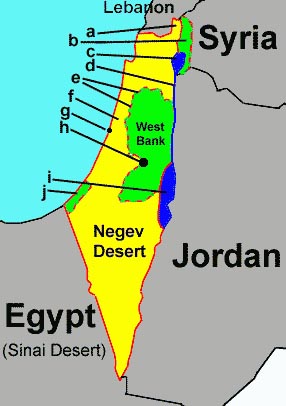
The surrounding 22
Arab countries are 640 times larger than tiny Israel yet they expect
Israel to turn over all the West Bank, Gaza Strip, the Golan Heights and
half of Jerusalem... territory the Arabs lost after they started the
1967 war!
http://www.mefacts.com |
a. 3 miles
wide here
b. Golan Heights
c. Sea of Galilee
d. Jordan River...
Sea of Galilee
to Dead Sea
e. 1967 "Green Line"...
the 1949
armistice lines separating
Israel from its heartland of
Judea-Samaria when Jordanian
forces illegally annexed it. After the
1967 Arab-Israeli war, Israel
regained that land... at which time
the world began referring to Judea and
Samaria as the "West Bank" in
order to
try to erase any Jewish connection
to this historically Jewish land!
f. 9 miles wide here
g. Tel Aviv
h. Jerusalem
i. Dead Sea
j. Gaza Strip |
History,
Reality and Prophecy
Friday, December 07, 2012
Jack Kinsella - Omega Letter Editor
Israel promised to respond to the UN General Assembly's
recognition of Palestine as a state, in violation of the Oslo Agreement, by
building an additional 3,000 settlement units on land claimed by the
Palestinians.
This immediately prompted cries from the Arab
League-dominated UN about Israel's "expansionist" policies requiring
immediate UN intervention. The UN General Assembly voted to recognize
Palestine based on the pre-1967 borders.
If they are pre-1967 borders, then what does that
mean? It means the borders which existed prior to the Six Days War, which
means the borders as they existed in 1948.
Let's fire up the WayBack Machine and revisit how the
State of Israel came to be in the first place.
During the First World War, Turkey supported Germany
against the Allies, so when Germany was defeated, so were the Turks. The
Ottoman Empire was broken up via the Sykes-Picot Agreement that divided up the
former Empire into Western zones of influence.
Lebanon and Syria were mandated over to France. What is
today known as Jordan and Israel (including the West Bank) was mandated to
Great Britain.
Since no other people had established a homeland in the
region since the Jews had been expelled by the Romans 2000 years earlier, the
British government "looked favorably" upon the establishment of a
Jewish homeland on their ancestral territory of Palestine. (Israel, West Bank,
Gaza, Jordan).
In 1917, Lord Balfour issued what is known to history as
"The Balfour Declaration":
"His Majesty's government view with favour the
establishment in Palestine of a national home for the Jewish people, and
will use their best endeavours to facilitate the achievement of this object,
it being clearly understood that nothing shall be done which may prejudice
the civil and religious rights of existing non-Jewish communities in
Palestine, or the rights and political status enjoyed by Jews in any other
country."
Everything would have probably proceeded forward from
this point without a hitch . . . except there was one. A big one that neither
the Europeans nor the Americans could ignore. As Winston Churchill wrote in
1922:
"In both Houses of Parliament there is growing
movement of hostility, against Zionist policy in Palestine. . ."
"Zionist policy . . ." -- what does that mean?
What is a "Zionist?"
A Zionist is one that believes in a national homeland for
the Jews. Modern Zionism emerged in the late 19th century in response to the
violent persecution of Jews in Eastern Europe, anti-Semitism in Western
Europe.
Zionists recognize the historical reality of Jewish
persecution and agree with the Jews that without a national homeland, there is
nothing to prevent more pogroms, persecutions and genocidal terror being
perpetrated against the Jewish people.
And more than that, a Zionist recognizes that the reason
for the pogroms, persecutions and genocide is because they are Jews.
Zionism recognizes that Jew-hatred is blind, unreasoning and deadly.
And so, the "Zionist policy" objected to by
Churchill and the Parliament was the establishment of a homeland for the Jews
as a defense against persecution.
In 1923, the British reneged on their promise and divided
the Palestine portion of the Ottoman Empire into two administrative districts,
with everything east of the Jordan going to the Arabs and everything west of
the Jordan for the Jews.
In effect, the British had "chopped off" 75% of
the originally proposed Jewish Palestinian homeland to form an Arab
Palestinian nation called Trans-Jordan (meaning "across the Jordan
River").
The territory east of the Jordan River was given to Emir
Abdullah (from Hejaz, now Saudi Arabia) who was not even a
"Palestinian". This portion of Palestine was renamed Trans-Jordan.
Trans-Jordan would later be renamed "Jordan".
So the eastern 3/4 of Palestine would be renamed TWICE,
in effect, erasing all connection to the name "Palestine". The
remaining 25% of Palestine (now WEST of the Jordan River) was to be the Jewish
Palestinian homeland.
In 1947 the UN passed Resolution 181 partitioning the
remaining 25% of the Jewish mandate into a Jewish partition and an Arab
partition. The Jewish Palestinians accepted 12.5% of the Balfour Mandate
gratefully. The Arabs rejected the 1947 Plan (which would have resulted in the
creation of a Palestinian state sixty-five years ago).
Israel declared independence on its 12.5% of the British
Mandate on May 14, 1948.
The next day, the combined forces of Egypt, Jordan,
Lebanon, Saudi Arabia, Iraq and Yemen attacked.
(It is worth noting that all of those Arab states were also
created by the same British authority out of the Ottoman Empire following
WWI, only years AFTER the 1917 Balfour Declaration.)
Arabs living inside the newly declared State of Israel
were encouraged to leave by the invaders to keep them out of the crossfire.
Once the Arab Legions had eliminated the Jews, the
displaced Arabs could return and reclaim their own property, plus whatever the
Jews left behind.
(Similar to what actually did occur fifty-eight years
later when Israel unilaterally pulled out of Gaza in 2005.)
Some 70% of the Arabs living in the new state of Israel
fled. Not because they feared the Jewish army, but because it was a good deal.
Avoid the war, stay out of the crossfire, and be rewarded with the spoils of
war for staying safe.
Those that did not flee are today full citizens of the
State of Israel, with the same civil rights as Jews, including Arab
representation at the Knesset.
The borders as they existed in 1948 (essentially
pre-1967) puts the Palestinians in possession of East Jerusalem, the Old City,
all of Gaza, and all of the West Bank, leaving Israel almost cut in half at
the center.
What would have been the Palestinian State under the UN
Partition Plan was immediately occupied by Egypt and Jordan. Egypt took
control of the Gaza Strip and Trans-Jordan occupied the land west of the
Jordan River (Biblical Judea and Samaria) all the way to Jerusalem.
In 1950, Trans-Jordan formally annexed the West Bank and
since it was no longer divided by the Jordan River, renamed itself Jordan and
extended Jordanian citizenship to those Arabs living in the West Bank.
What about those Arabs that fled to neighboring Arab
countries to await the destruction of the Jews? Their Arab brothers interned
them in concentration camps that they renamed "refugee camps" and
kept them there for sixty-five years.
The Jordanians that lived in the West Bank after 1950
never petitioned Jordan for a homeland -- and Jordan never offered. Instead,
they "discovered" in 1964 that they were really an ancient people
called "Palestinians" rather than Jordanians.
(The total lack of evidence of any prior Palestinian
indigenous people, Palestinian language, culture, history or unique national
characteristics notwithstanding.)
Led by an Egyptian Arab named Yasser Arafat they formed
the PLO, which was dedicated to creating a "Palestinian" homeland.
Of course, at the time, they had one -- they were Jordanians!
In 1967, the armies of Egypt, Jordan and Syria massed for
another invasion of Israel aimed at driving the Jews into the sea. Instead,
Israel soundly defeated the invaders, pushing Egypt out of Israel and back
inside its own territory and pushing Jordan back across the Jordan River.
That left Israel in possession of Gaza and the West Bank.
Now the Jews occupied 1/640 of the total land mass of the Arab world and were
only outnumbered fifty to one.
Thus began Israel's "brutal occupation" -- an
occupation so brutal that Israeli-Arabs in East Jerusalem voted against
being ruled by the Palestinian Authority, preferring to stay under Israeli
jurisdiction. Evidently, freedom trumps Arab nationalism.
There is a lesson in there, somewhere.
Consider the situation as it actually exists, devoid of
the anti-Semitic propaganda of the Arab world (and a significant portion of
mainstream Western Christianity).
From 1948 to 1967, Egypt ruled Gaza, Syria ruled the
Golan Heights, while Jordan ruled the West Bank. They could have set up
independent Arab-Palestinian states in any or all of those territories, but
they didn't even consider it.
Instead, in 1967 they used the Golan Heights, Gaza and
the West bank to launch a war that was unambiguously aimed at destroying
Israel, which is how Israel came into possession of those territories in the
first place.
The historical reality is that, if there is a Palestinian
State, it would be Jordan, since Jordan accounts for 75% of the British
Mandate of Palestine. The "Palestinians" living in the West Bank
could have had an independent state sixty-five years ago, but their goal
wasn't independence.
It was NEVER independence. The goal was and is the
destruction of the Jewish State. In every instance where they were offered
some measure of independence, they used that independence to attack Israel.
The fact is, until Yasser Arafat invented a Palestinian
people, the Palestinians were the Jews!
The Middle East Conflict was always a war by Arabs
against Jews, not a conflict between Israelis and "Palestinians".
The war was repackaged as a conflict between Jews and Palestinians as a public
relations gimmick in the early 1970's.
The Palestinians were a regional group of Arabs having
virtually no cultural nor national distinctive traits separating them from
Syrians, Lebanese, and Jordanians. The bulk of what are called
"Palestinian Arabs" are members of families who migrated into the
Land of Israel beginning in the late 19th century.
Palestinian nationalism is a reinvented version of Arab
nationalism. Arab nationalism exists, although it is closely bound up with
Islamic nationalism and even Islamism. Palestinian nationalism, however, is a
phantom. The Arab assaults and aggressions against Israel in 1948, 1956, 1967,
1968, and 1973 had nothing to do with Palestinians.
They were wars of annihilation launched against Israel by
the Arabs; Egypt, Jordan, Syria, Iraq, Saudi Arabia, etc. -- not a
'Palestinian' in the woodpile.
Having been defeated in every instance, the Arab world
focused on using the "Palestinians" as a fifth column inside Israel
to facilitate the eventual annihilation of the Jewish State.
Returning to the present, Israel's intention to build
3000 apartment units on land claimed by the "Palestinians" prompted
UN Secretary Ban ki-Moon to declare the decision would deal "an almost
fatal blow" to the peace process.
Is he kidding??
The fatal blow was dealt when the United Nations
recognized Palestine, thereby CREATING a failed state where no state existed.
Is Gaza part of Palestine? Is it not ruled by a terrorist organization
dedicated to Israel's destruction?
The Palestinian Authority is led by Mahmoud Abbas, a
co-founder of Arafat's Fatah Party and the PLO. He was elected in 2005 for a
four year term, which expired in 2009. The Palestinian Authority feared defeat
by Hamas and so they simply canceled elections, allowing Abbas to rule by
decree.
Consequently, based on the actual rules of democracy,
Hamas, a recognized terrorist organization dedicated to Israel's destruction,
is the only legitimately elected leader of the newly recognized Palestinian
State.
So, you see how insane all this is in the natural. It has
no equal in modern history, and certainly no equal in the history of the
United Nations.
Never has a failed non-state entity without a legitimate
government and dedicated to the principles of terrorism been offered
recognition of statehood without it having, A) an actual indigenous people, B)
a functioning economy, C) a functioning legal system, and D) or one that was
carved out of, and over the objections of, an existing member state.
Who Is
Being "Intransigent"?
July 9, 2012 , http://www.gatestoneinstitute.org/3155/who-is-being-intransigent
Forty-five years after the Six Day War,
declassified transcripts were released this June of the Israeli cabinet and
government committee meetings in the days after war that ended on June 10,
1967. The documents provide a breathtaking insight into the efforts of Israeli
leaders to reach a peace settlement with the countries and groups which had
been at war with Israel. The evidence of the hard work and the varied opinions
on the part of the Israeli ministers, all eager to reach a peace treaty and an
understanding with the Palestinians and Arab states, presents a revealing
contrast to the long-term refusal of the Arab parties to come to the
negotiating table -- an attitude that was reiterated at the summit meeting of
the Arab League on September 1, 1967 in Khartoum, Sudan. As has now been
revalidated by the declassified transcripts, the Israelis were ready to
negotiate land for peace; the Arab leaders instead issued their statement of
the three "nos:" no peace with Israel, no recognition of Israel, no
negotiations with Israel -- an unconditionally negative position taken by Arab
leaders that still persists.
The Arab and Palestinian intransigence, the
refusal to accept a peace agreement, has a long history and is all too
familiar. In 1922 the League of Nations Mandate for Palestine was officially
established. Under it a Jewish Agency, set up in 1929, and composed of
representatives of world Jewry, would assist the British administration in
establishing the Jewish National Home in Palestine. The Jewish Agency then
organized an infrastructure of political and social institutions that became
the basis for the state of Israel. The Arabs refused the offer to create a
similar Agency.
In 1922 the Arab leaders who refused to
participate with the Jews in any plan or in a joint legislature, in which
anyone other than the Arabs would have been the majority; rejected the
proposal for a Palestinian Constitution with a Legislative Council in which
the Arabs would have formed the majority, and boycotted the election for the
Council.
In 1937 the Arab Higher Committee rejected
the idea of two states, first officially proposed by the British Peel
Commission Report. The Report had recommended a Jewish state in about 20
percent of Palestine, about 5,000 square kilometers, while most of the rest
was to be under Arab sovereignty. The Report also suggested a transfer of land
and an exchange of population between the two states. The Peel Commission
Report was accepted, in principle, by the Jewish Agency, even though it meant
that the Jewish state would be a small one, but it was totally rejected by the
Arab Higher Committee, which called for a single state in all of Palestine.
In 1939, in the last attempt before World War
II, to reach some agreement, the British Colonial Secretary organized a Round
Table Conference in London that February. Failure was inevitable: the
representatives of the five Arab states and the Arabs in Mandatory Palestine
who were present refused any direct contact or discussion with the Jewish
representatives -- even to sit in the same room with them.
The Arabs also refused to accept United
Nations General Assembly Resolution 181(II) of November 29, 1947, which
adopted the recommendation of the UN Special Committee on Palestine (UNSCOP)
that Western Palestine -- the area outside of Jordan -- be partitioned into
two states, one Jewish, one Arab, with an internationalized Jerusalem as a corpus
separatum, or separate body. The Jewish state would have about 55 percent
of the area, but not the historic areas of Judea and Samaria. The Resolution
was accepted by the Jewish leaders, but rejected by the Palestinian Arabs and
by six of the seven member states -- Jordan being the exception -- of the Arab
League, which at that time had replaced the League of Arab States.
Arab refusal to enter into peace negotiations
persists to this day, inflexible as ever. The Palestinians decline to enter
into negotiations with Israel unless Israel first accepts the "pre-1967
borders" (borders that have never existed; they are merely the armistice
line of where the fighting stopped in 1949), agrees to Jerusalem as the
capital of a Palestinian state, and ends all construction in areas acquired by
Israel as a result of the 1967 war.
In the Six Day War of June 1967, Israel
achieved a remarkably rapid victory over its Arab opponents; it left Israel in
control of the Sinai Peninsula, the Golan Heights, Gaza which had been ruled
by Egypt, the Jordan River, the Suez Canal, and the West Bank, so named by
Jordan which had "annexed" the area despite almost unanimous
international disapproval.
The Israeli documents just released also show
among Israeli leaders a startling readiness to compromise, which contrasts
with the total disinclination of Arabs and Palestinians to compromise. The
documents show clearly that, while there were acute differences among the
Israelis about the fate of the territories captured in 1967, almost all
Israelis were eager to trade land for peace.
The discussions and proposals were not
initially intended to be policy proposals; they were directives to Israel's
Foreign Minister, Abba Eban, who was participating in New York in the Special
Session of the UN General Assembly, called to resolve the Israeli-Arab
conflict. The ministerial discussions have to be put in the context of Israeli
concern about any UN action after the memory of at least two issues. The first
occurred when Israel was forced to withdraw from the Sinai after the Suez war
of 1956 and had to rely there on United States guarantees and the UN Emergency
Force (UNEF), which proved ineffective. The second was the speedy compliance
in May 1967 of U Thant, Secretary–General of the UN, without the required
approval of the UN General Assembly, to accede to Nasser's demand that the
UNEF troops in the Sinai be withdrawn. The Israeli ministers feared that
pressure would again be exerted on the state as in 1956 and May 1967, leaving
Israel vulnerable.
It is also relevant that the Israeli
government was a unity one under Prime Minister Levi Eshkol, and included
members of Gahal (Menachem Begin and Yosef Safir) and the Rafi party (Minister
of Defense Moshe Dayan). Not surprisingly, there were strong differences of
opinion on the issues of security, borders, refugees, and water -- all of
which prevented agreement.
Consensus was reached, however, on some
issues. First, Israel should withdraw from captured territories only if
the Arab states agreed to make peace and end the boycott of Israel. Most
important, Israel would return the Sinai Peninsula to Egypt and the Golan
Heights to Syria in return for either a peace treaty or strong security
guarantees. The Israeli cabinet also agreed that east Jerusalem would not be
returned to Jordan, which had ruled it; that Egypt had no greater claim to
Gaza than Israel had, and that Jordan had no greater claim to the West Bank
than Israel had, as all three countries had acquired the areas through war.
Some ministers thought that the demand for
peace treaties was unrealistic. In the desperate effort to find positions that
would both lead to negotiation and also also protect the state of Israel, they
grappled with a variety of contradictory alternatives: control over the Gaza
Strip, freedom of navigation in the Strait of Tiran; demilitarization of the
Sinai and of the Golan Heights; control of the sources of the Jordan River;
rule over the West Bank; end of any Israeli rule in the West Bank; military
rule during a transition period; and self-rule for the Arab inhabitants of the
West Bank while Israel still concerns itself with foreign affairs and national
security.
Although there were differences on the issues
of the destiny of the West Bank, and on whether peace treaties should be based
on international frontiers, ministers all spoke of peace with security
arrangements. The positive answer to the security issue was finally approved
by a majority of one, 10 to 9: it was decided that a peace agreement should
ensure freedom of navigation in the Strait of Tiran, the Gulf of Aqaba, and
the Suez Canal; the freedom of flight over them, and the demilitarization of
the Sinai Peninsula.
The formula agreed to by unanimity on June
19, 1967 was that "Israel proposes the conclusion of peace treaties with
Egypt and Syria on the basis of the international frontiers and Israel's
security needs." This proposal was presented to both Egypt and Syria, but
no positive response came from either. Instead, the Arab Summit leaders at
Khartoum announced on September 1, 1967 the three "nos."
As a result of Khartoum, Prime Minister
Eshkol wrote a month later, "I doubt whether the government would approve
the decision of June 19 exactly as it stands." In view of the continuing
Arab leaders' refusal to negotiate, the decision did indeed become invalid.
What these newly released Israeli documents
show in dramatic fashion is the eagerness of all the Israeli leaders, no
matter how they differed on specific issues, to reach peace agreements with
their Arab neighbors. If there is any hope for peace at this time among the
Palestinians, they might wish to reconsider.
Israeli
Settlements an Obstacle to Peace?
July 23, 2012 at 4:30 am, http://www.gatestoneinstitute.org/3184/israeli-settlements-obstacle-to-peace
The settlements occupy
less than three percent of the area of the West Bank, and have a population of
about 300,000 there, another 20,000 in the Golan Heights, and 190,000 in east
Jerusalem, Israel's capital. The immediate problem is the question of who
can legitimately claim sovereignty over the disputed areas of east
Jerusalem and the "West Bank," a term coined by Jordan when it
controlled the area from 1949 until 1967. For over four centuries, these areas
were provinces of the Turkish Ottoman Empire; after that, from 1922 until
1948, they were ruled by Britain under the Mandate given it by the League of
Nations. The areas have never been under any Arab sovereignty.
Jordan declared it had
"annexed" the West Bank after the 1948-49 War. Only two countries,
Pakistan and Britain, ever recognized that claim; and Britain only de facto,
not by full legal recognition. The Palestinians have never had a political
state of their own and, when offered the opportunity by the United Nations
General Assembly in November 1947, refused to create one. The Golan Heights,
about 400 square miles, was ceded to Syria by a Franco-British agreement.
The boundaries of
"Palestine," and the decision about the exercise of sovereign power
over it, remain to be determined in an overall peace settlement, as agreed to
by all parties concerned in the UN Security Council Resolution 242 of November
1967. As the West Bank and the Gaza Strip were
unallocated parts of the British Mandate, the land held by Israel since the
1967 was determined not to be the accepted legal territory of any particular
people or country. Moreover, Jewish settlement in the West Bank was never seen
as an intrusion into alien territory as a result of war, nor as a violation of
international agreements -- either of which would have made settlements
illegal.
International law gives no
clear answer on the issue of Israeli settlements. The Fourth Geneva Convention
does forbid government deportation or "individual or mass forcible
transfers" of population into territory it occupies. This Convention was
formulated because of the activities during World War II of the Nazi regime,
and by inference the Soviet Union, in transferring population into occupied
territory for political or racial reasons, or for colonization. As a result of
those activities, millions were subjected to forced migration, expulsion,
slave labor, and extermination. On this issue two factors are pertinent. One
is that Israeli governments have not aimed at any displacement of the
population in any of the disputed areas. The other is that neither the Geneva
Convention nor any other law prevents the establishment of voluntary
settlements on an individual basis, nor on their location, if the underlying
purpose is security, public order, or safety, and as long as the settlements
do not involve taking private property. It is absurd to suggest that the state
of Israel "deported" or "transferred" its own citizens to
the territories.
This conclusion was buttressed
by a report, in July 2012, of the independent Israeli three-member committee,
headed by former Supreme Court Justice Edmund Levy, which held that the
classic laws of "occupation" do not apply to "the unique and sui
generis historic and legal circumstances of Israel's presence in Judea and
Samaria spanning over decades." The committee held that consequently Israelis
have the legal right to settle in Judea and Samaria, and that the
establishment of settlements is not illegal.
Israel's Arab
Settlements
[rightsidenews.com, 1/6/10]
|
While
the media and politicians wail over Israeli settlements and revisionist
historians pen narratives in which Israel's entire history comes
down to a plot to seize Arab land (following in the footsteps of how
their American counterparts have reinterpreted US history)... very
little is said of Israel's Arab settlements.
But
Arab settlements in Israel far
outweigh Jewish ones and have far less legitimate roots. Consider
East Jerusalem, which Obama and the EU are insisting should be reserved
for Arab residency alone. East Jerusalem
does indeed have a solid Arab majority because in 1948 the armies of
seven Arab nations invaded Israel and occupied half of Jerusalem,
dividing it as their Soviet allies divided Berlin, and ethnically
cleansed its Jewish population. Jewish
places of worship in East Jerusalem were bombed or turned into mosques
and toilets, even the dead were not allowed to rest in peace as
their tombstones were used to pave roads. Jewish homes were seized by
Arabs and East Jerusalem became wholly Arab.
This
is the situation that Obama and the EU are fighting to perpetuate by
banning any Jewish housing in the eastern half of the now united
Jerusalem. This is what every government that refuses to recognize
Jerusalem as Israel's capital is legitimizing by rewarding
the ethnic cleansing practiced by the Jordanian Legion and the Holy War
Army (Jaysh al-Jihad al-Muqaddas) of the nephew of Nazi
collaborating Grand Mufti of Jerusalem, Mohammad al-Husayni.
And
then there are the so-called Israeli settlements of Gaza, Judea and
Samaria-- which indeed were built on territory that Israel captured from
Egypt and Jordan in 1967, after Egypt
and Jordan had captured the territory in 1948, destroying Jewish
villages on the territory in the process. Some Jewish villages
like Kfar Darom suffered the fate of being destroyed twice over, once by
the Arab occupation armies in 1948, to be reestablished and again
destroyed by Fatah's terrorist militias after Israel agreed to
ethnically cleanse its own population from Gaza to appease Arab
terrorism.
That
is the truth behind the so-called Israeli Settlements issue, but it is
not by any means the whole truth. Because the UN, the EU and the State
Department have only applied the term "settlements" to Jewish
towns and villages, never Arab ones, regardless of their legality. This
double standard that is defined purely by ethnicity and religion, and by
no other factor whatsoever, represents the real international Apartheid
that targets Jews for ethnic cleansing to the benefit of Arab Muslims.
That
means that the Arab Muslim seizure of land for the creation of
settlements has been mostly unregulated and is widespread. Not only that
it's often aided and abetted by foreign activists who regularly come to
"help" Arab villagers
harvest olives. In reality this is often a charade in which those same
villagers have marked the territory by planting
on the land of Jewish villages nearby, resulting in calculated
clashes that are broken up by soldiers and police, and filmed by the
same activists resulting in international condemnations. To avoid those
condemnations, Israel eventually seizes the land from the Jewish farmers
and turns it over to the Arab villagers. This only sets the stage for
the next stage of the clashes, recreating in a microcosm the entire
"peace process", in which terrorism results in concessions,
which results in more terrorism and more concessions, creating the cycle
of appeasement and terrorism that has bedeviled Israel and most of the
First World when dealing with Islam.
Those
same left wing activists, most notably groups such as Peace Now and
Rabbis for Human Rights, go on to destroy and damage the land of Jewish
farmers. When the farmers attempt to defend their land, the activists
videotape the resulting encounter and the farmers are arrested. At which
point the land can be easily seized while its owners are tied up by the
legal system. Attempting to reestablish ownership then becomes next to
impossible in a political system constantly afraid of international
condemnation and in a legal system controlled by the Anti-Israel left
all the way up to the Supreme Court, which actually refused to seat a
Justice for being too conservative.
And
in the process Arab settlements continue to expand on land that they
casually appropriate, whether from public domain lands under the
authority of the Israel Land Administration or from that of farmers and
villages who own the land. Arab
villages and towns routinely expand into public lands, fouling
water sources and seizing
property they do not own, and then defying the government to do
anything about it. And while the government occasionally issues a
demolition order, then braces itself for the rioting and the
international condemnations, these orders constitute only a fraction of
the illegal Arab construction.
While
Saudi Arabia and other Islamic states fund Arab land purchases, similar
Jewish ventures, such as Irving Moskowitz's developments in Jerusalem
meet with aggressive opposition from the EU and the State Department.
Once again the double standard is all too clear and it promotes the
growth of Arab towns and houses, at the expense of Jewish ones.
The
media, whether the international media, or the Israeli media, which is
just as left wing as its American and European counterparts, naturally
report the Arab side of the story. The culture of demonization they have
created toward Jewish farmers and residents helps justify the terrorist
attacks aimed at them. Every time the media reports on the victims of a
Muslim terrorist attack as "settlers", the labeling of Jewish
residents as subhuman continues.
Israel's
left wing parties have sold much of the secular public on the idea that
the "settlers" are the problem. This conveniently allows them
to ignore the fact that on Arabs maps and in the Islamic lexicon, all
Israeli Jews are settlers, regardless of which side of the demarcation
line they happen to be living on. Since non-Muslims cannot live in a
Muslim land except by agreeing to become Dhimmis and paying Jizya, under
Islamic law no Jews, aside from a handful of collaborators who
recognize the area as an Islamic ruled state like the Neturei Karta have
any right to live anywhere in Israel.
When
Zionist activists opposed to the Oslo Peace Process shouted that Hevron
is Jerusalem in the early 90's, they were laughed at. Today Jerusalem is
indeed Hevron, the new slogan should be that Tel Aviv is Hevron, because
any dividing lines of legitimacy exist only as a diplomatic fiction. The
idea that Muslims are any more reconciled to 1948 than they are to 1967,
and that returning to 1948 will somehow win their friendship is the
worst form of political and diplomatic delusion. But it is the dominant
policy of the EU and successive American and Israeli governments.
As
a result Israel is shrinking and Arab settlement is expanding. The
settlement freeze enacted under pressure from Obama has frozen the
ability of Jewish residents to build and expand homes, even those
already mortgaged and under construction. But Barak has gone even
further by barring Jewish
residents from planting trees. Jewish residents pay 28 shekels
for a cubic meter of water. Arab residents pay less than 50 agorot
(cents). The result is that Jewish
residents are being charged up to 50 times more for water. And
water is the lifeblood of farming in a generally arid part of the world.
Since
Oslo elements within the Israeli political system, aided and abetted by
foreign funding from the likes of Soros, have been on a crusade
to wipe out Jewish towns and villages in order to destroy the
conservative and Zionist parts of the country. The resulting quiet civil
war in which hundreds of thousands of Jewish villagers have been pitted
against the machinery of government bureaucracy, the judicial system and
various left wing activist groups, has only further increased
Arab settlements, at the expense of Jewish ones.
Every
institution that was once intended to promote Jewish residency, has
instead been transformed into a hostile force that aids and abets Arab
settlement, and works against Jewish settlement. Case in point, the
Jewish National Fund which normally refuses to plant trees outside the
Green Line around areas of Jewish residency, is donating 3,000 trees for
Rawabi, a new Palestinian Authority Fatah city set in a strategic
location.
While
inspectors march around every Jewish town looking for signs that anyone
has lifted up a hammer to bang in a nail on a door, Arab
construction is continuing non-stop, including on places like
Rawabi, an Arab settlement meant to house 40,000. And while Tony Blair
repeatedly warned Israel against building Jewish settlements, he himself
visited the headquarters of the Bayti Real Estate Investment Company
that is constructing Rawabi. Bayti is co-owned by the Qatari Diar Real
Estate Investment Company, which is itself owned by the Qatar Investment
Authority, which is an arm of the Government of Qatar.
Qatar
is an oil rich gulf dictatorship that is one of the biggest
funders of Hamas and Al
Queda. It is likely that Hamas and Al Queda would have
serious trouble continuing their operations without money from Qatar. It
is an Islamist
Sharia paradise much like the rest of its gulf neighbors and
it funds Jihad around the world.
Rawabi is another expression of the international Islamic Jihad, which
in this case takes the form of demographic warfare through Arab
settlement. Gulf State construction companies such as the Bin Laden
group are tools for promoting Islamic expansionism. And JNF's gestire of
appeasement is another example of how Israel's institutions continue to
collaborate with Arab settlement, even as they restrict Jewish
settlement.
The
global double standard
treats Israel's Jewish residents as foreign invaders who must be
expelled, despite the fact that the Jewish
presence in the land is a matter of record in virtually every
major world religion, while treating the Arabs,
many of whom came to the area from Egypt after the British conquest
and Jewish immigration created jobs, as indigenous natives who have
every right to be there.
This form of political ethnic cleansing has become the de facto
narrative, rooted in double talk about settlements and terrorism. But to
treat Jewish towns and villages as illegitimate and working to destroy
them, while encouraging the construction of Arab towns and villages
means that talk of "settlements" and "settlement
freezes" is nothing more than an international apartheid and the
Islamist agenda dressed up in seemingly reasonable talk. Until Israel's
Arab settlements are on the table, as much as Israel's are, the only
thing that Israel can do is reject this international mandate for ethnic
cleansing.
http://www.rightsidenews.com/201001068056/global-terrorism/israels-arab-settlements.html
|
We’re not going anywhere
Sara K. Eisen -- Published: 06.09.10, 17:33 / Israel
Opinion
Here’s the thing. I’ve been thinking about
poor Helen Thomas, who I believe was probably just saying what everyone thinks
and has therefore been made a scapegoat. Not that I really care, because we
ought to share the scapegoat status once in a while. It’s the least we can
do to dispel the stereotype that we are stingy, us irritating Jews.
Helen,
you know why we were in Germany and much of Eastern
Europe in the first place? (And by the way, if I follow your advice, do
you think the nice old ladies who got my grandmothers’ large houses and
farms from the Nazis in what was once Czechoslovakia
will kick the property back two generations? That would be cool because I’d
love a vineyard and an agricultural estate.)
We were in Germany and Hungary and Czechoslovakia and Russia
(where we were regularly just plain killed by Cossacks), and also, for many
centuries, Poland (ditto), because we were told to get the hell out of
England, France, and Spain.
(Or, you know, just plain killed by handsome and heroic fairytale knights.)
And
you know why we were in Western
Europe to begin with? Because we were told by the Greeks and the Romans
– wait for it – to get the hell out of “Palestine,” where we had been
living since the beginning of recorded history.
We
also ended up in Babylonia (Iraq) and other Middle Eastern and North African
countries, where we stayed as second class citizens for hundreds and hundreds
of years, till the Arab world finally caught up with the pagans and the
Christians in their hatred of the Jews. Amazing how the student has now far
surpassed the teacher. But I digress.
In
any event, there is no way around it: Jews being asked (usually not by old
ladies on the White House lawn) to get the hell out of anywhere and everywhere
is just the way it goes.
Persona
non grata in East Europe So
it came to pass that about 200 years BCE the Macabees got sick of it and
established a Jewish state in Palestine, within the Roman
Empire, which lasted till about the time of Jesus (another Pesky Jew)
and the destruction of the Second
Temple.
And
it also came to pass that Jewish settlers began arriving in Ottoman Palestine
in the late 1800s, after the Russians and the Poles made it clear that Jews
were persona non grata in Eastern Europe. Palestine was as good a place as any
to escape to, since it was the last place, about 2000 years before, that the
Jews had a sovereign state (see above). Never mind Jewish liturgy and texts
pining for Jerusalem,
since I know these are inadmissible in the international courts of the mind.
Anyway,
nowhere else wanted European Jews any more than Russia did, not even America
really, where there were very strict quotas, although the Americans, again
politely, refrained from all the messy European killing, which was apparently
in vogue until after Hitler. Besides, those Ottoman Turks, as now, were known
around the world for their amazing human rights activism and the Jews were
excited to see it firsthand. (No, not really. But…they were better than the
Polish peasants. Unless you were Armenian.)
But
when the Jews came back to Land
of Israel, it was suddenly necessary, once again, to tell them to get
the hell out. There was no living side by side, even though that was an
express Jewish desire right up until 1947/8, when the Partition Plan was
summarily rejected by the Arab
League, who started the war that Israel
won. If keeping land you win in a war others provoke (when you wanted to make
peace) is called occupation, Helen, the world’s axis of furious justice has
a lot bigger fish to fry than Israel.
The
Arab desire to kick the Jews the hell out of Palestine did not begin in 1967,
and not in 1948. It began the moment the initial groups of Jews arrived and
started to make the land flower and produce crops. The Hebron
Massacre of 1929, where marauding Arabs killed nearly 70 Jews and
wounded countless others, took place long before a single house was built over
the Green Line.
At
any rate, it seems that every time a Jewish minority starts to make a society
too successful – so annoying!!!! – the indigenous people start to feel
very uncomfortable, and tell them one way or another to get the hell out.
Nowhere
left for us to go But
now, alas, there is nowhere left for us to go, except the eternal place
Ahmadinejad wants us to go, and Haniyeh and Nasrallah, and Hitler before them,
and Khmelnitsky before him, and Haman before him, and so on. And, I suspect,
in her heart of hearts, perhaps Thomas and the likes of her, who, the pesky
Jew Freud may have observed, seriously let her slip show.
Let
me make it clear: I know that Israel has made mistakes over its 62 years, some
clumsy and inept (was there no intelligence regarding the terrorists aboard
the Mavi Marmara?!?), and some borderline immoral. But none worse than every
other democracy on earth has also done, and most much better than the large
majority of the UN rogue nations which condemn Israel daily have done…daily.
But
let’s be honest: the international community’s human rights crusades on
behalf of the Palestinians are just the latest Crusades, and the ones who
really suffer are not the Jews or the Israelis but the poor occupants of the Third
World who are ignored while the enlightened First
World castigates the Jews… and yes, of course, the Palestinians, who
are kept in misery by their own leadership in order to provide the polite Jew
haters with a media club to beat them with.
So
here’s the thing: We are not going anywhere this time, Helen. We totally get
it: Ya’ll pretty much hate us. It’s just the way it is, like a natural
law.
Nothing
we can do – not giving away pieces of Palestine/Israel (witness our
evacuation of Gaza in 2005, and handing over the keys to army bases and
greenhouses- a new economy! Food for the children! – which were summarily
torched as property of the infidels); not donating billions annually to global
charity, nor discovering a cure for Polio or the Theory of Relativity, or
writing revered legal and religious texts, or co-founding Google,
or manufacturing the microprocessor in the majority of laptops that spew Jew
hatred to the Internet, or founding Christianity itself, or championing
women’s rights and gay rights in the US and helping to bring about a human
rights revolution in America in the 60’s. None of those things will absolve
us of our real sin: Existing and overcoming.
I’m
really sorry they told you to get the hell out of the White
House, Helen. It really wasn’t your fault that you thought you could
say what you said. It’s not like it’s a secret: That’s what people
think.
But
this time, seriously. Getting the hell out is not in the cards. We’re just
sick of moving all the time.
I
know. Irritating.
The Israelis know that the Jews
have lived in the land of Israel without interruption for nearly 4,000 years.
They know that, except for a short Crusader kingdom, they are the only people
who have had independent sovereignty on this land. And they are the only
people for whom Jerusalem has been their capital.
They are not a foreign occupier
because the State of Israel is the child not of European colonialism but rather
of Ottoman decolonialization. It was that Jewish historical bond that led the
League of Nations 85 years ago to establish the right of the Jewish people to
reconstitute a Jewish homeland on all the territories west of the Jordan River,
all the way to the Mediterranean. That same right to a national home was
sanctioned again 59 years ago by the new United Nations. After an Arab invasion
40 years ago, the U.N. passed a resolution affirming Israel's right to
"secure and recognized boundaries." As Winston Churchill noted in
1922, "The Jews are in Palestine by right, not sufferance." And when
Yasser Arafat said there was no First or Second Temple in Jerusalem but only
"an obelisk," he, too, was trying to deny the history of the Jewish
people in Jerusalem. But this is the site of the binding of Isaac by Abraham,
the place where David built the altar on the threshing floor of Aravna to halt
the plague. The Temple Mount was where Jesus was brought as an infant and where
he later chased away the money-changers. Mentioned 20 times in the New
Testament, the Temple Mount is one of the cornerstones of the Judeo-Christian
ethical tradition of the West. Yet it is all denied by the Palestinians. This
obduracy, combined with waves of terrorism, has shattered the
Israeli-Palestinian relationship.
It was Arafat who invoked the Islamic terms of jihad and shahada;
it was Arafat who described "all of Palestine," which includes all of
Israel, as a "holy wakf," i.e., an Islamic trust that cannot
be given away; it was Arafat who introduced children to radical Islamic thinking
so that they could become terrorists and suicide bombers. The name that Arafat
gave to the violence that began in the year 2000 was not the "West Bank
intifada" but the "al-Aqsa intifada," making it clear that
religion was an integral part of the struggle. When suicide bombers blow up
Israelis, they don't yell, "Free Nablus!" They yell, "Allahu
Akbar!" The backdrop is Islamic and not territorial.
That is why the Middle East is so different from Northern Ireland, which
is sometimes falsely used as a comparison. The basic goal of the Irish
Republican Army was to create a united Ireland, to bring Ireland to Ulster, not
to London. Their goal was never to replace England with Ireland, unlike the
Palestinians who wish to rule not just in the West Bank and Gaza but in
Jerusalem, Tel Aviv, and Haifa. The IRA struggle was primarily a political one,
its violence not supported by the Roman Catholic Church. At its core the
conflict was over borders, whereas in the Middle East the conflict has become
not just a territorial conflict but much more of a religious one.
Arafat personified the Palestinian problem of leadership, and for a long
time the current president, Mahmoud Abbas, has been weak and ineffective. As
David Makovsky of the Washington Institute for Near East Policy put it,
"The people who are moderate are not effective. And the people who are
effective are not moderate." Today, the impossible Arafat has been replaced
by an impotent Abbas, but the new figure of Salaam Fayed as prime minister may
change the equation. He is the most talented Palestinian to emerge at the
leadership level. He recognizes that rather than continually presenting
themselves as victims, Palestinians must work to build a credible and honest
institution of government, beginning with reforming their security services.
Absent these reforms, the Palestinians will be unable to confront and
subdue Hamas, the jihadists, and the various warlords of the local militias in
the West Bank. The Israelis are naturally leery of Abbas because they witnessed
how Hamas so humiliatingly chased his men out of Gaza. They remember that Hamas
beat Fatah to win a plurality of the vote in the West Bank during the last
election; they have been warned by their security services that Hamas could take
over the West Bank if the Israeli Defense Forces weren't there. The Israelis
will be reluctant to fund, arm, and embrace a new Palestinian leadership that
has yet to tackle terrorism, yet to stop instilling hate in the young, yet to
stop printing maps without Israel, and yet to confront their own people with the
clear message that the end of terrorism is a precondition to progress. Had there
been a peace education in the West Bank parallel to that in Israel after Oslo,
no one would have joined Arafat's calls for war. Without such a program, signing
a piece of paper with the Palestinians is meaningless.
Fayed knows that Fatah must win popular support by focusing on health,
education, law, and order to improve the lives of the Palestinians; he knows
this means establishing an honest administration and a civil society that can
develop a functioning economy and middle class, rather than support a corrupt,
rich elite. (No wonder the Palestinians refer to Abbas's government as the
government of salaries.) He knows that the Israelis will be unable to pull out
of large sectors of the West Bank while they fear a Gaza-like repetition of
rockets raining on Ben-Gurion Airport and Tel Aviv. The Israelis fear that even
if a Palestinian state is officially demilitarized on paper, it could accumulate
within a few years a vast arsenal of weapons that could kill thousands of
Israelis. Gaza has shown that a security fence cannot prevent missiles from
flying over and killing and wounding Israelis. Then there is the fact that
Palestinians in the West Bank would control 60 percent of Israel's water. The
Israeli defense minister put it squarely: In those circumstances, Israel could
not leave the West Bank until it develops a defensive system against rocket
attacks. (USN&WR, 10/8/07, 68)
http://www.usnews.com/articles/opinion/mzuckerman/2007/09/28/mortimer-b-zuckerman-on-irans-campaign-of-repudiation.html

The Myth of “Settlements”:
Very briefly: The Ottoman Empire was the sovereign in the entire area. In
1917, while World War I was still raging, Britain issued the Balfour
Declaration. It designated “Paleatine” — extending throughout what is
now Israel (including the “West Band”) and what is now the Kingdom of
Jordan — as the homeland for the Jewish people. In 1922, the League of
Nations ratified the Balfour Declaration and designated Britain as the
mandatory power. Regrettably, Britain, for its own imperial reasons and
purposes, separated 76 percent of the land — that lying beyond the Jordan
River — to create the kingdom of Trans-Jordan (now Jordan) and made it
inaccessible to Jews. In 1947, tired of the constant bloodletting between
Arabs and Jews, the British threw in the towel and abandoned the Mandate. The
UN took over. It devised a plan by which the land west of the Jordan River
would be split between the Jews and the Arabs. The Jews, though with heavy
heart, accepted the plan. The Arabs virulently rejected it and invaded the
nascent Jewish state with the armies of five countries, so as to destroy it at
its birth. Miraculously, the Jews prevailed and the State of Israel was born.
When the smoke of battle cleared, Jordan was in possession of the West Bank
and Egypt in possession of Gaza. They were the “occupiers” and they
proceeded to kill many Jews and to drive out the rest. They systematically
destroyed all Jewish holy places and all vestiges of Jewish presence. The area
was “judenrein.”
In the Six-Day War of 1967, the Jews reconquered the
territories. The concept that Jewish presence in Judea/Samaria is illegal and
that the Jews are occupiers is bizarre. It just has been repeated so often and
with such vigor that many people have come to accept it. How about the
“Palestinians,” whose patrimony this territory supposedly is and about
whose olive trees and orange groves we hear endlessly? There is no such
people. They are Arabs — the same people as in Lebanon, Syria, Jordan, and
beyond. Most of them migrated into the territories and to “Israel proper,”
attracted by Jewish prosperity and industry. The concept of “Palestinians”
as applied to Arabs and as a distinct nationality urgently in need of their
own twenty-third Arab state, is a fairly new one; it was not invented until
after 1948, when the State of Israel was founded. http://www.factsandlogic.org/ad_77.html
[USN&WR, 11/2010, 73]
ETHNIC CLEANSING
Mr. Netanyahu took the opportunity of the approaching holiday of Tu
Bishvat, a Jewish arbor day, to reaffirm Israel’s claim to the Etzion bloc
of settlements just south of Jerusalem. “Our message is clear,” he said
during a tree-planting ceremony there. “We are planting here, we will stay
here, we will build here. This place will be an inseparable part of the State
of Israel for eternity.”
The Etzion settlements were
settled by Jews before the Israeli state was established in 1948. The
area became part of the West Bank under Jordanian control after the 1948 war,
and the settlements were destroyed.
Some settlers returned there immediately after Israel captured the territory
from Jordan in the 1967 war, and the settlements
were rebuilt.
http://graphics8.nytimes.com/images/2010/01/25/world/25mideast_CA1
(NY Times, 1/25/10)
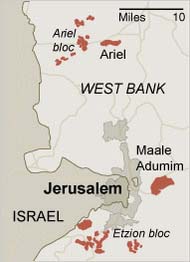
Did Obama
call on Israel to vacate Temple Mount?
Israeli politicians accuse president of 'misrepresenting history' in U.N. speech
(JERUSALEM,
WorldNetDaily , 9/24/09)
– Did President Obama yesterday adopt U.N. and Palestinian phraseology while
calling on Israel to give up the biblical West Bank and eastern sections of
Jerusalem, including the Temple Mount? Some members of the Israeli government
here reacted angrily to Obama's strongly worded demand – expressed during his
speech to the U.N. General Assembly – for the creation of a "viable,
independent Palestinian state with contiguous territory that ends the occupation
that began in 1967."
The term "occupation" routinely is used by the Palestinians as well as
some countries hostile to the Jewish state in reference to Israel's presence in
the West Bank and Jerusalem. It is unusual for U.S. presidents to use the term,
although Jimmy Carter once famously called Israel's presence in the West Bank
and eastern Jerusalem "illegal." "Occupation that began in
1967" is a specific reference to the lands Israel retained after the Six
Day War of that year, particularly the West Bank and eastern Jerusalem,
including the Temple Mount.
The Palestinians never maintained any official capacity in either territory,
lands in which Jews have been present for thousands of years. The territories
came under Jordanian rule from 1948 until Israel captured them in 1967 after
Jordan's King Hussein ignored Israeli pleas for his country to stay out of the
Six Day War. Most countries rejected Jordan's initial claim on the area, which
it formally renounced in 1988.
Commenting on Obama's speech during a WND interview today, Tzipi Hotovely, a
Knesset member for Prime Minister Benjamin Netanyahu's Likud party, accused the
U.S. president of "misrepresenting history "
"Obama is misrepresenting Mideast history," she said. "The Jewish
people's right to live in Judea and Samaria is firstly rooted in the
Bible and God's promise 2,000 years before 1967." "I really believe
the whole 16-year process since the Oslo Accords (in which Israel gave up
land in exchange for promises of peace) has proven the settlements are not the
obstacle for peace. The main obstacle is the Palestinians' continued rejection
of Israel as a Jewish state even within the borders of 1967."
Danny Danon, another Likud Knesset member, told WND today, "Obama cannot
force this on Israel. We do not have a partner in Israel which is a viable
partner." Continued Danon: "Every concession Prime Minister Netanyahu
makes was not appreciated by the Palestinian Authority. The Jewish presence in
Judea and Samaria is an asset for Israeli security . Instead of pressuring
Israel, we would like to see the Obama administration deal with the real threat
– the global threat coming from Iran."
The West Bank is considered landlocked territory not officially recognized as
part of any country. Israel calls the land "disputed."
The Palestinians and the U.N. Security Council claims the West Bank is "occupied"
by Israel, which maintains overall control of most of the area while the
Palestinian Authority has jurisdiction in about 40 percent. The U.N. Security
Council is traditionally considered hostile to Israel. The West Bank borders
most of Israel's major cities, including Jerusalem and Tel Aviv. Military
strategists long have estimated Israel must maintain most of the West Bank to
defend its borders from any ground invasion.
Many villages in the West Bank,
which Israelis commonly refer to as the "biblical heartland," are
mentioned throughout the Torah. The Book of Genesis says Abraham entered Israel
at Shechem (Nablus) and received God's promise of land for his offspring. He
later was buried in Hebron. The nearby town of Beit El, anciently called Bethel
meaning "house of God," is where Scripture says the patriarch Jacob
slept on a stone pillow and dreamed of angels ascending and descending a
stairway to heaven. In that dream, God spoke directly to Jacob and reaffirmed
the promise of territory. And in Exodus, the holy tabernacle rested in Shiloh,
believed to be the first area the ancient Israelites settled after fleeing
Egypt.
Obama's reference yesterday to "occupation that began in 1967" comes
after a top PA official, speaking on condition his name be withheld, said the
Obama administration largely has adopted the positions of the PA to create a
Palestinian state within two years based on the 1967 borders, meaning Israel
would retreat from most of the West Bank and eastern sections of Jerusalem. The
official said Obama also accepted the PA position that Israeli-Palestinian
negotiations begin where they left off under Prime Minister Ehud Olmert, who
went further than previous Israeli leaders in his concessions to the
Palestinians.
Olmert reportedly offered the PA not
only 95 percent of the West Bank and peripheral eastern Jerusalem neighborhoods
but also other territories never before offered by any Israeli leader,
including parts of the Israeli Negev desert bordering Gaza as well as sections
of the Jordan Valley. The official claimed the Obama administration will still
support the announcement of a Palestinian state within two years. "We
understand from the U.S. that the Netanyahu government is not in a position to
go against creating a state within two years," the official said. The
official claimed the Obama administration was ready to ultimately consider
"sanctions" against Israel if the Netanyahu government rejected
negotiations leading to a Palestinian state. The official refused to clarify
which sanctions he was referring to or whether he was specifically told by the
U.S. government it would consider sanctions.
http://www.wnd.com/index.php?fa=PAGE.view&pageId=110896
| No
Room in Obama's Jerusalem for the Jew |
| (rightsidenews.com,
11/22/09) |
|
The same media which can't be bothered to notice that there is a proxy
war going on between Iran and Saudi Arabia
in Yemen, with Saudi jets bombing civilian targets. Who have paid no
attention whatsoever to a week of violence between Algerians and Egyptians
that included stonings and death threats, are up in arms over the
building of 900 housing units in the Gilo neighborhood in Jerusalem.
The
Obama Administration and the media are naturally not upset by the Jerusalem
municipality's decision to build
500 housing units for Arabs in Jerusalem. No they're upset by a
private Jewish housing project
built on privately owned land. And that double standard aptly
conveys their premise that a Jewish
house in Jerusalem is a "settlement",
while an Arab house in Jerusalem is just a house. A Jewish home
violates the "status quo" and is "unhelpful for
peace", while an Arab home is just a home. There is of course a
name for that sort of policy, it's one that Jimmy Carter who is still
continuing his tour on behalf of Hamas knows quite well, Apartheid.
In
response to the Nof Zion construction,
Obama warned that, "additional
settlement building does not contribute to Israel's security".But
Nof Zion is not about security, as much as it is about an overcrowded Jewish
population in Jerusalem looking for someplace to
live. When the Arabs seized
half of Jerusalem in Israel's War of Independence, they forcibly
expelled the Jewish population of Jerusalem in a brutal act of ethnic
cleansing that goes ignored by the same leftists who focus on
elderly Arab men waving keychains in the air. Homes
belonging to Jewish families were replaced by Arab families,
who in turn were not expelled when Israel liberated and reunited both
halves of Jerusalem in 1967.
While
countries such as England
recognized Jordan's annexation of East Jerusalem, they have failed
to recognize Israel's reunification of the city. This has led
to the ongoing absurdity in which children born in Jerusalem are
treated as stateless by the US government and the US embassy remains
in Tel Aviv, while the
US Consulate in East Jerusalem does its best to pretend
that it's in the capital of Palestine, completely refusing to
recognize Israel's existence.
Were
security the issue, Gilo which faces the Arab towns of Beit Jala and
Al Khader, and has been shot at repeatedly from them, would be a poor
choice to live in. But Jerusalem is bulging at the seams. The price of
housing has shot up, and while US Ambassador Richard H. Jones may
have told Jewish residents of Jerusalem that "Sometimes
people do have to move to a different location. They cannot always
stay close to their families", the reality is that living
next to their families is exactly what people want to do. Regardless
of what the State Department thinks about the matter.
1800
years ago the Romans expelled the Jewish population of Jerusalem
and renamed it Aelia Capitolina, a pagan city, and renamed Israel,
Syria Palaestina. Today Obama
and the State Department seem determined to do the very same thing.
By calling a Jerusalem neighborhood, a "settlement", Obama
is actively attacking the right of Jews to live in Jerusalem. If
Jewish Jerusalem is a settlement, then effectively every other part of
Israel where Jews live is a settlement too.
When
even liberal US news outlets such as CNN have described Gilo as a
Jewish neighborhood, in contrast to radical left wing British outlets
such as the BBC and Reuters, who branded it as a
"settlement", Obama's shift is a deliberate one. Helpful as
always, UN Secretary General Ki Ban Moonbat stepped in to denounce
Gilo as a "settlement built on Palestinian land that undermines
efforts for peace". Considering that Gilo already holds a
population of 50,000, the land was privately owned and the Jewish
presence there goes back to the Book of Joshua, but the facts are no
obstacle to the lies.
In
Time
Magazine, the increasingly unhinged Joe Klein
claimed that Gilo "would be the capital of Palestine", with
presumably a Hadrianiac or Jordanian style ethnic cleansing solution
for the 50,000 Jews who live there right now. Not that I imagine that
would stop him in the least, so long as he had someone else to do the
dirty work for him.
But
finally what is the basis for calling the Gilo
neighborhood a "settlement"? The
land on which Gilo was built was bought and owned by its Jewish
residents. That land was occupied and seized by Jordan in 1948, until
Israel liberated the territory in 1967. To call Gilo a
"settlement", recognizes the Jordanian invasion and seizure
of the land as legitimate, while treating the Jewish presence there as
illegitimate.
And
that is the real basis behind all this madness. The reason why a
Jewish home in Jerusalem or anywhere in Israel is a settlement. To
speak of "settlements" is to claim
that the Jewish presence in Israel is illegitimate. And while
some Israeli leftists may fondly imagine that settlers are religious
Jews who live in caravans, as the case of Gilo once again
demonstrates, all of Israel is a settlement.
And
that is why as far as the world's diplomats are concerned, an Arab
terrorist has more right to open fire on a Jewish family driving down
the road, than the Israeli army has to shoot that same terrorist. And
by giving in to US pressure to negotiate directly with the PLO, by
signing the Oslo accords and by repeatedly agreeing to talk peace with
Arafat and Abbas, the door was opened to greater and greater
delegitimization of Israel.
Israel's
global diplomatic position is far worse than it was 17 years ago.
Israel's strategic position is far worse than it was 17 years ago. The
most rabid bigotry and the ugliest incitement has become the norm, the
sort of language you would once hear in Ridyah or Damascus has now
become cocktail party chatter in London, Paris and Washington D.C. All
of Israel's concessions have combined to put a gun to Jerusalem, and
then to the rest of the land for a great going out of business,
everything must go sale.
The
case of Gilo is one more wake up call that not only our terrorist
"peace partners", but even the so-called honest brokers
of the world community do not
believe that Jews have the right to live anywhere in Israel.
Their backing of a Palestinian state has nothing to do with peace, as
the fact that peace has failed to emerge over 17 years has not in any
way dampened their ardor and enthusiasm for the project. Nor is it
about a Two State Solution bringing regional stability. Even the
dimmest paper pushers in the State Department and Foreign Ministry
know that even were a Palestinian state to be created, the result
would be more regional instability, not less. Only a One State
Solution can succeed, and that solution is an Arab state and no
Israel. The "Peace Process" and the "Two State
Solution" are an incremental approach to bringing about that
final solution.
The
men and women who toiled and worked the land, who turned
swamps and desert into farmland and cities, understood that if
there was no room for Jews in Israel, there was no room for Jews
anywhere. Palestinian Islamic terrorism in turn is driven by
the national and religious imperative to destroy the only non-Muslim
country in the Middle East. And while America
and Europe decry Israel's capital as a Jewish settlement, Muslim
settlements are springing up in their own capitals. While the
cocktail party chatter is that serving up Israel on a platter to the
beast will keep them safe, the violence is already in their streets.
The same violence that Israel was built as a refuge against. And if
Israel falls, they will be the next item on the menu.
http://www.rightsidenews.com/200911227437/global-terrorism/no-room-in-obamas-jerusalem-for-the-jew.html
|
Israel's Historic Achievement
Jews have lived in
the land of Israel for over 3,300 years since 1312 B.C They had lived
there at least 1,800 years before the
Arab conquest of 635 C.E., which lasted only 22 years. Jerusalem was the
Jewish capital for over 3,300 years and never was the capital of any Arab or
Muslim entity. King David founded Jerusalem; Muhammad never set foot in it. Jews
pray facing Jerusalem, and Muslims face Mecca. Jerusalem is mentioned hundreds
of times in the Old Testament and not once in the Koran. The Jews have never had
any other national homeland. When the Roman Empire later extended its rule to
Israel and colonized the land, the Romans decimated the Jewish population and
exiled the Jews to Europe and other parts of the empire. In A.D. 70, the Second
Temple was destroyed by Titus, who returned to Rome in 71 with 14,000 Jews as
slaves and forced them to build the Roman Coliseum. But the Jews never lost the
connection to their ancestral home.
Through the centuries of Ottoman rule and the years of the
British mandate after World War I, the Jews kept faith in their history and came
back—to the displeasure of the others ("Arabs" for short) who had
moved in. Deadly Arab riots against Jews
occurred in 1920, 1929, and 1936-1939. In World War ii, the Jews themselves
fought on two fronts, fending off attacks by the Arabs who favored the Nazis and
serving alongside the British against Hitler. There was not one inch on all the
surface of the Earth that the Jews could call home until the 1947 vote of the
United Nations in favor of the establishment of Jewish and Arab states. Thus
ended the longest exile ever endured by a people. After almost 2,000 years of
homelessness and wandering since the Romans sacked Jerusalem, the Jewish people
came miraculously home.
This is a story without parallel, of a love of a people for
the land of Israel. In this land in ancient times, the Jewish people were born.
In this land in modern times, the Jewish people were reborn. They have never
left Israel voluntarily and returned when they could, from more than a hundred
countries speaking more than 80 languages, a modern-day gathering of the exiles.
More than 3,000 years earlier, Moses had prophesied, "Even if you have been
banished to the most distant land under the heavens, from there the Lord your
God will gather you and bring you back." And so it was.
The day after the vote for partition,
Arab gunmen began ambushing Jews, and then five Arab armies invaded. That marked
the start of the tragedy that persists today. The Palestinians who were urged by
Arab leaders to leave Israel have never been integrated with their
coreligionists. All these years since 1948, their "host" countries
have held them hostage in camps (and the integrated refugees have now grown to
several million people). They cannot be returned, for if that were to happen,
there would be no state at all for the Jewish people. The Republican nominee for
the presidency in 1940, Wendell Willkie, summed up the competing claims this
way: "The Arabs have a good case in Palestine. There is only one thing
wrong with it—the Jews have a better case." Time and again, the Palestinians
have been offered an Arab state next to Israel: first, in the partition
plan of 1947; then, in the Oslo accords; then at Camp David in 2000; and
finally, in countless declarations since then by both Israeli and international
leaders. All have met with a violent rejection by the Palestinians and by the
Arab countries
The refusal to accept the existence of Jews in a separate
state of Israel is worse than anti-Semitism. It is, as former Canadian Minister
of Justice Irwin Cotler described it, "a genocidal
anti-Semitism, the
public calls for the destruction of Israel and the Jewish people," wherever
they may be. Listen to the state-sanctioned genocidal anti-Semitism in Mahmoud
Ahmadinejad's Iran, made clear by the publicly avowed intent to acquire nuclear
weapons for this purpose. It is in the language of the covenants, charters,
platforms, and policies of the terrorist movements and militias of Hamas,
Islamic Jihad, Hezbollah, and al Qaeda, which call not only for the destruction
of Israel and the killing of Jews but also for acts of terrorism in furtherance
of that objective, supported by religious fatwas in which these
genocidal calls are held out as religious obligations. All this comes from a
culture that greets brutal deeds of terrorism with glee and celebrates martyrs
and their families.
The Jews who became Israelis have built a thriving economy,
based to a large extent on their human capital. They revived as a spoken
language an ancient language, Hebrew. They have integrated new arrivals from
around the world and resolutely maintained a vibrant, free, and democratic
society; they have created the political and economic infrastructure of a
nation; and they have survived in war after existential war as Psalm 129
foretold. "Sorely have they afflicted me from my youth, yet they have not
prevailed against me." They have cultivated desolate lands with one of the
world's most innovative agricultural economies; they have established legal
systems that protect civil liberties against the backdrop of the most lethal
security threats. They have made a home for the world's largest Jewish
population, passing America by about 1 percentage point. They have fulfilled
Israel's destiny to give Jewish communities threatened from without, or
assimilated to the point of extinction from within, a place to survive and
thrive. This is the dream that has come true. Even though Israel seeks no
allegiance and loyalty from anyone who is not an Israeli citizen, the
realization of the dream and the remarkable historical event that Israel
represents with its rebirth have evoked the spirit of kinship and emotional and
association with those who share the Judeo-Christian community throughout the
world.
They have failed in one respect. They have been unable to
make peace with terrorists, but it is because the terrorists
reject all compromise. But Israel fights those bent on its destruction
within the rule of law and within reasonable constraints of human rights and
civil behavior, a remarkable model in an era of terrorism. The achievements are
without parallel, but Israel remains a permanently embattled nation. Today, as
Israel celebrates its 60th anniversary of independence, Iran develops nuclear
weapons, Kassam rockets are daily fired into Sderot from Gaza, and Hamas
continues to threaten Israel with more and more terrorism. In the north,
Hezbollah remains a potential threat, building up its inventory of longer range,
more lethal rockets; prospects for peace with Syria look as dim as ever; and
negotiations with those few Palestinians who seem to wish to live in peace are
barely progressing. Israel is in a long-term struggle for its security in a
region with virtually no margin for error. But President Bush, in his speech
last week to the Knesset, gave the members comfort when he said, "Israel's
population may be just over 7 million. But when you confront terror and evil,
you are 307 million strong, because the
United States of America stands with you." (USN&WR, 5/26/08, 72)
http://www.usnews.com/articles/opinion/mzuckerman/2008/05/16/israels-historic-achievement.html?PageNr=3
Arabs launched terrorism against unarmed Jews in 1920, 1921, 1929, and
1936 to 1939, murdering hundreds of Jewish civilians. In 1929, the grand mufti
of Jerusalem ordered the slaughter of more than a hundred rabbis, students, and
others whose ancestors had lived in Hebron for millenniums. The Saudi
Prince Bandar said that Arafat's refusal to accept 95 percent of the West Bank
and all of Gaza was "a crime" and his account of the circumstances was
"not truthful." (USN&WR, 5/5/08, 72)
Israel through the years
November 29, 1947: U.N. General Assembly proposes partitioning Palestine
into Jewish and Arab states.
May 14, 1948: State of Israel proclaimed. Neighboring Arab states invade
the next day, ending in October 1949.
[In late October 1956, instigated by
Britain and France during the crisis over Egypt's seizure of the Suez Canal,
Israel invaded the Sinai Peninsula to destroy military bases. Israel captured
Gaza and Sharm el Sheikh at the tip of the Sinai Peninsula that controls access
to the Gulf of Aqaba. It also occupied most of Sinai east of the canal.
According to plan, the British and French intervened in the conflict to enforce
a U.N. cease-fire. The crisis ended in December when the United Nations
stationed a peacekeeping force in Sinai. Israel withdrew in March 1957.]
June 1967: Israel captures Gaza Strip, Golan Heights, West Bank and east
Jerusalem in Six Day War against Egypt, Syria and Jordan. More than one million
Palestinians come under Israeli military occupation.
October 6, 1973: Egypt and Syria launch surprise attack against Israel,
making initial gains. Israel recoups, aided by massive U.S. arms airlift, and a
cease-fire takes effect Oct. 24.
September 1978: Egypt and Israel agree on frameworks for peace in the
Middle East. A treaty is signed in Washington on March 26, 1979, under which
Israel is to withdraw from the Sinai in three phases.
June 1982: Israeli forces invades Lebanon and do not withdraw until
February 1985, leaving behind an Israel-backed Christian Lebanese force to act
as a control over and buffer against attacks by Palestinian guerrillas and
Islamic militants.
December 1987: Palestinian uprising in West Bank and Gaza breaks out. The
revolt lasts six years.
September 1993: In secret talks in Oslo, Norway, Israel and the PLO
produce an interim framework for autonomy in the West Bank and Gaza Strip. In
the first stage, Israel pulls out of most of the Gaza Strip and area of Jericho
in West Bank.
October 1994: Jordan and Israel sign peace treaty calling for close
economic and political cooperation; Jordan becomes Israel's closest ally in
region.
September 2000: Violence flares again and Israel eventually reoccupies
most Palestinian towns in the West Bank.
July 2006: The Lebanon war begins after Hezbollah guerrillas cross the
Israel-Lebanon border and attack an Israeli patrol, killing three soldiers and
capturing two others. Israel bombards Lebanon from the air and then invades, and
Hezbollah launches nearly 4,000 rockets at Israeli population centers. In 34
days of fighting, 159 Israelis were killed, including 119 soldiers. (OCR,
5/4/08, News 3)
DAYTON,
Ohio (AP, 2/24/06) - Ohio Farmers
Seeking Israel's Expertise. Farmers in Israel raise crops in conditions
that couldn't be more foreign to their Ohio counterparts. But the arid soils,
limited water and cramped spaces have turned Israeli
farmers into experts at making
crops bloom in the desert. A group of Ohio farmers hopes to use that
expertise to improve productivity. A 29-person delegation is leaving for a
10-day trip to Israel to learn everything from water management to milk
processing to handling urban expansion. "I'm extremely intrigued by the
ability of them to grow enough crops for 7 million people in the desert,"
said Daniel Corcoran, 42, who raises soybeans, wheat and alfalfa on his
4,000-acre family farm near Waverly in southern Ohio. "Hopefully, there are
things we can bring back here." Israel is one of the most densely
populated countries in the world. Only
about 20 percent of the land can be farmed and half of that has to be irrigated.
But Israel not only produces most of its
own food, it also has enough to export. Fruit, vegetables and fertilizer
are among the most successful exports. Israeli farms have prospered by
irrigating crops, seeding clouds to increase rainfall, landscaping to redirect
floodwaters toward crops and using drip irrigation so that crops receive the
precise amount of water and fertilizer. The Israelis have also developed
computer-controlled greenhouses that have curtains, skylights and netting to
control sunlight and temperature. The trip is being hosted by the Ohio
Department of Agriculture and the Cleveland-based Negev Foundation, a group
whose mission is to develop agriculture in the southern, largely desert portion
of Israel. The journey is part of a larger initiative to help Israelis benefit
from business opportunities in Ohio and from sharing ideas with Ohio
agricultural researchers. Last fall, Israeli farmers promoted their products at
the Farm Science Review in London, Ohio. Ram Ben-Dor, 52, lived on an Israeli
farm for 20 years, raising poultry and fruit. He said the Ohio farmers should be
able to help Israelis with technologies that would increase their productivity
and make them more competitive in world markets. He said it would be an
opportunity to make contacts that could increase soybean imports from Ohio. Sam
Hoenig, foundation president, said Israeli farmers are also interested in Ohio's
expertise on turf as they seek to develop recreational areas. Among those going
on the trip are several Ohio fish farmers. John Bechtel raises trout, perch and
bluegill near Fredericktown in central Ohio. He is most interested in how the
Israelis prevent the spread of disease among fish. He also wants to tap into
their knowledge about fish nutrition, genetics and water-quality management.
"They use water over and over again," Bechtel said. "That is the
future of fish farming." Bob Peterson raises hogs and grows corn, soybeans
and wheat on his farm in central Ohio. But residential and commercial
development from Columbus, Cincinnati and Dayton keeps creeping in. He hopes to
see how Israeli farmers manage to work in densely populated areas while
increasing production and profits.
CRASH COURSE ON the ARAB
ISRAELI CONFLICT
1. Nationhood and Jerusalem. Israel became a nation in 1312 B.C.E., two
thousand years before the rise of Islam.
2. Arab refugees in Israel began identifying themselves as part of a Palestinian
people in 1967, two decades after the establishment of the modern State of
Israel.
3. Since the Jewish conquest in 1272 B.C.E. the Jews have had dominion over the
land for one thousand years with a continuous presence in the land for the past
3,300 years.
4. The only Arab dominion since the conquest in 635 C.E. lasted no more than 22
years.
5. For over 3,300 years, Jerusalem has been the Jewish capital. Jerusalem has
never been the capital of any Arab or Muslim entity Even when the Jordanians
occupied Jerusalem, they never sought to make it their capital, and Arab leaders
did not come to visit.
6. Jerusalem is mentioned over 700 times in Tanach, the Jewish Holy Scriptures.
Jerusalem is not mentioned once in the Koran.
7. King David founded the city of Jerusalem. Mohammed never came to
Jerusalem.
8. Jews pray facing Jerusalem. Muslims pray with their backs toward
Jerusalem.
9. Arab and Jewish Refugees: In 1948 the Arab refugees were encouraged to leave
Israel by Arab leaders promising to purge the land of Jews. Sixty-eight percent
left without ever seeing an Israeli soldier.
10. The Jewish refugees were forced to flee from Arab lands due to Arab
brutality, persecution and pogroms.
11. The number of Arab refugees who left Israel in 1948 is estimated to be
around 630,000. The number of Jewish refugees from Arab lands is estimated to be
the same.
12. Arab refugees were INTENTIONALLY not absorbed or integrated into the Arab
lands to which they fled, despite the vast Arab territory. Out of the
100,000,000 refugees since World War II, theirs is the only refugee group in the
world that has never been absorbed or integrated into their own peoples' lands.
Jewish refugees were completely absorbed into Israel, a country no larger than
the state of New Jersey.
13. The Arab - Israeli Conflict: The Arabs are represented by eight separate
nations, not including the Palestinians. There is only one Jewish nation. The
Arab nations initiated all five wars and lost. Israel defended itself each time
and won.
14. The P.L.O.'s Charter still calls for the destruction of the State of Israel.
Israel has given the Palestinians most of the West Bank land, autonomy under the
Palestinian Authority, and has supplied them with weapons.
15. Under Jordanian rule, Jewish holy sites were desecrated and the Jews were
denied access to places of worship. Under Israeli rule, all Muslim and Christian
sites have been preserved and made accessible to people of all faiths.
16. The U.N. Record on Israel and the Arabs: of the 175 Security Council
resolutions passed before 1990, 97 were directed against Israel.
17. Of the 690 General Assembly resolutions voted on before 1990, 429
18. The U. N was silent while 58 Jerusalem Synagogues were destroyed by the
Jordanians.
19. The U.N. was silent while the Jordanians systematically desecrated the
ancient Jewish cemetery on the Mount of Olives
20. The U.N. was silent while the Jordanians enforced an apartheid-like policy
of preventing Jews from visiting the Temple Mount and the Western Wall.
http://a-voice.org/discern/islam.htm
In a complete turnabout from previous positions, but probably
also yielding to enormous pressure by President Obama, Israel’s Prime Minister
“Bibi” Netanyahu has declared his willingness to accept a Palestinian
state.A generous offer. Since the “two-state solution” has long been
declared to be the Holy Grail of the Palestinians, one would have expected that
Mr. Netanyahu’s announcement be greeted with cheers and hosannas. That,
however, not surprisingly perhaps, was not the case. In fact, the Palestinians
and all others involved declared it to be an insult and a “non-starter.” The
principal objections were that Mr. Netanyahu insisted that the newly created
Palestinian state would have to be totally demilitarized, and that its air space
would be available to the IAF (Israeli Air Force); that Jerusalem would remain
undivided as the capital of the Jewish state; that the “Palestinian
refugees” would, if they so desired, be returned to the newly formed state and
not to Israel; that the Palestinians acknowledge Israel as the state of the
Jews; and, finally, that he did not commit for the “settlements” to be
dismantled.
The “Settlements.”
Judea/Samaria (the “West Bank”) is the ancient Biblical homeland of the
Jewish people. This area is part of the Palestinian Mandate, which was declared
by the Balfour Declaration and by the mandate of the League of Nations, to be
the homeland of the Jewish people. After the 1948 War of Israel’s Liberation
this area remained in possession of the Kingdom of Jordan, which declared
sovereignty over the area. The only possible rationale for the conclusion that
this area is Palestinian land is that it is encompassed by the 1949 armistice
line. There is absolutely no other reason. This area has never been Palestinian
land. In fact, never before the creation of the State of Israel has there ever
been a Palestinian people or a Palestinian country anywhere in the long course
of human history. The Palestinians were never until recent times in any control
over the area. At the very most, the area could be described as “disputed.”
In fact, a very good case could be made that Jews have a better right than the
Arabs to live there. What a shame that even the leaders of our country cannot
see this fundamental truth. And don’t let’s forget that over one million
Arabs live in Israel unmolested and nobody gets exercised about that.
Demilitarization.
Not so long ago, Israel unilaterally evacuated every last Jewish family from
Gaza. One would have hoped that the Palestinians, grateful for being rid of the
hated Jews and no longer having to suffer their presence, would have shown their
gratitude for that “liberation.” Instead, almost from the very first day,
they bombarded Israeli cities with thousands of rockets. Eventually, the
patience of Israel snapped and it invaded Gaza to put a stop to this outrage. It
has to be clear to all that having had such bad experience with Gaza, Israel is
fully justified to expect that if statehood were ultimately granted to the
Palestinians, and if demilitarization were not imposed and strictly supervised,
the Palestinians of the “West Bank” would be equally inclined to attack
Israel on a daily basis. Instead of being confronted by the insular Gaza, Israel
would be surrounded totally by those who are sworn to destroy it. Full
demilitarization would have to be a key requirement of any Palestinian
statehood. Without it, virtually all of Israel – its population centers, its
industries, its military installations and its international airport – would
be under the gun. Life in Israel would be virtually impossible. How could
anybody possibly think otherwise?
Return of the “Refugees.”
During the 1948 War of Liberation, about 650,000 Arabs, goaded by their leaders,
fled the nascent state of Israel. They and their descendants wish to
“return” to Israel. That is a bizarre request. The principal purpose of a
Palestinian state would obviously have to be the ingathering and settling of the
“Palestinian refugees” and not to foist them onto Israel. Injecting them
into Israel would undermine the Jewish state and smooth the path to its
destruction. And that is, indeed, the rub. The principal intent of the Arabs is
not the creation of a state, but, as they repeat over and over, the destruction
of Israel, which they call the “cancer on the Arab body.” And don’t
let’s forget that about 800,000 Jews, who escaped barely with their lives from
Arab countries during the War of Liberation in 1948 and during the Six-Day War
in 1967, were quickly absorbed into the state of Israel and are now at least
one-half of the total population. The Arabs, in contrast, have kept their
“refugees” in miserable refugee camps for the last 60+ years, on the dole of
the world – mostly that of the United States.
There is little likelihood that Mr. Netanyahu’s generous
offer, however it might ultimately be modified, will be accepted by the Arabs.
Because, if that were the objective, they could have had their own state for
over seventy years. But whatever was offered was never sufficient. As Abba Eban,
Israel’s former Foreign Secretary, so well put it: “The Arabs will never
miss an opportunity to miss an opportunity.” Sadly, therefore, there is little
question that Mr. Netanyahu’s generous offer of a separate state for the
Palestinians will again be rejected – most likely even being followed by
another “intifada.”
http://www.factsandlogic.org/ad_117.html
(USN&WR, 9/09, 97)
The War Against Israel Goes On
The « Gaza flotilla » failed. Only one boat reached the eastern coast
of the Mediterranean. Most of them could not even leave their ports of
departure. An attempt to replace the fleet with a « flytilla » of
demonstrators on a plane to Tel Aviv failed miserably.
It would, however, be dangerous to consider this failed attempt more
than a limited and short-lived victory. « Pro-Palestinian » organizations in
Europe and the United States continue to spread their venom and are already
preparing for their next battles : the quest for a U.N. recognition of a
Palestinian state within the « 1967 borders », and the organization of the
Durban III summit on September 22nd in New York.
These organizations must be seen for what they are : instruments in a
war against Israel that has never stopped since 1948, and that has simply
undergone a change in tactics.
Israel's enemies initially resorted to conventional armies fighting on
behalf of the « Arab nation ». Each time, they were defeated.
They then decided to resort to terrorism, propaganda and disinformation.
They created movements to carry out attacks; bloody and deadly attacks took
place. These attacks only stopped when Israel undertook security measures --
such as a long, electronic barrier – that reduced to almost zero the
possibility of successfully carrying them out. Propaganda and disinformation,
however, have not stopped.
We have now reached the next phase : the effects of propaganda and
misinformation. These are firmly anchored in the minds of millions, and have
begun to take root in reality,
The aim is still to wipe Israel off the
map, but to do it by using other
means: demonization, suggesting that Israel is a criminal state whose demise
is perhaps even necessary; exploitation of prejudices; boycotts that, if
pursued literally, would only deprive the boycotters of medicine and
technology that they they have no intention of going without; willful
blindness over both the history and the facts of the growth of the state of
Israel, and falsifications leading to other falsifications.
No one had heard of a « Palestinian people » before the
mid-1960s.
They did not exist. Israel under the British Mandate until Israel' s
Independence in 1948 was called Palestine. All Jews who were born there until
i948 had the word « Palestine » stamped on their passports. The current
Palestinians are those Arabs who, for a variety of reasons, decided to leave
the land during the 1947 War of Independence, when five countries - Jordan,
Egypt, Syria, Lebanon and Iraq - attacked the 600,000 people in the fledgling
state of Israel the day after its birth, hoping to kill it in the crib. After
all five countries were stopped, repelled and defeated, and after the Arabs
who had fled asked to return, they were told that as they had not stayed to
help fight, they were regarded as a fifth column, and were therefore not
welcome. The Arabs who did stay are the Israeli Arabs who live there now, and
who comprise 20% of the population, or over a million and a half out of seven
million people. They live freely among the Jews ; freely elect members of
Israel's parliament [Knesset]; operate their own independent political
parties ; hold judgeships on Israel's Supreme Court; practice as physicians
alongside Jewish doctors in Israeli hospitals and as professors in Israeli
universities ; and often volunteer to fight alongside Jews in the Israeli
army, even though they are not required to join Israel's defense forces.
At this moment, however, multitudes are certain that a « Palestinian
people » have existed for centuries; were dispossessed of their rights and
are now engaged in a « national liberation struggle » to free themselves
from their « oppressors. » The fact is : there has never been an independent
Palestinian State or any Palestinian territory – the word comes from the
Philistines of the Bible who sailed up from what is now North Africa. But
those who are sure that a « Palestinian people » exists, however, are also
sure there are « Palestinian territories » occupied by Israel but that used
to belong to the « Palestinian people, » and must therefore be returned to
their « legitimate » owners.
The idea that millions of human beings were driven by force from the
territory of Israel and therefore have a full « right of return» may easily
be deduced from that fictitious version of events. The idea that the day
Israel was created was a « catastrophe » (naqba) for the «
Palestinian people » may be deduced from it as well. It then become simple
enough to add that the « Palestinian people » are victims of a « genocide
» committed by the Israelis.
The fact that Jews have lived for over two millennia in Judea-Samaria
and throughout the city of Jerusalem is erased from memories and history
books. Also erased is the ethnic cleansing that banished Jews from the West
Bank and East Jerusalem in 1947-48. And in the name of the « rights » of the
« Palestinian people, » a new ethnic cleansing -- banishing the Jews again
from the West Bank and East Jerusalem -- may perversely be considered a «
moral » imperative, and anyone who disagrees may perversely be called an «
extremist. »
Leaders of terrorist movements who never renounced terrorism were given
a quasi-State, the Palestinian Authority, which is now treated in may
countries throughout the world as a legitimate entity.
Leaders of Hamas, who openly call for a holy war [jihad], from
their Charter on down, and who created a totalitarian regime in Gaza, recently
nearly made an agreement with the Palestinian Authority, but no one in the
West seems to worry. No one dares say anything : « Palestinians » are almost
universally regarded as the epitome of the wretched of the earth -- without
anyone asking why the Arabs should not be blamed for insisting they be penned
in camps, or the United Nations, which not only keeps them penned in these
camps, but also reinforces and promotes the Palestinians' revisionist version
of events -- so that with this tonnage of disinformation, the « Palestinian
cause » is almost unanimously considered as holy.
Meanwhile, in several European countries, Israeli politicians are
subject to prosecution for alleged « war crimes, » which seem mainly to
consist of efforts to defend themselves from people pledged to their
destruction.
Israel is compared to South Africa in the apartheid era or to the Third
Reich.
The electronic security fence, erected to keep terrorists out and
protect Israelis' freedom, is recklessly and maliciously compared to the
Berlin Wall, erected to keep East Germans in and deprive them of
freedom.
Despite massive evidence to the contrary, the blockade of the Gaza Strip
is described as a means to prevent the entry of food and medicine into Gaza ;
it is said to create unbearable suffering. The fact that the border between
Gaza and Egypt was recently opened -- but then closed by Egypt again a few
weeks later - - is totally ignored. Why are there no flotillas demanding that
Egypt open its border to Gaza ?
« Boycott, divestment and sanctions » campaigns are being organized
around the world against Israeli companies, against the sale of Israeli
products, and against Israeli academics, artists and scientists.
The results are evident in Europe. In surveys conducted year after year,
Israel is regarded as the « most dangerous country for world peace » and as
the main cause of unrest in the Middle East. During televised debates in
France and Germany, voicing the idea that Israel is a « parenthesis in
history » or a « mistake » that must be corrected, is no longer taboo.
Books that viciously denigrate Israel and cast doubt on the existence of the
Jewish people become best sellers. One of them, The Invention of the Jewish
People, by Shlomo Sand, received a prestigious literary prize, the Prix
Aujourd'hui, in France in 2009.
Polls showing that a huge majority of the « Palestinian people » are
murderously anti-Semitic and want Jews annihilated are never quoted in the
press ; if there are any mentions of such views, they are carefully «
sanitized» to seem more benign than they actually are.
The situation is not as catastrophic in the United States, but is
deteriorating ; it could continue to deteriorate unless strong vigilance comes
into play and the intelligence community face realities they would rather not
know about.
The failure of the « Gaza flotilla » and the « flytilla » should not
be allowed to conceal the « pro-Palestinian » agitation that goes on, and
that the aim of the agitators and those they support remains unchanged: They
are at war; they want the destruction of Israel; they will not stop. They
create a hatred of Israel that never ceased to grow, and that looks as if the
agitators are hoping for a return to all kinds of attacks.
Arsenals are growing fast in Lebanon and Gaza. Iran, extremely unstable,
may soon have nuclear weapons. The Syrian regime is engaged in a crackdown
suitable to that government's hazardous decisions. In Egypt, the Muslim
Brotherhood is at the gates of power. In the Gaza Strip Hamas, the «
Palestinian » branch of the Muslim Brotherhood, which took over political
control within a few weeks of being democratically elected by throwing PLO and
Fatah sympathizers off the top floors of high buildings, is eager to take over
the West Bank should the opportunity arise.
A war ends only when there is a winner and a loser. For now, Israel's
enemies have not lost. But Israel has not yet won.
http://www.hudson-ny.org/2304/war-against-israel
August 8, 2011 at 5:00 am
In the West, the so-called "Green Line" is usually referred to
when the "peace process" is being evaluated. Someone usually states
that Israel should retreat
behind this Green Line in order to maintain legitimacy and legality. The Green
Line is allegedly synonymous with "the Borders of 1967." This is a
highly misleading semantic trick. By asserting the Green Line as the borders of
1967, the case is made to sound as if this is the border from whence the
Israelis started an aggressive expansion. The truth is the opposite. The Green
Line is in reality the armistice line of 1949: the border where the Arab war of
extermination was halted and where the Israelis finally prevented the attempted
genocide of their people. The term "occupied territories," even if not
correct, is enough to nonplus the average Israel supporter and send left-wing
and Muslim
front groups into a twist. It is probably worthwhile to examine the legal
accuracy of the term "occupied" as it is applied to the West Bank.
First, it is important to realize that the West Bank had no
legally recognized sovereign prior to 1948. After the proclamation of
the state of Israel in 1948, which then counted
a scarce 660,920 Jewish inhabitants, Israel, literally on the day of its birth,
was immediately faced with a war of extermination launched by Egypt, Syria,
Lebanon, Jordan and Iraq, complemented by Saudi
Arabian forces fighting under Egyptian command and a Yemeni
contingent. During this effort to obliterate the nascent state, Jordanian forces
took control of the area that had, from biblical times, been known as Judea
and Samaria. The Jordanians, in 1950, changed this name to the
"West Bank" [of the Jordan River], apparently in an attempt to
semantically strengthen their case of "occupation" by making the
territory sound as if it were a legitimate part of their East Bank. The
move also appears to be an attempt to delegitimize Israel's claim to the area by
de-Judaizing its name -- a strategy first adopted by Roman emperor Hadrian, when
he changed the country's name from Judea
to Palestine, after a nomadic maritime people, the Philistines, who
had been in constant armed conflict with the Jews. Moreover, only Britain, Iraq
and Pakistan recognized the Jordanian occupation of Judea and Samaria. The rest
of the world, including Jordan's Arab allies, never recognized the Jordanian
occupation of Judea and Samaria as legitimate, let alone legal. The same goes
for the Gaza Strip, only there, it was the Egyptians who ended up illegally
occupying the area after the 1948 war of extermination. During the
Six Day War of 1967, Israel was faced with another war of extermination launched
by its Arab neighbors. To survive yet another attempted genocide, Israeli forces
conducted, in response, a war of defense in which the Israel Air Force destroyed
Egyptian aircraft before enemy troops could reach Israel's fragile borders. In
the process of this defensive war, the Israelis ended up expelling the
Jordanians from the part of Jerusalem they occupied and the West Bank of the
Jordan River: Judea and Samaria. Because Judea and Samaria had no recognized
sovereign, apart from the Ottoman Empire, prior to the illegal Jordanian
occupation, the current Israeli presence in Judea and Samaria cannot possibly be
designated as illegal. After all, from whom are they occupying the area, save
from the former Ottoman Empire? The area can only be correctly designated as
"disputed" territories, just like Kashmir, the Western
Sahara, Zubarah,
Thumbs
Island, and a lengthy parchment of other disputed
territories. It has been alleged -- originally by diplomats of the
Arab and Muslim world, and later parroted by a gullible European political elite
-- that to leave this dispute unresolved blocks not only the peace process but
also the general stability of the region. Any impartial examination of facts,
however, shows that the Israeli presence in Judea and Samaria has no significant
relationship to either the "peace process" or regional stability. It
is probably just irresistibly convenient for autocrats to keep telling diplomats
to focus on Israel and the Palestinian problem to throw them -- as well as their
own people -- off the scent of their own questionable governance. If the Israeli
presence in the West Bank, and the "settlements" from 1967 on, are the
root cause of the conflict between Israel and the Palestinians, then why does
Article 14 of the 1964
PLO charter call for the destruction of all of Israel? "The
liberation of Palestine, from an Arab viewpoint, is a national duty. Its
responsibilities fall upon the entire Arab nation, governments and peoples, the
Palestinian peoples being in the forefront. For this purpose, the Arab nation
must mobilize its military, spiritual and material potentialities; specifically,
it must give to the Palestinian Arab people all possible support and backing and
place at its disposal all opportunities and means to enable them to perform
their role in liberating their homeland."
In
1964, there was not a single Israeli in Judea and Samaria, nevertheless the PLO
called for the obliteration of Israel. It is this '64 PLO mentality that has
pervaded the upper echelons of Palestinian administration ever since. With the
signing of the 1993 Oslo accords, although PLO leader Yasser Arafat said 'yes'
to peace, in the period following his actions led to the first massive wave of terror
attacks, known as the "Second Intifada." In 2000,
then-Prime Minister Ehud Barak made Arafat an offer that shocked the world.
Barak offered the PLO nearly everything it demanded, including a state with its
capital in Jerusalem; control of the Temple Mount; the return of approximately
97% of the West Bank and all of the Gaza Strip, and a $30 billion compensation
package for the 1948 refugees. Arafat turned this deal down. In 2008, then-Prime Minister Ehud Olmert offered
Palestinian President Mahmoud Abbas almost 98% of the West Bank, and again
accepted nearly all Palestinian demands. Olmert too, was turned down. (Gatestone,
3/28/14)
http://www.gatestoneinstitute.org/4227/european-boycott-west-bank
Security
Fence
A
growing number of Israeli politicians believe that the only way to protect
Israeli citizens from Palestinian terrorist attacks is to build a fence between
Palestinian and Israeli territory. "There are nearly no instances of
suicide bombers, Palestinian guerrillas or weapons infiltrating through the
border fences in Gaza." (LAT, 8/20/01, A3) ..... "Suicide attacks left
25 Israelis dead and about 220 injured in less than one day's time." (LAT,
12/3/01, A1) ..... 25 Israelis would be equal proportionally to 1,130
Americans. (LAT, 12/4/01, B4) ..... "During 14 months of fighting with
Israel, Yasser Arafat mostly looked the other way as Islamic militants and some
of his own supporters killed more than 230 Israelis with guns and bombs."
(OCR, 12/4/01, News 20) [Proportionally equivalent to 10,396 Americans] .....
Two suicide attacks [about 3/28/02, Passover] killed 40 and injured 200, because
Hamas now is using weapons-grade explosives. (OCR, 4/4/02, News 7) .....
The Mossad hunted down and killed nearly all the Palestinians responsible for
killing 11 Israelis during the 1972 Munich Olympics. (OCR, 11/29/02, News 10)
..... There are 5.2 million Jews and 1.3 million Arabs in Israel, with 3.5
million Arabs in the West Bank and Gaza. The Arab birth rate exceeds the Jewish
birth rate. If the Arab and Jewish areas are not partitioned, the entire area
may become dominated by Arabs. (OCR, 12/13/03, News 31) ..... The intifada
has failed
because of the Israeli Army's killings or arrests of several thousand
Palestinian militants, its seige of Palestinian cities, villages, and refuge
camps, and its erection of a high
concrete and barbed-wire security barrier
in the West Bank. (USN&WR, 1/10/05, 24)
Sharon
endorsed a buffer zone separating Israel from the West Bank. It could be a mile
or two wide in places, to stop suicide bombers and other attackers from slipping
across the porous borders from the West Bank. (OCR, 9/8/01, News 34) .....
The Gaza neighborhood, where the homes were demolished, has been a hotbed of
violence. Palestinian gunmen routinely lob grenades at Israeli army outposts
guarding the border with Egypt, and fire at the outposts and at Israeli patrols.
The army had previously destroyed homes in the area in an attempt to create a buffer
zone
near the border. (LAT, 1/14/02, A3) ..... "In Sharon's Feb. 21 [2002]
speech, he said he would implement a Cabinet decision calling for
buffer zones
between Israel and the Palestinian territories." (OCR, 3/2/02, News 23)
..... The "idea of
partition
- or unilateral separation - which seemed a radical idea a year or so ago, has
become a live option in Palestinian and Israeli politics. Nobody knows how
separation would work - whether it would require a large structure like the
Berlin Wall or simply a fence - but there are already factions within the
separation movement." (OCR, 3/11/02, Local 6) ..... Sharon said that once
Israel withdrew from the West Bank, "our forces will deploy to constitute
a
buffer
between Palestinian territories and our territories in order to prevent any
penetration in Israeli communities." This may involve Israeli forces
remaining in some areas of the West Bank. (OCR, 4/9/02, News 6) .....
Israeli military and civilian officials said that Israeli troops plan to
withdraw from Palestinian areas and perhaps establish a several-mile wide
buffer zone
in an effort to fend off future attacks. (OCR, 4/14/02, News 8) ..... Israel
plans to build
physical barriers
to separate the West Bank from Israel proper, to erect fences and giant
obstacles to make it more difficult for terrorists to penetrate Israel. (OCR,
4/22/02, News 4) ..... A 9-foot high barbed-wire fence
and broad 6-foot deep trench stretch several miles separating two towns, Jewish
Gila and Palestinian Beit Jalla. Similar fence and trench systems are in other
parts of the West Bank. (OCR, 5/25/02, News 46) ..... To prevent suicide
bombings, Sharon approved a fence
between part of the West Bank and Israel, defying supporters who fear it will
lead to Israel's giving up most of the territory. (OCR, 6/5/02, News 13) .....
To protect Israel from West Bank suicide bombers, Israel started a 75-mile electronic
fence, costing $2 million per mile. Eventually the fence will be 215
miles. No suicide bombers have come from Gaza, which is fenced in. (OCR,
6/17/02, News 9) ..... Israel is building 300-yard wide buffer
zones around some of the Jewish
settlements to make it harder for Palestinian attackers to infiltrate. (OCR,
12/27/02, News 36) ..... Sharon said, "Tens of thousands of Arabs had
been infiltrating illegally into Israel and has to be stopped. ... Arafat's
strategy is to make terror part of political negotiation. ... The security
fence, when it is finished, will close off this strategy. Losing this
negotiating weapon bothers them." (OCR, 7/31/03, Local 9) .....
"The plan to erect a security barrier between Israel and the West Bank is
popular in Israel as a way to block suicide bombers. No
Palestinian bombers have come from the Gaza Strip, which is fenced."
(OCR, 9/15/03, News 11) ..... Israel should complete the fence to stop suicide
bombers, or nothing serious will happen with the peace process. (USN&WR,
9/29/03, 67) ..... To stop Palestinian suicide bombers, Israel had built almost
100 miles of security fence, that
eventually will be up to 400 miles. The Gaza Strip has been fenced for years,
and no suicide bombers have crossed that fence. (OCR, 10/1/03, News 17) .....
Sharon said that the Palestinians must halt terrorist groups in the next few
months or he will unilaterally partition the land along the security
fence, whose construction will be greatly accelerated. (OCR, 12/19/03,
News 29) ..... The security fence may be renamed the "Terror Prevention
Fence." (OCR, 1/16/04, News 16) ..... Sunday's double bombing at Ashdod
port, some 16 miles north of Gaza, dealt a new blow to Israel's sense of
security because Palestinian attackers managed to sneak out of the fenced-in
Gaza Strip for the first time in more than three years of conflict. (Reuters,
3/16/04) ..... Military officials said there is concern that the bombers, a pair of
17-year-old high school students, used forged IDs and permits to get through the
Erez crossing between Gaza and Israel. A militant leader in Gaza said he
believed the bombers crawled through tunnels. (AP, 3/16/04) .....
Israel's main concern is keeping Palestinian attackers out. About 100 suicide
bombers have infiltrated Israel from the West Bank in more than four years of
conflict, but the current, relatively simple fence around Gaza has prevented
most infiltrations by armed Palestinians. The military laid out its plans for
the new barrier, including new army bases and 22-foot concrete walls around
nearby Israeli communities to stop Palestinian sniper fire. The new
Gaza barrier draws on experience from the West Bank barrier Israel is
building and the high-tech border fence with Lebanon, the army said, but it will
be more advanced. Palestinians trying to infiltrate into Israel - like a
would-be suicide bomber who managed to penetrate the old fence with wire cutters
last week before being captured - will first encounter fence made of coils of
razor wire. They would then have to cross a patrol road before reaching the
current barrier, a fence with electronic sensors that sends a signal to a
central command whenever it is touched or cut. If they pass this barrier, they
would have to traverse a 130-yard swath of land - codenamed Hoover - filled with
motion sensors and scanned by an array of day and night optical devices, before
reaching the third and newest electronic fence. Watchtowers armed with
remote-controlled machine guns are to be built every 1.2 miles and within a
year, remote-controlled, unmanned vehicles will begin patrolling the area.
Running about 35 miles around the seaside territory, the new barrier will cost
about $220 million and will be completed by mid-2006, military officials said.
(AP, 7/28/05)
There is only one
course for Israel. That is to continue building its defensive
physical barrier between itself and the West Bank. In a recent poll, 59
percent of Palestinians wanted to see terrorism against Israel continue, even
after the creation of a Palestinian state, and in all of the territories,
including East Jerusalem. Only 26 percent wanted to give up the armed struggle.
Israelis have concluded that the reason the Palestinians reject peace is not
because Jews live in the West Bank city of Hebron but because they live in Tel
Aviv and Haifa. The Palestinian leaders have made no bones about it. Their own
magazine stated long ago their aim clearly: "Not to impose our will on the
enemy but to destroy him in order to take his place." Palestinians have few
qualms in admitting that the original accord negotiated in Oslo was worse than a
sham. The bloody bookends are a statement--within days of the signing by
Arafat--that Oslo was part of the "plan of stages" to destroy Israel
and the June 24, 2001, affirmation by the relatively moderate Faisal Husseini
that the Oslo agreement constituted a "Trojan horse," whose pure
essence was deception. The fence would transform the Israeli role from that of
fighting terrorists in the West Bank to preventing terrorists from breaching the
security fence. This would make it possible for the Israelis to withdraw their
soldiers from the West Bank, to end their roadblocks, and give up their
remaining responsibility over the Palestinian population. Thus, the Palestinians
would lose the propaganda benefit of TV pictures of the Israeli Army in the West
Bank. (USN&WR,
12/15/03, 72) ..... "The wall will encompass less than 10 percent of the
West Bank, and leave 99.4% of the
Palestinian population on the east side." (USN&WR, 5/3/04, 76)
..... Israelis have discovered that they have the resources to wage
war against terrorism, including the determination to complete the
security barrier that saves lives. Israel has put down the intefada the old way,
by fighting back. (OCR, 7/23/04, Local 9) ..... The facts are
conclusive: Before the fence was
erected, the average number of terrorist attacks was 26 per year. Since its
partial construction, the number has dropped to three per year, while the death
toll has dropped by over 70 percent from 103 to 28, and the number of injured
has dropped by more than 80 percent, from an annual average of 628 to 83.
Terrorist penetration into Israel from the northern West Bank, where the initial
portion of the fence was completed, has dropped from 600 a year to zero--as
Israel was able to foil every suicide bombing originating from the northern West
Bank and specifically from the cities of Nablus and Jenin, areas that had
previously been infamous for exporting suicide bombers. Under the new court ruling, about 75 percent of
Israeli settlers would be incorporated into roughly 8 percent of the West Bank
on the Israeli side of the barrier. Fewer than 1 percent (13,000) of West Bank
Palestinians would be stranded in these Israeli areas, while over 99 percent
(1,970,000) would be left in the approximately 92 percent of the West Bank on
the other side of the fence, which would be a contiguous area. Building a fence
is a civilized way for a nation to defend itself. The U.N. built a fence in NY
to protect itself. India built a 460-mile barrier in Kashmir to contain
terrorist infiltration from Pakistan, and is building an
Israeli-like fence to stop Muslim terrorists coming in from Bangladesh.
Saudi Arabia build a 60-mile barrier to stop smuggling of weapons from Yemen.
Morocco and Turkey have built fences. (USN&WR,
8/2/04, 88) [The great wall of China was built for protection.]
Gaza was fenced in 1994; since 2001 not one suicide bomber has
entered Israel. The new security fence in northern West Bank has reduced attacks
from 59 to 3 in the same month period, a year apart. Captured Arab infiltrators
confirmed the fence blocked them, and they had to go south to an unfenced part
to enter Israel. 83% of Israelis favor construction of the fence. (USN&WR, 2/23/04, 88)
| Sharon's most ambitious construction scheme
is a 150-mile security barrier
currently going up along the Green Line that divides Israel and the West Bank.
(Newsweek, 6/9/03, 33) (pictures too)
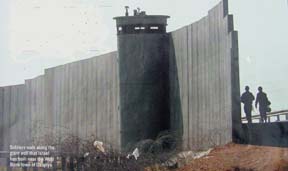
About 70 miles of the 370-mile fence have been built. The average width is 198
to 330 feet. The fence is composed of razor-wire coils, 13-foot trench, patrol
road, path for detecting footprints, 10-foot high fence with electronic sensors,
13-foot trench, razor-wire coils. (OCR, 7/30/03, News 13) (picture below)
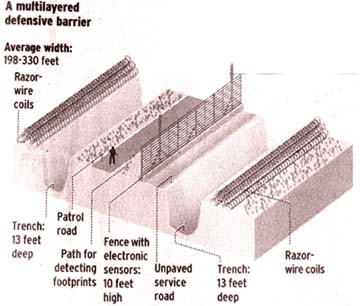
|
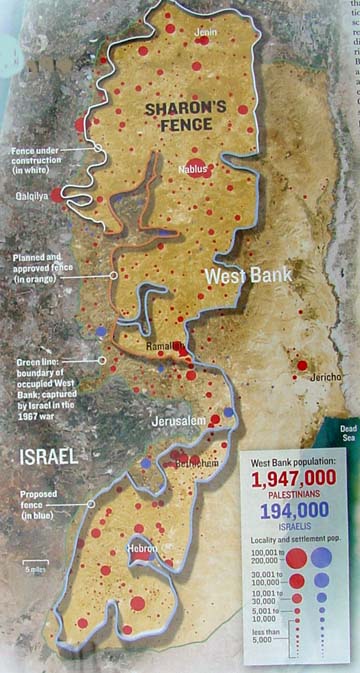 |
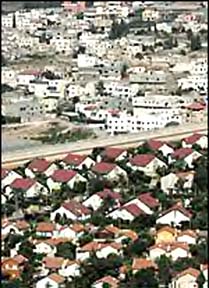 |
SEPARATE: This
aerial view shows Israel's separation barrier running between an Israeli
town (bottom) and a Palestinian one (top), just south of the West Bank
town of Qalqilya
(AP, 2/27/06)
|
Ethnic
violence erupted in Cypress in December 1963, three years after independence
from Britain. The violence escalated until 1974, when Greece attempted to make
Cypress a part of Greece. Turkey invaded, resulting in 6700 dead or missing, and
215,000 displaced on both sides. 35,000 Turkish troops partitioned Cypress, with
1/3 going to the Turks, who were 25% of the population. An uneasy peace
has existed since then. Now, 27 years later, serious talks are underway to
resolve the differences, form one nation, and join the European Union. (LAT,
1/16/02, A1) [An example for mideast peace: partition,
cooling off period, serious peace negotiations?] ..... Talks to reunify Cypress
are deadlocked, with Turkey threatening to annex the Turkish area. (OCR,
6/14/02, News 38)
The
Hefer Valley is a narrow nine-mile wide strip of land where Israelis are
squeezed between between the Palestinian West Bank and the Mediterranean Sea. A
thick concrete wall, 8 feet high and one mile long, separates an Israeli town
(Bat Hefer) and a Palestinian city (Tulkarm), about one mile apart. The wall is
being extended 600 yards with a 10.5-foot high fence. An electric fence, with
surveillance cameras, also is being installed. (LAT, 9/10/01, A1) ..... Palestinian
gunmen evaded an electric fence and night-vision equipment to attack a heavily
fortified army base in southern Gaza. Three Israelis were killed and seven
wounded, before two gunmen were killed. (LAT, 8/26/01, A1) ..... In the 10
cease-fires since 1993, Hamas used the time to regroup and rearm. Hamas recently
said that they reject a two-state solution and there can be no compromise. The
security fence is in response to 1000 days of terrorism and 800 deaths, mostly
women and children. The fence is needed because the Palestinians refuse to live
in peace. Not one suicide bomber has come from the fenced-in Gaza Strip,
compared to 300 from the West bank with no fence. Israel had to fence its
borders with Lebanon, Syria, and Jordan. U.S. has fenced parts of the Mexican
border. There is a wall between Greek and Turkish Cypriots. (USN&WR,
8/11/03, 60) ..... American troops in Iraq are enclosing entire villages in
barb wire, demolishing buildings, imprisoning relatives. The counterinsurgency
campaign is similar to that used by Israel. (OCR, 12/7/03, News 27) ..... Fences
of razor wire, watch towers, and minefields separate Israel from its other
neighbors Lebanon, Syria, and Jordan. But most of the 320 km (200 mile) border
with Egypt is literally just a line in the sand. At least seven militants
from the Gaza Strip have slipped into Israel by way of Sinai. Three gunmen, and
an Israeli army patrolman, were killed in ensuing clashes -- prompting Israel to
set up an airborne special forces unit that is always on standby. The other
militants were arrested. (Sex, Flies and Videotape on Sinai Smuggling Routes, by
Dan Williams, Reuters, 8/26/04)
JERUSALEM (06/17/05, AP) - Israeli Navy building a sea
barrier to keep out Gaza attackers, The Israeli navy is building a sea
barrier off the coast of northern Gaza to keep out potential attackers once
Israel pulls out of the coastal strip this summer. The navy concluded the
barrier, stretching 950 meters (yards) into the sea, is necessary because of the
loss of surveillance systems in the planned pullout. Designed to keep potential
attackers from swimming to the Israeli coast, the barrier's first hundred meters
(yards) will consist of cement pilings buried into the sandy bottom; the
structure will extend another 800 meters (yards) in the form of 1.8-meter-deep
fence floating beneath the surface. The navy is also refurbishing its radar
system at the Erez Crossing between Gaza and Israel. Construction of the new sea
barrier will begin soon and that it will be a major project costing millions of
dollars. The barrier is not expected to be complete in time for Israel's planned
withdrawal from Gaza, set to begin in mid-August. Gaza, home to 1.3 million
Palestinians, is surrounded by an Israeli fence built to keep back attackers and
which prevents Gazans from being able to come and go. Israel is also building a
barrier between itself and the West Bank. ..... A Palestinian suicide bomber
attacked a bakery in this southern Israeli resort town on Monday, killing three
people and himself, police said. It was the first
suicide bombing in Israel in nine months and the first ever to hit Eilat,
Israel's southernmost city. It was the first suicide bombing in Israel
since last April, when a bomber struck a Tel Aviv restaurant, killing 12 people.
Suicide bombings were at their
height four years ago, when hundreds of Israelis were killed in dozens of
attacks. (AP, 1/29/07) http://www.wkrn.com/nashville/news/ap-suicide-bomber-kills-at-israeli-bakery/74361.htm
"Today there is no [peace] process and no hope, said
Dennis Ross, long time American mediator in the middle east. "What we're
facing is not even an attempt to defeat the other side, but a kind of
exhaustion. Israel doesn't think it has a partner for peace any more. It just
wants to be done with it, just to build a high
wall." (OCR, 8/12/01, News
12) [Turkey was condemned for partitioning Cyprus in 1974. It may have been unfair and
wrong, but it seems to have stopped the fighting there.] ..... Ariel Sharon said
that Israel would create buffer zones
to achieve security separation from the Palestinians, and any Palestinian
state be demilitarized. (OCR, 2/22/02, News 23) ..... Cyprus reunification talks
failed when Turkey demanded full recognition of Turkish Cyprus and Greece
demanded that refugees be allowed to return to their homes. (OCR, 3/11/03, News
15)
| For Israel, the barrier is a 'life and
death' issue |
|
Israelis call it a "security fence." Palestinians call it
an "apartheid wall." Call it what you like, Israeli officials
say, but the barrier has been a effective means of warding off suicide
bombings.
"The fence is a success story and the fence is saving lives. In
areas where the fence has gone up, there has been something like a 90-percent
success rate in stopping suicide penetration," says Mark Regev,
spokesman for the Israeli Foreign Ministry. "In
2006, we've had fewer successful suicide bombings than we had in one week
in 2002. That's in large part because of the fence."
In response to new information indicating that the barrier's route
was motivated by the demographic struggle that is one of the underpinnings
of the Israeli-Palestinian conflict, Mr. Regev says that it is natural
that the mappers of the barrier took Israel's concerns about a rising Arab
population into consideration. "The government's positioning of the
fence does take into account demographic realities, topographical
realities, and security concerns," Regev says. "The object of
the fence is to have as many Israeli citizens as possible protected by the
fence."
Regardless of the route, he adds, Israel is bound to be the subject
of criticism here.
"If this were a land grab, then we should have included all of
Shuafat in the area of the fence," he says. "Look at Jerusalem.
If we put areas of East Jerusalem inside the fence, we're accused of
annexing Jerusalem. But if we leave them out, we're cutting off
Palestinians from their brothers on the other side of the fence. I think
the arguments about the route tend to be disingenuous."
"The route can be changed, and one day when there's peace, the
fence will come down," Regev says. "This is the fence that is
designed to keep suicide bombers out. We have an obligation to let people
pass through it and that's why there are gates in the fence."
The Israeli government calls the barrier a fence, he says, because
more than 90 percent of the route from north to south is made of fencing.
The difficulties it causes, he says, pale in comparison with its success.
"We understand that there has been a negative impact on the
quality of life, and it's our obligation to do everything we can to
minimize that negative impact," he says. "But we're talking
about a quality of life issue, while on my side of the fence, it's a life
and death issue."
|
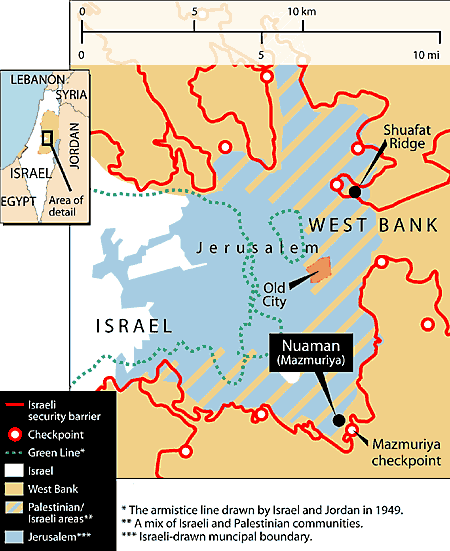
http://www.csmonitor.com/2006/1219/p01s04a-wome.htm
(CSM, 12/19/06)
Palestinian Suicide Attacks Since 2001
-- During more than six years of Palestinian-Israeli violence, 540
people have been killed in 130 Palestinian suicide bombings. Some
of the deadliest suicide attacks in Israel:
_ Jan. 29, 2007: A bombing at a bakery in the southern town of Eilat
kills three.
_ April 17, 2006: A bombing kills 11 Israelis in Tel Aviv.
_ Dec. 5, 2005: An attacker kills five at a shopping mall in the
coastal town of Netanya.
_ Oct. 26, 2005: A bomber kills five people at a falafel stand in
Hadera.
_ July 12, 2005: Bombing kills five at a shopping mall in Netanya.
_ Feb. 25, 2005: In the first attack after a truce, a bomber blows
himself up in crowd near a nightclub in Tel Aviv, killing four.
_ Aug. 31, 2004: Two bombers set off explosives in buses in Beersheba,
killing 16.
_ March 14, 2004: Two bombers attack Ashdod port, killing 10.
_ Jan. 29, 2004: Bomber on a bus on Gaza Street in Jerusalem kills 11
people.
_ Oct. 4, 2003: Bomber kills 19 people at a seaside restaurant in
Haifa.
_ Sept. 9, 2003: A bomber kills eight Israeli soldiers at a bus stop
near an army base outside Tel Aviv.
_ Aug. 19, 2003: A bomber blows up a bus in Jerusalem, killing 23
people.
_ June 11, 2003: A bus bombing on central Jerusalem's Jaffa Street
kills 17.
_ March 5, 2003: A bombing on a bus in Haifa kills 17 people.
_ Jan. 5, 2003: Two bombers strike the Neve Shaanan pedestrian mall in
Tel Aviv, killing 23.
_ Oct. 21, 2002: A bombing on a bus in northern Israel kills 14
people.
_ June 18, 2002: A bomber kills 19 in southern Jerusalem.
_ June 5, 2002: A bus bombing near Megiddo Junction in northern Israel
kills 17.
_ May 7, 2002: A bomb attack at a pool hall in the Tel Aviv suburb of
Rishon Letzion kills 15.
_ March 31, 2002: A bomber kills 15 at a restaurant in Haifa.
_ March 27, 2002: An attacker kills 29 people in Netanya during a
ritual Seder meal at a hotel dining room at the start of Passover.
_ March 9, 2002: A bomber kills 11 at Jerusalem's Moment Cafe.
_ March 2, 2002: An attack kills 11 in Jerusalem's ultra-Orthodox Mea
Shearim neighborhood.
_ Dec. 2, 2001: A bomber kills 15 on a bus in Haifa.
_ Dec. 1, 2001: Two bombers strike Jerusalem's Ben Yehuda pedestrian
mall, killing 11.
_ Aug. 9, 2001: An attack at a Sbarro pizzeria in Jerusalem kills 15.
_ June 1, 2001: A bomber kills 21 people, mostly teenagers, at a
seaside disco in Tel Aviv.
http://www.washingtonpost.com/wp-dyn/content/article/2007/01/29/AR2007012900703_2.html
(AP, 1/29/07)
SECURITY FENCE RESULTS
Firstly, there was less violence, both between Israelis and Palestinians,
and between Palestinians and Palestinians, than there had been for years. Among
other landmarks, 2009 was the first year
in a long time without any successful suicide bombings against Israel.
Then, there was the strong economic growth in both Israel and the
Palestinian territories relative to most of the rest of the world, for which
2009 was a bleak year. (While Gaza is not undergoing the same kind of economic
growth enjoyed by the West Bank, the standard of living there is nonetheless
considerably better than you would suppose from the distorted picture provided
by certain partisan journalists and NGO workers, and much better then in many
other areas of the world.) And most importantly, 2009 was the year that a Likud
Prime Minister, Benjamin Netanyahu, not only recognized the principle of an
independent Palestinian state, but also made the most sweeping freeze on Israeli
settlement-building in the West Bank since 1967.
Every informed observer knows that for a realistic two-state solution to
be achieved, Israel cannot return to what Abba Eban famously referred to as
Israel's "Auschwitz borders" (i.e., borders that were indefensible),
and that there will be land swaps between Israelis and Palestinians so final
borders will more closely reflect demographic and security considerations.
Indeed as long ago as 1967, the international diplomats who carefully crafted
U.N. Resolution 242 acknowledged that the 1967
borders would not and should not necessarily constitute Israel's final
boundaries. They made clear in the wording of their text that they
believed that not all of the land previously occupied by Jordan (land that has
come to be known as the West Bank) should necessarily be relinquished by Israel.
(Wall Street Journal, 1/27/10)
http://online.wsj.com/article/SB10001424052748703906204575027383170233218.html?mod=googlenews_wsj
Arafat,
Hamas, and terrorism 
Arafat
wants
all the land taken by Israel in the 1967 war to be placed under Palestinian
control. Sharon is less concerned about a belief in Israel's birthright to the
land, but more about a cold appraisal of security and resource needs, and a
pessimistic view of the possibility of reconciliation with Arab neighbors. (OCR,
10/12/01, News 38) ..... "The Palestinians who claim that every inch of the
West Bank must be returned should learn some history, The world is full of
territory lost by those who start and then lose wars. The
Arabs have no right to the land they lost
by their own folly. ..... Israel cannot trust Arafat as a negotiator and must
see to its own security. A
fence
and separation for a generation seem the best chance." (OCR,
4/21/02, Commentary 1) ..... Yasser Arafat "saw the Oslo peace accord not
as a means to a two-state solution but as a means to the substitution of a
Palestinian state for the State of Israel." "Arafat violated most of
the essential elements of Oslo, inciting Palestinians to hatred while erecting
and empowering a murderous terrorist network." (USN&WR, 7/12/04,
140)
The terrorists
understand only the language of force and can be stopped only by means of force.
There can be no appeasing of terrorists and no apologies for states like Syria
that coddle them. Abu Mazen refuses to rein in the Palestinian Authority's
anti-Semitic, anti-Israel rhetoric that spews endlessly from TV and other public
platforms. Listen to the words of hate, and you'd never guess there's a
cease-fire in place. Palestinian rhetoric leaves no lines to which Israelis can
withdraw from the collective Palestinian desire to annihilate
the Jewish state. Hezbollah, is sponsoring most of the terrorist activity
in the West Bank. Like Islamic Jihad, Hezbollah has headquarters in Lebanon and
Damascus and is, thus, less susceptible to Israeli pressure. Supported by Iran
and Syria, Hezbollah recently increased the bounty for spilling Jewish blood
from $5,000 to $20,000. (USN&WR, 3/14/05, 72) ..... GAZA - Hamas militants said
they would not disarm despite Israel's planned Gaza pullout, so they could carry on their fight against the Jewish state.
Hamas, sworn to Israel's
destruction, made clear it has not budged from its historic goal of a creating an Islamic state that would encompass not only the West Bank and Gaza Strip but also what is now Israel. "We will draw the map of Palestine from the sea to the river and from Lebanon to Egypt." (Reuters, 08/12/05)
Palestinians will have to detoxify their society before
anything like a real peace can exist. Too many Palestinians have devoted
themselves for far too long not to the creation of a two-state solution but to
the eradication of one state and
one people: Israel and the Jews. Arafat
made moderation synonymous with treason. He established a cult of total victory
and a culture of hatred toward Israel; he legitimized terrorism and suicide
bombings; he used the mosques, the media, and the schools to instill his animus
in his people, even among the youngest children. A temporary cease-fire is no
solution. It will simply raise Israeli suspicions that time is being bought to
give Hamas, Islamic Jihad, and the al-Aqsa Martyrs Brigades a respite to rebuild
their arsenals. None of them will forswear the destruction of Israel. Why?
Simply because terrorist groups are rarely, if ever, truly neutralized unless
they are disbanded and disarmed, for their credo is "I kill, therefore I
am." Abu Mazen is also a
Holocaust denier who asserts that the Temple never existed in Jerusalem. He
supported Arafat when he rejected the Camp David proposals four years ago. Abu
Mazen mouthed Arafat's doctrines, including a pledge to return all of
Palestinian refugees, now totaling 4 million, to the pre-1948 original home of
their ancestors in Israel and to oust Israel from all of the West Bank. The
"right of return," he said, was a nonnegotiable prerequisite. The
implementation of this demand would destroy the Jewish character of Israel and
is clearly a nonstarter. Abu Mazen has attacked Israelis as "Zionist
enemies" and vowed that he would not only never attack members of Hamas,
Islamic Jihad, Hezbollah, and al-Aqsa but defend them instead. Palestinians see
Abu Mazen as a member of the old guard, the Tunis thugocracy that came to
Palestine and became rich men. (USN&WR,
1/24/05, 60)
Yasser Arafat was personally responsible for the murder of eleven Israeli athletes at the 1972 Munich Olympics; he directed the execution of two American diplomats in Sudan; he masterminded the cold-blooded murder of 25 people – 21 of them children – in Ma’alot, a city in northern Israel; he authorized the takeover of the Italian cruise ship ACHILLE LAURO, and the murder of a wheelchair-bound American citizen. He was the originator of the infamous crime of suicide bombings and brought it to a horrified world. He was the inventor of the hijacking and bombing of airplanes that killed thousands. And that is just the tip of the evil iceberg. Arafat rejected a more than generous offer that gave virtually everything he ever demanded, except the “right of return” of the descendants of the Palestinian “refugees,” which would have been the end of the Jewish state. Arafat decided instead to start his bloody “intifada,” which by now has cost over 1,000 Jewish lives – and three times as many Arab lives and untold thousands wounded on both sides. The Palestinian economy is in ruins. More than one-half of its population is without work; famine would be rampant were it not for the constant infusion of cash by the U.S. and other western countries (most of it pilfered by Arafat and his cohorts and stashed in secret accounts all over the world). But the greatest harm, the greatest crime that Arafat committed was to poison the minds of two generations of Palestinian Arabs against Israel and against the Jews. Evil propaganda permeates all Palestinian media. Palestinian children, beginning with pre-school, learn to hate Jews and Israel, and to become “shahids” – martyrs and suicide bombers. The State of Israel does not appear in Arab textbooks; the area is described as “Occupied Palestine.” Even with the best effort, it may take at least two generations to change that mind set.
It seems almost incredible and a cruel joke that such a man, such a fiend, would have received the Nobel Peace Prize and that presidents, prime ministers and secretaries of state of major countries would have attended this man’s funeral in Cairo.
Arafat left his people and the territory that the Israelis had generously yielded to him in a shambles. He refused to create any institutions that could possibly become precursors to a government. He looted the treasury that foreign countries – mostly, of course, the United States – had generously provided for the welfare of his constituents. He implanted hate and poisoned the minds of his people. His main interest never seems to have been the creation of a Palestinian state; his primary goal, ceaselessly pursued, was the destruction of Israel. With that heritage, it will take a very long time, if it can ever happen at all, that peace between Arabs and Jews can come about.
http://www.factsandlogic.org/ad_89.html
JERUSALEM (09/09/05, AP) - Arafat's Death Remains a Mystery.
Newly revealed medical records have failed to solve the mystery of Yasser Arafat's death, although they do cast doubt on popular conspiracy theories about poisoning or rumors of AIDS. But the main question - what led to the massive stroke that killed the longtime Palestinian leader - may never be answered. Arafat, 75, died Nov. 11, 2004, in a French military hospital near Paris after a sudden, rapid decline in his health. Arafat's wife, Suha, refused an autopsy and Palestinian leaders have never given a definitive cause of death. French doctors who treated Arafat concluded he died of a "massive brain hemorrhage" after suffering intestinal inflammation, jaundice and a blood condition known as disseminated intravascular coagulation, or DIC. But the records are inconclusive about what brought about DIC, which has numerous causes ranging from infections to colitis to liver disease. Since Arafat's death, rumors have swirled throughout the Middle East that Arafat died from either AIDS or poisoning. Many Palestinian officials insist that Israeli agents somehow poisoned him. Poisoning was highly unlikely; toxicology studies done by the French doctors were negative and said Arafat did not suffer extensive kidney and liver damage typical of poisoning. Arafat's condition improved in the hospital and that he was able to walk and talk before slipping into a coma Nov. 3. Such improvement would make poisoning unlikely. An unidentified Israeli infectious-diseases expert as criticized the French medical team for not testing for AIDS. But the expert said after studying the records, AIDS was unlikely due to the sudden onset of an intestinal illness.
For two decades, Hezbollah's Islamic fanatics have been a foreign legion for Iran in Lebanon, dedicated to hate and violence. When thousands of them cried, "Death to America! Death to America!" in response to a speech last year by Sheik Hassan Nasrallah, Hezbollah's leader, they meant it. Before 9/11, Hezbollah was responsible for more American casualties than any other terrorist organization.
What of the civilian deaths, exemplified by the tragedy of Qana? A truer picture is summarized by a cartoon showing an Israeli soldier standing defensively in front of a baby carriage, while a soldier of Hezbollah fires at Israel from the other side of the baby carriage. To kill Israelis, Hezbollah cynically hides behind women and children, just as it deliberately dug bunkers in the crowded suburbs of Beirut. Yet these abuses don't attract much international condemnation, especially from the anti-Israel United Nations. It is only luck and tough security measures that have prevented large-scale Israeli tragedies. By contrast, Israel warns the Lebanese population in advance of attacks and urges people to leave the area. Warnings preceded the bombing of the Hezbollah rocket site in Qana--which is still a mystery. The building collapse came seven hours after the bomb fell on or near it. If the blast was perceived as a danger, why didn't Hezbollah or the Lebanese get the civilians out? Hezbollah has clearly violated the most basic laws of war, including the Geneva Conventions, which require parties to a conflict to "avoid locating military objectives within or near densely populated areas" and state that "the presence of a protected person [i.e., a civilian] may not be used to render certain points or areas immune from military operations."The Geneva Conventions also forbid exactly what Hezbollah was doing at Qana, that is, concealing weaponry among civilians, as revealed in video footage from an Israeli drone showing a Hezbollah rocket launcher firing from a spot directly adjacent to the building struck in Qana. Israeli forces didn't know that dozens of civilians had found refuge there. Hezbollah did when it set up its rocket launcher there. International law is not a suicide pact.
(8/6/06) http://www.usnews.com/usnews/opinion/articles/060806/14edit_3.htm
Israel pulled out of Gaza more than a year ago, but instead of using their independence to build a Palestinian state, the Gaza Arabs have been killing each other, as well as trying to kill Israelis. Factional fighting between
Hamas forces loyal to Prime Minister Ismail Haniyeh and the Fatah forces more or less loyal to President Mahmoud Abbas verges on a civil war. The turmoil will threaten Israel, which cannot be expected to stand aside as it did to its cost in southern Lebanon while Hezbollah grew strong enough to rocket Israeli cities. In Gaza, every intelligence, police, military, and security agency predicted violence if the security of the Gaza-Egypt border, the Philadelphia Route, was left to those parties when Israel withdrew. Secretary of State Condoleezza Rice forced the Israelis to agree to the deal-and the border has indeed become a sewer for terrorists and weapons. The Egyptians have betrayed their obligations, even though Hamas is a threat to Egypt. The Israeli Defense Forces have discovered as many as 100 transborder tunnels, through which some 20 tons of explosives, tens of thousands of rifles, RPGs, rockets, and missiles of all kinds have been shipped. The Gazans have made matters worse by building hundreds of short-range Kassam rockets to rain on southern Israel. None of this is in the interest of the people of Gaza. Their vote for Hamas back in January has brought anarchy, corruption, chaos, and tribal wars. Abdallah Awad, columnist for the Palestinian daily Al-Ayyam, writes: "The factions, which not long ago were, in the eyes of the public, the guarantee for ridding ourselves of the occupation and for freedom and independence, have become ... another occupation, more repressive than the [Israeli] occupation itself." Hamas simply isn't interested in peace; in the latest survey, two thirds of Gazans reject peace with Israel while almost as many believe in shelling Israeli cities. Hamas ensures further bloodshed by indoctrinating Palestinian children. They are not born hating, but from the age of 3 their radical leadership incites them to murder. The hate pervades the educational system, TV broadcasting, summer camps, children's trading cards, movies, music, even games that make martyrdom a major theme. A Palestinian psychiatrist recently reported that over half the Palestinian children between the ages of 6 and 11 dream of becoming suicide bombers. And in this perverse and tragic pursuit, they are urged on by their prime minister, Haniyeh. "One of the signs of victory," he told a rally recently, "is the Palestinian mother who prepares her son to be a warrior and then receives the news of his death for the sake of Allah with cries of happiness." Hamas prefers to let the Gazans suffer in the hope that sympathy for the victims of its own intransigence trump reason and sound judgment. Hamas, in truth, is not a nationalist force. It is part of the global movement of jihad, a Palestinian arm of the Muslim Brotherhood founded in Egypt with the goal of eliminating Israel with help from its Syrian and Iranian backers. Middle East diplomats, so enamored of process, keep hoping the right dose of concessions will somehow result in mutually reinforcing perceptions of security. This is hopelessly naive. For now and the foreseeable future, the seat on the other side of the table across from Israel is occupied only by a death's-head.
(11/5/06) http://www.usnews.com/usnews/opinion/articles/061105/13edit_2.htm
A
captured Hamas leader, who recruited and trained Palestinian suicide bombers,
said they could strike anywhere and anytime they wanted. He claimed that most
Palestinians would be willing to sacrifice their lives to accomplish their goal
to destroy Israel. They are promised martyrdom, which includes everlasting happiness
with 70 virgin wives. (CBS, Sixty Minutes, 8/19/01) ..... Hamas,
sworn to wipe
out Israel,
wants the Jewish state and the Israeli-occupied West Bank and Gaza Strip for a
future Palestinian state run in accordance with Islamic
law.
(Reuters, 03/25/04 11:10 ET) ..... Islamic
terrorists in suicide missions are told they will be rewarded in heaven with 72
virgin brides. However, females are promised little rewards, possibly explaining
why so few volunteer. (USN&WR, 2/25/02, 6) ..... UCLA Islamic Law Prof.
Khaled Abou El Fadl said that studies of the Koran suggest that the rewards for
martyrdom should actually be translated as "raisons,"
not "virgins."
(USN&WR, 4/15/02, 36) More complete info at http://win4sports.com/terror.htm#virgins
..... Despite past feuds, Hamas
now is allied with (PLO) Fatah. Hamas' goal is the
eradication
of Israel
as a Jewish
state, dismantling of Jewish settlements, return of 4 million Palestine
refugees, establishment of Islamic state with Islamic law. (OCR, 4/4/02, News 7)
..... Hamas repeated "its demand that all of historic Palestine - including
all of
modern-day Israel - should be in Arab hands."
(OCR, 8/23/02, News 40) ..... Dogs are a new weapon against terrorists. Dogs can
detect bombs from surprising distances. "Islamic radicals believe that dogs
are dirty, and if Fido's blood is mixed with that of a 'martyr,' he will not
ascend to paradise and win his 72
virgins.
As a result, some officials want to place
dogs at sites most threatened
by suicide bombers." (USN&WR, 9/29/03, 2) ..... Hamas leader Ahmed
Yassen said that Muslims will defeat America, and those carrying bombs and
blowing themselves up (suicide
attackers)
are destined for paradise. (OCR, News 15, 9/25/03)
Hamas
teaches children to hate Jews. http://www.youtube.com/watch?v=eTGbP55HGi8
There are one million male
students studying in Pakistan's 10,000 mostly militant Islamic religious
schools. The students range from 8 to 35 years, are
taught to hate
and kill
Americans, and many become
Pecharich terrorists.
(Reader's Digest, 1/02, 70) ..... "More than a million of the
[Palestinian] refugees from the 1948 war live in 59 camps scattered throughout
the West Bank, Gaza, Jordan, Syria, and Lebanon. The camps have supplied most of
the fighters willing to kill themselves." (OCR, 3/10/02, News 4) ..... On
3/9/77, About a dozen armed Hanafi Muslims invaded three buildings in Washington
D.C., killing one person and taking more than 130 hostages. The siege ended two
days later. (OCR, 3/9/02, Accent 7)
Three
14-year old Gaza male classmates left suicide notes about martyrdom,
attacked a Jewish settlement in Gaza with homemade pipe bombs, and were killed.
Interviewed Palestinians blamed the deaths on Israel for causing a sense of
hopelessness and traumatizing the boys. [The Palestinians refuse to accept any
responsibility for the deaths of the boys. The boys have been taught in school
to hate the Jews, that Israel must be destroyed, and to die for the cause leads
to martyrdom. Either the Palestinians are lying to us, lying to themselves, or
both.] (OCR, 4/25/02, News 21) ..... "The Arab world seethes with hatred
of the Jews
as rabid as the Nazi's. ... it is the Arab world that preaches 'Kill the Jews!'
and dances in the street when terrorists do so." (OCR, 9/29/02, Commentary
6)
"Ahmed Tibi, a former
advisor to Arafat and now a member of Israel's parliament, accused Arab states
of hypocrisy when they cite Palestinian corruption as an obstacle to financial
aid. Many of the regions other leaders are every bit as corrupt, he said."
(L. A. Times, 3/27/01, A4) ..... Bush urged Arafat to purge his
administration of the corruption
that is the source of much criticism from Palestinians themselves. European
leaders echoed those comments. (OCR, 5/3/02, News 4) ..... "Palestinians
resume their calls for democratic reform and an end in what is widely seen as
rampart corruption." (OCR,
5/14/02, News 11) ..... Israel estimates that Arafat's
personal property is worth $2 billion. (Newsweek, 1/27/03, 46) [Rags
to riches!] ..... For ten years it has been alleged that Arafat, and a few close
advisors, have diverted millions of dollars to secret bank accounts. The
Palestinian Authority's first public accounting claims it has $600 million in
liquid assets. (OCR, 3/1/03, News 38) ..... Arafat
has violated every agreement he has made. Arab leaders also have stopped
trusting him. (USN&WR, 9/29/03, 68) .....
Arafat
appropriates $800M,
By
the JPost.com Staff November 7, 2003 The CBS-News program 60 minutes will report
Sunday that PA Chairman Yasser Arafat
has diverted $800 million to his private accounts
from Palestinian Authority aid money. According to the report, Arafat continues
to send his wife Suha an additional $100,000 – also from PA aid funds – each
month to Paris, where she lives with their daughter. PA Finance Minister, Salam
Fayad is currently tracking down missing PA finances, and is reported to have
assisted CBS in their report. http://www.jpost.com/servlet/Satellite?pagename=JPost/JPArticle/ShowFull&cid=1068185482292
Arafat's principal legacy is hate, his gift to the world a kind of terrorism whose techniques have been aped from Indonesia to Iraq. Arafat was resolute in refusing to prepare his people for peace. He used every platform--radio, TV, newspapers, the mosques, schools, even summer camps for kids--to inculcate a hatred of Jews, Israel, and the West. The Jews, Arafat declared, "never lived in or ruled Palestine.
They were relying on false mythological sources," i.e., the Bible. Canaan, for Arafat, was not the Promised Land for Abraham, Isaac, Jacob, and their descendants; it was the land of banishment. For good measure, he added that "there was no temple in Jerusalem," thus denying that Jesus ever walked there, preached there, or was crucified there. A Palestinian poll in Gaza asked whether rockets and mortar attacks on Israeli towns should continue even after Israel's full withdrawal: 51 percent approved of more attacks. Only 42 percent said no. A couple of years ago, another poll found only 26 percent of Palestinians favored stopping terrorist attacks--even if they were to receive all of the West Bank and Gaza, East Jerusalem, and sovereignty over the Temple Mount. Hundreds of millions of dollars
Arafat received to improve life for Palestinians were diverted to support a terrorist network. Now the Palestinians are to be guided, it appears, by some 10 feuding groups and their warlords who have about 40,000 guns (to say nothing of the criminal gangs that control swaths of the West Bank and Gaza).
(USN&WR, 11/29/04, 68)
Yasser
Arafat ‘has £1.8bn fortune’ A TELEVISION
documentary is to claim that Yasser Arafat, the Palestinian president, has
amassed a personal fortune of up to £1.8bn and his wife is given tens of
thousands of pounds each week to fund a lavish lifestyle in Paris. The
£1.8bn estimate of Arafat's personal fortune is almost six times higher than
had been previously been touted. According to a report in the New York Daily
News, the CBS show 60 Minutes will claim on Sunday that he has amassed a
personal fortune of between £602m and £1.8bn. It will also claim that Arafat's
wife, Suha, 40, who lives away from the struggles of her homeland, is given more
than £60,000 a month from Palestinian Authority funds.
Lesley Stahl, a CBS correspondent, told the
newspaper that Raymonda Tawil, Mrs Arafat's mother, is apparently enjoying life
in Paris at the expense of the Palestinian taxpayers. http://ww1.theherald.co.uk/news/4130-print.shtml
..... "Yasser Arafat has run a system built on corruption
and repression. His aids reap money from many sources in all corners of
the dirt-poor territories -- brazenly showing off their newfound wealth with
grand new homes and fancy cars. ... The most senior PA officials are stealing
the money that belongs to the people. ... hundreds of millions of dollars have
disappeared from the PA treasury." Palestinians are fed up with PA
repression, extortion, and demand for bribes. (USN&WR, 7/1/02, 16) [Many
horrifying examples in article.] ..... Arafat Fends Off Challenge Over
Reforms, By MOHAMMED DARAGHMEH, AP, RAMALLAH, West Bank (Aug. 26, 2004) -
Veteran Palestinian leader Yasser Arafat turned back another effort by critics
to force him to reform his bloated,
corruption-plagued administration. The recommendations included forming a
viable government capable of fighting corruption more effectively and restoring
law and order. It also called on Arafat to follow through on promises made in a
speech last week to crack down on graft. ..... Starting in 1979, Arab
countries gave the PLO about $200M per year for 10 years. They stopped when
Arafat supported Saddam Hussein, who gave $150M. From 1993 to 2000, Israel gave
about $4B in tax rebates to the PA. From 1994 to 2003, other countries donated
$6.5B to the PA. Thus, more than $12.5B
has been given to Arafat, who refuses
to give an accounting of his financial empire. Arafat's wealth is
estimated to be between $3B and $5B. When he was 62, he secretly married a
28-year-old woman. His wife flew to Paris to give birth because she said
conditions in Gaza were terrible. His wife and daughter live a lavish life style
in Paris on $100,000 per month. $11.4M allegedly was transferred to the wife's
bank account between 7/02 and 9/03. (OCR, 11/9/04, News 14) ..... The
Palestinian attorney general said that senior officials in the authority may
have stolen billions of dollars
of public funds. (OCR, 2/6/06, News 11)
On Sept. 9, 1993, Yasser Arafat
signed a letter to Israeli Prime Minister Yitzhak Rabin pledging that the
Palestine Liberation Organization "recognizes the right of the State of
Israel to exist in peace and security." That was a lie.
The list of crimes the PLO chairman has incited or been associated with over the
years would stain every page of a good-sized book. Highlights, however, would
include the slaughter of athletes at the 1972 Olympics by Black September; the
assassination of U.S. diplomats in Sudan in 1973; the massacre of schoolchildren
at Maalot in 1974; a bus hijacking that killed 35 civilians in 1978; the slaying
of Leon Klinghoffer on the Achille Lauro in 1985; the torture and execution of
Palestinian dissidents, especially during the intifada of the late 1980s and
early '90s; and the suicide bombings of the Al Aqsa Martyrs Brigade in more
recent years. Even those incidents provide but a flavor of Arafat's culpability
in the decades-long terrorism that sabotaged the likelihood of Middle East
peace. Given an opportunity in '93 to lead the Palestinians in setting up a
state of their own, Arafat botched it utterly, staffing a soon-to-be corrupt
Palestinian Authority with cronies and thugs. At every turn, meanwhile, he
walked away from the possibility of a settlement with Israel. Most notably in
the fall of 2000, he left on the table a two-state
solution that gave the Palestinians nearly everything they could realistically
expect in terms of territory and a capital in East Jerusalem. In the four
years of violence that have followed, Arafat has made no serious efforts to halt
suicide bombings against Israeli civilians or to rein in the violence that has
made a shambles of the economy. No doubt part of the reason for this feeble
performance is that his Fatah movement and the PA itself are implicated in the
attacks. (Rocky Mountain News, 11/5/04) ..... Arafat realized early that Arab
dictators would pay to keep the Palestinian issue alive because it gave
them an all-purpose diversion from the disaster they were wreaking on their own
societies. Arafat became the custodian of the Palestinian grievance for
everyone. (OCR, 11/5/04, Local 7) ..... "Arafat
has said he was born in Jerusalem, though biographers have concluded that his birthplace
was Cairo." (OCR, 11/6/04, News 4)
Marwan Barghouti, a senior
official in Arafat's Fatah movement, said, "I think that President Arafat
is not only supporting the uprising but also the leader of it." Israel has
long charged that Arafat has directed the violence. Arafat has denied that he is
behind attacks on Israelis by Palestinian militants and has suggested he is
doing everything he can to stop the violence. (LAT, 9/1/01, A4) ..... Netanyahu
said that Arafat
tells his people in Arabic every night that they ought to annihilate
the Jewish state.
He has violated dozens of cease-fires, using them just to rearm. (OCR, 4/4/02,
News 2) ..... President Bush said Arafat
has not earned his trust. "I mean, here's a man who said he has signed on
at Oslo that he was going to fight off terror. We thought we had a cease- fire
arranged. We were close to a cease-fire, and the next thing we know, there's a
suicide bomber that hits. We thought a couple of months ago that ... we had an
agreement. The next thing we know, he's ordered a shipment of arms from
Iran. He's got a long way to go." (OCR, 4/6/02, News 11) ..... After
Arafat
rejected Israel's offer at Camp David, he said, "Look, we've got 150
years, and we'll throw them into the sea." Arafat has lied about everything
and to everyone. Arafat's colleague Mazen Izz al-Din said on a PLO television
broadcast "One day history will expose the fact that the whole intifada and
its instructions came from Brother Commander Yasser Arafat." Dennis Ross
wrote that he never met an Arab leader that trusted Arafat. (USN&WR, 7/8/02,
68) ..... Arafat told Italian journalist Oriana Fallaci: "We don't
want peace. We want war, victory. Peace for us means the
destruction of Israel
and nothing else. " (USN&WR, 5/20/02, 60) ..... However,
Hamas will not oppose Palestinian statehood despite its announced desire to destroy
Israel, he said. "It is the right of Palestinian people to have a
state in the West Bank, Gaza Strip and Jerusalem." "What we
will not accept ... is if a state was (created) in return for giving up any of
the rights of the Palestinian people," Abu Marzouk said. Hamas says all of
Israel and occupied Palestinian territories belong to the Palestinians. He
warned that no Israeli would be safe until the Israeli government caves in.
(DAMASCUS, Dec 9, 2004, Reuters)
International human-rights group Human Rights Watch said
Palestinian suicide attacks
against Israeli civilians are "crimes against humanity" and Arafat
has not done enough to deter them. No Israeli military action or violations of
international law justified such attacks. (OCR, 11/3/02, News 29) ..... For 50
years, an idealistic Jewish group from Argentina,
believing in coexistence,
lived in a kibbutz in Israeli territory bordering the West Bank. Arabs from
neighboring villages shared meals and events with the settlers. The kibbutz even
offered their own land to be used in place of Arab land for a security zone. A
Palestinian gunman from an Arafat associated group infiltrated the kibbutz and
killed five, including a mother and her young sons (4 and 5). (OCR, 11/12/02,
News 11) ..... Palestinian gunmen in Gaza killed
a pregnant Israeli woman and her four young daughters
as they headed into Israel. (OCR, 5/2/04, News 9)
Arafat
"has shown a contempt for working democracy. Corruption and nepotism are
rampant ...... a judicial system is virtually nonexistent, most media are
state-controlled and the legislature is powerless." (LAT, 12/11/01,
A18) ..... "Yasser Arafat
denounced Israel on Friday night as a racist colonial power at a U.N. conference
on intolerance, just hours after one of his senior aids [Nabil Shaath] announced
that the Palestinians would reject a proposed declaration that labeled Israel as
a racist state." (OCR, 9/1/01, News 29) ..... Arafat
arrested two people for making explosives used in a 1996 attack. They were
allowed to make more explosives in jail, and were recently released so they
could make the bombs used in a terrorist attack on a pizzeria that killed 15
innocent civilians. (USN&WR, 3/25/02, 60) ..... One day before Arafat
condemned terror against civilians, his wife told an Arab-language magazine that
she endorsed suicide attacks, and it would be an honor for her son to do it, if
she had one. She and her daughter (she has no son) live in
Paris.
(OCR, 4/15/02, News 4) .... Arafat said that Palestinians are against all forms
of terrorism. Then he said that terror doesn't serve their interests, not that
it is morally wrong. A few days prior, Arafat said he would outlaw suicide
bombings, but that was omitted from his speech. (OCR, 9/10/02, News 13)
..... An IMF official said Arafat
diverted $900 million in public funds to a special bank account he
controlled. Palestine legislator Hanan Ashrawi said she and others have been
aware of past misuse of funds for some time. (OCR, 9/21/03, News 35)
..... Gunmen in Arab
Beit Jala fired on civilians in Jewish Gilo. Israel sent in troops to stop the
attacks. The troops withdrew after two days when the Palestinians promised to
stop firing on Jala. An American official said, "This shows that Arafat can
stop the shooting." (USN&WR, 9/10/01, 19)
Defense
Secretary Rumsfeld said "I have no reason to believe anything a Taliban
representative would say." First they said they do not know where Bin Laden
is. Then they said the Taliban have been been constantly guarding and protecting
Bin Laden for more than two years. (LAT, 10/1/01, A1)
"Israeli
authorities contend that Bin Laden has not made greater inroads in their nation
and the Palestinian territories because of the tight control the Jewish state
maintains over its borders and the ability of Israeli-paid agents to penetrate
and spy on Palestinian groups." (LAT, 10/3/01, A6)
A survey found 46% of
Palestinians and 41% of Israelis believe there will be no peace in the
foreseeable future, 59% of Palestinians and 46% of Israelis expect the conflict
to continue for 5 to 10 year. Hatred has soared among Palestinians, with wide
support for suicide bombings and other armed attacks on Israelis. "Saleh,
69, once served as agriculture minister in the government Palestinian Authority
President Yasser Arafat, but he quit to protest rampant corruption. ..... He is
one of a daring handful of prominent Palestinians who speak out in favor of
nonviolent resistance." (LAT, 8/22/01, A6) ..... A Palestinian poll of 1179
randomly selected adult Palestinians during May 2002 shows 51% support
eliminating Israel and 43% wanted to push Israel out of Palestinian areas.
During December 2001, the numbers were 43% and 49%, respectively. (OCR, 6/12/02,
News 33)
JERUSALEM (AP, 4/11/06) - Israel on Tuesday stood by its new policy of firing
artillery shells at Palestinian rocket squads operating from populated areas
in Gaza.
The Israeli military intensified its offensive against Palestinian rocket fire
after the Hamas militant group took charge of the Palestinian Authority two
weeks ago.
In a major policy shift, it has begun allowing guns to fire close enough to
hit populated areas.
"As long as it's not quiet here (in Israel), it won't be quiet there (in
Gaza)," Israeli Defense Minister Shaul Mofaz said Tuesday.
Deputy Defense Minister Zeev Boim said
the military operations would continue as long as Palestinian militants
continue to launch rockets at Israel. The
military's task is to defend the security of the citizens of Israel,"
Boim said. "If the Hamas government will not control these terrorists
from firing Qassam (rockets) against Israeli civilians in cities and
communities, we will continue to push these citizens out of the range of these
rockets."
Since the beginning of the month, Israel has retaliated against the estimated
32 rockets that landed in Israeli territory with 16 air strikes and more than
1,000 artillery rounds, the military said. Seventeen Palestinians, including
13 militants, have died in the offensive since Friday. There have been no
Israeli casualties from the rocket fire.
Palestinian militants have threatened revenge for the Israeli military
crackdown, but the Hamas government is quietly urging them to refrain from
launching rockets at Israel without permission, officials from both sides have
confirmed.
While Hamas says it still supports armed resistance against
Israel, a halt in
violence would enable it to focus on other brewing crises.
Hamas won Palestinian legislative elections in January on a platform of ending
government corruption and improving public services. But since being sworn
into office, the government has found itself facing tough Western aid cutoffs,
Palestinian infighting and now, growing violence with Israel.
An Israeli
military report expects the conflict to continue for another 5 years. An
influential Israeli adviser has said the Palestinians "will never stop
shooting until they drive us into the sea." (OCR, 8/20/01, Local 6) .....
"The
Palestinians were attacking Jews even when they [Palestinians] controlled the
land now under dispute." (LAT, 8/26/01, M4 Letter) ..... "The 'right
of return,' meanwhile, is a rallying cry for Arabs, particularly hard-line
opponents of Israel. Many Arab states,
in hope of keeping anti-Israeli fervor alive, deny
Palestinians property, citizenship and other rights that might make their
lives as refugees easier." (OCR, 4/16/04, News 28) ..... "Israel is
better, more moral in conduct of its affairs, than any Arab nation you can name.
... Arab nations oppress their own
people and seek the destruction of Israel. They encourage, finance and
celebrate the most horrible acts of terrorism directed against innocent Jewish
citizens. (OCR, 11/1/04, Local 6)
Al
Jazeera, started
11/96, is a 24-hour
satellite uncensored television station from Qatar. It is "a
nightmare for Arab governments accustomed to determining what kind of
information their masses receive." Protests have been received from Jordan,
Kuwait, Arafat, Libya, Morocco, and others. Algeria has cut off power to prevent
receiving its broadcasts. Bahrain and Saudi Arabia will not permit the reporters
on their soil. Israel is concerned that the broadcasts incite Palestinians to
riot, yet "continues to allow its correspondents to operate freely within
its borders." Faisal al Kasim, an Arab current affairs show host on the station said, "For fifty
years, the media in the Arab world have been feeding people nothing but lies." (LAT, 5/7/01, A1)
"The
governments of the Arab nations
are among the most repressive in the world. In most of the countries, there is
no free press. There is no freedom of association. Dissent is crushed. Torture
is common. Opposition parties are weak or ineffective. ..... The lack of a
democratic outlet in Arab countries fosters a breeding ground for Islamic
extremists." (LAT, 10/8/01, A4 R)
The writer of this
article was talking to a Palestinian friend in 1994 in Jerusalem. The
Palestinian confided, "We have many caches of weapons buried there and all
over Israel. Arafat will make the 'peace' with the Israelis and when the time is
right and when we get more of the land, we'll take the guns out and take
the rest of the land." (O. C. Register, 4/1/01, Commentary 4)
Faisel
Husseini, the Palestinian leader who headed the Orient House, compared the 1993
Oslo peace accords with the Trojan horse, an attempt to subvert and ultimately
destroy Israel through territorial concessions. The Oslo agreement is a phased
goal, while ambushing and cheating the Israelis. The ultimate goal is the
liberation of all Palestine, even if this means conflict for another 1000 years.
(LAT, 8/20/01, B11) ..... In 1949, one year after Israel was established, Arafat
published the Voice of Palestine, in which he vowed to fight "the Zionist
entity" and the "agent of imperialism" in the Middle East.
(LAT, 2/10/02, A5)
Most Arabs most times believe "that
the Jewish state must be destroyed, with its inhabitants either subjugated,
exiled or killed." Syria portrays the current Palestinian violence as the
"countdown for the destruction of Israel." Lebanon claims that the
present time offers "an exceptional historic opportunity to finish off the
entire cancerous Zionist project." A Palestinian magazine children's poem
addresses Israelis: "You can choose the sea like cowards, or choose us, and
we will rip you to shreds." Zionist leader Zev Jabotinsky in 1923
explained, "So long as Arabs have a glimmer of hope to rid themselves of
our presence, they will not give it up for all sweet words and far-reaching
promises in the world." (LAT, 8/31/01, B15) ..... Author Hillel Halkin
is searching for the descendants of the 10
lost Jewish tribes, driven from ancient Palestine in 8BC by the
Assyrians. There may be more than 35 million descendants world wide, which could
help offset the sharply increasing Palestinian population. (Newsweek, 10/21/02,
11)
A
Palestinian militant said, "These weapons (mortars) have existed here for a
long time and now is the time to use them." There have been 56 mortar
attacks in the last two months. By the 1993 Oslo agreement, which gave the
Palestinians control of some of the land, Arafat's police can have 15,000 guns
and a few armored personnel carriers. Most other weaponry is illegal. The
Palestinians are now using mortars with a range of 2.5 miles. Israel believes
the Palestinians have been stockpiling antiaircraft guns, antitank missiles, and
other far more deadly equipment. These items have been smuggled into, or
manufactured in Gaza. (LAT, 4/10/01, A9)
The Israeli
navy intercepted a fishing boat loaded with long range weaponry destined for
Palestinian fighters in Gaza. The captured weapons included Katyusha
ground-to-ground rockets, antiaircraft missiles, mines, and antitank grenades.
(LAT, 5/8/01, A3)
Israel intercepted a ship in the Red Sea,
allegedly from Iran, carrying 50 tons of advanced weaponry destined for the Palestinian Authority.
The Captain and several crew members were officers in the Palestinian navy. The
ship was owned by the Palestinian Authority. The Palestinian Authority denied
any involvement. The weapons included 12-mile range Katyusha rockets, 120-mm
mortars, antiaircraft missiles, mines, armor-piercing Sagger antitank missiles,
sniper rifles, and C4 explosives. Most of the weapons are forbidden to the
Palestinians under existing agreements. (LAT, 1/7/02, A3 & 1/5/02, A7) .....
The Bush administration accused Arafat of lying about his government's role in
the arms smuggling operation and lying about arresting three Palestinians
involved. (LAT, 1/25/02, A3) ..... "Yasser Arafat
lied to the president about a ... shipment of weapons to terrorists that
Yasser Arafat said he had nothing to do with, had no knowledge of, when it was
proven that he was involved in it," Bush spokesman Ari Fleischer said last
year. (Dan Williams, Reuters, 10/18/04) ..... US and Israeli intelligence concluded Arafat
has had an agreement with Iran for
shipments of heavy weapons and millions of dollars to Palestinian groups that
are waging guerrilla war against Israel. The partnership was arranged at a
clandestine meeting in May in Moscow. (OCR, 3/24/02, News 27)
"Under the 1993 Oslo peace accords,
Palestinian security forces were allowed to have thousands of machine guns,
assault rifles, and pistols, much of the weaponry supplied by Israel.
In addition, large caches have been smuggled into Palestinian territory from
Egypt, Jordan and Israel or manufactured domestically. Recently, militants
have added mortars to their arsenal, and judging from intercepted shipments, may
have acquired surface-to-air missiles and artillery." Palestinians
"have been armed and trained since the Palestinian Authority gained control
of the West Bank and Gaza Strip in 1994 and 1995, and are now organized into
paramilitary units determined to eject the
Israelis." (LAT, 5/24/01,
A1) ..... The Israeli army seized eight missiles and a launcher in
the West Bank. The missiles have a range of eight miles and could hit cities in
the heart of Israel. The missiles were found in a truck carrying vegetables from
Nablus to Jenin, both towns very active in the fight against Israel. This is the
first time these missiles have been found in the West Bank, but Hamas has fired
similar missiles in the Gaza Strip. (LAT, 2/7/02, A3) ..... Palestinians fired
two home-made Kassam-II rockets from the Gaza Strip into Israel. They carry up
to 22 pounds of explosives, and have no guidance systems, but are precise enough
to be used against a metropolitan target. (OCR, 2/11/02, News 11)
RAMALLAH, West Bank (1/31/06, AP) - Hamas is searching for new sources of funding. International donors that support the Palestinian government said millions of dollars of aid could be in jeopardy if Hamas does not change its violent ways. Hamas, which has killed hundreds of Israelis in suicide attacks, is poised to lead the next Palestinian government after winning legislative elections. Western donors, led by the United States and EU, funnel some
$900 million to the Palestinians each
year, most of it designated for reconstruction projects in the impoverished Gaza Strip and West Bank. The United States and European Union list Hamas as a terrorist group, making it difficult, if not illegal, for them to give money to a government led by Hamas. Israel also said it would stop the
monthly transfer of $55 million in taxes and customs it collects from Palestinian workers and merchants to the Palestinian Authority if a Hamas government is installed. Hamas officials said the group already is in touch with potential donors in Arab and Muslim nations. Analysts say that although most wealthy Gulf nations will not stand by and watch the Palestinians starve, the
Arab and Muslim world is unlikely to provide the kind of cash Western nations have
given. Government officials in the oil-rich countries of Saudi Arabia, Kuwait, and Qatar, the most likely donors, are staying clear of the subject for now, refusing to discuss the issue despite repeated contacts from the AP. The
Gulf governments have pledged tens of millions of dollars to the Palestinians in the past but sent only a tiny fraction of that money.
..... Arafat opened the space for Hamas. Arafat created one of the most
ill-disciplined, corrupt, and
ineffective organizations ever to be taken seriously on the world stage.
(Newsweek, 2/6/06, 32)
Palestinian aid in jeopardy
[after Hamas election victory]: At least half of the PA's $3
billion budget is dependent on funds from donors. The European Union is the largest donor to Palestinian projects. Last year it gave $612 million in aid, but halted direct payments to the Palestinian Authority (PA) due to concerns over the high level of government salaries.
The United States gave the PA $400 million last year and has budgeted $234 million in assistance this year. Since 1993, the US has given the Palestinians more than $1.5 billion.
Israel has suggested it would suspend customs revenue transfers to the PA, which total $40 million to $50 million per month and are crucial toward paying the salaries of 135,000 Palestinian employees.
Hamas has rejected threats of a funding cutoff as blackmail and has said it could seek money from alternative sources, within the Arab world and beyond.
Source: Reuters, 1/31/06
The birth of a Hamas terrorist statelet in the West Bank is not just one disaster but many. It will destroy the Israeli-Palestinian peace process, it will threaten America's regional friends, such as Jordan and Egypt, and it will embolden all of America's enemies in the region—Syria, Iran, the Islamic insurgents in Iraq, al Qaeda, and Hezbollah. Hamastan, as they call it, will become a training ground for terrorism—a sort of Afghanistan lite. As Hamas leader Mahmoud Zahar put it, "We will join the Legislative Council with our weapons in our hands." These killers will now be wearing official police and military uniforms. Who in Palestine will dare argue for a peaceful negotiation with Israel? Hamas, which claims the blood of almost 600 innocent Israelis on its hands, could not have been more explicit than it was in a tv advertisement that aired January 17: "We do not recognize the Israeli enemy, nor his right to be our neighbor, nor to stay [on the land], nor his ownership of any inch of land." Hamas doesn't even pretend to want peace with Israel. Its goals are, quite simply, the
annihilation of the Jewish state in favor of an Islamic state throughout the Holy
Land—an Islamic regime whose source of authority and laws is Islamic law as codified in the sharia. As Zahar put it, "In the Islamist Palestinian State, every citizen will be required to act in accordance with the codes of Islamic religious law."
Hamas covenant: "The time [of Muslim unity] will not come until Muslims will fight the Jews and kill them; until the Jews hide behind rocks and trees, which will cry, 'O, Muslims, there is a Jew behind me, come on and kill him.'" In Article 6, the covenant states Hamas's objective clearly: "To raise the banner of Allah over every inch of Palestine . . . Israel will just continue until Islam will eliminate it." The conflict is defined in religious terms: "The Land of Palestine from the river to the sea is considered an Islamic waqf [endowment], and no Muslim has the right to cede any part of it."A two-state solution? "Never!" How will Hamas accomplish the obliteration of Israel? Article 13 states: "There is no solution to the Palestinian problem except by jihad; initiatives, proposals, and international conferences are but a waste of time." A former Hamas leader, Abdel Aziz Rantisi, spelled it out: "We will not leave one Jew in Palestine." The current Hamas leader, Khaled Mashaal, reiterated the threat at a post-election press conference in Damascus. Hamas will not disarm; it will not even recognize Israel's 1967 borders—never mind the secure and recognized boundaries for Israel called for by U.N. resolutions. A two-state solution? "Never!" vowed Zahar, when asked if Hamas would recognize Israel.Hamas is not just a mortal threat to Israel and all who live in the state. It inhabits an irrational world of paranoid fantasy. Articles 22 and 32 of the covenant, for instance, assert that "the Jews" control the world media, such as news agencies, the press, publication houses, broadcasting, and the like and have used this power and their wealth to stir revolutions—including the French and the Communist revolutions, wwi, and wwii. "They used their money to establish clandestine organizations such as the Free Masons, Rotary Clubs, Lions Clubs, and the like—all secret organizations . . . that act for the interest of Zionism and under its direction . . . laid out in the Protocols of the Elders of Zion." The Protocols! Everyone knows they were a clumsy Bolshevik fraud, but to Hamas they are sacred writ. How can Israelis or anyone else negotiate with such fantasists? And only fantasists can hope that Hamas will soon turn its back on terrorism. Extremist parties of this nature don't become more moderate; they become more extreme—see the record of the Baath Party in Syria under Hafez Assad and in Iraq under Saddam Hussein, as well as Muslims under the Ayatollah Khomeini in Iran—not to mention how Arafat's idea of responsibility was starting the second intifada or the wretched behavior of Hezbollah in Lebanon.Hamas may try to play the old word game and put a sheep's clothing on the wolf, as Arafat did. Israeli intelligence has concluded that, in fact, Hamas will do just that, biding its time before it finally strikes. It ought to be clear to everyone that any deal with Hamas will have as much meaning as a deal with Osama bin Laden. Is it really so hard to understand that a group that calls for genocide, extols terrorism, and demands a Taliban-style regime is not about to become moderate?
Contempt for Christianity. Hamas hates Christians as much as it does Jews. Take Bethlehem. It is no longer a Christian city. Muslims now vastly outnumber the departing Christians who are being effectively forced out at a rate where fairly soon the only Christians in Bethlehem will be holiday tourists. Just last year, Hamas won the citywide election, and a city councilor quickly advocated a special tax on non-Muslim residents, as ordained by the Koran for dhimmis, second-class Jews and Christians. The contempt for Christianity was manifest several years earlier when the newly elected radical Muslim mayor of Nazareth gave permission to build a mosque in the parking lot of the Basilica of the Annunciation, which would have overwhelmed the Basilica and made it virtually impossible for Christians to visit. Fortunately, the plan was blocked by the Israelis.In 2002. Washington has already helped create another flashpoint, by imposing on Israel the porous border-control agreement between Gaza and Egypt in Raffah in the belief that the Palestinian Authority, corrupt and inefficient as it was, would do what it promised. Now this border will be taken over by Hamas, which will try to bring in terrorists and weapons, especially rockets with greater range and accuracy. If rockets are deployed to fire on Israeli cities, Israel will have to intervene to protect its citizens.The Palestinian election reminds us all that the Islamists remain the only organized political force in the Arab world. They are the most effective at capitalizing on popular discontent. We have seen their resurgence in Iraq. If really free elections were held in Egypt, the Muslim Brotherhood would win; in Algeria, in Saudi Arabia, the same thing would happen—and not because of Israel. Jordan, with its population made up of 70 percent Palestinians, is now at risk, and it is a country whose stability is vital to America's interests.Sadly, the beneficiary of this turn of events is another heinous power in the region, Iran. For 25 years, Tehran has been steadily giving more and more money to terrorist organizations. It has been the principal sponsor of Hezbollah and the Palestinian Islamic Jihad, as well as Hamas, and they all work together. For example, Hamas has been transferring rockets and other materiel to these terrorist organizations so they can launch rocket attacks from Gaza against Israel. A few weeks ago, in Damascus, the extremist Iranian president, Mahmoud Ahmadinejad, said publicly to Mashaal, the Hamas leader, that the party's victory in Palestine has become a matter of life and death for the Islamic world. The
flow of funds from the United States and Europe should cease; it has long been unconscionable that so many millions of dollars have been spent to support terror and hate: Palestinian schools and media have never ceased inculcating hatred, sowing the poison from generation to
generation. (USN&WR, 2/13/06, 64)
MOSCOW (AP, 3/3/06) - Hamas' political leader on Friday bluntly
rejected any discussion of the militant group's refusal to recognize Israel,
dealing a setback to Moscow's effort to persuade it to soften its stance. The
issue of recognition (of Israel) is a decided
issue," said Hamas' exiled political leader Khaled Mashaal upon
arrival in Moscow for talks with Russian officials. "We
don't intend to recognize Israel."
The newly designated Hamas prime minister, Ismail
Haniyeh was speaking from Shati refugee camp in Gaza, where he lives with
his wife and 12 children. Do you recognize
Israel's right to exist?
The answer is, let Israel say they will recognize a Palestinian state
along the 1967 borders, release the prisoners and recognize the rights of the
refugees to return to Israel. Hamas will
have a position if this occurs.
(Newsweek, 3/6/06, 30) [Clear answer and commitment?]
A video message on the Hamas website proclaims: "We are a
nation that drinks blood, and we know that there is no blood better than the blood
of the Jews." But the lust to kill Jews is only part of it. Hamas,
like Osama bin Laden and Iranian President Mahmoud Ahmadinejad, has ambitions
that threaten us all. Khaled Mashal, Hamas's top leader, spelled them out:
"The nation of Islam will sit at
the throne of the world ... Muhammad is gaining victory in Palestine
[and] in Iraq. ... The Arab and Islamic nation is rising and awakening. ... Tomorrow
we will lead the world." Not to be outdone is the Hamas leader in
Gaza, Mahmoud al-Zahar: "We are part of the great world plan whose name is
the world Islamic movement." According to the Jerusalem Post, the Hamas
victory will "lift the morale of the Arab and Islamic world and affect the
battle for Afghanistan and Iraq." Just a few days before the Palestinian
election, Ahmadinejad met Mashal and Hamas's other leader-in-exile, Musa Abu
Marzuk, in Damascus, along with the leaders of nine other Syria-based terrorist
groups. The Palestinian conflict, they
concluded, will become a "focal point of the final war" between Islam
and the West. Hezbollah has already moved its operational headquarters
from Beirut to Gaza; al Qaeda elements are already there. These are omens
of an evil confluence, the formation of a Tehran-Damascus-Hezbollah-Gaza axis in
which Iran will fund and arm a new front of terrorism with its head in Iran, its
body in Iraq and Lebanon, and its feet in Gaza and the West Bank. Ayatollah Ali
Khamenei, Iran's leader, warned that
financial aid to the Palestinians would be conditional on continued terror and
resistance against Israel. (USN&WR, 3/20/06, 72)
Muslims
and Jews
"The
original Jewish community in Hebron was destroyed in 1929, when Arabs rose up
against Jewish immigration to Palestine, killing 69 people and forcing the rest
to flee." (L. A. Times, 4/2/01, A6) ..... After living in Hebron for
centuries, Jews were driven out during Arab riots in 1929. Dozens were massacred.
When Israel captured the West Bank in the 1967 Middle East war, settlers began moving back into what had been Hebron's Jewish quarter. Kiryat Arba, one of the West Bank's largest settlements, was established in 1972, and is home to thousands of Israelis today.
Nearly all the (about 450) Jews in Hebron and many living in the nearby settlement of Kiryat Arba walk to the Tomb of the Patriarchs every Friday evening, and the route is heavily guarded by Israeli security forces. The site is the burial place of the biblical Abraham, Isaac and Jacob, who are revered by both faiths.
(AP-NY-11-15-02 1601EST) ..... Before 1948, Arab riots forced Jews from Yemen to
flee from Silwan, a community area in east Jerusalem. Some Jews now want to
re-establish their Silwan community. The Arabs call it a "land
grab." (OCR, 4/1/04, News 21)
Israeli public relations now will stress that the Jews were
there long before the Palestinians. They recognize that Palestinians now living
in Israel are entitled to rights, but "the whole land of Israel is the
birthright of the Jewish people." (LAT, 8/8/01, A1)
No practising Muslim looks at you as a Jew -- if he knows you
are a Jew -- looks at you in any way other than you are the enemy. He can give
you any line, he can tell you, he can lie…Under the practise of Islam, Taqiya
is lying under Islam in order to advance the cause of Islam. And the way
you advance the cause of Islam is lying to the Jews under Dawa, and I know this
is another word that you have never heard. Dawa is literally "the
call" -- when Muslims must befriend the Jews in order to win them over.
http://www.ajn.com.au/news/news.asp?pgID=3403
http://www.answering-islam.org/Index/T/taqiya.html more on
taqiya
Lebanese troops arrested about 250 Christians because of their
demands that Syria pull its 25,000 soldiers out of Lebanon. (LAT, 8/9/01, A4)
..... A Lebanese journalist faces death for meeting with Israeli
officials. (OCR, 8/24/01, News 30) ..... Israel fears that Syrian-backed
Hezbollah is heavily armed and preparing direct attacks on Israel. However, the
Israeli response will not be to Lebanon, but will be to Syria.
(USN&WR, 3/18/02, 4)
"The
United Nations admitted last month that it misled Israel about the existence of
a videotape filmed 18 hours after the Oct. 7 abduction [of 3 Israeli soldiers].
It showed U.N. peacekeepers handing over, at gunpoint, two vehicles probably
used in the abduction." (LAT, 8/9/01, A6) ..... A U.N. report found no
evidence of a massacre in Jenin refugee camp (April 2002), refuting Arab
lies that it had occurred. (OCR, 8/3/02, News 2)
"A
Palestinian blew himself up in a crowded downtown Jerusalem pizzeria at
lunchtime Thursday, killing 15 other people, including children and one
[pregnant] American." This followed a June 1 suicide bombing outside a Tel
Aviv disco killing 22 young people. (LAT, 8/10/01, A1) ........ A
28-year old Palestinian blew himself up in a cafe in northern Israel, injuring
about 20. (LAT, 8/13/01) ..... During the five months of the Palestinian
uprising when Barak was prime minister, Israelis were killed by Palestinians at
a rate of 13 per month. This increased to 21 per month during Sharon's year in
office. (OCR, 3/7/02, News 14)
In
1981, Israeli warplanes destroyed the Osirak (Iraq) nuclear
reactor, capable of
producing nuclear weapons. The raid was roundly condemned in Europe and
the United States. Ten years later (1991), Iraq invaded Kuwait, and a
U.S.-backed coalition responded. Secretary of Defense Dick Cheney gave to Israel
a satellite photo of the destroyed nuclear plant, with the message, "With
thanks and appreciation for the outstanding job you did on the Iraqi nuclear
program ..... which made our job much easier in Desert Storm." (LAT,
8/12/01, M2) ..... http://www.alisrael.com/tamuz/
..... Ilan Ramon, a 48-year-old Israeli air force colonel, died
with 6 other astronauts on the Columbia space shuttle 2/1/03. Ramon was one of
the first Israeli pilots for F-16 fighters, fought in 1973 and 1982 wars, and
was one of the pilots that destroyed an unfinished nuclear
reactor in Iraq in 1981. (OCR, 2/11/03, News 18)
"Under the Israeli government, all religious groups have
always had full access to their special sites and, in most cases, full control
of them." (San Diego Union-Tribune, 9/5/01, B9 Letter) [The Jews were
denied access to their most important religious site, the wailing wall, when the
Arabs controlled it.]
In 1901, a fund was created to buy
land for Zionists. During the past 100 years, the fund has developed 250,000
acres and planted more than 200 million trees. (LAT, 9/7/01, A3)
After the 9/11/01 murder of 5000? civilian Americans, the
Israeli Defense Minister said, "I hope the world now understands that its
No. 1 enemy is Islamic terror." Predictably, most Arab leaders, even those
advocating 'death to Americans', expressed their regrets about the killing of so
many innocent people. However, many of their people were dancing with joy and
having celebration parties. Elliot Cohen, professor of strategic studies, said
"we have to stop thinking about this as cops and robbers and start thinking
of it as war. .... It means you may well do thing that may well involve
collateral damage and hurting civilians." Loren Thompson, a defense
analyst, said "retaliation might include bombing in major cities and
attacks on material assets of countries considered friendly to terrorists. .....
The only way to prevent this in the future is to do what the terrorists did to
demonstrate the consequences. We need a huge show of force that involves huge
loss of material assets and lots of casualties." Larry Johnson, a former
counter-terrorist official, said "Bin Laden's awakened people to the need
to use weapons not used before - including nuclear weapons - on Afghanistan. You
don't launch a few missiles and make a few craters and expect the problem to go
away." (LAT, 9/12/01, A15) ..... A poll in the U.S. "finds that
66 percent of Americans think that a government should stop terrorists before
they act, just as Israel has done in Palestine." (USN&WR, 9/10/01, 10)
Arafat angrily rejected any suggestion that the Palestinians
rejoiced over the terrorist attacks on the U.S. He said that "it was less
than 10 children in East Jerusalem, and we punished them." "It was
unclear how this assertion could be squared with photographs of the
crowds." (OCR, 9/13/01, News 22) ..... Palestinian groups celebrated in the
streets the attack on the U.S. "Palestinian policemen and gunmen threatened
photographers and other journalists who attempted to cover the demonstrations,
and Arafat quickly banned further displays." (LAT, 9/14/01, A36) .....
"Palestinian security agents are said to have detained cameramen and
confiscated their tapes after they filmed Palestinians celebrating the Sept. 11
attacks on the United States. In subsequent days, some areas of the Gaza Strip
were closed to journalists by Palestinian authorities in an apparent effort to
prevent the coverage of such demonstrations." (OCR, 5/4/02, News 7)
Extermination
of Jews and Subjugation of Christians-Inevitable Goal of History
(Excerpt from Palestinian
Authority TV Sermon)
The final stage of history will be the subjugation of all Christian countries
under Islam and the extermination of every single Jew - this according to the PA
religious leader during Friday’s Sermon. The Jews are so evil, Ibrahim
Mudayris teaches, that they cannot be subjugated like the Christian countries,
and therefore the only solution awaiting them is death – literally the
extermination of every Jew. In his words: “The day will come and we shall rule
America, Britain, we shall rule the entire world, except the Jews.” In
the sermon Ibrahim Mudayris reiterated many of the often-repeated PA
justifications for the anticipated genocide, including the following hate
messages: God has predetermined that the Jewish problem will be
solved with the extermination of the
Jews. God has predetermined that the Christian -Islam interactions will
end with today's Christian countries
under Islam. Israel has no right to exist and will be destroyed. http://www.pmw.org.il/Latest%20bulletins%20new.htm#May13
5/16/05
Jews
in Arab Countries
1948
Now
Algeria
140,000
0
Egypt
75,000
100
Iraq
135,000
100
Lebanon
5,000
100
Libya
38,000
0
Morocco
265,000 5,700
Syria
30,000
100
Tunisia
105,000 1,500
Yemen
55,000
200
http://www.factsandlogic.org/pdf/ad_106.pdf (USN&WR,
3/19/07, 63)
The suffering of the
Palestinians, which does not compare to the suffering of other groups, has been
largely self-inflicted. They could have had a state, with no occupation, if they
had accepted the Peel Commission Report of 1937, the United Nations Partition
Plan of 1947, the Clinton-Barak offer of 2000-2001, the Ehud Olmert offer of
2008. They rejected all these offers -- responding with violence and terrorism
-- because they would have required them to accept Israel as the nation-state of
the Jewish people -- something they are unwilling to do even today. I know,
because I have asked President Mahmoud Abbas that question directly, and he has
said no. The Palestinian leadership has always wanted there not to be a Jewish
state more than they wanted there to be a Palestinian state.
(1/24/19) https://www.gatestoneinstitute.org/13615/palestinian-issue-truth
The Middle
East Mindset
4/13/11, http://www.hudson-ny.org/2011/middle-east-mindset
It is now clear why Mahmoud Abbas and his
Palestinian Authority have refused negotiations with Israel for more than a
year, even after Israel agreed to freeze Jewish construction in Judea, Samaria
and Jerusalem: they have been busy working behind the scenes with South American
leaders to obtain a declaration of
statehood for "Palestine." Abbas has reason to gloat. President
Cristina Fernandez de Kirchner of Argentina recently recognized "Palestine
as a free and independent state based on its pre-1967 borders," and other
South American countries have followed her lead.
Having failed to obtain an independence
declaration at the U.N. Security Council, the PA is now preparing to bypass the
Security Council and ask the General Assembly to invoke the precedent of the
U.N. General Assembly's "Uniting for Peace" Resolution 377 (passed in
1950), which could allow that body to recommend collective action "if the
Security Council, because of lack of unanimity of the permanent members, fails
to exercise its primary responsibility for the maintenance of international
peace and security". Such action would not only preempt the authority of
the Security Council, but would pressure Israel into accepting Palestinian
statehood without the Palestinians being required to honor their international
commitments or to make any compromises or concessions.
Forgotten are UN Security Council Resolutions
242 and 338, both passed in the wake of the Six-Day War (1967) and the Yom
Kippur War (1973). These Resolutions acknowledged Israel's need for secure and
recognized boundaries prior to any Israeli withdrawals. They now appear,
however, to be irrelevant, raising the question: Why should Israel honor its
international commitments with the Palestinians (such as those enshrined in the
Oslo Accords) if international commitments made with Israel by the Palestinians
are not honored as well?
The fact that the Montevideo Convention on the
Rights and Duties of States requires a "state" to have a permanent
population, a defined territory over which it has control, a stable government,
and the capacity to enter into relations with other states - and that
"Palestine" does not qualify for statehood under any of these
conditions is apparently unimportant to these countries in the General Assembly.
While most of the world ignored a similar
declaration by the Palestinian National Council in Algeria in 1988, these new
events are disturbing not simply because they contradict both the letter and
spirit of the Oslo Accords and bypass existing UN Security Council Resolutions
designed to do justice to both Israelis and Palestinians, but because they
reinforce the myth that the creation of
a Palestinian state on the West Bank and Gaza will satisfy the Palestinians
and resolve the Israeli-Palestinian conflict. There is no historical, political
and religious basis to believe this will be the case.
The Arabs
have initiated six wars to exterminate Israel, and have lost all of them.
So intense is the fear of Arab leaders that their own people will target them as
the true source of their misery (as appears to be happening today throughout the
Arab world); so intense is their hatred of Israel incited as it is by Al-Jazeera,
al-Manar and countless other outlets; so humiliating is Israel's presence in
their midst, that any compromise on core issues --such as settlements, borders,
Jerusalem, a Palestinian right of return, and especially recognizing Israel as a
Jewish state -- would be seen by the Arab street as a betrayal of unbearable
magnitude. Arab and Muslim leaders understand that any compromise on these core
issues would threaten their power and their lives.
Sixty-three years after Israel's establishment,
Arabs who fled or left mandatory Palestine in 1948, and their descendants, who
now number over five million, continue to live in the refugee camps of Gaza, the
West Bank, Lebanon, Jordan and Syria. There, they are enveloped with hatred for
Israel, while being used by their Arab brethren, and given "permanent
refugee status" by the United Nations Relief and Works Agency [UNRWA],
where they are promised that one day they will return to their homes in
"Palestine" [Israel]. At the entrance to the UNRWA-funded Aida Refugee
Camp, established in Bethlehem in 1950, and where an estimated 3,000
Palestinians live, there is a gigantic key on which is written in English and
Arabic: "Not for Sale." What is not for sale is all the land from the
Jordan River to the Mediterranean Sea -- that is, all of Israel -- which, they
unapologetically state in their "moderate" Palestinian Charter, must
never be abandoned in any peace agreement. On almost every house one can see
graffiti showing an undivided Palestine.
As no Israeli government could allow an influx
of millions of hostile Palestinians into its country, Israel's refusal to allow
a complete "right of return" has become a useful pretext for
continuing the conflict. The longer Israel can be used as a scapegoat, the
better it serves Arab interests by re-directing their citizens' rage away from
their own oppressive, corrupt and crushing governance. For this reason, at Taba
(2001) and at Annapolis (2007), the Palestinian leadership, supported by the
Arab and Muslim world, and rejected Palestinian statehood on more than 95% of
the West Bank and Gaza rather than recognize Israel as a Jewish state and forego
its "right of return." Even the Fatah Revolutionary Council, the
ruling PLO Authority in the West Bank, has declared: "No to Israel as a
Jewish state, no to interim borders, no to land swaps;" and Palestinian
Prime Minister Salam Fayyad refused to sign a meeting summary with the Israelis
that accepted the concept of two-states-for-two-peoples.
Consequently, from the Arab
perspective, there is no basis for compromise and nothing to negotiate with
Israel except its demise. Recognizing Israel as a Jewish state would be
the ultimate humiliation for the Arab world: any compromise by any Arab or
Muslim leader on that subject would likely prove fatal, as it did with Egyptian
President Anwar Sadat.
This uncompromising mindset also pervaded the
Oslo "Peace Process." Despite eight years of direct negotiations with
the Israelis, Arafat could not bring himself to make peace with Israel. As
Richard Landes writes in "Augean Stables", Arafat acted with enormous
reluctance, pocketing all he could, using the ceiling of Israel's last
concession as the floor for the next; offering no concessions in return, and
assuring the Arab street that signing the Oslo Agreement was merely a Trojan
Horse, through which he planned to continue his 1974 Phased Plan for the
dismantling and ultimate destruction of the Jewish state. For Arafat, the
concessions were never real. In response to virtually universal condemnation
from the Arab/Muslim world, he justified making the Agreements by stating:
"I am hammering the first nail into
the Zionist coffin." He equated the Accords with Mohammed's Treaty
of Hudabiya with the Koreish tribe, which Mohammed maintained for only two years
instead of the promised ten -- until his forces grew strong enough to crush the
Koreish. Speaking in Johannesburg in 1993, after signing the Accords, Arafat
assured his audience that Jerusalem, in the end, would be exclusively Muslim;
that the only permanent state in present-day Israel would be the Arab state of
Palestine, and that the "peace
process" would end in the Palestinian conquest of Israel -- no
surprise given that Fatah's constitution maintains to this day that "the
struggle will not end until the elimination of the Zionist entity and the
liberation of Palestine."
Similarly, Mahmoud Zahar, co-founder of Hamas,
took pains to explain to Gazans that his commitment to an unofficial ceasefire
with Israel should not be seen as an act of weakness, but as a tactic that would
allow Hamas time to re-arm and re-organize for the coming war.
Intertwined with these overriding feelings of
humiliation, hatred and fear should any compromise be reached on Israel's right
to exist, are the principles of Islamic Shari'a law which provide for the
subordination of women, the subordination of "unbelievers," death for
apostasy, homosexuality, alleged adultery, cartoons ...," and so forth --
principles that flow through this conflict and that are downplayed by Western
leaders as mere rhetoric. Recently, the Palestinian Authority's religious
affairs official praised Palestinians who carry out ribat (religious war)
against Israel; and the coordinator of the National Committee on Summer Camps
told his local media that Palestinian summer camps instill in children the
Palestinian culture "which unites the culture of resistance, the culture of
stones and guns ... and the culture of shahada (martyrdom)."
Professor Robert Wistrich in his book, A
Lethal Obsession: Anti-Semitism from Antiquity to the Global Jihad leaves no
doubt that the Arab and Muslim rejection of Israel is based in large measure on
Islamic principles that permeate their societies. The treatment
of Jews in Muslim lands throughout the centuries further confirms that this
hostility toward Jews -- and the genocidal rhetoric and suicide bombers
that flow from it -- cannot be separated from an enmity that began with
Mohammed; was later encouraged by the Grand Mufti of Jerusalem (infatuated as he
was with the Nazis and their propaganda); and is now aimed at Israel as a Jewish
state.
Whatever points of ideology and tactics may
divide the nominally secular Palestinian Authority from the religiously orthodox
Hamas, both agree that Zionism is a "criminal conspiracy" against the
Palestinian people; that Israel's creation is a satanic, imperialist plot that
must be reversed, and that Palestine is, was, and always will be, indivisible
Islamic land. Sermons urge believers to "Have
no mercy on the Jews, no matter where they are, in any country. Fight
them. Whenever you meet them, kill them."
These are broadcast live, day-in and
day-out on the PA's official TV channel. [see www.palwatch.org
and www.MEMRI.org
for documentation].
When Jews are discussed in PA textbooks, it is
only to recite the same litany of their supposedly negative traits from the days
of the Prophet to the present. On maps, Israel is portrayed as Palestine;
Israeli cities are portrayed as Palestinian; and Zionism continues to be
portrayed as a modern-day expression of the Jews' essential evil -- all of which
raises the question: Can generations of Palestinians force-fed such beliefs ever
set them aside to make a stable, long-lasting peace with Israel as a Jewish
state within any borders?
These religious imperatives are, additionally,
woven into the PLO Covenant (Charter) which sees Judaism as a religion, not a
nationality. Although Israel, with all its flaws, represents the realization of
a 3,800-year vision of Jewish nationalism, the Palestinian Charter alleges that
Jews are not a nation, and it repudiates any claim Jews have to national
self-determination or national sovereignty. Instead, it confers upon them the
inferior religious status of second-class citizens under Islamic law.
Thus, from a theological perspective, the Arab
street cannot accept the right of Jews to sovereignty on even one centimeter of
land which, according to Islamic law, forms part of the Islamic waqf, or holy
endowment. This law holds that any land
that was ever under Muslim control must forever remain so, whether al-Andalus
in Spain, or Israel under the Ottoman Turks.
What is also clear is that the Arab and Muslim
narrative is focused on Jews, not just Israelis. Jonathan Kay writing in the National
Post observes that "When Israeli planes smashed Egyptian airfields in
the opening hours of the Six-Day War announcers on Radio Cairo took to the
airwaves, calling on Arabs in neighboring countries to attack any Jews they
could find. In the Libyan capital of
Tripoli, then home to about 5,000 Jews, rioters responded with an orgy of
murder, arson and looting that lasted three days. Even after the survivors had
fled to Israel and the West, leaving Libya virtually free of Jews, the
anti-Semitic bloodlust remained. It was "the unavoidable duty of the city
councils," stated one Libyan newspaper, "to remove [Jewish] cemeteries
immediately, and throw the bodies of the dead, which even in their eternal rest
soil our country, into the depths of the sea ... Only then can the hatred of the
Libyan people toward the Jews be satiated." Carrying this pathology
forward, the idea of any compromise that would lead to a sovereign, independent
Jewish state in the Islamic Middle East would seem a sweet, misguided wish.
This hatred is also reflected in constant
Palestinian attempts to negate Jewish history by denying
the Jewish people's ancient historical connection to the Western Wall, the
Temple Mount, and Jewish historical sites in Judea and Samaria
(including, but not limited to, Rachel's Tomb, the Cave of the Patriarchs at
Machpelah and even the city of Hebron); the ludicrous claim that Abraham and
Jesus were Palestinians; the claim that Islam represents the final and one true
faith (Christianity and Judaism presumably being flawed precursors), and the
utilization of the Palestinian Authority's educational system and media to deny
Israeli legitimacy to any land at all -- not only by falsifying maps, but also
by falsifying or destroying any archeological evidence of that history, such as
the recent vandalism of Joshua's Tomb in the Samarian village of Timnat Heres.
By vandalizing Jewish historical sites, they are making credible the myth they
themselves have created that Israelis are mere "foreign occupiers,"
"modern-day Crusaders" and "imperialists," who have no legal
or historical claim to "Palestine."
Then, of course, there is Palestinian and Arab
television, such as Qatar's Al-Jazeera and Hezbollah's Al-Manar that continue to
flood the Arab and Muslim world with a new variant of anti-Semitism
in the form of fables that masquerade as
reality. These fables not only include libels from the Protocols of the
Elders of Zion - the notion that Jews use the blood of Arab children to make
their Passover matzoh - but now also speak of plagues of vicious Israeli attack
dogs descending upon Jericho to harass poor Palestinian Arabs; wild boars
released by Israeli settlers to attack Palestinians and destroy their plants and
crops in the northern West Bank during prayers; the use of Israeli trained rats
to drive Arab residents from Jerusalem; and sharks released by the Israelis that
attack tourists swimming off Egypt's Red Sea coast in order to weaken Egypt's
thriving tourist industry. Of course, as Khaled Abu Toameh dryly writes, "it
is still unclear" how these animals are trained to distinguish Arab victims
from Jewish ones; but while people in the West might laugh at these
libels, they are taken seriously in the Arab world where the media is tightly
controlled by Arab governments --- the same governments that have declared that
Israelis are responsible for the civil war in Lebanon; the division of Sudan;
civil strife in Yemen, and the massacre of Christians and the persecution of
Palestinians in Iraq.
Western journalists and non-governmental
organizations who repeat and give weight to these lies do no honor to the values
of their trade, their countries or those Arabs trying to rid their societies of
such damage. Perhaps the ultimate source of Arab backwardness lies in the Arab
and Muslim leaders' debasement of the minds of their own citizens by diagnosing
every problem as caused by the Jews.
Under such circumstances, how can there be a
lasting peace until this mindset changes? Thus, the paradigm floated by the U.S.
and the Europeans of "two states for two peoples" is not only naive
but dangerous: it not only fails to acknowledge that the Arabs will refuse to
make peace with a sovereign Jewish state in their midst, but it also refuse to
take into account that any Palestinian state established on the West Bank and
Gaza will be a subterfuge for the outspoken Palestinian plan for the
extermination of Israel -- phased or otherwise.
A 2009 poll showed that 71% of the Palestinians
continue to consider it essential that their state consist of all Israel and the
territories. More recently, a poll of Palestinian public opinion in the West
Bank and Gaza, released by the Arab World for Research and Development in
Ramallah, asked: "If Palestinian negotiators delivered a peace settlement
that includes a Palestinian state on the West Bank and Gaza, but had to make
compromises on key issues (right of return, Jerusalem, borders, settlements) to
do so, would you support the result?" 12% responded "Yes," while
85% responded "No." 65% said
it was "essential" that any peace agreement include historic Palestine
from the Jordan River to the Mediterranean Sea.
This is what the Arab-Israeli conflict was
about in 1948, 1956, 1967 and 1973; this is what the conflict is about today.
Are we to believe that U.S., South American and European leaders are ignorant of
these facts or willfully blind to them due to their own domestic and foreign
agendas? The dispute is, was and always has been about the destruction of Israel
as a sovereign Jewish state in the midst of the Islamic world. As such, Israel's
return to the 1949 armistice lines (euphemistically referred to as
"borders") will not mark the end of this conflict. On the contrary, a
Palestinian state established on the West Bank and Gaza will serve as the
staging area for even further aggression and destabilization in the region -- as
promised in the Palestinian and Hamas Charters; in the Arab media, schools,
summer camps, textbooks, and even crossword puzzles [www.palwatch.org
and www.MEMRI.org].
The reality is that the Arab-Muslim world
cannot openly acknowledge even the most basic facts underlying any two-state
solution: the existence of a Jewish people; that Jewish temples have
historically existed under independent Jewish sovereignty on that land for
millenia, and that all Jewish rights to sovereignty -- legal, historical and
moral -- are in no way inferior to those of the Palestinians. The establishment
of a Palestinian state will not resolve these issues. It will only guarantee
future wars.
Obama’s faithless pledges to Israel
[Washington Times,
7:46 p.m., Friday, May
20, 2011]
The White
House was caught by surprise by the furor over President Obama’s
statements on Israel
in his major foreign-policy speech on Thursday. Mr.
Obama’s defenders pointed out his position is consistent with
long-standing administration policy, which explains why the peace
process has been a raging failure.
At one point, there was promise of hope and change. On June 4,
2008, then-candidate Barack
Obama made an address to the American
Israel Public Affairs Committee (AIPAC)
carefully calculated to appeal to Jewish voters concerned about his
views towards Israel.
“Let me be clear,” Mr.
Obama said. “Israel’s
security is sacrosanct. It is non-negotiable. … [A]ny agreement with
the Palestinian people must preserve Israel’s
identity as a Jewish state with secure, recognized, defensible
borders.” In 2009, however, Secretary of State Hillary
Rodham Clinton established the 1967 lines “with agreed swaps” as
one of the starting points for negotiations.
Israel’s
longtime ambassador to the United States, Abba Eban, called this line
the “Auschwitz border,” the front lines where the Arab armies were
stopped while attempting to destroy Israel
in 1948-49. The violent patrimony of this border and its grim
implications should give Mr.
Obama pause before further setting it in stone.
Mr.
Obama also pledged in 2008 that it would be his policy that “Jerusalem
will remain the capital of Israel
and it must remain undivided.” This pledge
was broken almost immediately upon taking office. White
House demands in 2009 that Israel
freeze new construction - which the administration referred to as
“settlements” - in eastern sections of Jerusalem effectively
affirmed Palestinian claims on the city, which they envision as their
own capital.
There’s reason to believe Mr.
Obama
doesn’t recognize Jerusalem as Israel’s
capital. In June 2009, Mr.
Obama issued Presidential Determination 2009-19, “Suspension of
Limitations Under the Jerusalem Embassy Act,” a legally required
waiver to continue to delay the May 31, 1999, deadline for moving the
U.S. Embassy in Israel from Tel Aviv to Jerusalem. Presidents have
issued this determination twice a year ever since, but Mr.
Obama deleted a passage that appeared in previous declarations
stating the United States “remains committed to beginning the process
of moving our embassy to Jerusalem.” It would be a mark of good faith
for Congress to close the loopholes in sections 3(b) and 7(b) of the
Jerusalem Embassy Act of 1995 to test whether Mr.
Obama really believes what he pledged three years ago.
In 2008, Mr.
Obama also told AIPAC,
“We must isolate Hamas unless and until they renounce terrorism,
recognize Israel’s
right to exist and abide by past agreements. There is no room at the
negotiating table for terrorist organizations.” In his speech
Thursday, Mr.
Obama simply reframed this deadly issue as a rhetorical question:
“How can one negotiate with a party that has shown itself unwilling to
recognize your right to exist?” For its part, Hamas called
Thursday’s speech “a complete failure,” which lends some clarity
to Mr.
Obama’s philosophical musing.
On Israel,
the president needs to explain what happened to the candidate who
promised so much but has delivered so little.
http://www.washingtontimes.com/news/2011/may/20/obamas-faithless-pledges-to-israel/
One aspect of the Iranian Revolution of 1979 that seems to have been
overlooked is the history of Iranian-Jewish relations.
Since the Khomeinist power grab, the Iranian people have been paying a
great price for the continuing hard-line inhumane practices and policies of
the Shia clergy and their militant Revolutionary Guards Corps.
Iranians who live in Iran have been stripped of all their human and
civil rights, while living in constant fear and substandard economic
conditions -- forced to accept the unacceptable.
The ones who have been lucky enough to flee their homeland have had to
keep their heads down: as the result of the Islamist regime's actions and
policies, they have been labeled as terrorists.
Iranians, once proud of a heritage that made outstanding contributions
to human civilization, are now forced to obscure their identity because of the
actions of a kleptocratic collective of immoral men, who are holding Iran
hostage.
In an unscientific, underground poll inside Iran, taken in 2005, the
Iranian people, not the regime, overwhelmingly expressed their disapproval of
the Iranian regime's anti-Israel policies and belligerence. A large majority
said that , despite the regime's constant anti-Israel indoctrination, they
felt no animosity toward Israel.
It may be too presumptuous to say that the first Zionist in recorded
history was an Iranian of the Pars tribe. In the year 539 BCE, Cyrus the Great
freed and returned 50,000 Jews from the Babylonian captivity to Jerusalem, and
his proclamation of human rights, initiated in Jewish history, is referred to
as the "return to Zion."
Over the last 2500-plus years, despite what history has brought, the
relationship between the Iranian people and the Jewish people has not only
been one of friendship and respect, but one of support and protection of each
other in times of need.
During Israel's 1967 war, not only did Iran refuse to participate,
despite outside pressures, it openly supported Israel.
Various historians have maintained that some Arabs never forgave the
Shah of Iran for standing with Israel, and even spent millions of dollars
financing Khomeini's takeover from him.
The name "Persia" has also been subjected to a long and
frustrating discussion. Many whose political ideologies demanded, have managed
to twist facts to their advantage, camouflaging historical evidence.
As Cyrus the Great was from a Parsi tribe, the name "Persia"
was given to the Iranian empire by the Greeks. The Iranian plateau was
populated by the immigration of the Parsi, Persians in Greece, Meads,
Toranians, Akadians, and many other tribes who all came from the Eurasian
steppes and are called Indo-Europeans or Iranic people -- 2400 years before
Nietzsche and Hitler.
A short look into Iranian literature and history books clearly shows
that Iran has been the only name Iranians have used for their country. In the
very popular and famous Iranian book of mythology, Shahnameh,
or The Book of Kings, 11th century, the only name used for the country is
Iran. The book begins with the statement: "If Iran is not, I am not"
-- 1100 years before the European holocaust.
From 626 AD until 1924, Iran had been occupied first by Arabs, then by
Mongols, then by Turks, then by Mongols again, followed by Turks again several
times over.
During the last 500 years, the Shia clergy worked hand-in-hand with
every occupier and invading horde to keep Iranians oppressed and deprived of
their identity.
During the 19th and most of the 20th century, Iran endured Russian and
British colonialism; so Iran per se, effectively did not exist, and
what the Westerners called her became the fact.
In 1933 the new Iranian king, Reza Shah (a populist constitutional
revolution soldier who challenged the authority of the Mullahs), challenged
the British method of Iranian oil misappropriation: he declared that the
British could no longer get away with taking Iranian oil without paying Iran
its fair share.
When the allies occupied Iran in 1941 to support the Soviet Union from
the back door, the British government used the occasion to oust
the Iranian king by lying to President Roosevelt that he was a fascist
Hitler sympathizer. Their proof was that he changed the name of the country
from Persia to Iran, or "the land of Arians," the race that the
Nazis had chosen.
History, however, shows that Reza Shah was neither a fascist nor an
anti-Semite. Unlike the Western world, the doors of Iran were open to all the
Jewish refugees of East Europe, Russia, Iraq or any other country; my mother's
uncle married one of the polish refugees. The Iranian embassy in Paris even helped
European Jews by giving them Iranian passports.
Egypt and Saudi Arabia allow intellectuals to attack the United
States and Israel, as long as they leave the local government alone.
Consequently, the dissidents vent their anger and produce many believers. (USN&WR,
10/22/01, 43) ..... Vietnam now is viewed as a safe place for tourists because
the communist government does not tolerate Muslim radicals and Muslims are
less than 1% of the population. (OCR, 1/5/03, News 23)
The Arabs already are complaining if the U.S. bombs Afghanistan
during the month of Ramadan. The 1973 Middle East war launched by Syria and
Egypt against Israel was called "The Ramadan War" in the Arab world
because that is when it was started. The "Arab world can launch wars on
Ramadan, but not receive them." (OCR, 10/28/01, Commentary 5) [The Arabs,
with the equivalent of all the forces of NATO, attacked Israel on 10/6/73 on the Jews' holiest day, Yom
Kippur. The remarkable story is on http://www.us-israel.org/jsource/History/73_War.html]
"Islam was great in medieval times, establishing Muslim
empires, spawning magnificent art, culture, architecture, and medicine, and
ending the Dark Ages of Europe. But today it is an anachronism, and no more than
expansionist ideology. While there may be great passages in the Koran about
tolerance and equality, the modern Islamic nations are characterized by
suppression of women, intolerance of non-Muslims, and intolerance for freedom of
expression." (USN&WR, 11/5/01, 4 letter) ..... Fourteen girls
died and 50 were injured in a fire 3/11/02 at the Mecca, Saudi Arabia,
31st Girls Middle School. The country's religious police allegedly prevented
male firemen from rescuing the girls, because the girls were not wearing the
long dresses and head coverings required in public. (OCR, 3/18/02, News 15)
The tablighis evangelical Muslims believe Islam should be
spread by good example, modesty, and nonviolence. 500,000 met in Pakistan, with
scant media coverage. The same day in Pakistan, 6000 Islamic
fundamentalists demonstrated with fiery rhetoric and burning effigies, well
covered by media television. (LAT, 11/3/01, A1) [The media frequently create
the news, rather than simply reporting it.] ..... The Dome of the Rock and
Al-Aqsa Mosque were built on The
Temple Mount in Jerusalem in the 7th Century by the Umayyad Muslims. Thus, we
have the Muslim's third most holy site atop the Jew's most holy site. The Jewish
flag was hoisted over the site after the 1967 war. General Moshe Dayan
immediately ordered the flag lowered and gave control of the site to the Muslim
Waqf (religious trust), which has remained relatively independent of Israeli
control for over 30 years. One proposal would divide the hill
horizontally, the
Muslims controlling above the surface and the Jews controlling below the
surface. This makes historical sense given the nature of the site. (Archaeology,
Nov./Dec. 2001, 62)
| The Muslims are attempting to construct a
large mosque next to the main Christian shrine in Nazareth, the Basilica
of the Annunciation, the largest church in the Middle East. Tradition says
the angel Gabriel foretold the birth of Jesus at the site. Christians
worldwide, including the Vatican, are angered, saying it is disrespectful
to build a mosque just outside the Basilica. After much deliberation,
Israel halted construction of the mosque. This drew a furious response
from the local Muslim leader, who called it a "declaration of
war" on Israel's large Muslim minority. (LAT, 1/10/02,
A4R) [Damned if you do and damned if you don't.] |
 |
Historian Bernard Lewis has divided the Middle East into three
broad categories: pro-American regimes and anti-American populations (Egypt,
Saudi Arabia, Jordan), anti-American regimes and pro-American populations (Iran,
Iraq), pro-American regimes and pro-American populations (Turkey, Israel). (USN&WR,
2/18/02, 26) ..... About 355 million people live in Middle Eastern and North
African Muslim nations, and less than 1% of them live in the West Bank and Gaza.
77% of Muslim countries are non-democratic. Israel and Turkey are the only two
democracies in the Middle East. (OCR, 3/17/02, Commentary 1) ..... The
International Committee of the Red Cross
recognizes only the Cross and the Muslim Crescent as official emblems and will
not sanction the Jewish Star of David as a symbol for relief workers. (OCR,
4/24/02, News 19)
The Israeli Supreme Court ruled that the state must officially
recognize conversions to Judaism
by Reform and Conservatives groups in Israel. The Orthodox controls marriages,
divorces, and burials for Jews, and could continue to refuse such services to
such converts. (OCR, 2/21/02, News 15) ..... "An American can lose citizenship by serving in the armed
forces of a foreign state that is engaged in hostilities against the United
States." (LAT, 12/4/01, A13)
The Ford-Werke plant in
Cologne used slave and forced labor, but Ford claims it did not profit
from its German subsidiary during World War II. "Company founder was a
notorious anti-Semite who wrote a 1921 pamphlet, 'The International Jew: The
World's Foremost Problem,' and other anti-Jewish articles admired by
Adolph Hitler. In 1938, the year before the war began, Hitler awarded the
American industrialist the Grand Cross of The German Eagle, the highest honor
the Nazis bestowed on foreigners." (LAT, 12/7/01, B1) ..... In 1920, Henry
Ford began publishing 91 successive weekly articles, "The International Jew: The
World's Problem", depicting the Jews as perpetual aliens, united by
race, and busy employing their financial sophistication to further a program of
world domination. (Business Week, 1/21/02, 15) ..... In 1940 Henry Ford's son
agreed to build a Willow Run (MI) plant for B-24 bombers for lend-lease to
England, then fighting Germany. Henry Ford was such an isolationist that he
tried to stall construction by pulling up surveyors' stakes. (USN&WR,
2/25/02, 62) ..... Evangelist Billy Graham complained to President Nixon in 1972
that Jews control the nation's media and that "this stranglehold has got to
be broken or the country is going down the drain." (USN&WR, 3/11/02,
18) ..... American Christians
donated $20 million in 2001 to help Jews resettle in Israel. Some of the
strongest support for Israel comes from evangelical Christians (including Jerry
Falwell and Pat Robertson), which are 26% of U.S. voters. Christian Zionists are
a segment of evangelicals, and believe that the Jews have a divine right to
settle the entire Holy Land, so oppose a Palestinian state. (OCR, 2/1/03, News,
18)
Bernard Lewis, in his book "What Went Wrong?", traces
the seething anger among Muslims
to the Islamic world's catastrophic loss of influence and power to the West,
starting about the 15th century. The peak of Islamic power, 9th through 13th
centuries, represented the greatest military power on earth, with armies
invading Europe, Africa, India, and China. It was the foremost economic power in
the world and achieved high levels in arts and science. The reversal was
remarkable. In the 19th century, the Western powers began colonizing the Islamic
world, and after WWI, they sliced up the Ottoman Empire. The Islamic world soon
was surpassed by other parts of the world, and could not prevent the
establishment of Israel. Western society allows the individual far more freedom
and scope for creativity. the Islamic lands place severe restrictions on women,
spawn rapacious rulers, and lack separation between religion and state.
(Business Week, 1/28/02, 20) ..... "It is hard for some Americans to
appreciate what we are dealing with - not just people who differ with us but are
ready to die to assault Christianity, Judaism, and anything connected with the
West. America in particular is seen as a direct challenge to their civilization
centered in faith. What we see as pluralism and diversity, these extremists see
as indifference to values. They believe that Islam should command all life, and
in pursuing those ends, will use whatever means are at their commands. ... The
suicide bomber may well become a metaphor for these people as a symbol of hate
and spite, rage and self-pity, and ruthless lack of concern for non-Muslims. We
may not feel we are at war with Islam, but the most radical elements in the
Muslim world are convinced they are at
war with us." (USN&WR, 3/24/03, 76) ..... American Muslim
groups continuously complain about a massive increase in anti-Arab crime. There
were 481 anti-Muslim incidents in 2001, for a population of 2 to 7 million
Muslims. Anti-Jewish incidents that year were twice the Muslim total. In Orange
County (CA) there were 15 incidents in 2002, compared to about 7 per year during
the 1990s. Complaints about "racial profiling" have made
anti-terrorism more difficult. Is a Swedish nun as likely to set off a bomb as a
young male from Iran? (USN&WR, 6/9/03, 37)
Between 900 and 1200, Islam and Christianity were battling,
with the Jewish minority left with few privileges in medieval Spain. The Jews
were free to live in the Islamic world as long as they paid special taxes to
Muslim rulers. The Jews had their own legal system and social services, but
could not own Muslim slaves, could not build new synagogues, and were supposed
to wear identifying clothing. (USN&WR, 8/16-23/99,50) ..... For more than
600 years, Jews were at the heart of intellectual and commercial life in
medieval Spain. An estimated 500,000 Jews lived there before the edict of
expulsion in 1492, when all Jews and Muslims were forced to convert to
Christianity or were expelled. (OCR, 2/17/02, Getting Away 5)
In Saudi Arabia, all Christian
and most Muslim feasts are banned. Sexes are segregated in public: schools,
festivals, restaurants, fast-food outlets (screens separate the takeout lines).
Dating is taboo and unmarried couples caught together are imprisoned. (OCR,
2/9/02, News 35) ..... Two million Muslim pilgrims converge outside Mecca for an
annual hajj. (OCR, 2/21/02, News 21) ..... A London Muslim cleric was charged
with incitement to murder after a newspaper reported he had urged his followers
to kill Jews. (OCR, 2/21/02/News 21) ..... Billy Graham's son (Franklyn)
said terrorism is part of main-stream Islam and the Quran preaches violence. The
silence of the Muslim clerics around the world is frightening, for not
condemning the 9/11/01 attacks on the U.S. (OCR, 8/15/02, News 6) ..... A Kuwaiti
official said he was happy about the 9/11 attack and attended parties held in
celebration. He considers the two Kuwaiti men who killed a U.S. marine to be
martyrs. His view is common in the Middle East, but surprising coming from
someone whose country the U.S. rescued from Iraqi domination. His view
represents a spreading anti-American
sentiment. (OCR, 10/12/02, News 7) ..... A Lebanese Grand Ayatollah said
that Islam is "a religion of mercy and love." An Iranian Muslim cleric
said that Rev. Jerry Falwell must
be killed because he said Muhammad "was a violent man. a man of
war." (OCR, 10/13/02, News 32) [Ayatollah Ruhollah Khomeini issued a FATWA against Salman Rushdie
February, 1989 because Rushdie (a Muslim) wrote a book disapproved by Khomeini.
Rushdie's death was ordered, with
rewards increasing to $2.5 million.]
About 1800, "The [Barbary] pirates were Muslims, their
captives Christians. Prisoners who converted to Islam escaped hard labor and
landed cushy jobs. Those who disparaged Allah risked being impaled or roasted
alive. Jefferson and Adams, as diplomats in Europe, asked Tripoli's ambassador
why his government sanctioned such savagery. The Koran established that non-Muslims
were 'sinners,' the envoy replied, and Muslims had a 'right and duty to make
war upon them wherever they could be found, and to make
slaves of all they could take as Prisoners.'" (USN&WR, 2/25/02,
48) ..... Pat Robertson described Islam as a violent
religion that want to "dominate and then, if need be, destroy."
Spokeswoman Angell Watts explained that militant Islam is dedicated to the
destruction of America and the killing of Jews and Christians around the world.
To deny that the Quran promotes violence to many followers would be to deny the
truth. (OCR, 2/23/02, News 15) ..... Malaysian
Muslim fundamentalists want a hard-line Islamic with hudud laws that
punish adultery and sodomy by stoning, theft with amputation of hands and feet,
drinking alcohol with whipped 80 times, and death to those denouncing Islam. The
laws would extend to all Malaysians, Muslim or not. (OCR, 7/19/02, News 27)
..... Radical Muslims will meet in London to celebrate the 9/11 attacks on the
U.S. They support making Britain a
Muslim state and aim to implement Sharia law in Britain. (OCR, 9/8/02,
News 8) ..... There are no true
democracies or free countries in the Arab world. The only free country
with a Muslim majority is Mali. (OCR, 9/22/02, Commentary 6) ..... "Apart
from Israel, there are no faithfully
functioning democracies in the Arab world, stretching from western Africa
to Central Asia and taking in some 275 million people." (OCR, 3/9/03, News
3)
In the early 1600s in Constantinople, Murad IV, ruler of the
vast Ottoman Empire, roamed the city streets in disguise, feigning a craving for
a smoke, then beheading anyone who gave him one. In 14 years, Murad killed or
had put to death 25,000 suspected smokers. (BW, 2/18/02, 22)
The U.S. and Russia have 6000+ nuclear
weapons. China ranks third with an estimated 400. However, Israel had an
estimated 100 to 200 in 1986, though it never acknowledged having nuclear
weapons. It is assumed that Israel has strengthened its nuclear stockpile since
then, and may now rank third. (OCR, 2/15/02, News 2) ..... Even though
outnumbered, the Israeli military is qualitatively far superior to Arab armies,
and the Israelis have the ultimate deterrent: a small undeclared nuclear
arsenal.
(OCR, 4/14/02, News 8) ..... It is estimated that Israel has
150 nuclear weapons.
With air-, sea- and land-based launching systems, Israel has the middle East
under control. (OCR, 4/22/04, News 23)
During the mid-1970's the United States adopted two laws that
seek to counteract the participation of U.S. citizens in other nation's economic
boycotts or embargoes. These "antiboycott" laws are the 1977
amendments to the Export Administration Act (EAA) and the Ribicoff Amendment to
the 1976 Tax Reform Act (TRA). The antiboycott laws were adopted to encourage,
and in specified cases, require U.S. firms to refuse to participate in foreign
boycotts that the United States does not sanction. They have the effect of
preventing U.S. firms from being used to implement foreign policies of other
nations which run counter to U.S. policy. The
Arab League boycott of Israel is the principal foreign economic boycott
that U.S. companies must be concerned with today. The anti-boycott laws, however,
apply to all boycotts imposed by foreign countries that are unsanctioned by the
United States. http://www.bxa.doc.gov/AntiboycottCompliance/OACRequirements.html
..... The U.S. seriously considered using military force to seize Middle
East oil fields during the 1973 Arab oil embargo. (OCR, 1/2/04, News 26)
Across the lands of the Bible, Christians are
abandoning their homes. According to the World Council of Churches, the region's
Christian population has plunged from 12 million to 2 million in the past 10
years. Lebanon, until recently a
majority Christian country—the only one in the Mideast—has become
two-thirds Muslim. The Greek Orthodox archbishop in Jerusalem,
where only 12,000 Christians remain,
is pleading with his followers not to leave. "We have to persevere,"
says Theodosios Atallah Hanna. "How can the land of Jesus Christ stay
without Christians?" The proportion of Christians
in Bethlehem, once 85 percent, is now 20 percent. Egypt's Coptic
Christians, who trace the roots of their faith back to Saint Mark's preaching in
the first century, used to account for 10 percent of their country's population.
Now they've dwindled to an estimated 6 percent. "The flight of Christians
out of these areas is similar to the
hunt for Jews," says Magdi Allam, an Egyptian-Italian author and
expert on Islam, himself a Muslim. "There is no better example of what will
happen if this human tragedy in the Arab-Muslim world is allowed to
continue." Nowhere is the exodus more extreme than in Iraq. Before the war,
members of the Assyrian and Chaldean rites, along with smaller numbers of
Armenians and others, constituted roughly 1.2 million of the country's 25
million people. Most sources agree that well over half of those Christians have
fled the country now, and many or most of the rest have been internally
displaced, but some estimates are far more drastic. According to the Roman
Catholic relief organization Caritas, the number of Christians
in Iraq had plummeted to 25,000 by last year. Of the 1.7 million Iraqi
refugees in Jordan and Syria, half are Christians, says Father Raymond Moussalli,
a Chaldean vicar who now says mass every night in a basement in Amman. http://www.msnbc.msn.com/id/19762050/site/newsweek/page/0/
Allah or Jesus? by Rick Mathes (This is a true story and the
author is a well known leader in prison ministry.)
Last month I attended my annual training session that's required for maintaining
my state prison security clearance. During the training session there was a
presentation by three speakers representing the Roman Catholic, Protestant and
Muslim faiths, who explained each of their belief systems. I was particularly
interested in what the Islamic Imam had to say. The Imam gave a great
presentation of the basics of Islam,
complete with a video. After the presentations, time was provided for questions
and answers. When it was my turn, I directed my question to the Imam and asked:
"Please, correct me if I'm wrong, but I understand that most Imams and
clerics of Islam have declared a holy jihad [Holy war] against the infidels of
the world. And, that by killing an infidel, which is a command to all Muslims,
they are assured of a place in heaven. If that's the case, can you give me the
definition of an infidel?" There was no disagreement with my statements
and, without hesitation, he replied, "Non-believers!" I responded,
"So, let me make sure I have this straight. All followers of Allah have
been commanded to kill everyone who is
not of your faith so they can go to Heaven. Is that correct?" The
expression on his face changed from one of authority and command to that of a
little boy who had just gotten caught with his hand in the cookie jar. He
sheepishly replied, "Yes." I then stated, "Well, sir, I have a
real problem trying to imagine Pope John Paul commanding all Catholics to kill
those of your faith or Dr. Stanley ordering Protestants to do the same in order
to go to Heaven!" The Imam was speechless. I continued, "I also have
problem with being your friend when you and your brother clerics are telling
your followers to kill me. Let me ask you a question. Would you rather have your
Allah who tells you to kill me in order to go to Heaven or my Jesus who tells me
to love you because I am going to Heaven and He wants you to be with me?"
You could have heard a pin drop as the Imam hung his head in shame. (An e-mail,
3/27/04)
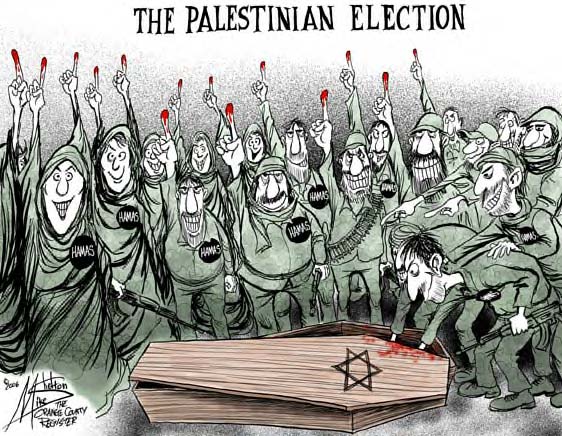
http://blogs.ocregister.com/mikeshelton/archives/2006/01/palestinian_ele.html
It was vote for Corruption & Violence or just Violence, Mike Shelton
(OCR, Local 8, 1/27/06)
What
Islam Isn't By:
Dr.
Peter Hammond
FrontPageMagazine.com | Monday,
April 21, 2008
The following
is adapted from Dr. Peter Hammond's book: Slavery,
Terrorism and Islam: The Historical Roots and Contemporary Threat:
Islam is not a religion nor is it a cult. It is a complete system.
Islam has religious, legal, political, economic and military components. The
religious component is a beard for all the other components.
Islamization occurs when there are sufficient Muslims in a country to
agitate for their so-called 'religious rights.'
When politically correct and culturally diverse societies agree to 'the
reasonable' Muslim demands for their 'religious rights,' they also get the
other components under the table. Here's how it works (percentages source
CIA: The World Fact Book (2007)).
As long as the Muslim population remains around 1% of any given country they
will be regarded as a peace-loving minority and not as a threat to anyone.
In fact, they may be featured in articles and films, stereotyped for their
colorful uniqueness:
United States -- Muslim 1.0%
Australia -- Muslim 1.5%
Canada -- Muslim 1.9%
China -- Muslim 1%-2%
Italy -- Muslim 1.5%
Norway -- Muslim 1.8%
At 2% and 3% they begin to proselytize from other ethnic minorities and
disaffected groups with major recruiting from the jails and among street
gangs:
Denmark -- Muslim 2%
Germany -- Muslim 3.7%
United Kingdom -- Muslim 2.7%
Spain -- Muslim 4%
Thailand -- Muslim 4.6%
From 5% on they exercise an inordinate influence in proportion to their
percentage of the population.
They will push for the introduction of halal (clean by Islamic standards)
food, thereby securing food preparation jobs for Muslims. They will increase
pressure on supermarket chains to feature it on their shelves -- along with
threats for failure to comply. ( United States ).
France -- Muslim 8%
Philippines -- Muslim 5%
Sweden -- Muslim 5%
Switzerland -- Muslim 4.3%
The Netherlands -- Muslim 5.5%
Trinidad &Tobago -- Muslim 5.8%
At this point, they will work to get the ruling government to allow them to
rule themselves under Sharia, the Islamic Law. The ultimate goal of Islam is
not to convert the world but to establish Sharia law over the entire world.
When Muslims reach 10% of the population, they will increase lawlessness as
a means of complaint about their conditions ( Paris --car-burnings). Any
non-Muslim action that offends Islam will result in uprisings and threats (
Amsterdam - Mohammed cartoons).
Guyana -- Muslim 10%
India -- Muslim 13.4%
Israel -- Muslim 16%
Kenya -- Muslim 10%
Russia -- Muslim 10-15%
After reaching 20% expect hair-trigger rioting, jihad militia formations,
sporadic killings and church and synagogue burning:
Ethiopia -- Muslim 32.8%
At 40% you will find widespread massacres, chronic terror attacks and
ongoing militia warfare:
Bosnia -- Muslim 40%
Chad -- Muslim 53.1%
Lebanon -- Muslim 59.7%
From 60% you may expect unfettered persecution of non-believers and other
religions, sporadic ethnic cleansing (genocide), use of Sharia Law as a
weapon and Jizya, the tax placed on infidels:
Albania -- Muslim 70%
Malaysia -- Muslim 60.4%
Qatar -- Muslim 77.5%
Sudan -- Muslim 70%
After 80% expect State run ethnic cleansing and genocide:
Bangladesh -- Muslim 83%
Egypt -- Muslim 90%
Gaza -- Muslim 98.7%
Indonesia -- Muslim 86.1%
Iran -- Muslim 98%
Iraq -- Muslim 97%
Jordan -- Muslim 92%
Morocco -- Muslim 98.7%
Pakistan -- Muslim 97%
Palestine -- Muslim 99%
Syria -- Muslim 90%
Tajikistan -- Muslim 90%
Turkey -- Muslim 99.8%
United Arab Emirates -- Muslim 96%
100% will usher in the peace of 'Dar-es-Salaam' -- the Islamic House of
Peace -- there's supposed to be peace because everybody is a Muslim:
Afghanistan -- Muslim 100%
Saudi Arabia -- Muslim 100%
Somalia -- Muslim 100%
Yemen -- Muslim 99.9%
Of course, that's not the case. To satisfy their blood lust, Muslims then
start killing each other for a variety of reasons.
'Before I was nine I had learned the basic canon of Arab life. It was me
against my brother; me and my brother against our father; my family against
my cousins and the clan; the clan against the tribe; and the tribe against
the world and all of us against the infidel. – Leon Uris, 'The Haj'
It is good to remember that in many, many countries, such as France, the
Muslim populations are centered around ghettos based on their ethnicity.
Muslims do not integrate into the community at large. Therefore, they
exercise more power than their national average would indicate.
http://97.74.65.51/readArticle.aspx?ARTID=30675
CHRONOLOGY -
Ethiopian immigration to Israel
LONDON, Feb 1, 2005 (Reuters) - Israel said on Tuesday
it would double the pace of Jewish immigration from Ethiopia in order to bring
out the remaining 20,000 members of the Falasha Mura group by 2007.
Here is a short chronology of attempts to bring Ethiopian Jews to Israel.
-- 1973: Status of Ethiopian Jews is formally decided by Israeli chief rabbis
who determine they are descendants of the Jewish biblical tribe of Dan and
entitled to immigrate.
-- 1984: Under tight military censorship, Israel brings 12,000 Ethiopians to the
Jewish state in a secret airlift through Sudan known as Operation Moses.
-- 1985: Israeli magazine breaks censorship in interview with Israeli
immigration official. The story appears worldwide. Sudan, a Muslim country,
responds angrily, halting airlift.
-- 1989: Israel and Ethiopia restore diplomatic relations, bringing hope to
those awaiting stranded relatives.
-- 1990: Under a family re-unification programme, then- president Mengistu Haile
Mariam allows Jewish emigration but interrupts it several times. About 3,500
arrive in the year.
-- 1991: Planeloads of Ethiopians arrive several times a week with about 350
passengers each in what Israel dubbed "Operation Solomon." About 2,000
Ethiopian Jews arrive in Israel by February.
In March, immigration stops abruptly. Concern in Israel for fate of 15,000 to
18,000 Jews waiting to leave Addis Ababa.
In May, Mengistu flees to Zimbabwe. Israel airlifts out more than 15,000
Ethiopian Jews.
-- 2003: Ethiopia blocks a plan by Israel to move the Falasha Mura to Israel,
arguing that a mass migration was unnecessary when everyone was free to leave
Ethiopia in the normal way.
-- 2004: Following a visit by Foreign Minister Silvan Shalom, Israel says it
plans to start moving the remaining 20,000 Ethiopians of Jewish origin to
Israel.
-- 2005: Prime Minister Ariel Sharon approves the decision to allow 700 Falasha
Mura a month to fly to Israel.
GAUHATI, India (AP) - About 6000
people in India's northeast who claim to be descendants of a lost Israel tribe
are celebrating a reported Israeli government decision to formally convert them
to Orthodox Judaism - a step that would allow them to emigrate to Israel. About
800 members of the Bnei Menashe have been taken to Israel from northeast India
over the last decade by a group called Amishav, Hebrew for "my people
returns." According to Amishav, there is ample evidence to show that the
Bnei Menashe - comprised mainly of the Mizo, Kuki and Chin ethnic groups - are
of Jewish descent. Their customs, including mourning rites, hygiene and the use
of a lunar calendar, closely mirror Jewish traditions. The Bnei Menashe were
animists when they were converted to Christianity by British missionaries in the
19th century. In 1953, a tribal leader named Mlanchala had a dream that his
people would return to Israel. The tribe then adopted - or perhaps readopted -
Jewish traditions. However, their links to the Jewish people could not be
proved, so they were not deemed eligible to immigrate to Israel under Israeli
law, which gives Jews the right to automatic citizenship.
http://www.gesher.org/Humanitarian%20Work/Ethiopia/Understanding%20the%20Shoresh.html
more info
The
Full-Blown Return of Anti-Semitism in Europe
by Guy
Millière
May 16, 2011 at 5:00 am
http://www.hudson-ny.org/2122/anti-semitism-in-europe
On April 19, the Corfu synagogue, in Greece,
was burned. How many Jews live in Corfu today? One hundred and fifty. How many
Jews live in Greece? Eight thousand, or about 0.8% of the population. For some,
it seems these figures are still far too high. Two other synagogues were burned
in Greece during the past year. Anti-Semitic graffiti on the walls are spreading
all over the country.
What happened in Greece is happening everywhere
across the European continent.
During the last decade, synagogues were
vandalized or set on fire in Poland, Sweden, Hungary, France. Anti-Semitic
inscriptions are being drawn on building walls in Paris, Madrid, Amsterdam,
London, Berlin and Rome. Jewish cemeteries are being ransacked. Jews are being
attacked on the streets of most major cities on the continent. In the
Netherlands, the police use « decoy Jews » in order to try arrest the
perpetrators red-handed.
Jewish schools are being placed under police
protection everywhere, and are usually equipped with security gates. Jewish
children in public high schools are bullied; when parents complain, they are
encouraged to choose another place of learning for their children.
In some cities such as Malmö, Sweden, or
Roubaix, France, the persecution suffered by the Jewish community has reached
such a degree that people are selling their homes at any price and leaving.
Those who stay have the constant feeling that they are risking their lives: they
must be extremely streetwise and carry no sign showing who they are. In 1990,
approximately 2000 Jewish people lived in Malmö; now there are fewer than 700,
and the number is decreasing every year.
Jews now, in fact, have to be streetwise in all
European countries: men wearing a skullcap usually hide it under a hat or a cap.
Owners of kosher restaurants located on avenues where protests are organized
close their facilities before the arrival of the participants -- even if the
protest is about wages or retirement age. They know too well that among the
demonstrators, there will always be some who will express their rage at the
sight of a Jewish name or a star of David on a store front. In Paris, on Labor
Day, May 1st, in front of a Jewish café on Avenue of the Republic, several
hundred demonstrators stopped and began to boo « Jews » and « Zionists ». A
man coming out of the café was assaulted until police officers arrived on the
scene.
A few weeks ago in Norway, when Alan
Dershowitz was banned from giving lectures on the conflict in the Middle
East, the professors who supported the ban used anti-Semitic stereotypes in
their remarks. What happened to him is now commonplace. In many universities in
Europe, giving lectures on Jewish culture has become risky, and giving lectures
on Israel anywhere -- without being clearly « pro-Palestinian » - is even more
risky, or impossible: Once the event is announced, the organizers and the
lecturers immediately receive explicit death threats by mail or by the internet.
The day the lecture takes place, « anti-Zionists » organize violent protests,
try to prevent people from entering the hall, and physically attack the
lecturers. The only way to avoid this type of situation is to organize the
lecture by invitation only, without ads.
After World War II, anti-Semitism seemed to
disappear in Europe. It is back, to a very disquieting degree.
Although it is not exactly the same
anti-Semitism that in the 1930's, it is not fully different.
It is an anti-Semitism that is widespread in
the Muslim population that settled in Europe, and it would be easy to think that
it is strictly an Islamic phenomenon, but the anti-Semitism as it exists today
in the Muslim world was heavily influenced by the old European anti-Semitism.
And what the Muslim immigrants bring with them can easily find resonances in
European non-Muslim populations. Copies of fraudulent Protocols of the Elders
of Zion in Arabic are sold in Islamic bookstores from one end of the
continent to the other,and they also circulate abundantly again in many European
languages, under the mantle or via internet.
It is also an anti-Semitism that allows the far
right to restate its rejection of « cosmopolitanism » -- an adjective on the
European continent that has always been used to point out the Jews -- in a
context where, because of the European economic decline, nationalist tensions
and isolationism sound more and more seductive. It is an anti-Semitism that the
left does not want to fight, because for it, the Muslims are oppressed, and the
left is always on the side of those it defines as oppressed, whether or not the
oppression is caused by the terrible governance inside those countries, or
scapegoated onto someone else. European anti-racist movements say they are very
concerned about « Islamophobic racism », but they are totally reluctant to
discuss the anti-Semitism in the Muslim populations.
The new, current anti-Semitism now adds on to
the old kind, the demonization of the State of Israel. The Islamic view of
Israel is now the dominant view of Israel in Europe. The idea that Israel is a
« colonial power » that has « robbed » people of their land, and is an «
artificial State », even though the Jews have been on that land for three
thousand years -- and even though many states in the area, such as Jordan and
Libya, and Iraq are even more illegitimate, their borders having been drawn on
papre by the British in the 1920s -- is a commonplace among journalists.
Hatred towards Israel is now the most widely
shared sentiment among Europeans, whatever their place on the political
spectrum. It is now through hatred of Israel, that hatred of Jews as annoying «
troublemakers » can again express itself.
European Muslim populations hate Israel and
seek its destruction. European non-Muslim people seem think that if Israel did
not exist, tensions with Muslims would be less, and they attribute to Israel all
the responsibility of the tensions, even though , since most of the Jews have
fled from countries in the Middle East, it is now the Christian Copts in Egypt
and the Christian Assyrians in Iraq who are being attacked by Islamic mobs. As
the Arabic saying goes, "First the Saturday people, then the Sunday
people."
As Israel is a Jewish state, European Jews are
asked to be « good Europeans », and to disavow Israel. If they refuse, or
worse, if they say they still support Israel, they are considered untrustworthy.
In the 1930s, Jews were accused of not being
full members of the country where they lived. Today, the same criticism rises in
a slightly different form: Jews are accused of the existence of a Jewish state,
and are suspected of being too tied to that state to be full members of the
country where they live.
More deeply, the Jews of Europe might feel that
if they can paint the Jews as evil, then perhaps what their parents and
grandparents did to them during World War II was not really so bad after all;
you could even say they deserved what they got. As some Scandinavians put it,
The Jews killed Christ; at least the Muslims did not do that.
The anti-Semitism of the 1930s led to the
Holocaust, which led the Jews to flee to Israel, the only country that would
take them in and not let shiploads of fleeing Jews sink at sea. Now, European
anti-Semitism accuses the Jews of Israel's existence, and of reminding them of
the Holocaust by remembering it themselves. Meanwhile, an increasing number of
Europeans seem quite ready for another Holocaust: one that would be the
annihilation of Israel.
If sacrificing Israel allowed non-Muslim
Europeans to see Muslim anger disappear, they would be willing to make the
sacrifice immediately. If, in order to accept the sacrifice with a clear
conscience, non-Muslim Europeans have to caricature Israel ignobly, they will --
and do. Anti-Israel cartoons fill European newspapers from London to Spain, and
even receive awards. The Israeli army is often compared in European media to the
Nazi army. The comparison is fully playing its role: if the Jews are Nazis
today, it means that the Europeans did the world a favor in killing six million
of them, and that the Europeans are not really guilty.
If Israel can be portrayed as a Nazi state, its
destruction is acceptable, maybe even legitimate, maybe even desirable. The fact
that Mein Kampf is a bestseller in the Palestinian territories and in
most countries of the Muslim world is totally left out, just like the fact that
many Jews living in Israel are survivors of the Holocaust committed in Europe
sixty five years ago.
A survey conducted last year for the Friederich
Ebert Foundation, a German think tank linked to Germany's Social Democratic
Party, was eloquent. To the question: « Do you think that Jews abuse their
status as victims of Nazism ? » , positive responses reached proportions hardly
imaginable: 72.2% in Poland, 48% in Germany, 40.2% in Italy, 32.3% in France.
Another question, « Do you understand why people do not like Jews », generated
results that must be faced. Number of positive responses: 55.2% in Poland, 48.9%
in Germany, 40.2% in Italy. The question was not asked in France. In several
polls conducted in Europe over the last decade, Israel was identified as the
most dangerous country for world peace, tied with Iran.
The question: « Are you anti-Semitic » was
not asked anywhere. I have no doubt that, if asked the question, those who
understand that « People do not like Jews, » and who probably do not like them
either, would have said that they were not anti-Semitic.
The question, « Do you think that Israel is
conducting a war of extermination against the Palestinians », was asked.
Positive responses : 63% in Poland, 47.7% in Germany.
Moshe Kantor, president of the European Jewish
Congress, called the poll « very disturbing. The governments of Europe, and the
European Union," he said, "would do well to wake up to this problem
before it is too late, »
In his eloquent foreword Harold Evans,
surprised by the widespread globalization of hateful antisemitism, regards it
as a mental condition conducive to paranoia, impervious to truth, a very
peculiar pathology that recognizes no national borders. Goldstein, starting
with the antisemitism displayed over 2500 years ago in Elephantine, an island
in the Nile in southern Egypt, puts this mental condition on display.
Prejudice against Jews goes back to early history and is found in Egyptian,
Greek, and Roman writings and actions, and in early Christianity. Behavior
patterns, that have become familiar through two thousand years, were present
in this early period, as for instance, in the burning of the Jewish temple and
the use of Jews as scapegoats in the struggle between the rival Persian and
Roman powers in Egypt. In Alexandria, in which Jews constituted 40 percent of
the population, in 38 C.E. there was mob violence against Jews fed by false
accusations, and the categorization of Jews as a "diseased race of
lepers" by Apion, a Greek lawyer resident there. It was realized early
that antisemitism was a convenient device for a leader or a group to unite
adherents against a supposed enemy, a way of diverting attention from problems
and the real causes of them.
Goldstein provides some interesting details
while telling her stories. One of particular interest, in the light of events
that would occur shortly thereafter with blame for the crucifixion of Jesus
falling on the Jews, was the Roman action in erecting 2000 crosses outside
Jerusalem on which to hang Jews, a few years before Jesus was born. She does
not claim to be a deep specialized scholar, in the sense of Anthony Julius in
his book on antisemitism in Britain, nor is she an expert in the many
languages in which antisemitism has been expressed, but she has mastered the
existing literature in English on the subject. She presents her thoughts in a
readable style and systematic manner, and brings the subject up to date by
relating the distortions of present day Holocaust deniers and the unpleasant
fulminations of Mahmoud Ahmadinejad, president of Iran. Goldstein might have
dealt more fully with the sordid record of the Mufti of Jerusalem, and with
the present complicated interaction of antisemitism and anti-Zionism.
In this historical tour we witness the
manifestations of antisemitism during the emergence of Christianity from the
followers of the Jewish Jesus, the anti-Jewish laws issued by Emperor
Constantine in 314 after his conversion to Christianity, the accusations of
Jews as "Christ killers," the impact of Islam and its empires, the
episode of the Crusades, the struggle between the new Protestantism and
Catholicism, the mixed fruits of the Enlightenment, the false conspiracy
theories of Jewish power, the distortion of race theories, the machinations of
the Soviet Union, the abuse of international organizations, and the
Arab-Israeli conflict.
Throughout 2000 years demonization,
dehumanization, and discrimination against Jews have occurred. Goldstein
illustrates this in the various chapters, in both familiar and less known
issues: included are those in 167 A.D. on the charge of deicide or the murder
of God; the burning of synagogues in Iraq in 388; the slaughter of Jews in the
Rhineland during the first Crusade in 1096; the even greater slaughter by the
leader of the Crusade of Jews in Jerusalem in 1099; the attacks on Jews by
individuals and groups during the second Crusade in 1146-7; the imposition of
special taxes on Jews and attempts to remove them from international trade;
the incitements by John Chrysostom in Antioch in the late 14th century; the
expulsion of Jews from England in 1290 and later from other countries
including Spain in 1492; the charge in 1144 of ritual murder of Christians to
obtain their blood; alleged responsibility for poisoning wells and the Black
Death in the 14th and 15th centuries; the desecration of the host in the late
13th century; the insistence by the Church from the 13th century on that Jews
wear clothing or head covering that distinguished them from Christians; the
attacks on the Talmud and the burning of Jewish books in 1242 in Paris; the
expulsion of Jews from Spain in
1492; forced conversions; the Inquisition in Spain
in 1480 to deal with alleged false conversos by burning or torture (the
notorious auto-da-fe, the burning of Jews at a public event); the insistence
in Spain on purity of blood (la
limpieza de sangre) which made race a major rationale for antisemitism; the
assault of Martin Luther on the "damned, rejected race of Jews, "the
prejudice of the Jesuits which lasted until 1946; the teaching of contempt of
the Jews in church documents, a practice that was not disavowed until 1947;
the inclusion of Jewish books in the Vatican Index of Forbidden Books in 1549;
the confinements of Jews to ghettoes starting in Venice in 1516; the belief of
Voltaire during the Enlightenment period that Jews "were ignorant and
barbarous people;" the special clothing, hats, and even shoes Jews were
obliged to wear in the Ottoman Empire; the massacres in the Ukraine in 1648;
the second class status, dhimmis, of Jews under Muslim rule; the
political use of anti-Jewish rhetoric by Tories against Whigs in the 1754
British election; the murder in 1840 of innocent Jews for the disappearance of
a monk in Damascus; the refusal of many European countries to allow Jews to
become citizens; the well known Dreyfus Affair in France in the 1890s; the
pamphlet in 1878 by Wilhelm Marr which coined the word "antisemitism;"
the racial theories of Ernst Haeckel; the forged Protocols of the Elders of
Zion produced by the Russian secret police and later publicized by Henry
Ford and recently by Saudi Arabia and by Hamas in Gaza; the confinement of
Jews to the Pale of Settlement in Western Russia and attempts to convert Jews
to the Russian Orthodox faith; the pogroms (thunder) beginning in 1881 in
Russia and continuing for over two decades and then resuming in 1917-9 in the
Ukraine; the lynching of Leo Frank in Atlanta in 1913 for the murder of a 13
year old girl; the allegation of responsibility for the Russian Revolution and
two World Wars; the Holocaust; the massacre in Kielce, Poland in July 1946;
the ritual murder of Daniel Pearl in Pakistan in 2002; and the incessant
condemnations of Israel since its establishment.
It is still difficult to provide a rational,
unprejudiced explanation, economic, social, religious, or political, for the
persistence of antisemitism. Why for example is antisemitism so deeply
embedded in the culture of Spain
since it is over 500 years since Jews were expelled from the country? Why did
General George S. Patton in his
diary on September 15, 1945 refer to Jewish DPs in the camps in Europe as
"lower than animals?" The danger of antisemitism remains, in
governmental actions, in international bodies especially those related to the
United Nations, the Durban Conferences, and among those opposed to the
existence of Israel. After centuries of animosity towards Jews displayed by
Christian Churches it is saddening that Arab and Islamic organizations,
influenced by the example of the Mufti of Jerusalem who called for the removal
of Jews from Palestine, have now made antisemitic rhetoric and calls for
action against Jews a significant part of their activity. Radical Islamists
have linked anti-Semitism, or Judeophobia, to their disproportionate criticism
and hostility to the state of Israel.
One must ask why international organizations,
supposedly promoting and protecting human rights around the world, have been
obsessed with condemning and demonizing the state of Israel for fifty years
through one-sided resolutions and disproportionate criticism. The fantasy of
Jewish and Israeli power and conspiracy reached an absurd climax when some
declared that Jews were responsible for the bombing of the World Trade Center
in New York on September 11, 2001
A Convenient Hatred, The
History of Antisemitism
by Phyllis Goldstein, Facing History and Ourselves, 2011. 432 pp. $17.95
The Czech
Republic and the Arab World
Czechoslovakia was the only democratic country in Central
Europe in the 1930's, as Israel is the only democratic country in the Middle
East today. By its vote in United Nations, the Czechs
have made it clear that the Arab world should not be appeased; that the
appalling Western mistake in 1938 – of trying to appease Hitler by giving
him the Sudetentland to Hitler, must not be repeated by giving Israel the
Arabs.
A vote in the United Nations General Assembly is often the
consequence of a complicated assessment of national interests and a response to
international pressures, rather than of actual convictions on a particular
issue. The Czech Republic was the only country in the European Union to vote
against the resolution that Palestine be granted the status of a non-member
observer state at the United Nations on November 29, 2012. Fourteen members of
the EU, including France, voted for the resolution, and 12, including Germany,
abstained.
The Czech vote at the UNGA reflects both a fresh assessment
of the Israeli-Palestinian issue, as well as a bond based on historical and
personal factors. The Czech Republic does support the creation of a Palestinian
state in a two state solution, but insists that it can only be established as a
result of an Israeli-Palestinian negotiated process, as agreed to by both the
Palestinians and the Israelis -- not only in both UN Security Council
Resolutions 242, 338, and 1850, but also in countless bilateral agreements -- in
particular the Oslo II agreements of September 28, 1995, Article 31, that
"neither side shall initiate or take any step that will change the status
of the West Bank and the Gaza Strip pending the outcome of the final status
negotiations. The Czech Republic seems to have regarded the Palestinian request
to attain non-member status not only as a unilateral act that is detrimental to
the peace process, but as a totally illegal one under the UN's own system of
jurisprudence.
For Czechs, the memory of their betrayal by the appeasement
policy of the Western powers in the 1930s remains potent. At the Munich
Conference on September 30, 1938, Britain and France, wishing to avoid
confrontation with Germany, allowed Adolf Hitler to control the Czech
Sudetenland. The following year, Nazi Germany took control over the whole
country. As a result of this Western failure to control Nazi aggression,
"appeasement" has become a synonym for weakness and cowardice.
Although the vote on the November 2102 UNGA Resolution in
opposition to the Palestinian position cannot of course be regarded as an exact
parallel with the Western abandonment of Czechoslovakia in 1938, a similar
situation exists: Czechoslovakia was the only democratic country on Central
Europe in the 1930's, as Israel is the only democratic country in the Middle
East today. By its vote in the UNGA, the Czechs have made clear that the
appalling Western mistake in 1938 -- of trying to appease Hitler by giving him
the Sudetenland -- must not be repeated by giving Israel to the Arabs.
This Czech emphasis on the necessity of direct negotiations
between the Middle East parties may be an echo of the successful negotiations in
1993, when the federal state of Czechoslovakia was divided between the
contending parties, and the two separate states of the Czech Republic and
Slovakia were established.
Czech attitudes towards Israel have varied over the years.
Czechoslovakia was one of the 33 countries voting for the UNGA November 1947
Resolution which led to the establishment of the State of Israel, and on May 18,
1948, Czechoslovakia recognized the Israel, four days after its creation. It was
also a main supplier to Israel of
military aircraft and weapons in July of 1948, after other countries had
imposed a boycott on the new state. Czechoslovakia even trained
some of Israel's pilots who belonged to the Haganah, the Israeli defense
organization that preceded the Israel Defense Forces before Israel's
independence. The formal diplomatic relationship, broken by the Communist regime
after the Six Day War of 1967, was restored with the Velvet Revolution of 1989,
which ended the Communists' rule.
Since then, the Czech
Republic has constantly fathomed the problems Israel faces. It agreed in
2006 that Israel had a right to defend itself against the attacks from Lebanon
by Hezbollah; and in 2008-9 refused to condemn Israel's response to rocket
attacks from Gaza by Hamas, which the Czechs have labeled a terrorist
organization. Although the Czechs acknowledged that the conditional opening of
crossings of goods and people into Gaza -- to prevent the smuggling of weapons
and materiel into Gaza -- was a problem, they admitted that it was not the main
problem. More important was that Gaza was ruled by a terrorist organization.
The Czech Republic also supported Israel's legal military
operation in May 2010 in the Mediterranean Sea to prevent six ships, a flotilla
sailing from Turkey, from breaking a legal blockade so that weapons would not be
smuggled into Gaza via a sea-route.
In January 2009, when the Czech Republic served as
president of the European Council of the European Union, it proposed that EU
relations with Israel be upgraded. The proposal was not approved.
Historical and personal factors also played a role in the
Czech attitude to Jews and to the State of Israel. The legendary hero Tomas
Garrigue Masaryk, the founder and first President of the State of Czechoslovakia
in 1918, was a supporter of a Jewish homeland in Palestine, and is remembered by
a square in Tel Aviv named after him, and by a kibbutz near Haifa. In 1927, he
was the first head of state to visit the Jewish village in the area of that was
then the British Mandate. He spoke out against superstitious, "witch
trial" claims of the Hilsner Affair, a case in Bohemia in 1899, in which a
young Jewish boy was libelously accused of killing a Christian girl for her
blood. Later, Vaclav Havel, as President, opposed the sale of weapons to Syria
because of its hostility to Israel, and constantly spoke out against
anti-Semitism.
The Czechs have apparently understood the realities of
Middle East politics.
WHY ISRAEL MUST SURVIVE
NY Times, 8/9/11
Khotyn, Ukraine
HERE in the land of Tevye, the roosters still crow. Cows graze in open
fields. But Tevye doesn’t live here anymore.
I have set out from Israel to Ukraine to trace my ancestors. My first stop
is west of Kiev, in a corner of the czarist-era Pale of Settlement for Jews,
where “Fiddler on the Roof” was set. Here sits an old Jewish cemetery, now a
plowed-over field. It bears not a single headstone, just a house-like memorial
for the late-19th-century maggid, or preacher, Mordechai of Chernobyl, my
paternal ancestor five generations back.
I continue on, more than 250 miles, to the outskirts of Khotyn, a
1,000-year-old Bessarabian fortress city beside the Dniester River. I enter
another open field to connect with a far darker time. I find a 30-foot-long
concrete slab, etched at its head with the names, in Hebrew, of 45 men, women
and children. First are my grandfather and uncle: “The holy Rabbi Mordechai
Israel Twersky and his son, Aaron.”
Following a Jewish tradition, I remove my shoes. This is sacred ground —
one of three mass graves in the city, containing in all an estimated 1,900 Jews
who perished early in the Holocaust, 70 years ago this summer.
“The earth shifted for days,” an old, toothless man tells me in
Russian. He is one of Khotyn’s 15 remaining Jews and among the minyan, or
quorum for worship, who accompany me. “They couldn’t bury them fast
enough.”
I had never fully understood what happened here in 1941. Growing up in New
York, I heard stories from my father, who survived five labor camps before
making it to Ellis Island and becoming a rabbi. Not one to subject his three
children to horrors, he focused on how his father had lived. On this visit, I
wanted also to learn how my grandfather had died.
In the quiet streets of this city, where a Jewish community of 15,000 once
thrived, I find no living witnesses. But I carry vivid testimonies written and
spoken by Khotyn’s survivors, a guidebook from another era.
The history is complicated; it begins with the Soviet occupation in 1940
of Bessarabia and northern Bukovina, which the Nazi-Soviet pact allowed Stalin
to detach from Romania. The Romanian Army’s withdrawal, and its return a year
later with the invading Germans and their mobile S.S. killing units — the
notorious Einsatzgruppen — unleashed a systematic Romanian-German campaign of
torture, rape and mass murder. Then the Romanians deported some 23,000 Jews from
the Khotyn district, which includes the city, to an occupied zone known as
Transnistria.
Over a three-week period in July and August of 1941, approximately 50,000
Jews were murdered in Bessarabia and northern Bukovina, the historian Avigdor
Shachan wrote in “Burning Ice: The Ghettos of Transnistria.” According to
the International Commission on the Holocaust in Romania, 280,000 to 380,000
Romanian and Ukrainian Jews died in Transnistria during the war.
They were victims not just of Germany, but at least equally of Romania’s
anti-Semitic government. Just days before the dictator Ion Antonescu’s
henchmen murdered my grandfather, experts on the Holocaust say, his next in
command, Mihai Antonescu, advised top officials about the coming deportation of
Jews. The ministers, he said, could be “indifferent if history judges us as
barbarians ... This is the most opportune moment in our history. If need be, use
machine guns.”
On Stefan Cel Mare Street, I gaze at my grandfather’s house. A couple
sits outside at a table, drinking beer. What was once a synagogue sanctuary is
now a grocery store.
“Your grandfather prayed from that balcony,” says Genya Cherkes,
pointing upward and narrating a history her Jewish family bequeathed to her.
“On the Sabbath and holidays,” she says, “people gathered below just to
hear him pray.”
Ms. Cherkes, now 60, says her grandparents told her they had hidden my
grandfather and his family in their orchard (in a non-Jewish neighborhood) after
the Russians evicted the Twerskys from their home, leaving them to fear being
deported or shot.
I stare at the locals. My thoughts turn to the many collaborators,
Romanian and Ukrainian, who assisted the Romanian and German armies in their
atrocities. “They entered the homes of Jews with axes in their hands,” Nahum
Morgenstern, a survivor, said of the collaborators, in a remembrance on file at
Yad Vashem, the Holocaust remembrance institution and archive in Jerusalem.
“They forced the Jews to undress and took their clothing. Then they
decapitated them.”
I am taken to a deserted compound about a mile away. It resembles a
warehouse, with large glass windows and a high ceiling. A cow grazes outside.
“In 1941 this was a girls’ school,” says one of my guides, a man named
Ilya, whose mother survived the war. “Here,” he says of the Romanians and
Germans, “they gathered all the city’s Jews, then picked out the Jewish
leaders. Your grandfather was one of them.”
I feel that I know this compound. For years, I imagined it as I read
testimonies depicting Jews’ being herded into classrooms, gasping for air,
debating whether to rejoin their leaders. “I was pressed up against the
second-floor window,” Mr. Shachan himself recalled when I spoke with him. He
was 8 at the time.
Here, according to testimony at a war crimes tribunal held in Bucharest in
1945, Jews pleaded for their lives with a Romanian police commander who, in
quieter times, had engaged Jews in fluent Yiddish. But he told the assembled
Jews that day that he had a new name: “My name is Hitler.”
I open my briefcase. I show Ilya an account from the Yad Vashem archives.
A Jew, sensing the end was near, asked Rabbi Twersky to make sense of it all.
“It will be good,” the rabbi replied, in Yiddish. “One must always have
faith.”
We trace the path taken by the doomed Jewish leaders — doctors, lawyers
and teachers, but also scribes, butchers and pharmacists — along the Dniester
River, where hundreds of Khotyn’s Jews were shot. My grandfather was seen
breaking from the line. “He jumped into the river to purify himself,”
according to testimony from a survivor, Rachela Katz, cited in “On the Roads
of Exile: Memories, 1941-1945” by Solomon Shapira. “The soldiers pulled him
out and beat him.”
We arrive at the spot — a foul-smelling marsh — where, in Ms. Katz’s
account, the Jews were forced to dig their own grave. There is an eerie quiet.
The grass is high and thick. I recite psalms and a prayer for the dead, El Moleh
Rachamim (God Full of Compassion). I read from Ezekiel, “Son of man, can these
bones live?”
Roosters are crowing now, seemingly louder and louder. To these ears it is
a piercing, heckling sound — Tevye’s roosters sounding out an impudent
“Taps” for a community where real Tevyes once lived.
A towering poplar engulfs the grave in its soothing, protective shade.
“It is a sign,” one Jew tells me in Russian. “Life can still sprout
here.”
Time is short. I must travel to Murafa, where my grandmother Batsheva,
Rabbi Twersky’s wife, rests. She died there of malnutrition and typhus in a
ghetto set up by Romanian authorities in 1942.
Before leaving, I ask Ms. Cherkes, who tends Khotyn’s centuries-old
Jewish cemetery and the graves of her forebears, how she can still live in a
city where the martyrs so far exceed the remaining Jews.
“You can’t begin to understand,” she says, annoyed by the question
but forcing a smile. “You will never understand.”
http://www.nytimes.com/2011/08/10/opinion/revisiting-khotyn-70-years-after-a-holocaust-massacre.html?pagewanted=2&_r=2
Nobel Prizes . . . comparing Muslim and
Jewish recipents
The
global Islamic population is approximately 1,200,000,000, or
20% of
the world population. They have received the following Nobel Prizes:
Literature:
1988
- Najib Mahfooz
Peace:
1978
- Mohamed Anwar El-Sadat
1994 - Yaser Arafat:
1990 - Elias James Corey
1999 - Ahmed Zewai
Economics:
(none)
Medicine:
1960
- Peter Brian Medawar
1998 - Ferid Mourad
**************************************************************************
The global Jewish population is approximately 14,000,000, or
about 0.02% of
the world population.
They
have received the following Nobel Prizes:
Literature:
1910 - Paul Heyse
1927 - Henri Bergson
1958 - Boris Pasternak
1966 - Shmuel Yosef Agnon
1966 - Nelly Sachs
1976 - Saul Bellow
1978 - Isaac Bashevis Singer
1981 - Elias Canetti
1987 - Joseph Brodsky
1991 - Nadine Gordimer World
Peace:
1911 - Alfred Fried
1911 - Tobias Michael Carel Asser
1968 - Rene Cassin
1973 - Henry Kissinger
1978 - Menachem Begin
1986 - Elie Wiesel
1994 - Shimon Peres
1994 - Yitzhak Rabin
Physics:
1905 - Adolph Von Baeyer
1906 - Henri Moissan
1907 - Albert Abraham Michelson
1908 - Gabriel Lippmann
1910 - Otto Wallach
1915 - Richard Willstaetter
1918 - Fritz Haber
1921 - Albert Einstein
1922 - Niels Bohr
1925 - James Franck
1925 - Gustav Hertz
1943 - Gustav Stern
1943 - George Charles de Hevesy
1944 - Isidor Issac Rabi
1952 - Felix Bloch
1954 - Max Born
1958 - Igor Tamm
1959 - Emilio Segre
1960 - Donald A. Glaser
1961 - Robert Hofstadter
1961 - Melvin Calvin
1962 - Lev Davidovich Landau
1962 - Max Ferdinand Perutz
1965 - Richard Phillips Feynman
1965 - Julian Schwinger
1969 - MurrayGell-Mann
1971 - Dennis Gabor
1972 - William Howard Stein
1973 - Brian David Josephson
1975 - Benjamin Mottleson
1976 - BurtonRichter
1977 - Ilya Prigogine
1978 - Arno Allan Penzias
1978 - Peter L Kapitza
1979 - Stephen Weinberg
1979 - Sheldon Glashow
1979 - Herbert Charle s Brown
1980 - Paul Berg
1980 - Walter Gilbert
1981 - Roald Hoffmann
1982 - Aaron Klug
1985 - Albert A. Hauptman
1985 - Jerome Karle
1986 - Dudley R. Herschbach
1988 - Robert Huber
1988 - Leon Lederman
1988 - Melvin Schwartz
1988 - Jack Steinberger
1989 - Sidney Altman
1990 - Jerome Friedman
1992 - Rudolph Marcus
1995 - Martin Perl
2000 - Alan J. Heeger
Economics:
1970 - Paul Anthony Samuelson
1971 - Simon Kuznets
1972 - Kenneth Joseph Arrow
1975 - Leonid Kantorovich
1976 - Milton Friedman
1978 - Herbert A. Simon
1980 - LawrenceRobert Klein
1985 - Franco Modigliani
1987 - Robert M. Solow
1990 - Harry Markowitz
1990 - Merton Miller
1992 - Gary Becker
1993 - Robert Fogel
Medicine:
1908 - Elie Metchnikoff
1908 - Paul Erlich
1914 - Robert Barany
1922 - Otto Meyerhof
1930 - Karl Landsteiner
1931 - Otto Warburg
1936 - Otto Loewi
1944 - Joseph Erlanger
1944 - Herbert Spencer Gasser
1945 - Ernst Boris Chain
1946 - Hermann Joseph Muller
1950 - Tadeus Reichstein
1952 - Selman Abra ham Waksman
1953 - Hans Krebs
1953 - Fritz Albert Lipmann
1958 - Joshua Lederberg
1959 - Arthur Kornberg
1964 - Konrad Bloch
1965 - Francois Jacob
1965 - Andre Lwoff
1967 - George Wald
1968 - Marshall W. Nirenberg
1969 - SalvadorLuria
1970 - Julius Axelrod
1970 - Sir Bernard Katz
1972 - Gerald Maurice Edelman
1975 - Howard Martin Temin
1976 - Baruch S. Blumberg
1977 - Roselyn Sussman Yalow
1978 - Daniel Nathans
1980 - Baruj Benacerraf
1984 - Cesar Milstein
1985 - Michael Stuart Brown
1985 - Joseph L. Goldstein
1986 - Stanley Cohen [& Rita Levi-Montalcini]
1988 - Gertrude Elion
1989 - Harold Varmus
1991 - Erwin Neher
1991 - Bert Sakmann
1993 - Richard J. Roberts
1993 - Phillip Sharp
1994 - Alfred Gilman
1995 - Edward B. Lewis
The Jews are not promoting brain washing the children in military training
camps, teaching them how to blow themselves up and cause maximum deaths of Jews
and other non Muslims.
The Jews don't hijack planes, nor kill athletes at the Olympics.
The Jews don't traffic slaves, nor have leaders calling for "jihad and
death to all the Infidels".
Perhaps the world's Muslims should consider investing more in standard education
and less in blaming the Jews for all their problems.
Regardless of your feelings about the crisis between Israel and the Palestinians
and Arab neighbors, the following two sentences really say it all:
If the Arabs put down their weapons today, there would be no more violence.
If the Jews put down their weapons today, there would be no more Israel.
(from
an e-mail [unverified], 11/25/06}
RAND
Studies Make Recommendations
for a Successful Palestinian State
Washington,
D.C. — The RAND Corporation issued April
28, 2005, the most comprehensive recommendations ever made for the
success of an independent Palestinian
state.
The
proposals – including a landmark rail, highway and infrastructure link between
the West Bank and Gaza that would open the door to dramatic new development in
Palestine – are designed to give Palestinians new access to jobs, food, water,
education, health care, housing and public services.
Many
of the actions proposed by RAND can get underway now to begin improving the
lives of Palestinians and begin laying the groundwork to sustain long-term
development in a future state that would provide good government, become
self-reliant economically, and improve security for Palestinians and Israelis.
A
report produced under the oversight of RAND Health titled “Building a
Successful Palestinian State” describes many of the proposals. A companion
volume by the RAND Center for Middle East Public Policy titled “The Arc: A
Formal Structure for a Palestinian State” proposes a new corridor from the
northern West Bank to Gaza that would help achieve the goals of the first
report, enabling Palestinians to build a more prosperous future and cope with
rapid population growth.
The
corridor – called the Arc – would support a high-speed 140-mile interurban
rail line, highway, aqueduct, energy network and fiber optic cable linking
Palestine’s major towns and cities. This would act as a catalyst to generate
housing, jobs and business development. Construction of the Arc would create an
estimated 100,000 to 160,000 jobs for Palestinians over five years, on top of
thousands more jobs in new businesses built along the corridor. It would also
foster revitalization of historic city centers and preserve forests, nature
reserves and agricultural land.
“Creating
a state of Palestine does not ensure its success,” according to the first
report. “But for Palestinians, Israelis and many around the world, it is
profoundly important that the state succeed.” A failed Palestinian state, or
one so weak that it must be sustained and policed by others, would endanger
international security, the report says.
The
reports do not discuss how Israelis and Palestinians can reach a settlement to
create a
Palestinian
state. Instead, they focus on what would happen if such a state is created –
recommending
actions that Palestinians, Israelis and the international community can take to
increase chances a new state would be successful. An upcoming RAND report will
examine security issues and multinational military participation.
Rather
than being a blueprint to be followed in every detail, the reports are designed
to provide helpful ideas that Palestinians and other involved parties can study
and develop further to best meet the needs of the Palestinian people. They are
also designed to help a new Palestinian state avoid some of the problems
encountered in nation-building initiatives in Iraq and elsewhere.
“These
studies spell out practical steps that can help make the goal of a Palestinian
state living in peace and prosperity alongside Israel a reality,” RAND
President and CEO James A. Thomson said.
“We
hope RAND’s two years of rigorous and objective problem-solving research will
point the way to a better future for the people of the region,” said RAND
Executive Vice President Michael Rich.
Recommendations
in the reports could be implemented for approximately $33 billion in capital
investment in the first 10 years of a new state. This represents an annual
average of about $760 per person – a level that is broadly comparable with
other recent nation-building efforts. An estimated $6 billion of the investment
would be used to build the core rail and road infrastructure of the Arc.
Billions of dollars would need to come from international assistance and
investment, combined with Palestinian spending and private investment. Security
arrangements for Palestine would also need international financial commitments.
The
studies say the chances of success of a Palestinian state will increase with a
high level of territorial contiguity of Palestinian lands (apart from the
separation of Gaza from the West Bank); relatively open borders allowing
movement of people and goods between Palestine and its neighbors, especially
Israel; and security within Palestine and for its neighbors. Here are
highlights:
GOVERNANCE:
A precondition to good governance is that Palestinians view their leaders as
legitimate and effective. This will depend on terms of the final peace
settlement – including the size and contiguity of territory, status of
Jerusalem, and freedom of refugees to resettle in the new state – along with
actions of the Palestinian government. Good governance will be more easily
achieved if Palestine’s borders are open, its economy is prosperous, its
refugee absorption is manageable, its security is guaranteed, and its early
years are bolstered by significant international assistance. This assistance
should be invested to ensure long-term economic growth. Good governance and
legitimacy also require that Palestine fight corruption and authoritarian
practices, promote the rule of law and empower the judiciary, give more power to
a parliament, promote meritocracy in the civil service, and delegate power to
local officials. The more the international community and Palestinians insist on
good governance, the more likely good governance will be practiced.
INTERNAL
SECURITY: The first report says “the success of an independent Palestinian
state is inconceivable in the absence of peace and security for Palestinians and
Israelis alike…. An independent Palestinian state must be secure within
its borders, provide for the routine safety of its inhabitants, be free from
subversion or foreign exploitation, and pose no threat to Israel.” The most
pressing internal security concern will be to suppress militant organizations
that would undermine stability of the new Palestinian state and threaten Israel.
Public safety, routine law enforcement and the administration of justice will
also need to be put on a sound footing as quickly as possible. At a minimum,
this will require funds for rebuilding courthouses and police stations, buying
legal texts and computers, obtaining training and purchasing police equipment.
Internal security services will need to be restructured and will need
monitoring, training and analytical support.
THE
ARC: The Palestinian population of about 3.6 million in the West Bank and Gaza
is expected to grow to roughly 6.6 million by 2020 due to natural population
growth and immigration. The Arc would link the major towns and cities of
Palestine – including Nablus, Ramallah, Jerusalem, Hebron, and Gaza City –
making it possible to travel from southern Gaza to the northern West Bank in
less than 90 minutes. Each rail station, located several miles from existing
historic urban cores, would create a focal point for new development and would
connect to a historic core via a new boulevard and an advanced form of bus rapid
transit. Along each boulevard, new commercial and residential neighborhoods
would be developed – largely by private sector investment – to accommodate
population growth. Housing and jobs would be created within walking distance of
the transit system. New building design would incorporate sustainable systems
using solar energy and recaptured water. Development along each boulevard would
pump economic activity into the historic centers of Palestinian cities and
assure their preservation and revitalization – an essential strategy for
creating a much-needed tourism industry. In addition to creating a ladder of
linear cities along the defining mountain ridge of the West Bank, the Arc would
preserve open land for agriculture, forests, parks and nature reserves. A
national park following the line of the Arc would provide needed recreation
space within each city, and a path for hiking and biking between municipal
areas. A parallel toll road would provide access for trucks and other vehicles
for people and freight, linking the country to its economic gateways at a
possible airport and seaport in Gaza.
ECONOMIC
DEVELOPMENT: Successful economic development in Palestine will require adequate
security, good governance, contiguous territory, stable access to necessary
supplies of power and water, and a transportation infrastructure that meets the
needs of Palestinians. “In a territorially
non-contiguous state, economic growth would be adversely affected and the
resulting poverty would aggravate political discontent and create a situation
where maintaining security would be very difficult, if not impossible,”
according to “Building a Successful Palestinian State.” Economic
development will depend on human capital, with stronger systems of primary,
secondary and vocational education. Other important conditions include
Palestinian access to the Israeli labor market to get jobs, and substantial
freedom of movement of people and products across Palestine’s borders,
including the border with Israel. Economic activity would also be strengthened
by improvements and investment in the transportation, water, power and
communications infrastructure of Palestine. Equally important, the government
will need to adopt appropriate monetary and fiscal measures and open trade
policies.
WATER
SUPPLY: A successful Palestinian state will need adequate supplies of clean
water for domestic consumption, commercial and industrial development, and
agriculture. Today Palestinians have only half the minimum amount of water per
person established by the World Health
Organization.
Coping with a severe and worsening water shortage will require a combination of
measures
to enhance supply and restrain demand. One way to provide Palestinians with
enough water to meet World Health Organization standards would be for Israel and
Palestine to renegotiate the allocation of existing water resources. Removing
water from aquifers beyond sustainable limits must be halted to avoid creating
worse shortages. Increased efficiencies, water re-use, and irrigation management
should be used to deal with part of the water shortfall. The international
community should be ready to finance construction of desalinization plants and
infrastructure improvements.
HEALTH:
Palestine has a relatively healthy population, many highly qualified
health care professionals, national plans for health system development, and a
strong base of governmental and health care institutions. There is poor
coordination, however, in the health care system and too many under-qualified
health care providers. Health system planning and policy development should be
better integrated and planned. Public and primary health care also need to be
expanded to include programs for immunizations, nutrition, preventing and
treating chronic and noninfectious diseases, and treating developmental and
psychosocial conditions.
EDUCATION:
Schools should offer a quality education accessible to girls and boys. The
education system should be open to reform, enroll more students in secondary
schools, expand early childhood programs, make special education available, and
stress development of student civic skills and social responsibility. Vocational
education should be redesigned, expanded and modernized to produce workers with
needed skills. Universities should reduce an over-emphasis on humanities and
social sciences, and expand science and engineering programs. This will require
increased funding, higher quality standards, better-paid teachers, and new and
renovated facilities .
Lead
authors of “Building a Successful Palestinian State” are Steven N. Simon and
C. Ross Anthony. Others who worked on the study include Glenn E. Robinson,
Jerrold D. Green, Kenneth J. Shine, Michael Schoenbaum, Jack Riley, Justin
Adams, Mark Bernstein, Keith Crane, Adel K. Afifi, Rachel Christina and Charles
Goldman. Doug Suisman is lead author of “The Arc: A Formal Structure for a
Palestinian State.” Other authors are Simon, Robinson, Anthony and Schoenbaum.
A
donation by David and Carol Richards initiated and funded “Building a
Successful Palestinian State.” A donation by Guilford and Diane Glazer
initiated and funded “The Arc: A Formal Structure for a Palestinian State.”
Both studies were also funded directly by RAND from philanthropic donations and
fees earned on client-funded research.
RAND
Health is the nation’s largest independent health policy research program,
with a broad research portfolio that focuses on health care quality, costs, and
delivery, among other topics.
The
RAND Center for Middle East Public Policy provides objective analysis to promote
greater understanding, political and social reform, peace and well-being in the
Middle East.
http://www.amin.org/eng/uncat/2005/april/apr28.html
above news release
http://www.rand.org/palestine/
original source of study
Irena
Sendler, Polish Holocaust Heroione
When Hitler and
his Nazis built the Warsaw Ghetto and herded 500,000 Polish Jews behind its
walls to await liquidation, many Polish gentiles turned their backs or
applauded. Not Irena Sendler. An unfamiliar name to most people, but this
remarkable woman defied the Nazis and saved
2,500 Jewish children by smuggling them out of the Warsaw Ghetto. As a
health worker, she sneaked the children out between 1942 and 1943 to safe hiding
places and found non-Jewish families to adopt them.
Irena Sendler
was born in 1910 in Otwock, a town some 15 miles southeast of Warsaw. She was
greatly influenced by her father who was one of the first Polish Socialists. As
a doctor his patients were mostly poor Jews. In 1939, Germany invaded
Poland, and the brutality of the Nazis accelerated with murder, violence and
terror. At the time, Irena was a Senior Administrator in the Warsaw
Social Welfare Department, which operated the canteens in every district of
the city. Previously, the canteens provided meals, financial aid, and other
services for orphans, the elderly, the poor and the destitute. Now, through
Irena, the canteens also provided clothing, medicine and money for the Jews.
They were registered under fictitious Christian names, and to prevent
inspections, the Jewish families were reported as being afflicted with such
highly infectious diseases as typhus and tuberculosis.
But in 1942,
the Nazis herded hundreds of thousands of Jews into a 16-block area that came to
be known as the Warsaw Ghetto. The Ghetto was sealed and the Jewish
families ended up behind its walls, only to await certain death. Irena
Sendler was so appalled by the conditions that she joined Zegota, the
Council for Aid to Jews, organized by the Polish underground resistance
movement, as one of its first recruits and directed the efforts to rescue Jewish
children. To be able to enter the Ghetto legally, Irena managed to be issued a
pass from Warsaws Epidemic Control Department and she visited the Ghetto
daily, reestablished contacts and brought food, medicines and clothing. But
5,000 people were dying a month from starvation and disease in the Ghetto, and
she decided to help the Jewish children to get out.
For Irena
Sendler, a young mother herself, persuading parents to part with their children
was in itself a horrendous task. Finding families willing to shelter the
children, and thereby willing to risk their life if the Nazis ever found out,
was also not easy. Irena Sendler, who wore a star armband as a sign of
her solidarity to Jews, began smuggling children out in an ambulance. She
recruited at least one person from each of the ten centers of the Social Welfare
Department. With their help, she issued hundreds of false documents with forged
signatures. Irena Sendler successfully smuggled almost 2,500 Jewish children to
safety and gave them temporary new identities.
Some children were
taken out in gunnysacks or body bags. Some were buried inside loads of goods. A
mechanic took a baby out in his toolbox. Some kids were carried out in potato
sacks, others were placed in coffins, some entered a church in the Ghetto which
had two entrances. One entrance opened into the Ghetto, the other opened into
the Aryan side of Warsaw. They entered the church as Jews and exited as
Christians. "`Can you guarantee they will live?'" Irena later
recalled the distraught parents asking. But she could only guarantee they would
die if they stayed. "In my dreams," she said, "I still
hear the cries when they left their parents."
Irena Sendler accomplished her
incredible deeds with the active assistance of the church. "I sent most
of the children to religious establishments," she recalled. "I
knew I could count on the Sisters." Irena also had a remarkable record
of cooperation when placing the youngsters: "No one ever refused to take
a child from me," she said. The children were given false
identities and placed in homes, orphanages and convents. Irena Sendler carefully
noted, in coded form, the childrens original names and their new identities. She
kept the only record of their true identities in jars buried beneath an apple
tree in a neighbor's back yard, across the street from German barracks, hoping
she could someday dig up the jars, locate the children and inform them of their
past. In all, the jars contained the names of 2,500 children ...
But the Nazis
became aware of Irena's activities, and on October 20, 1943 she was arrested,
imprisoned and tortured by the Gestapo, who broke her feet and legs. She ended
up in the Pawiak Prison, but no one could break her spirit. Though she
was the only one who knew the names and addresses of the families sheltering the
Jewish children, she withstood the torture, refusing to betray either her
associates or any of the Jewish children in hiding. Sentenced to
death, Irena was saved at the last minute when Zegota members bribed one
of the Germans to halt the execution. She escaped from prison but for the rest
of the war she was pursued by the Gestapo.
After the war
she dug up the jars and used the notes to track down the 2,500 children she
placed with adoptive families and to reunite them with relatives scattered
across Europe. But most lost their families during the Holocaust in Nazi death
camps. The children had known her only by her code name Jolanta.
But years later, after she was honored for her wartime work, her picture
appeared in a newspaper. "A man, a painter, telephoned me,"
said Sendler, "`I remember your face,' he said. `It was you who took me
out of the ghetto.' I had many calls like that!"
Irena Sendler
did not think of herself as a hero. She claimed no credit for her actions. "I
could have done more," she said. "This regret will follow me to
my death." She has been honored by international Jewish organizations -
in 1965 she accorded the title of Righteous Among the Nations by the Yad
Vashem organization in Jerusalem and in 1991 she was made an honorary citizen of
Israel. Irena Sendler was awarded Poland's highest distinction, the Order of
White Eagle in Warsaw Monday Nov. 10, 2003. This lovely, courageous woman was
one of the most dedicated and active workers in aiding Jews during the Nazi
occupation of Poland. Her courage enabled not only the survival of 2,500 Jewish
children but also of the generations of their descendants.
http://www.auschwitz.dk/Sendler.htm
Bush pardons Israel bomber seller
US President George W Bush has granted a rare posthumous pardon to a man
who broke the law to supply aircraft to Jews fighting for the state of Israel.
Charles Winters served 18 months in prison for violating the US Neutrality
Act by helping to deliver in 1948 two converted B-17 Flying Fortress bombers. In 1961, then Israeli Prime Minister Golda Meir commended Mr Winters for his
contribution to her country's survival. Two others convicted with him in 1949 were pardoned by previous presidents. President John F Kennedy pardoned Herman Greenspun in 1961, and President
Bill Clinton pardoned Al Schwimmer in 2000. Mr Winters died in 1984. In the summer of 1948, Charles Winters worked with the two men to transfer
to Israel two B-17s that he had converted for use in his Florida fruit
business. Winters flew one of the two aircraft himself to Czechoslovakia, where they
and a third B-17 were retrofitted to be bombers before being flown to Israel. The three aircraft were the only heavy bombers in the Israeli Air
Force,
and historians say they helped turn the 1948 war against Arab armies in
Israel's favour. Mr Winters, a Protestant, was hailed a hero in Israel, but in the US he was
later convicted of conspiracy to export and the exportation of a military
aircraft to a foreign country. The posthumous pardon for Mr Winters - only the second ever granted by a US
president - came after a lengthy campaign by his son, Jimmy. "I'm overwhelmed," he told the Associated Press.
"It happened 16 years before I was born. He went to jail and he didn't
want his kids to know. He was old-school and proud." Jimmy Winters said he first learnt of his father's famous past after seeing
an outpouring of gratitude from the Jewish community after his death in 1984. His mother, Joan, was flown to Israel, where she buried half his ashes at a
Christian cemetery near the Jewish cemetery of the Knights Templar in
Jerusalem. The other half were scattered from the top of Mount Tabor. The Hollywood film director, Steven Spielberg, was one of the many people
who wrote a letter to President Bush in support of a pardon. "There are probably many unsung heroes of America and of Israel, but
Charlie Winters is surely one of them," he said.
[Story from BBC NEWS: 12/24/08]
http://news.bbc.co.uk/go/pr/fr/-/2/hi/americas/7799170.stm
Variety of Middle East web sites:
A SOLUTION FOR THE MIDDLE EAST When
the Palestinians say "End of occupation",What do they mean?
http://www.jimena.org/faq.htm#3
Arab countries expelling Jews, quite detailed
Preparing
for a Palestinian State http://israelbehindthenews.com/
http://homepage3.nifty.com/mid-east~truth/ Campus
Watch
http://www.israelnewsagency.com/
http://www.icej.org/
We
Should Not Forget
http://www.israphot.co.il
http://www.conceptwizard.com/conflict.html
www.israelinfocenter.com
www.womeningreen.org
Jewish
Virtual Library - Homepage World
Committee for Justice and Peace
IMRA - Middle
East News & Analysis Simon
Wiesenthal Center http://www.jewishworldreview.com/
A
Crash Course in Jewish History Judicial
Watch - Because no one is above the law!
Israel
Resources Palestine
Facts Home Page Israel
Defense Forces factsandlogic.org
http://www.mfa.gov.il/mfa/go.asp?MFAH00ps0
(UN 1947 partition resolution)
http://www.usnews.com/usnews/issue/021007/opinion/7edit.htm (excellent
article about antisemitism)
http://www.usnews.com/usnews/issue/021014/opinion/14john.htm
(American campus antisemitism)
http://www.boston.com/dailyglobe2/278/oped/Why_Israel_and_not_Sudan_is_singled_out+.shtml
(excellent
article about selectively complaining against oppression)
http://israelbehindthenews.com/Archives/Aug-17-02.htm#rj
(how Palestinians are winning the media war)
http://www.frontpagemagazine.com/Articles/ReadArticle.asp?ID=5229
(good article about Muslim agenda)
http://www.infoclick.org/conflict.html
http://www.infoclick.org/nutshell3.html
(quick history of area)
http://www.ocregister.com/commentary/bock/bock20020519.shtml (excellent
article on creation of Israel) http://www.worldnetdaily.com/news/article.asp?ARTICLE_ID=31194
(excellent article on history of Arab lies)
http://www.msnbc.com/news/wld/graphics/jewish_settlements_dw.htm
history of Jewish settlements
http://www.conceptwizard.com/pipeline_of_hatred.html anti-Semitism
(good graphics)
http://www.masada2000.org/israel-stats.html
Israel statistics, gives good perspective
http://www.jewishworldreview.com/mort/zuckerman_new_anti_sem.php3 anti-Semitism
(USNWR, 11/3/03, 44)
http://www.golan.org.il/map.html
importance of the Golan Heights
http://www.ciblr.com/ Christians for Israel's
Biblical land rights
http://www.pmw.org.il/Latest%20bulletins%20new.htm#May13 Extermination
of Jews and Subjugation of Christians
http://www.pmw.org.il/ Palestinian Media Watch
http://www.palestinereport.org Arab viewpoints
http://electronicintifada.net/new.shtml Arab viewpoints,
electronic intifada
http://www.palestinefacts.org/pf_early_palestine_brief_history.php
good history of region http://en.wikipedia.org/wiki/Operation_Entebbe
a courageous rescue of hijacked hostages
http://www.meforum.org/article/516 Hamas versus Fatah
http://www.israelipalestinianprocon.org/?gclid=COutxPCJnY0CFQf_YAoddjw40w
comprehensive history and maps
What Really Happened in 1948
http://www.usnews.com/features/news/religion/secrets-of-islam.html very
complete info on Islam https://www.aljazeera.com/indepth/interactive/2020/06/palestine-israel-mapping-annexation-200604200224100.html
good maps and stats 6/2020

Last update = 11/27/23 07:29 AM
Click here to send E-mail
now Please include software or other words in the subject of the e-mail to
clearly show it is not spam. Thanks.
Click BACK to return to home page.
Or, click here to return
to home page menu
WIN SPORTS FREE SOFTWARE
computer sports software
Win4sports@aol.com e-mail
http://Win4sports.com web site